Image
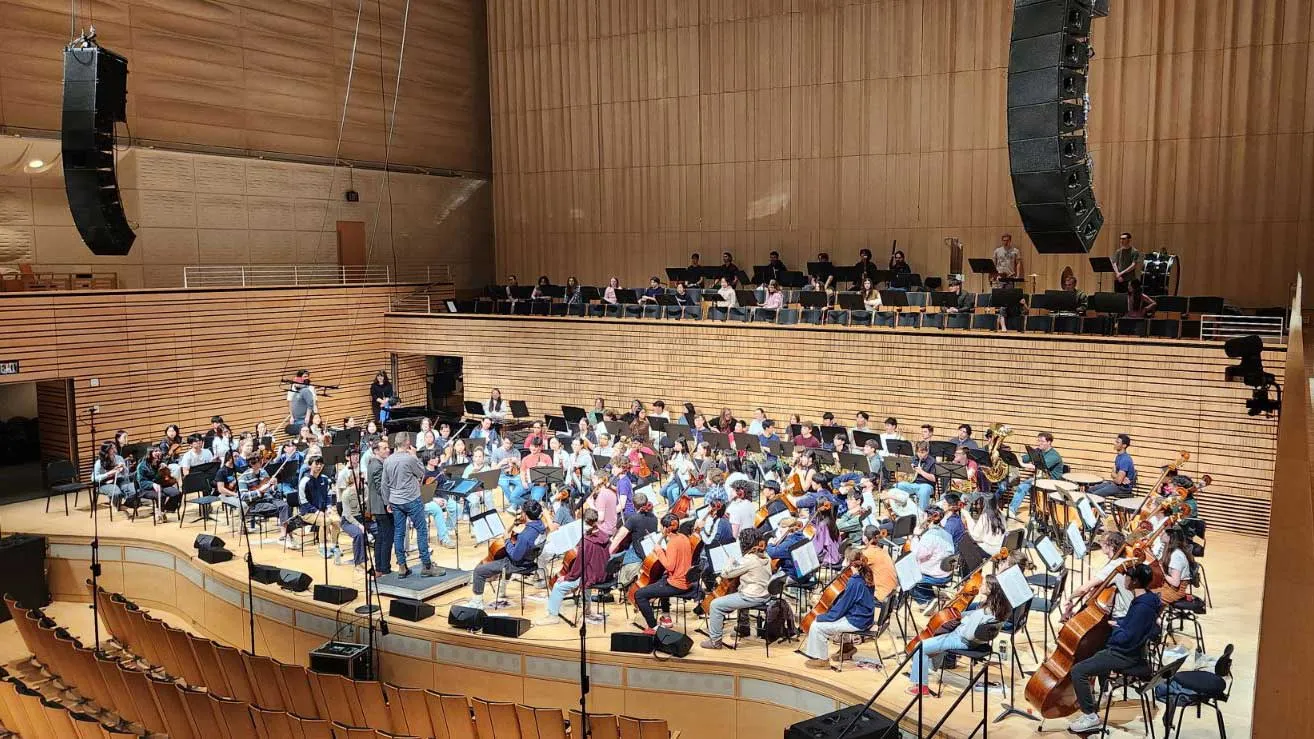
empire state youth orchestra in the concert hall on stage

Side by Side Concert 2026

Rensselaer Orchestra and Empire State Youth Orchestra

The combined forces of the RPI Orchestra and Empire State Youth Orchestra's Symphony Orchestra unite to perform Gustav Mahler's epic Symphony no. 1. The program will be led by RPI music faculty Dr. Robert Whalen, and will also include a performance of Edvard Grieg's famous Concerto for Piano and Orchestra by 2025 Concerto Competition winner Armstrong Wang '27.

To round out the program, ESYO Music Director and guest conductor Etienne Abelin will conduct Bedrich Smetana’s evocative “Vltava” or “The Moldau”, a masterful musical depiction of a river and the surrounding countryside and people who depend on it.

This performance will take place at 7:30pm on March 31st in the EMPAC Concert Hall. Admission is free.

Image
constellations a performance by RPI contemporary improvisation ensemble

Constellations

A space performance by RPI Contemporary Improvisation Ensemble

Constellations” explores open-form, structured improvisation, using both acoustic and electronic instruments, as well as generative algorithms to guide parts of the performance.  Nick Dunston — an acoustic and electroacoustic composer, improviser, and sound artist — will lead the students through the concert using conduction. This is a way of guiding musicians without a score, using only hand gestures, allowing players to improvise their parts while Dunston’s cues shape the overall form. 

Featured in parts of the performance will be DJ Rekha, a well-known and highly regarded NYC-based DJ who is currently earning their Ph.D. in Electronic Arts at RPI. 

Also featured in the performance will be Ph.D. student Joey Latka’s animated notation composition, Radix, which uses a generative algorithm in place of a traditional score. In Radix, musicians respond in real time to symbols appearing on a monitor, generated by Latka’s custom software. The system draws on a cross-mapping of the zodiac and the musical circle of fifths, prompting performers to improvise based on visual cues. 

The Contemporary Improvisation Ensemble is made up of RPI undergraduate and graduate students across disciplines. The group is focused on the art of musical improvisation — “an art that is too often overlooked in music education, despite being  a central aspect of all music making,” according to RPI Professor of Music and New Media, Michael Century.
 

Image
spring 2026 empac showcase RMA

2026 Spring Showcase Concert

Rensselaer Music Association

The Rensselaer Music Association will be performing in EMPAC this Friday! Our groups are excited to perform for you in this beautiful space - this brass heavy set will feature Symphonic Band, Trumpet Troupe and Analog Brainrot, the RMA's tuba and euphonium quartet. Hope to see you there!

Repertoire:

    Symphonic Band: Guadalcanal March (Richard Rodgers, arr. Erik Leidzen), Sea Storm (Qunicy Hilliard), Arabesque (Samuel Hazo)

    Trumpet Troupe: Antiphon for Trumpets (Stan Pethel),  Waltz in A Minor (Chopin arr. Cameron McCracken), Legend of Zelda Medley

    Analog Brainrot: Sleeping Beauty Waltz (Tchaikovsky, arr. David Werden), Songs of the British Isles (David Werden)
 

Ensembles:

Symphonic Band, Trumpet Troupe, Analog Brainrot

FREE and open to the public!  

Image
a black man in front of three large white screens in a black studio, audience in the foreground in darkness.

Black Holes Ain’t So Black

Thuto Durkac-Somo, Jonathan González & Mario Gooden

How does liberation feel in the body? How do structures of violence shape the spaces around our bodies and around our planet?

In this premiere of a new, multisensory performance-talk in development, cultural practice architect Mario Gooden delivers a rapid-fire oration drawn from an expansive bibliography of Black authors and references to outer space. Three-channel projections of archival images and film clips intersect with new footage shot by writer-filmmaker Thuto Durkac-Somo. These visual frictions are synthesized in the movements of choreographer-writer Jonathan González, performed both live and onscreen. By collaging spoken text, embodied movement, and moving image, these artists open a portal for imagining how the spatial practices of Black liberation unfold on bodily, architectural, and cosmological scales.

In A Brief History of Time: From the Big Bang to Black Holes (Bantam, 1998), theoretical physicist Stephen Hawking defines a black hole as a region of space from which escape is impossible: “It is a bit like running way from the police and just managing to keep one step ahead but not being able to get clear away!” Amidst the present planetary reckoning with  systemic oppression, Black Holes Ain’t So Black begins with this charged image, where cosmological space slips into social choreography. From there, the performance-talk moves through a cascade of juxtaposed images, gestures, and quotations, creating a barrage of sensory and conceptual connections. Following the presentation, the artists will join the audience in conversation, moderated by curator Tara Aisha Willis.

Main Image: Thuto Durkac-Somo, Jonathan González & Mario Gooden’s Black Holes Ain’t So Black In Studio 2 as part of Corpus Festival, 2026. Courtesy the artists. Photo: Michael Valiquette/EMPAC

Image
a group of people interacting with a structure made of wood pallets in a black box studio

Raft

Yanira Castro | a canary torsi

Can we hold our relationships to one another as sacred? How do we respond to our environment and effect change? What can we build together from a faltering world? 

At once a sacred mountain and a social microcosm, this sensitive interactive environment—constructed from the detritus of imperialism—invites visitors to build the responses that might carry us home. Meant to be collectively inhabited, Raft is an emergent space inspired in part by Jean-Louis André Théodore Géricault’s The Raft of the Medusa, a painting that frames the horrors that unfold when human lives are treated as expendable. Whether arriving alone or as part of a group activation, visitors are invited to take action, to gather, to take stock of who is present, and consider what must be done. 

In this installation premiere, Yanira Castro and team—including Kathy Couch, RPI alum Stephan Moore, Ariel Lembeck, LD DeArmon, and access doula Marielys Burgos Meléndez—craft a world meant to be felt and moved through, where visitors engage with the actions of others who came before. Intimate voices can be heard embedded inside the installation, interwoven with sounds from Castro’s archipelago origins. Here, participants can contribute to this expanding archive of recorded stories, sharing their own early memories of soil and dirt. 

Open Hours and Group Activations are different experiences. Visitors can do either or both. During the group activations on Thursday and Friday, the installation closes for a participatory experience led by the artist. RSVP is required; the activation begins at listed start times and lasts roughly 75–90 minutes.

For both the installation and group activation, consider wearing comfortable clothes and closed-toed shoes, along with anything else you would wear to freely play. You are encouraged to bring any support elements you typically use in your active life, such as reading glasses.

Accessibility

Raft integrates accessibility practices like low-sensory hours, a care toolkit to navigate the installation, and live Audio Description (AD) for blind and visually impaired people (upon request). Request access

Main Image: Yanira Castro | a canary torsi, Raft, performance documentation as part of Corpus Festival at EMPAC, 2026. Courtesy the artist. Photo: Michael Valiquette/EMPAC


Image
a woman in a dark theater standing as if running next to a green fluorescent lamp

preámbulo

nibia pastrana santiago

How does a site choreograph us? How might we re-choreograph it—or at least allow its architecture to hold our sense of time differently?

In this two-part improvisation, spanning over both days of the festival, nibia pastrana santiago works with movement, light, sound, space, and objects gathered from around the building itself. Alongside lighting designer Migdalia Luz Barens-Vera and sound designer vaga, she inhabits EMPAC’s proscenium theater—re-choreographing the space and allowing it re-choreograph her. With tenderness toward the theater’s capacity to frame a performer’s figure before an audience, pastrana santiago persistently unsettles and dissolves the venue’s familiar infrastructure.

The work draws on an evolving archive of performance practices developed in public spaces across Puerto Rico and beyond, in which movement becomes a way of mapping her body alongside—and as—object, territory, climate, effort, and collective presence. Her title, which translates to “preamble,” holds a feeling of anticipation, incompletion, and openness to failure. It hints at both a way of being on stage and of participating in a political landscape. 

Main Image: nibia pastrana santiago, preambulo, performance documentation, 2026 as part of EMPAC's Corpus Festival. Courtesy the artist. Photo: Michael Valiquette/EMPAC

Image
fashion engineered

Fashion Engineered

Black Students' Alliance in partnership with EMPAC

This year, the RPI BSA Fashion Show is introduced as Fashion Engineered, a student-led, multidisciplinary showcase featuring designers and artists from Rensselaer Polytechnic Institute and beyond.

Fashion Engineered celebrates originality in all its forms. Each featured piece encapsulates a distinct design language, shaped by the creator’s background, process, and vision. From experimental silhouettes and unconventional materials to technology-informed construction and conceptual storytelling, the work on display rejects uniformity in favor of thoughtful, intentional design. These pieces are not simply garments or artworks, but reflections of problem-solving, cultural narratives, and creative risk-taking.

The accompanying art exhibition further amplifies this individuality, presenting works that explore texture, movement, sound, and form. Together, the runway and gallery space highlight how unique approaches to design can coexist, converse, and push boundaries. Centering BIPOC world-building and local voices, Fashion Engineered challenges traditional notions of fashion and art, inviting audiences to engage with design as an evolving practice rooted in innovation, sustainability, and self-expression.


2026 Livestream - Fashion Engineered


2025 show, Eco-Futurism


Main Image: Courtesy Black Students' Alliance

Media
Image
An asian person with long wavy hair crys black liquid while embracing another person with black liquid running throught their long black hair.

The Ghost takes us by the hand

Korakrit Arunanondchai and Tosh Basco

with Rueangrith Suntisuk, Pornpan Arayaveerasid, Aaron David Ross, Alex Gvojic, Michael Beharie

The Ghost takes us by the hand is a new EMPAC commission that blends performance, video, and sound. Built on an inversion of the theater and its usual mode of address, the work unfolds in, over, and around the traditional fixed seating of the auditorium, with the audience seated on the stage. Video appears on clouds of fog; the performance overtakes the playhouse as its architecture pulses with light and sound. When the empty house of the theater is gradually seized by an atmospheric presence and choral score, a single dancer emerges within and above the rows of seats, drawn from this charged zone—as if a glitch has transmuted image into flesh.

Arunanondchai integrates performance into his live and recorded works. His investigations into animistic afterlives and spiritual technologies in Southeast Asia span the sacred and profane. The Ghost takes us by the hand takes cues from Asian horror films, using atmosphere—sonic, choreographic, visual, spiritual—as a primary medium for performance. The work disorients spectatorship and tests the boundaries between film and live action. Arunanondchai asks, What happens when ghosts haunt a place we think we already know? Are we merely watching—or are we instead witnessing, absorbing deep pasts and projecting new possible futures? After the performance, the stage shifts to present an installation of the video Unity for Nostalgia—a work that extends the questions of the performance, drawing on strategies also used in the performance such as thermal imaging and atmosphere. The work reflects on the power of historical myths and ancestral stories to shape experience in the present.

Main Image: The Ghost takes us by the hand (detail shot). Courtesy the artist.

Image
a student choir wearing black gathered in a semi circle on the concert hall stage.

RPI Holiday Concert and Victorian Stroll Kickoff

Presented in partnership with the Rensselaer County Regional Chamber of Commerce, this free, family-friendly event invites you to celebrate the season with music, community, and festive refreshments. The concert will feature performances by the RPI Orchestra, Concert Choir, and Wind Symphony, including works by Smetana, Tchaikovsky, Gershwin, Lauridsen, and Saint-Saëns.

Registration is required.

Image
People weave in and out of large paintings mounted on parallel tracks within a metal art installation.

Wing Theater

Jewyo Rhii

Jewyo Rhii’s Wing Theater, commissioned by EMPAC, is at once a self-contained theater, a sculptural archive, and a staging ground for storytelling. The installation uses walls that store objects, automated structures, and simple moving elements to give physical shape to personal and public stories, which are shown through precise gestures and motions. The project oscillates between installation and activated performance space, with Rhii offering two live activations daily throughout the festival.

At its base is a large-scale structure composed of six wings, each carrying an assembly of sculptures, images, and projections. These wings become engines for conversation—speaking with ghosts from Rhii’s past, with those who assert power by seizing and privatizing public space, and with the audience gathered in the studio. Throughout staging grounds, Wing Theater subtly spreads out across the studio, setting its stories in motion. In Studio 1, the piece evokes the atmosphere of an artist’s studio transformed into a dynamic stage—blurring the boundary between private process and collective encounter.

Wing Theater asks what it means to make, act, and think in the world as an artist. Two narrative trajectories extend across its physical structure. Viewed front to back, a series of vignettes charts Rhii’s path from her formation as an artist in Seoul, to her nomadic years working across Europe, and to her time in Queens, New York. Back to front, Wing Theater is a meditation on how the rapid pace of urban development transforms both people and place.

Widely recognized for her installations and her practice spanning sculpture, video, and performance, Jewyo Rhii approaches art-making as a mode of shared experience. Her work is marked by a sensitivity to the afterlives of artistic practice, and to the small, intimate acts that quietly shape collective histories.

Each performance is 60 minutes in duration.

  • FRIDAY, FEBRUARY 20
  • 6:30, Studio 1—Goodman
  • PERFORMANCE ACTIVATION, FREE, RSVP
  • Wing Theater / Jewyo Rhii / RSVP
  • SATURDAY, FEBRUARY 21
  • 1:30 + 4PM, Studio 1—Goodman
  • PERFORMANCE ACTIVATION, FREE, RSVP
  • Wing Theater / Jewyo Rhii / RSVP
  • TUESDAY, FEBRUARY 24–SATURDAY, FEBRUARY 28, 2026
  • 11AM–5PM, Studio 1—Goodman
  • INSTALLATION, FREE
  • Wing Theater / Jewyo Rhii / No reservation necessary
  • TUESDAY, FEBRUARY 24, 2026
  • 3PM, Studio 1—Goodman
  • PERFORMANCE ACTIVATION, FREE, RSVP
  • Wing Theater / Jewyo Rhii / RSVP
  • FRIDAY, FEBRUARY 27, 2026
  • 3PM, Studio 1—Goodman
  • PERFORMANCE ACTIVATION, FREE, RSVP
  • Wing Theater / Jewyo Rhii / RSVP
  • SATURDAY, FEBRUARY 28, 2026
  • 1PM, Studio 1—Goodman
  • PERFORMANCE ACTIVATION, FREE, RSVP
  • Wing Theater / Jewyo Rhii / RSVP

Main Image: Jewyo Rhii, Love Your Depot, 2019, installation view at the National Museum of Modern and Contemporary Art (MMCA), Seoul. Courtesy the Artist. Photo: Team Depot.