Image
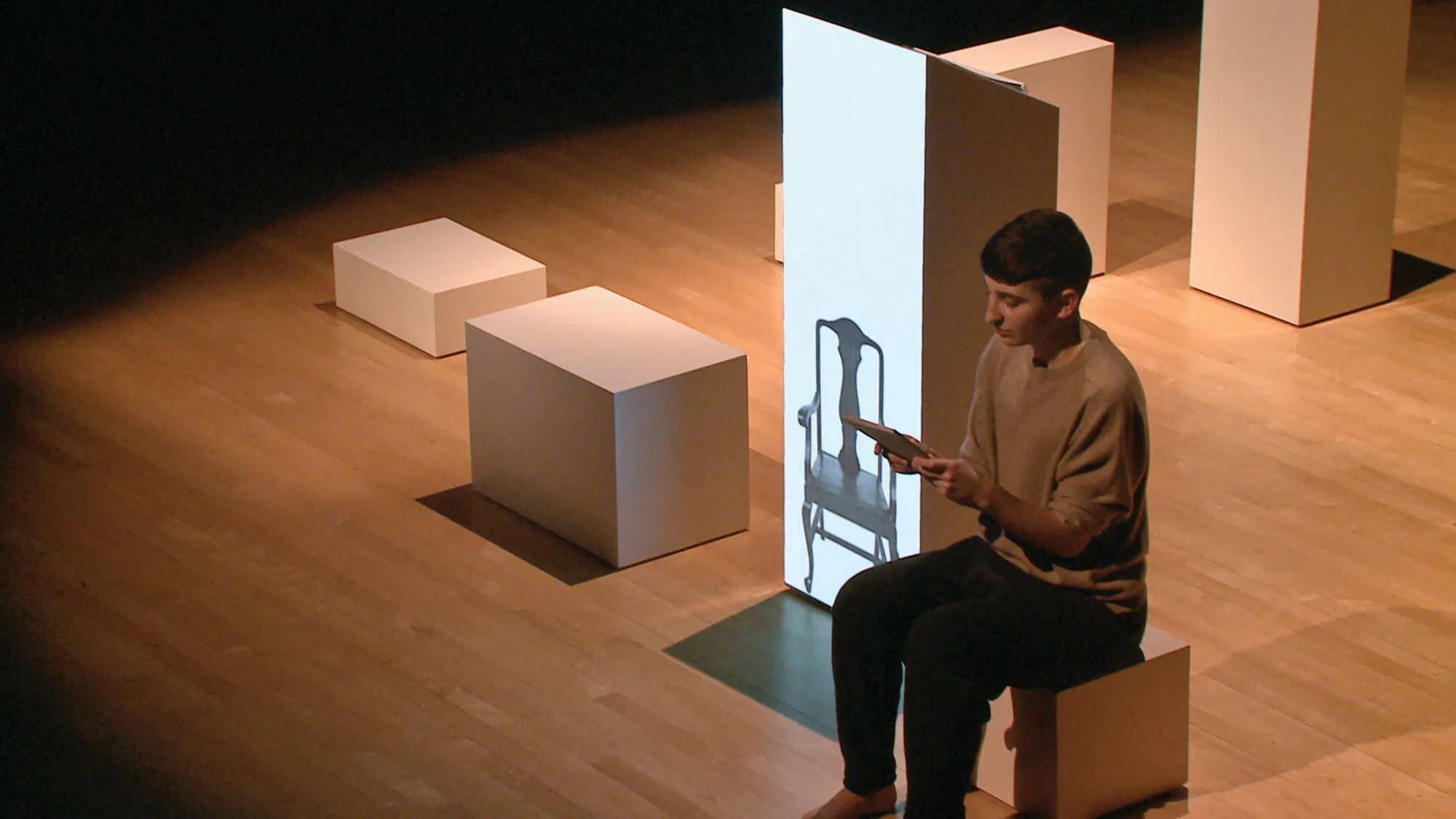
Gordon Hall
“Read me that part a-gain, where I disin-herit everybody”
Titled after a line from composer John Cage’s remarkable 1959 Lecture on Nothing, Gordon Hall’s lecture-performance Read me that part a-gain, where I disin-herit everybody will offer a history of lecture-performances using sculptural objects, sound, and projected images. Hall is the founder and director of the Center for Experimental Lectures, a roving series of curated lecture-performances that embraces the lecture format itself as a creative medium. The Center for Experimental Lectures emerged from Hall’s studio practice, where sculptures and performances pose questions about the possibilities created and foreclosed by different kinds of platforms, from furniture to politics.
VIDEO
Main Image: Gordon Hall performs in Studio 2 in 2014. Photo: EMPAC/Rensselaer.
Image
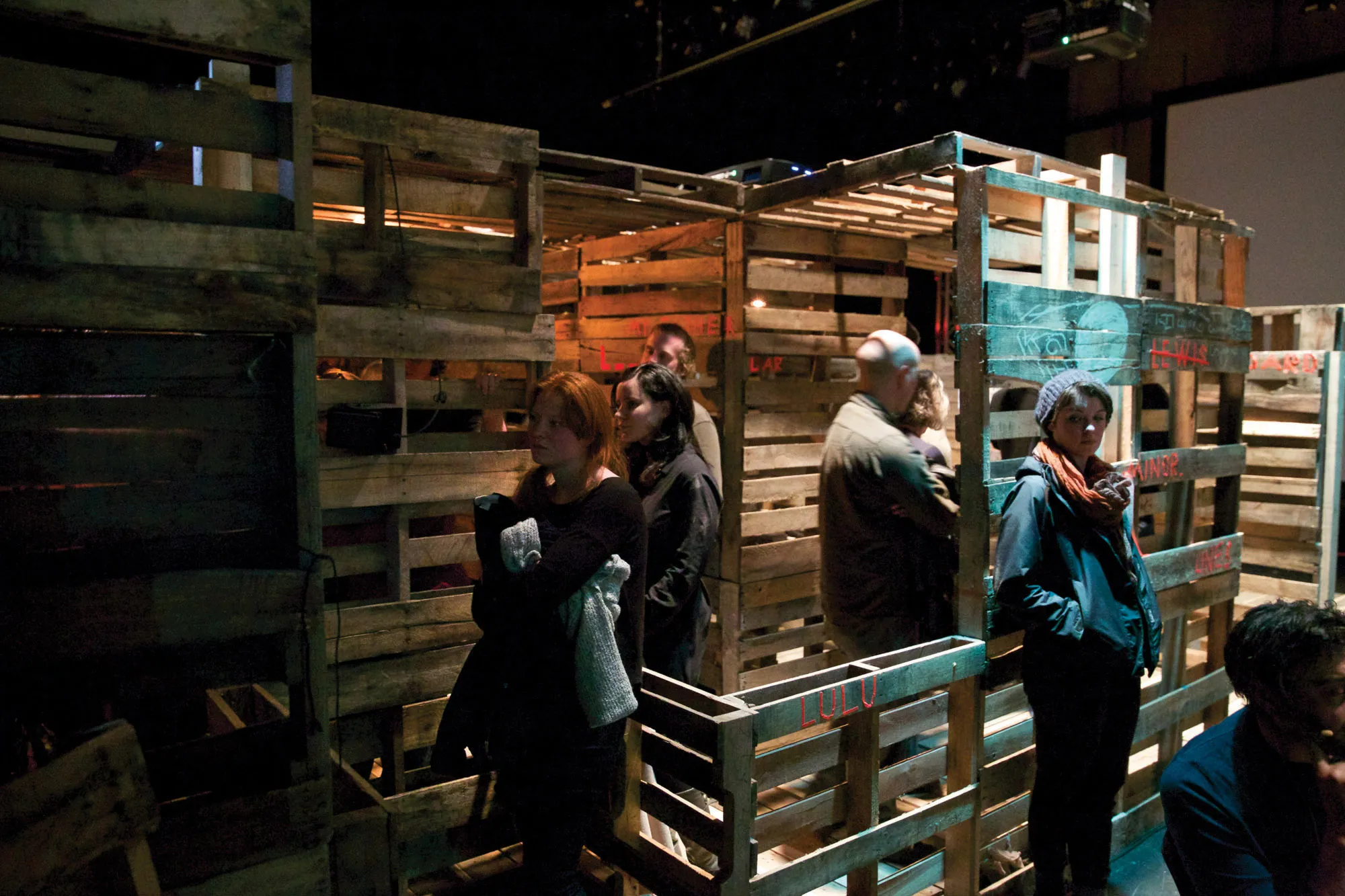
26 Letters to Deleuze
Alain Franco, Jörg Laue, Peter Stamer
Nearly 20 years after Gilles Deleuze’s suicide in 1995, the original interview is reworked into 26 performative “letters” toward the concepts of the alphabet and the philosopher. A performance, installation, concert, and symposium—this event dissects Abécédaire, the famous video interview with Deleuze.
In three sessions, between 1988 and 1989, philosopher Gilles Deleuze, sitting in his living room, faced television interview questions. The principle was simple but sophisticated. The topics Deleuze was confronted with followed the letters of the alphabet—one letter, one concept—from “A as in Animal” to “Z as in Zigzag.” To avoid zigzagging in his discourse, Deleuze received the list of topics beforehand, and although he worked assiduously on the answers, he then improvised during the recordings.
It’s the pleasure of both the arbitrary form and Deleuze’s way of thinking through his famous concepts that makes Abécédaire so fascinating: 26 earnest, witty, and instructive seven-and-half hours of philosophy on the go. There was only one condition Deleuze insisted upon—since he didn’t think much of television, the program was not to be aired before his death.
Alan Franco studied music at the conservatories in Brussels, Liège, and Antwerp and obtained a higher diploma for piano as well as a diploma of extended studies (DEA) in 20th century musicology (IRCAM-EHESS). He was the full-time conductor of the Champ d’Action ensemble (1989-1993), and since then has worked with, among others, the Ensemble Modern (Frankfurt), the Ictus ensemble (Brussels), the Musiques Nouvelles ensemble (Brussels), and the Liège Philharmonic Orchestra. He did musical analyses for Rosas and Anne Teresa de Keersmaeker’s D’un Soir un Jour (2006) and the Steve Reich evening (2007), which was shown at PACT Zollverein in 2007. He collaborates regularly with Deufert + Plischke (Anarchiv#3: Songs of Love and War, 2011) and Meg Stuart (Built to Last, 2013).
Jörg Laue lives in Berlin. From 1988 to 1993, he studied applied theater at Universität Giessen; in 1994 he founded LOSE COMBO, through which he has been realizing live art projects on the borders of stage performance, visual arts, and contemporary music. He has created sound, light, and video installations, writings, and lectures, and has been the recipient of several residencies and scholarships.
Peter Stamer works as director, dramaturge, mentor, and curator in the field of contemporary theater. He is interested in the aesthetic tension between the potency of bodies and their potential to language. His performance and theater projects have led him across Europe and to China, Egypt, the US, and Israel. Recent works include The Path of Money, a documentary / theater / installation on a traveling banknote through China; the performance For Your Eyes Only on cultural memory, body, and blindness; and The Big Event 1-3, a documentary theater play on the assassination of John F. Kennedy. Together with eight Egyptian and European artists, Stamer has initiated and worked on the international building performance project A Future Archeology, within which spatial structures in Berlin, Vienna, and Cairo were to be built during five months in 2013.
Roberts / Wooley
Mariel Roberts + Nate Wooley
At the forefront of the classical and jazz worlds respectively, Mariel Roberts (cello) and Nate Wooley (trumpet) each performed solo sets, along with a duo improvisation. Both artists have quickly developed international reputations: Wooley for his iconoclastic, expectation-defying playing, and Roberts for a fearless technical prowess. Roberts is a dedicated interpreter and performer of contemporary music. She holds degrees from the Eastman School and the Manhattan School of Music, where she specialized in contemporary performance practice. She has appeared as a soloist and with ensembles such as Signal, Wet Ink, Dal Niente, S.E.M., the Nouveau Classical Project, and the Wordless Music Orchestra. Wooley is one of the most in-demand trumpet players in the burgeoning Brooklyn jazz, improv, noise, and new music scenes. He has performed with John Zorn, Anthony Braxton, Fred Frith, Peter Evans, and Mary Halvorson.
program
Performed by Mariel Roberts:
SIMON STEEN-ANDERSON Study for String Instrument No. 2
ALEX MINCEK Flutter
IANNIS XENAKIS Kottos
Performed and composed by Nate Wooley:
For Kenneth Gaburo: TCACNO
Image
Allege
Clement Layes
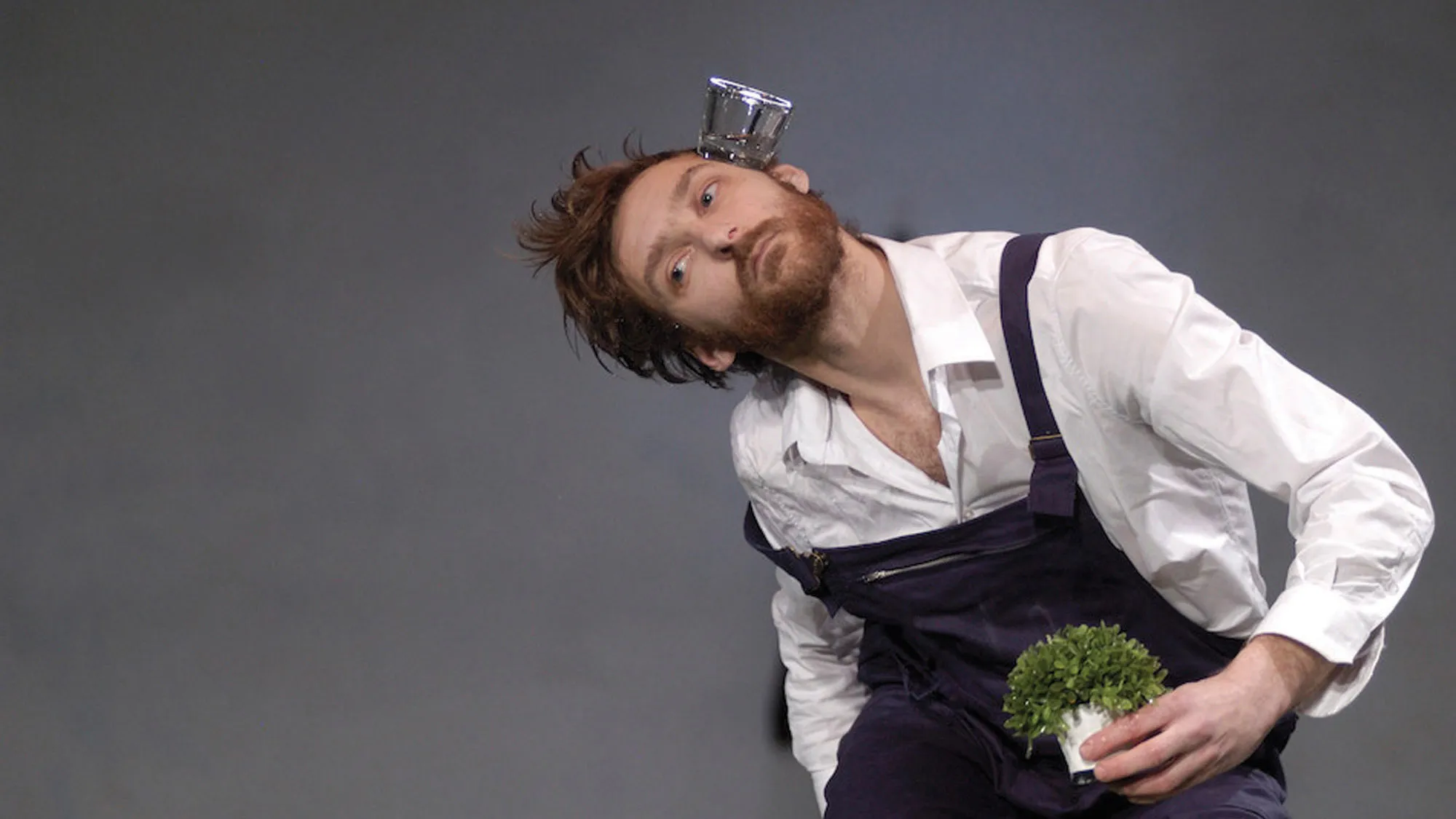
Humorous and conceptual, this solo by Clément Layes mixed performance art, philosophy, and dance with Chaplinesque virtuosity. Balancing a glass of water on his head for the duration of the performance, he took the audience on a contemplative journey involving habit and expectation, the absurdities of life, and overlooked small moments of beauty. In Allege, Layes offered both a remarkable physical feat and deep thinking about the daily life of objects.
Layes has a background in circus arts, dance, and philosophy. In 2008, with Jasna Layes-Vinovrski, he founded Public in Private; the company’s primary aim is to further develop choreography as a contemporary art form. Public in Private researches, reflects, and questions social, political, and cultural structures, as well the individual’s position in these structures. It uses a collaborative approach to broaden the borders of choreographic language and inspire different thinking, perception, and reflection of various mediums of creation.
In Other Words included six artists who delivered lecture-performances, juxtaposed with talks by six thinkers in order to cross boundaries and make dialogue a continuous process of renewal.
This performance is presented in conjunction with Seth Lloyds’ talk, Programming the Universe.
Media
Rensselaer Orchestra
The newly formed Rensselaer Orchestra, under the direction of Nicholas DeMaison, presents its first concert this Saturday, November 23rd, at 4:00 pm in the Concert Hall. The program will feature Beethoven’s Coriolon Overture, pieces by Pauline Oliveros and James Tenney, and Tchaikovsky’s Symphony No. 2 (“The Little Russian”). Arts Department graduate students Brian Cook & Kelly Michael Fox will also collaborate with the orchestra to develop live surround sound components for two of the works being performed.
Image
It’s going to get worse and worse and worse, my friend
Lisbeth Gruwez | Voetvolk
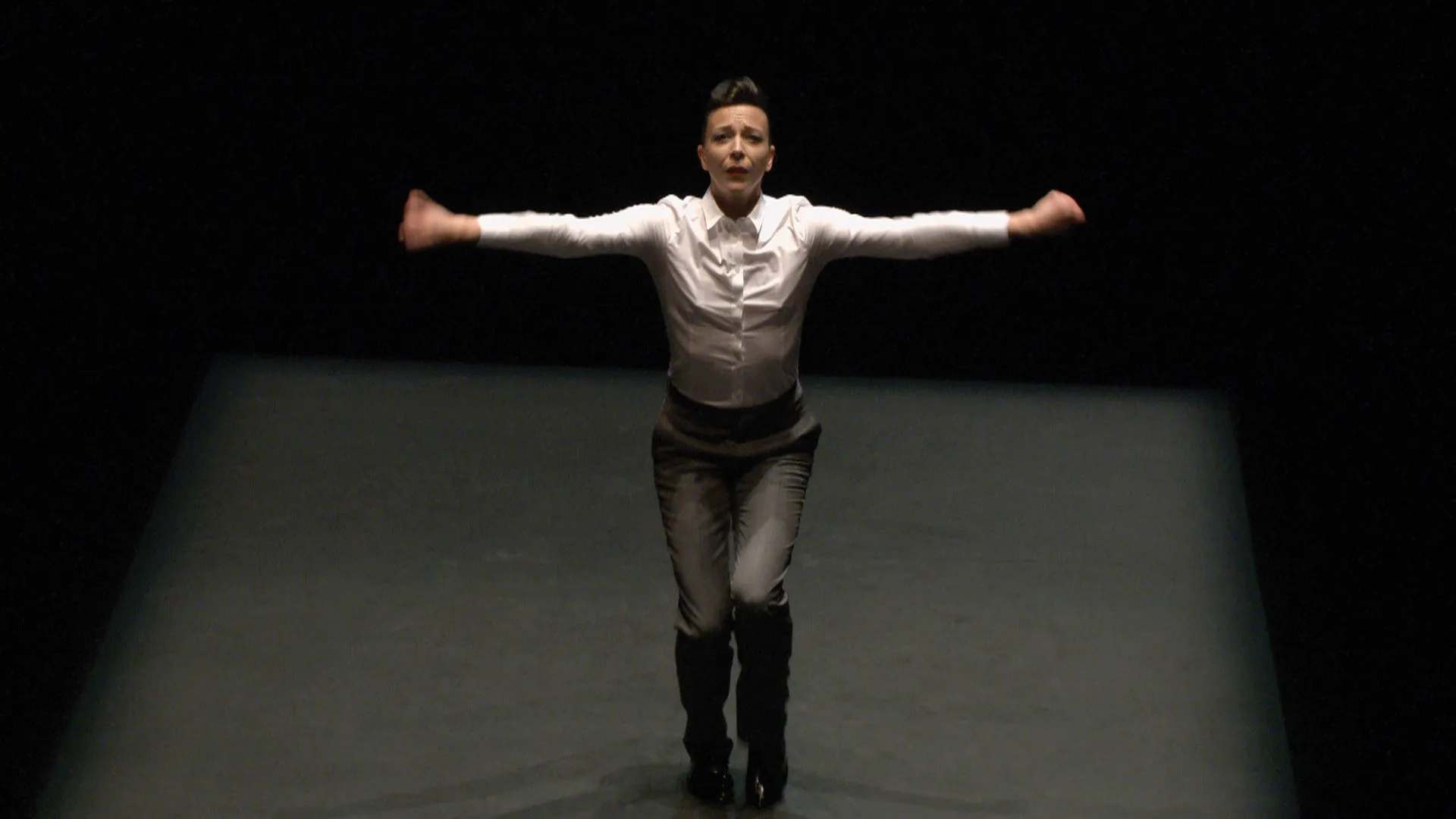
A speech can be a mighty weapon. Throughout the centuries it has enthused countless masses and mobilized them into action, for better or worse. It has unleashed revolutions and fueled wars. Such is the power of words. Belgian-based choreographer and dancer Lisbeth Gruwez transforms a recorded speech by ultraconservative American televangelist Jimmy Swaggart into a disturbing gesture and dance form. Her body juggles with words, makes syllables, shouts, stammers, horrifies, and fascinates. The piece deals less with the direct meanings of words and phrases and more with the violence that can lie in the rhetorical strategies of someone in a trance-like state.
Main Image: Video still: Lisbeth Gruwez, It’s going to get worse and worse and worse, my friend in Studio 1, 2013.
Media
Image
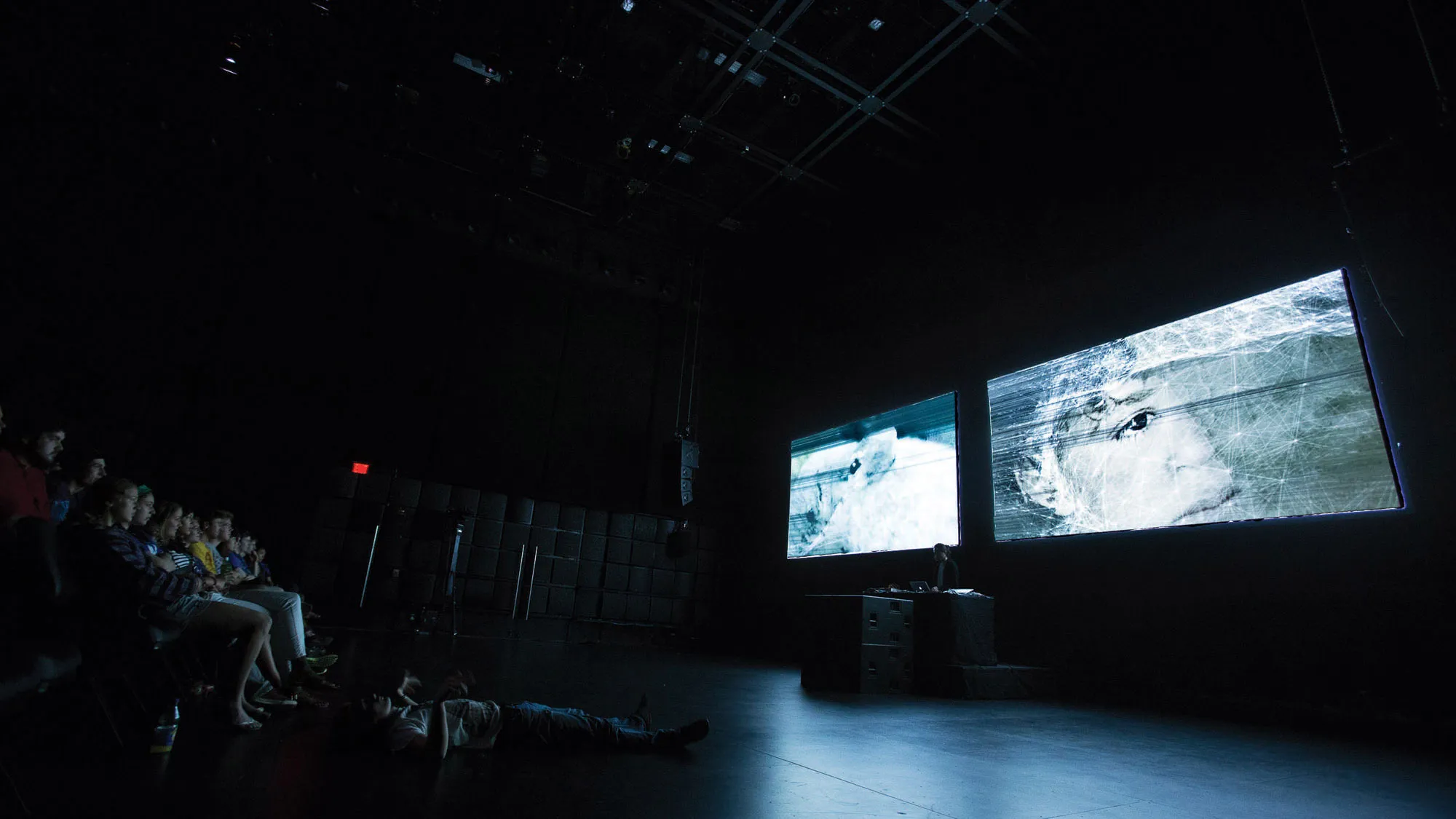
syn_
Ryoichi Kurokawa
Ryoichi Kurokawa’s audiovisual work syn_ obscures familiar everyday imagery with vibrating, impossibly detailed geometric constel-
lations. Performed live on dual projection screens, his visuals were accompanied with clouds of sound that pulsed in accord to construct a sensory experience of overwhelming energy.
Kurokawa’s works take multiple forms, including installations, recordings, and live performance. His audiovisual compositions bring visual and sonic materials together using a completely revolutionary perspective. His works have been shown at international festivals and museums including the Tate Modern (London), Venice Biennale, Transmediale (Berlin), and Sonar (Barcelona). In 2010, he was awarded the Golden Nica at Prix Ars Electronica in the Digital Music and Sound Art category. He lives and works in Berlin.
Main Image: syn_ in Studio 1, 2013. Photo: Mick Bello/EMPAC.
Media