Hot Box
Brian Rogers / The Chocolate Factory
Hot Box draws inspiration from a cinematic vocabulary—pans, zooms, cuts, etc.—while attempting to find a sustained stillness in an uncomfortable environment. Inspired by films like Apocalypse Now and Fitzcarraldo, it is a live performance that is violent and chaotic; and from that chaos arises a sequence of video images that are quiet, sustained, focused, and organized. Conceived, directed, and performed by Brian Rogers, Hot Box is a companion piece to his Bessie-nominated 2010 performance Selective Memory. Where Selective Memory was extremely clean and minimalist in its approach, Hot Box is noisy and messy.
Rogers is a director, video artist, co-founder, and artistic director of the Chocolate Factory Theater in Queens, which supports the creation of theater, dance, music, and multimedia performances. Since 1997, Rogers has conceived and/or directed numerous large-scale performances at the Chocolate Factory and elsewhere.
The Machine Starts
with Mary Ellen Strom + Joanna Haigood
The Machine Starts is based on E.M. Forster's 1909 sci-fi novella The Machine Stops, an eerily prescient tale that predicts the internet, television, global environmental ruin, social isolation and the impact of technology on the human experience.
Under the leadership of Rensselaer artists Shawn Lawson and Michael Oatman, professors in HASS and the SoA respectively, this student run performance features A Capella singing group, The Rusty Pipes, The Parkour Club, and Center Stage, a spoken word group, as well as interactive media, new music and architectures designed to transform EMPAC.
Image
Ben Frost
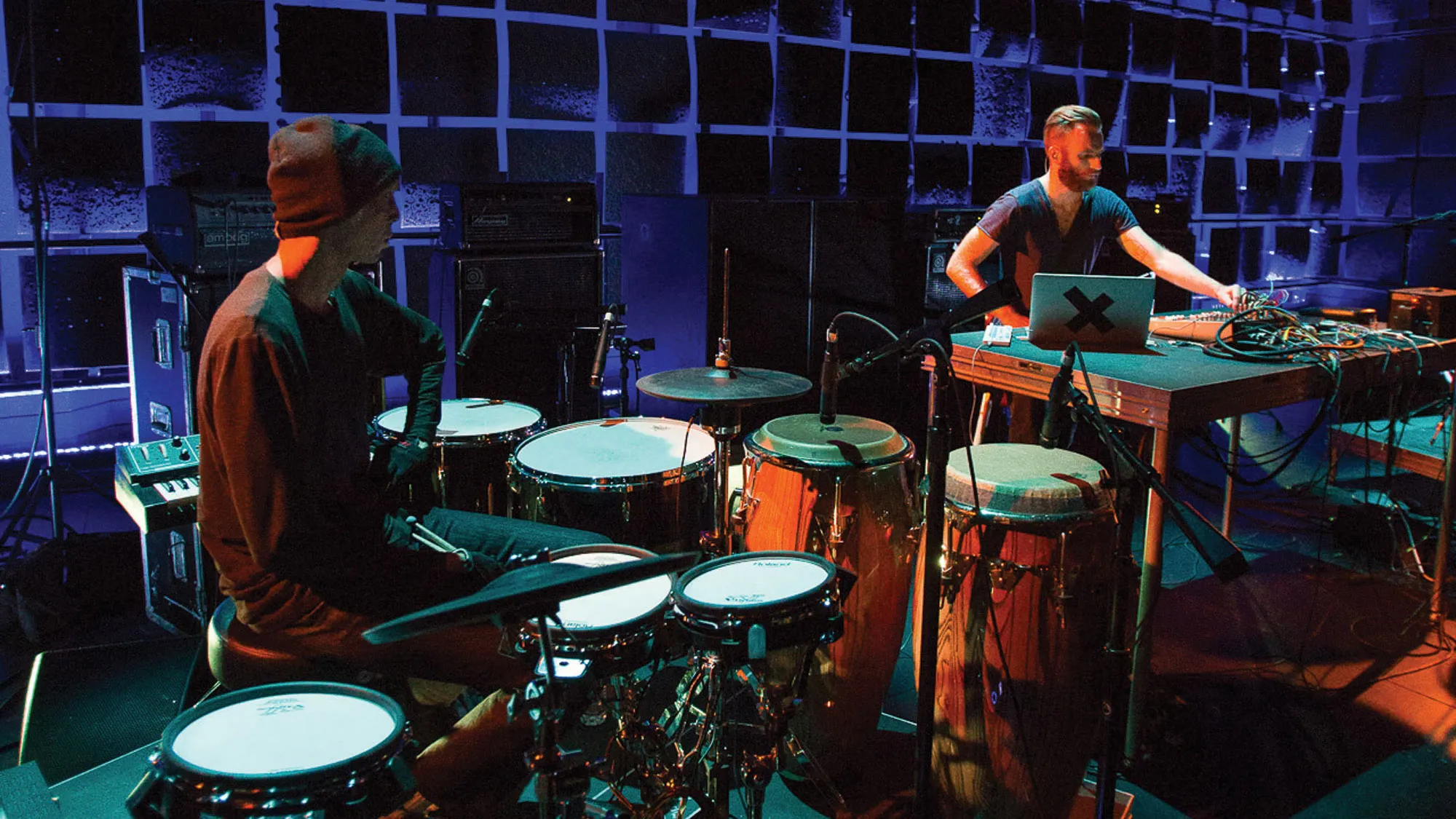
Ben Frost’s music is not just heard; it’s felt. Influenced by classical minimalism, punk rock, and metal, he creates intense, monolithic sounds that command attention. Keenly aware of listeners’ thresholds, Frost exploits every extreme of pitch and volume as he pushes the sound of electric guitars, drums, and laptops out from a wall of speakers and amps. As the music unfolds, overlapping layers and elongated structural forms emerge from within the encompassing sonic space.
Frost and his group were in residence to record and perform his composition A U R O R A. While using EMPAC’s Studio 1 for tracking, he routed sound back through the Concert Hall, transforming it into a real-time reverb chamber. Frost has given building-shaking performances at international festivals such as Montréal’s MUTEK, combining amplified electronics with the furious thrashing of live guitars. His music’s intense physicality has also driven contemporary dance productions by Chunky Move, the Icelandic Dance Company, and the choreographers Erna Ómarsdottír and Wayne McGregor.
Main Image: Ben Frost in residence in Studio 1, 2013. Photo: Mick Bello/EMPAC.
Image
HeadSwap
CREW / Eric Joris
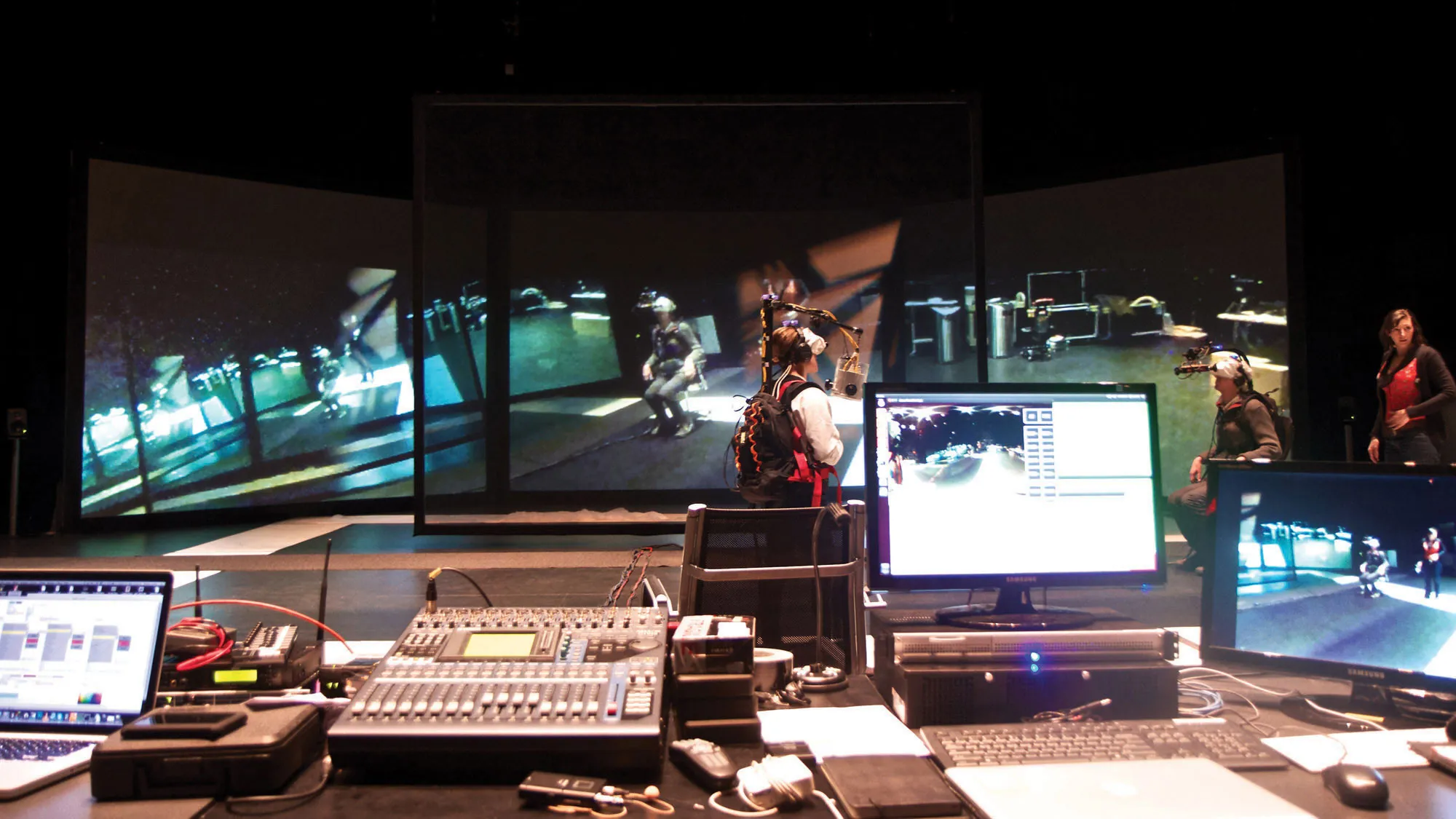
The goal for HeadSwap was to allow participants to choose an individual point of view within footage shot in Japan and New York City, while “swapping their heads”: simultaneously seeing what another person chooses to see. During a three-week research residency, Joris and a multi-disciplinary team of designers, programmers, and dramaturges worked to composite different video and graphic sources and find a way to view the end result in an “omnidirectional” way. They tested spherical layers upon which different media could be textured, and developed hardware to render and composite live images from a 360-degree camera without visible loss in quality or delay. This research enabled CREW to explore the conflict between live and prerecorded images and to see where both can enhance each other. At the end of the residency the work-in-progress was presented to the public followed by a discussion with the artists.
CREW, a Belgium-based multidisciplinary team of artists and researchers founded by Eric Joris integrate technology into theatrical events to create new forms of experience. They create immersive environments for audiences, using video goggles and interactive technology, that put each spectator at the heart of the experience and that challenge notions of presence, spectatorship, and narration.
Main Image: Headswap residency in 2013.
Media
Image
EXIT
Kris Verdonck + Alix Eynaudi
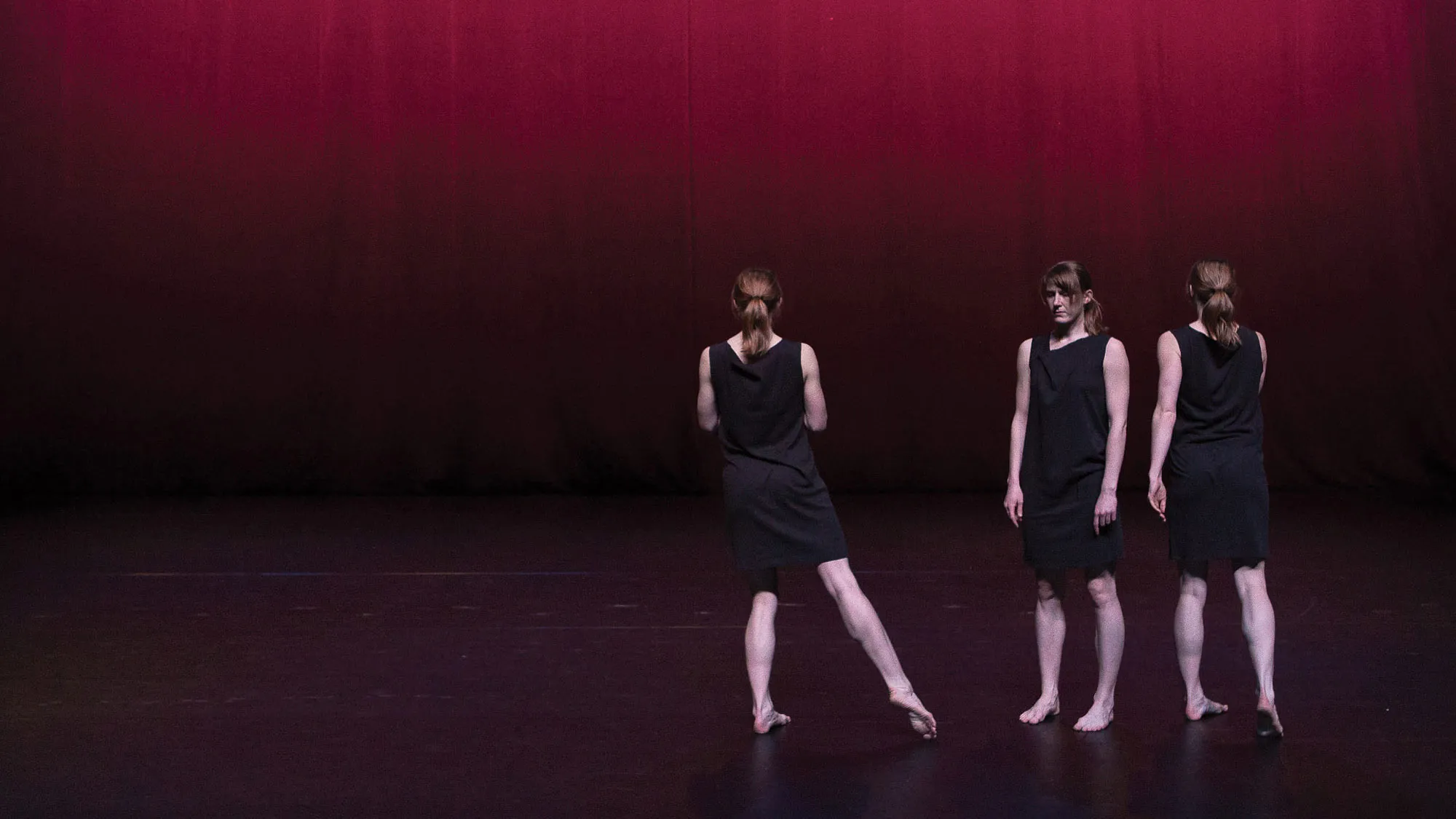
What value does our society attach to relaxation, rest, silence, sleep, and laziness? Are we caught up more than ever in the relentlessness of production and consumption? These were the central themes behind this performance created by Belgian artist Kris Verdonck and choreographer Alix Eynaudi that played with basic theatrical elements such as light, sound, movement, language, and scenography to steer the audience’s perception. According to Verdonck, “…sleep is anarchistic, not in the destructive sense, but rather dangerously constructive. Without sleep, our ideas and our knowledge become superficial mass products and therefore easy to set aside…by doing nothing at all, man becomes more productive and his knowledge more in-depth, thereby making him less vulnerable in a world that is flooded with information and choices.”
Kris Verdonck’s visual arts, architecture, and theater training is reflected in the work he produces: his creations are situated between visual arts and theater, installation and performance, and dance and architecture. Alix Eynaudi trained as a ballet dancer in the Opéra de Paris; in 1996, she joined Anne-Teresa De Keersmaeker’s company Rosas. She works in Brussels creating her own pieces, and in collaboration with Anne Juren, Marianne Baillot, and Agata Maszkiewicz.
Main Image: Kris Verdonk & Alix Eynaudi, EXIT (2013).
Media
Image
The Films of Laurie Anderson
with special guest Pauline Oliveros
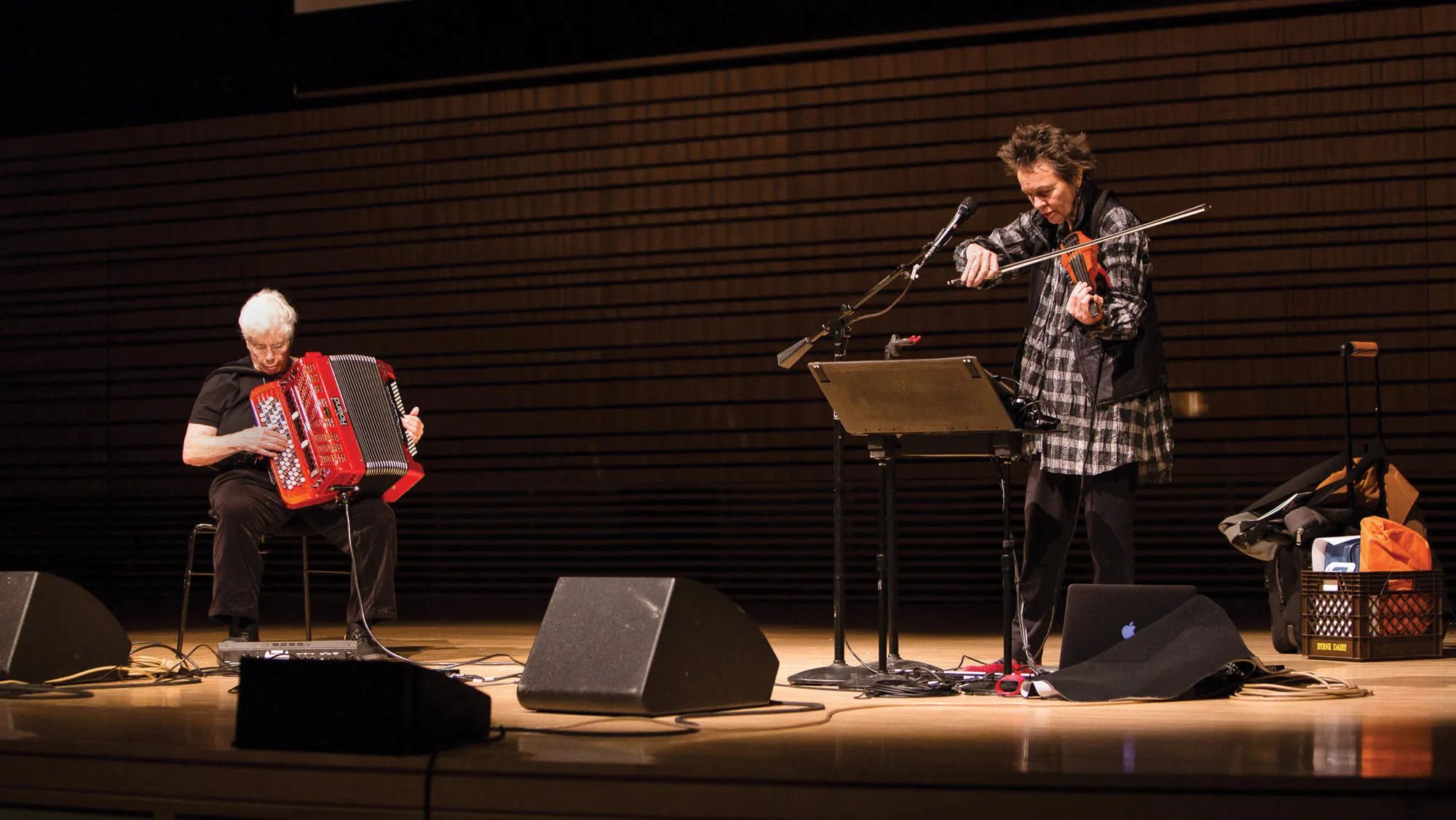
In two back-to-back screenings in one evening, Laurie Anderson presented many of her films and videos, culminating in a silent film with live music performed by Anderson and Pauline Oliveros.
Laurie Anderson, EMPAC’s inaugural distinguished artist-in-residence, presented a series of events focusing on topics unique to her practice as an artist.
5PM PROGRAM
What You Mean We? (1987) What You Mean We? stars Laurie Anderson, who also wrote and directed the piece. It was originally produced as a segment of the PBS arts series Alive from Off Center.
Personal Service Announcements (early 1990s)
Carmen (1991) Anderson’s Carmen, who works in a tobacco factory, is as strong-willed and carefree as the original (she steals cigarettes off the assembly line). The one significant difference in that she is married. The young soldier from Georges Bizet’s original opera (1875) has been transformed into her indifferent husband who sits home idly watching television with the kids while she works.
Puppet Motel (1994) Puppet Motel is a CD-ROM which invites to an imaginary universe made up of the interplay between light and darkness, mystery and poetry. This universe is populated by puppets and, of course, its creator, the artist herself.
Home of the Brave (1986), excerpts Home of the Brave is a concert film directed by and featuring the music of Laurie Anderson. The performances were filmed at the Park Theater in Union City, NJ, during the summer of 1985.
8PM PROGRAM
Hidden Inside Mountains (2005) Hidden Inside Mountains is a film of short stories about nature, artifice, and dreams. Located in a fictitious world of theatrical spaces, the stories unfold through music, gesture, text passages and the poetry of variously juxtaposed, evocative visual images.
Hidden Inside Mountains, commissioned by EXPO 2005 Aichi, Japan, is a high definition film that debuted in Japan at WORLD EXPO 2005 on the largest high definition Astrovision screen in the world. An original score was written and recorded by Laurie Anderson with additional vocals by singer /performer Antony.
Duets with Pauline Oliveros to films by Ken Jacobs and others
Excerpts from Performances
One of America’s most renowned performance artists, Laurie Anderson’s genre-crossing work encompasses performance, film, music, installation, writing, photography, and sculpture. She is widely known for her multimedia presentations and musical recordings and has numerous major works to her credit, including United States I-V (1983), Empty Places (1990), Stories from the Nerve Bible (1993), Songs and Stories for Moby Dick (1999), and Life on a String(2001), among others. She has had countless collaborations with an array of artists, from Jonathan Demme and Brian Eno to Bill T. Jones and Peter Gabriel.
Anderson has invented several technological devices for use in her recordings and performance art shows, including voice filters, a tape-bow violin, and a talking stick. In 2002, she was appointed NASA’s first artist-in-residence, and she was also part of the team that created the opening ceremony for the 2004 Olympic Games in Athens. She has published six books, produced numerous videos, films, radio pieces, and original scores for dance and film. In 2007, she received the prestigious Dorothy and Lillian Gish Prize for her outstanding contribution to the arts. She lives in New York City.
Pauline Oliveros’ life as a composer, performer, and humanitarian is about opening her own and others’ senses to the many facets of sound. Since the 1960s, she has profoundly influenced American music through her work with improvisation, meditation, electronic music, myth, and ritual. Many credit her with being the founder of present day meditative music. All of Oliveros’ work emphasizes musicianship, attention strategies, and improvisational skills.
She has been celebrated worldwide. During the 1960s, John Rockwell named her work Bye Bye Butterfly as one of the most significant of that decade. In the 70s she represented the US at the World’s Fair in Osaka, Japan; during the 80s she was honored with a retrospective at the John F. Kennedy Center for the Performing Arts in Washington, DC. The 1990s began with a letter of distinction from the American Music Center presented at Lincoln Center in New York, and in 2000 the 50th anniversary of her work was celebrated with the commissioning and performance of her Lunar Opera: Deep Listening For_tunes. Oliveros’ work is available on numerous recordings produced by companies internationally. Sounding the Margins—a forty-year retrospective, was recently released in a six CD boxed set from Deep Listening.
Main Image: Anderson and Oliveros in the concert hall in 2013. Photo: Mick Bello/EMPAC.
Neil Rolnick's Farewell Concert: Music for Violin, Piano & Computer
Neil Rolnick
Neil will be joined by violinist Todd Reynolds and pianist Vicky Chow in works for violin, piano and computer, including Hammer & Hair, Fiddle Faddle and Digits.