Cancelled: Strange Networks
Thom Mayne / Morphosis
This lecture has been cancelled.
For more information about this event please visit https://www.arch.rpi.edu/.
This lecture has been cancelled.
For more information about this event please visit https://www.arch.rpi.edu/.
For more information about this event please visit https://www.arch.rpi.edu/.
Please visit www.hass.rpi.edu for more information on this event.
For more information about this event, please visit events.rpi.edu.
Main Image:

Seth Parker Woods performs new works on the theme of “translation” for cello and electronics composed by Freida Abtan, Monty Adkins, Ryan Carter, Nathalie Joachim, and Pierre Alexandre Tremblay.
When translation is treated as a mere concept, misunderstandings can be discussed to try to overcome challenges. However, when the meaning of what’s lost in translation bleeds over into actual losses for living beings, the consequences of theoretical misunderstandings can be devastating. Joachim’s work The Race: 1915 uses newspaper texts from The Chicago Defender that used translation and specificity of words to empower its readers by challenging the way language could be used to gloss over the atrocities faced by African Americans during that time. In recalling this language, Joachim asks the listener to examine their own assumptions about the current situation in the United States.
Some of the other works approach this search for understanding through multimedia, such as the collaboration between Adkins and McLean layering textures of snow/sound, while others try to reach clarity of expression through a common memory of a shared past. The final work is accompanied by a new film by British artist Zoe McLean.
Main Image: Seth Parker Woods.
Taking into account robotics technologies’ increasing presence in our lives, labors, and wars, scholar Jennifer Rhee visits EMPAC to present the following questions: How is the human defined in these robotic visions and technological relations? What are the histories of erasures and exclusions that brought this definition of human into being? Whose lives and labors are excluded from these considerations of the human? This talk draws on Rhee’s book, The Robotic Imaginary: The Human & the Price of Dehumanized Labor (University of Minnesota Press, 2018), which argues that robotic and AI systems reflect historical gendered and racial devaluations around labor.
Rhee’s talk will begin by briefly plotting how labor devaluations are proliferated by AI assistants, vacuum-cleaning robots, and emotion-recognition AIs. She will then focus specifically on U.S. military drone warfare, which requires the racialized dehumanization of drone-strike victims. In conversation with contemporary artistic responses drone warfare, she will connect this to the U.S.’s history and continued present of racialized state violence.
The Robotic Imaginary will be available at a signing table hosted by Market Block Books following the lecture.
Jennifer Rhee is associate professor of English at Virginia Commonwealth University.
Jennifer Rhee presents her talk The Robotic Imaginary: The Human & the Price of Dehumanized Labor in EMPAC's Theater, January 29, 2020.
Jennifer Rhee: The Robotic Imaginary: The Human & the Price of Dehumanized Labor Talk. January, 2020.
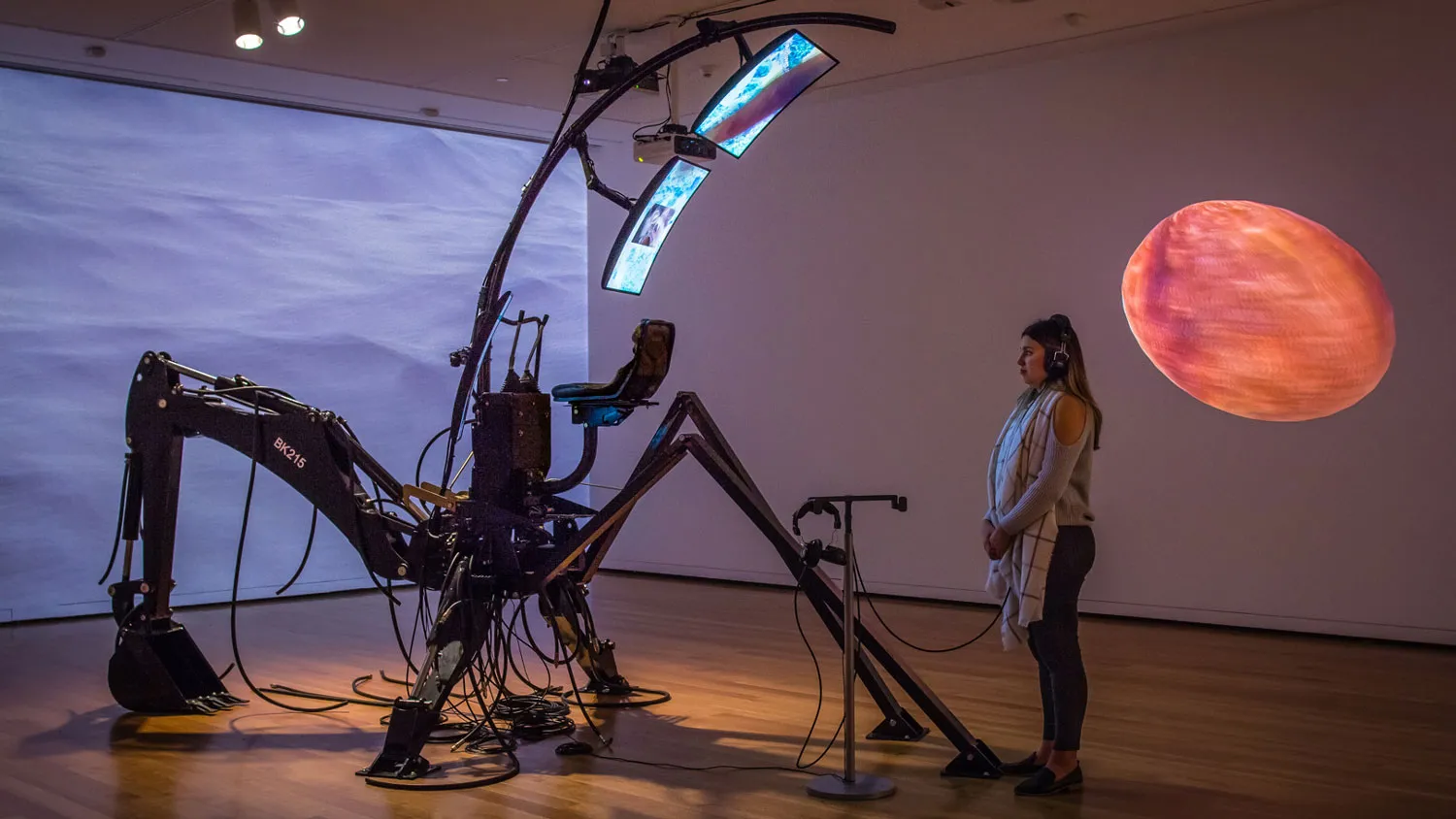
Sondra Perry makes videos, performances, and installations that foreground digital tools as a way to critically reflect on new technologies of representation and remobilize their potential.
Perry’s engagement with consumer image-making technologies produces artworks that reveal the calibration, protocols, and algorithms inherent in these devices. She repurposes exercise machines, video games, chroma studios, and computer graphics in multidisciplinary artworks that together form a corrective against the unreflective naturalization of technology. Her works examine how images are produced in order to reveal the way photographic representations are captured and recirculated.
Main Image: Sondra Perry, Eclogue for [In]habitability at Seattle Art Museum, Courtesy the artist.
For more information about this campus event please visit: https://www.arch.rpi.edu/2019/10/fall-2019-lecture-series/.
For more information about this campus event please visit: https://www.arch.rpi.edu/2019/10/karlheinz-brandenburg/
For more information about this campus event please visit: https://www.arch.rpi.edu/2019/10/fall-2019-lecture-series/.