Image
Laurie Anderson and Pauline Oliveros

The Films of Laurie Anderson

with special guest Pauline Oliveros

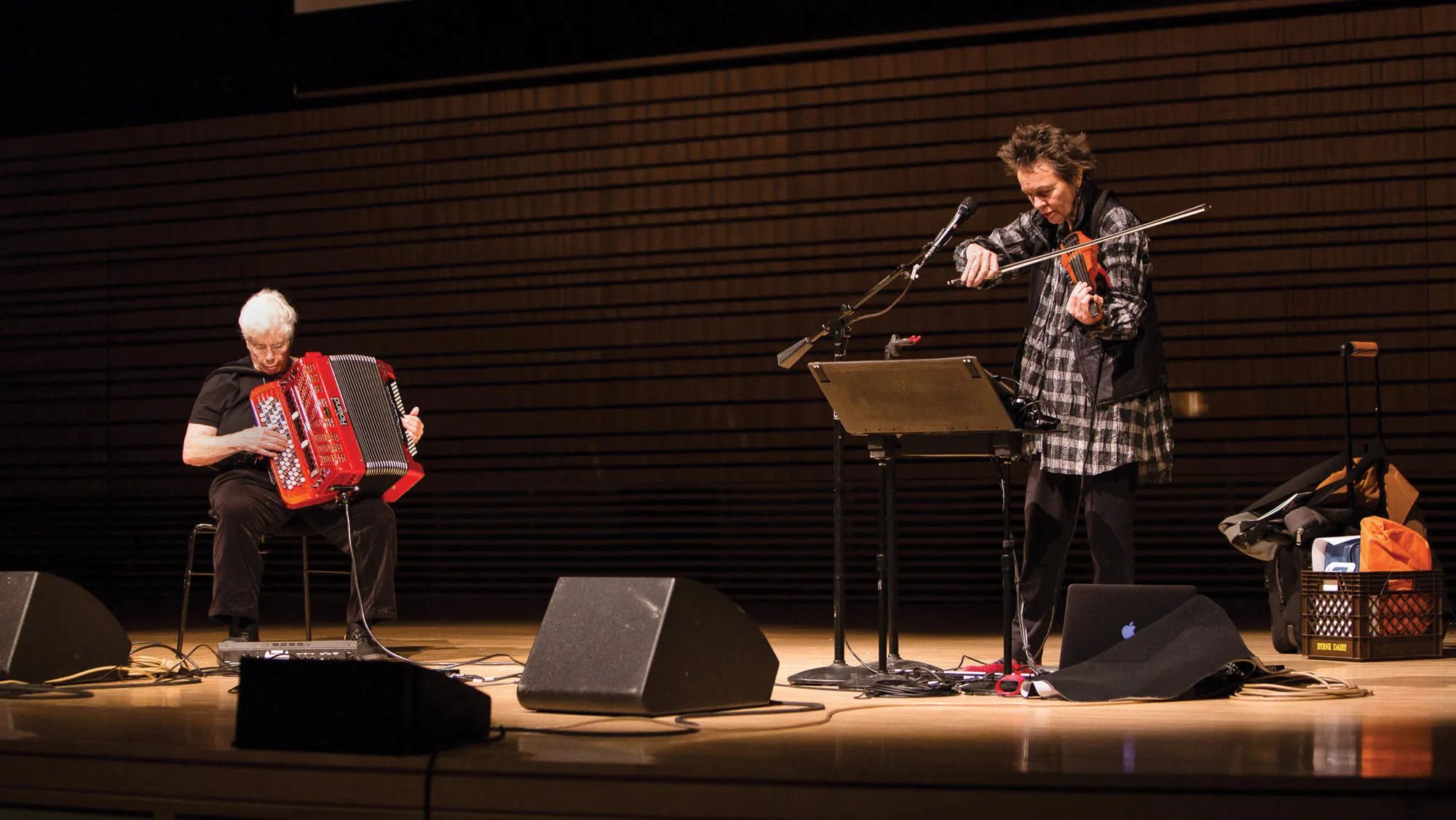
In two back-to-back screenings in one evening, Laurie Anderson presented many of her films and videos, culminating in a silent film with live music performed by Anderson and Pauline Oliveros. 

Laurie Anderson, EMPAC’s inaugural distinguished artist-in-residence, presented a series of events focusing on topics unique to her practice as an artist. 

5PM PROGRAM

What You Mean We? (1987) What You Mean We? stars Laurie Anderson, who also wrote and directed the piece. It was originally produced as a segment of the PBS arts series Alive from Off Center.

Personal Service Announcements (early 1990s)

Carmen (1991) Anderson’s Carmen, who works in a tobacco factory, is as strong-willed and carefree as the original (she steals cigarettes off the assembly line). The one significant difference in that she is married. The young soldier from Georges Bizet’s original opera (1875) has been transformed into her indifferent husband who sits home idly watching television with the kids while she works.

Puppet Motel (1994) Puppet Motel is a CD-ROM which invites to an imaginary universe made up of the interplay between light and darkness, mystery and poetry. This universe is populated by puppets and, of course, its creator, the artist herself.

Home of the Brave (1986), excerpts Home of the Brave is a concert film directed by and featuring the music of Laurie Anderson. The performances were filmed at the Park Theater in Union City, NJ, during the summer of 1985.

8PM PROGRAM

Hidden Inside Mountains (2005) Hidden Inside Mountains is a film of short stories about nature, artifice, and dreams. Located in a fictitious world of theatrical spaces, the stories unfold through music, gesture, text passages and the poetry of variously juxtaposed, evocative visual images.

Hidden Inside Mountains, commissioned by EXPO 2005 Aichi, Japan, is a high definition film that debuted in Japan at WORLD EXPO 2005 on the largest high definition Astrovision screen in the world. An original score was written and recorded by Laurie Anderson with additional vocals by singer /performer Antony.

Duets with Pauline Oliveros to films by Ken Jacobs and others

Excerpts from Performances

One of America’s most renowned performance artists, Laurie Anderson’s genre-crossing work encompasses performance, film, music, installation, writing, photography, and sculpture. She is widely known for her multimedia presentations and musical recordings and has numerous major works to her credit, including United States I-V (1983), Empty Places (1990), Stories from the Nerve Bible (1993), Songs and Stories for Moby Dick (1999), and Life on a String(2001), among others. She has had countless collaborations with an array of artists, from Jonathan Demme and Brian Eno to Bill T. Jones and Peter Gabriel.

Anderson has invented several technological devices for use in her recordings and performance art shows, including voice filters, a tape-bow violin, and a talking stick. In 2002, she was appointed NASA’s first artist-in-residence, and she was also part of the team that created the opening ceremony for the 2004 Olympic Games in Athens. She has published six books, produced numerous videos, films, radio pieces, and original scores for dance and film. In 2007, she received the prestigious Dorothy and Lillian Gish Prize for her outstanding contribution to the arts. She lives in New York City.

Pauline Oliveros’ life as a composer, performer, and humanitarian is about opening her own and others’ senses to the many facets of sound. Since the 1960s, she has profoundly influenced American music through her work with improvisation, meditation, electronic music, myth, and ritual. Many credit her with being the founder of present day meditative music. All of Oliveros’ work emphasizes musicianship, attention strategies, and improvisational skills.

She has been celebrated worldwide. During the 1960s, John Rockwell named her work Bye Bye Butterfly as one of the most significant of that decade. In the 70s she represented the US at the World’s Fair in Osaka, Japan; during the 80s she was honored with a retrospective at the John F. Kennedy Center for the Performing Arts in Washington, DC. The 1990s began with a letter of distinction from the American Music Center presented at Lincoln Center in New York, and in 2000 the 50th anniversary of her work was celebrated with the commissioning and performance of her Lunar Opera: Deep Listening For_tunes. Oliveros’ work is available on numerous recordings produced by companies internationally. Sounding the Margins—a forty-year retrospective, was recently released in a six CD boxed set from Deep Listening.

Main Image: Anderson and Oliveros in the concert hall in 2013. Photo: Mick Bello/EMPAC.

The Negotiation of Context

Davíd Brynjar Franzson and Yarn/Wire

Icelandic composer Davíð Brynjar Franzson was in residence with ensemble Yarn/Wire to record, edit, and master both audio and video for an upcoming release. Franzson is known for his experimentation with music at the edge of perception, bringing sounds from between the cracks of consciousness to the forefront of perception. Yarn/Wire is a New York City-based ensemble featuring two pianists and two percussionists who interpreted Franzson’s work for the recording. Yarn/Wire frequently presents US premieres by leading international composers, in addition to premieres of music written specifically for the ensemble. Davíð Brynjar Franzson has collaborated with ensembles such as Ensemble Adapter and the Mivos Quartet in addition to Yarn/Wire. His scores are published by Schott Music and his music can be heard on WERGO, Innova, Spektral, Smekkleysa and Carrier Records, a NYC-based record label that he co-runs with Sam Pluta and Jeff Snyder.

HeadSwap

CREW & Eric Joris

The goal for HeadSwap was to allow participants to choose an individual point of view within footage shot in Japan and New York City, while “swapping their heads”: simultaneously seeing what another person chooses to see. During a three-week research residency, Joris and a multi-disciplinary team of designers, programmers, and dramaturges worked to composite different video and graphic sources and find a way to view the end result in an “omnidirectional” way. They tested spherical layers upon which different media could be textured, and developed hardware to render and composite live images from a 360-degree camera without visible loss in quality or delay. This research enabled CREW to explore the conflict between live and prerecorded images and to see where both can enhance each other. At the end of the residency the work-in-progress was presented to the public followed by a discussion with the artists.

CREW, a Belgium-based multidisciplinary team of artists and researchers founded by Eric Joris integrate technology into theatrical events to create new forms of experience. They create immersive environments for audiences, using video goggles and interactive technology, that put each spectator at the heart of the experience and that challenge notions of presence, spectatorship, and narration.

Linked Verse

Jaroslaw Kapuscinski & The OpenEndedGroup

This residency supported a collaborative project featuring music by composer Jaroslaw Kapuściński and projections by The OpenEnded Group. The resulting work, Linked Verse, premiered at Stanford Live and was an evening-length concerto for cello (Maya Beiser), Japanese shõ (Ko Ishikawa), voice and surround sound from 24 speakers, and live 3D stereoscopic visual projection. A multimedia evocation of otherness and union that builds on tensions and accords between Japanese and Western cultures, Linked Verse explores ancient and contemporary eras and sensory modalities, both visual and aural. The work’s structure is derived from the ancient Japanese poetic practice of renga (“linked verse”) in which two or more poets take turns adding interlocking links to form a chain of unexpected associations. In Linked Verse, 3D scenes (captured on location in Tokyo, Kyoto, New York City, and the Bay Area) are linked and presented in counterpoint to the music

Something's Got Ahold of My Heart

HAND2MOUTH

The Portland-based ensemble Hand2Mouth was in residence for two weeks in EMPAC’s Theater for final rehearsals of Something’s Got Ahold of My Heart. Exploring the tension between how love is portrayed in popular culture versus how it is experienced in our personal lives, the performance drew on diverse source material including interviews, pop music concert footage, and advice books. The resulting work, performed in three movements, wrestles with people’s desire to craft the perfect declaration of love, and the gap between the ideal and the reality of long-term commitment.

Founded in 2000, Hand2Mouth creates performances that draw from dance, music, theater, and design.

Primal Matter

Dimitris Papaioannou

Against the backdrop of economic and social crisis stretching from Greece to the US, Dimitris Papaioannou embarked on an artistic challenge: investigating personal and national identity using the least possible means. The result is Primal Matter, where two bodies on the stage are the starting point for a journey that weighs body and soul to determine what is truly indispensable—what constitutes the essence. To create Primal Matter at EMPAC, Papaioannou and his artistic team erected a custom-made wall with built-in fluorescent light, and created an intricate live audio design using input from contact mics positioned around the set and processed in real-time and sourced to different outputs.

Papaioannou is an avant-garde stage director, choreographer, and visual artist who has worked across the boundaries of theater, dance, and the visual arts; he drew international acclaim for his direction of the opening ceremony of the Athens 2004 Olympic Games

The Swimmer

Laurie Anderson

EMPAC’s distinguished artist-in-residence Laurie Anderson returned to EMPAC to revise her multi-channel video installation, The Gray Rabbit, renamed as The Swimmer. In this new iteration, the piece was being prepared for The Language of the Future, an exhibition featuring works made by the artist between 1971 and 2013 to be presented at the Samstag Museum of Art at the University of South Australia as part of the Adelaide Festival. The exhibition was Anderson’s first solo exhibition in Australia. Like its earlier incarnation, in The Swimmer Anderson re-examines her memories of a summer spent in the hospital when she was 12, realizing that what she recounts from that time is what is palatable for her to remember. The installation projects a six-minute loop of dreamlike and heavily processed images that evoke scenes from the story—children swimming, nurses’ faces, and nostalgic farming country vistas—onto an alley made of shredded books on the floor to achieve the effect of “a story you could walk through.”

Laurie Anderson, EMPAC’s inaugural distinguished artist-in-residence, presented a series of events focusing on topics unique to her practice as an artist.

CLUSTER

Kurt Hentschläger

Austrian artist Kurt Hentschläger was in residence developing his audiovisual work CLUSTER, an evolutionary step in his artistic practice. A work in progress that began in 2004 combining seven complete, independent works, a full-length stereoscopic version of CLUSTER premiered in 2012. Focused on group behavior and the various stages of swarm motion, the 3D characters engage in a weightless slow-motion choreography, with human figures appearing as clouds of blurred matter intermingling with light.

Chicago-based Austrian artist Kurt Hentschläger creates audiovisual performances and installations. Between 1992 and 2003 he worked collaboratively as one half of Granular Synthesis, whose performances and installations confronted viewers on both a physical and emotional level, overwhelming them with sensory stimulation.

Zero

Deville Cohen

Deville Cohen spent two weeks at EMPAC shooting for his video work Zero, inspired in part by the television sci-fi drama The X-Files. Cohen takes closed narrative forms, like the television show structure of a crime scene—investigation and resolution—only to twist them apart. In doing so, the recognizable structure breaks down, becomes abstracted, and is exhausted, revealing the fragile qualities of the materials, devices, and logics he uses. Influenced by theater, sculpture, cinematography, and collage, Cohen creates abstract psychic dramas that are clearly handmade, but nonetheless visually and structurally complex. His performance-based photographs and video installations are made up of black-and white Xerox images as integral elements in their mise-en-scène. Sets, characters, and props are entangled in psychic dramas saturated with humor, desire, and anxiety.

Cohen was born in Israel, and lives and works in New York City. His work has been shown at SFMOMA and MoMA PS1.

Tim Hecker

Canadian musician and sound artist Tim Hecker was in residence developing a site-specific performance in the Concert Hall at EMPAC and recording new material for an upcoming album. Hecker used a multi-channel surround-sound setup, including speakers located above the Concert Hall’s suspended fabric ceiling, to create an immersive sound experience in near darkness.

Hecker is a Canadian-based musician and sound artist; since 1996, he has produced a range of audio works for Kranky, Alien8, Mille Plateaux, Room40, Force Inc, Staalplaat, and Fat Cat. His works have been described as “structured ambient,” “tectonic color plates,” and “cathedral electronic music.” He has focused on exploring the intersection of noise, dissonance, and melody, fostering an approach to songcraft that is both physical and emotive. His work has also included commissions for contemporary dance, sound-art installations, and various writings.