The Brooklyn Rail Reviews: TOPOS Music Festival 2026
The Curtis R. Priem Experimental Media and Performing Arts Center (EMPAC) at Rensselaer Polytechnic Institute in Troy, NY floats away from the hill that is the site of RPI’s campus. The main concert hall, an enormous wooden vessel held in place and acoustically isolated from the earth by muscular metal beams, is encased in a glass box embedded in the hillside. From the outside, it looks like a Fabergé egg lording itself over the rough charm of the old city center of Troy.
The imperiousness of it is real. Built out of an initial anonymous nine-figure donation, then a later $40 million gift from RPI alum and NVIDIA co-founder Curtis Priem, the architectural design separates EMPAC from both the campus and the town, something its founding director, Johannes Goebel, seemed to find advantageous. Goebel never seemed interested in making EMPAC any part of the Troy or RPI communities—despite being a campus facility. He’s now retired, and a new set of younger administrators are trying to make deeper connections with what surrounds EMPAC than through the anchors themselves.
The second TOPOS Music Festival, organized by EMPAC’s Senior Curator for Arts and Music Amadeus Julian Regucera, aimed to bridge that gap through a focus on narrative. This was more than just a music festival—there were only two music concerts—but rather a series of events that put music and media together, often with the former a secondary concern to what was happening in front of the eyes.
Inside this there was a more specific focus on Edward George. A man of many media himself, George has been part of the late-nineties UK electronic band Hallucinator (an evocative mix of the chill side of techno, ambient, and dub, sitting at the precipice of dubstep), and practices a mix of writing, public—meaning performed in front of the public—musicology, and also filmmaking. He had three events at TOPOS; the first one was the least musical and also one of the highlight bookends of the several days.
Away from EMPAC, at the Sanctuary for Independent Media on TOPOS’s opening night, George presented his film Black Atlas, with a follow-up Q&A with poet Fred Moten. Black Atlas is a singular, remarkable work. George made it by first rummaging through the Photographic Collection at the Warburg Institute in London, pulling out and assembling images of Black people from several hundred years of European (and some American) art into a linear presentation. What the images are, and their context, is essential to the experience and purpose of the film. There is some portraiture in the classic style; there are genre images and illustrations of servitude and, of course, the slave trade. There are also smaller details that George pulled out, with a discerning eye and fierce concentration, of Black people—men, women, and children—as minor figures, or in the background of larger images with a different focus, even seen in bits of decorations inside buildings and rooms that had Black figures within them in some way.
More than the portraits, some of which hint at artists’ admiration for the subjects, it is these images that gradually, subtly accumulate an overwhelming and indescribable force. There is a thoughtlessness to them: people as barely seen and viciously exploited labor, people as dehumanized decorations, people who have no more consequence or substance to the artists than a piece of furniture, people as objects to be fed into the process of society—“a map of things that aren’t there but for the presence of other things,” George says. People who are barely seen, captured on paper or canvas in the same way a camera mechanically captures the colors or dimensions of objects that fall within the scope of its lens.
They come, one after another, accompanied by George’s cool, measured, spare narration, the words delivered with care so that anger doesn’t distort them. There is also a spacious, quiet, dangerously abstract free jazz soundtrack led by saxophonist Seymour Wright, all ghostly, stabbing timbres. The pacing is measured and mesmerizing, masterfully crafted so that the viewer cannot look away, or even feel the full effect—which would make you look away—until it’s all over. But it doesn’t end. Black Atlas is a work that makes a permanent space in the mind with an effect that reaches deeper with each passing day.
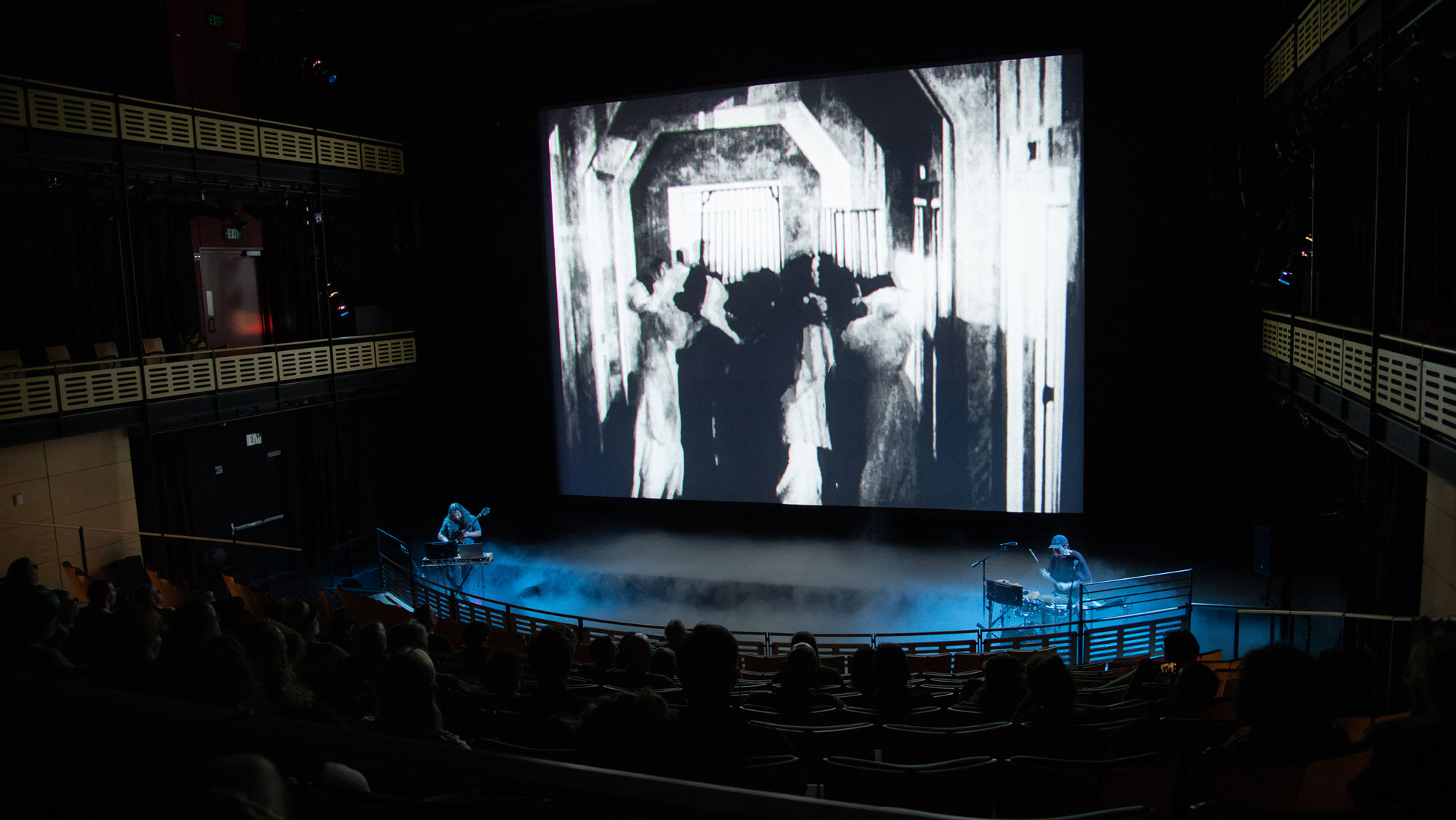
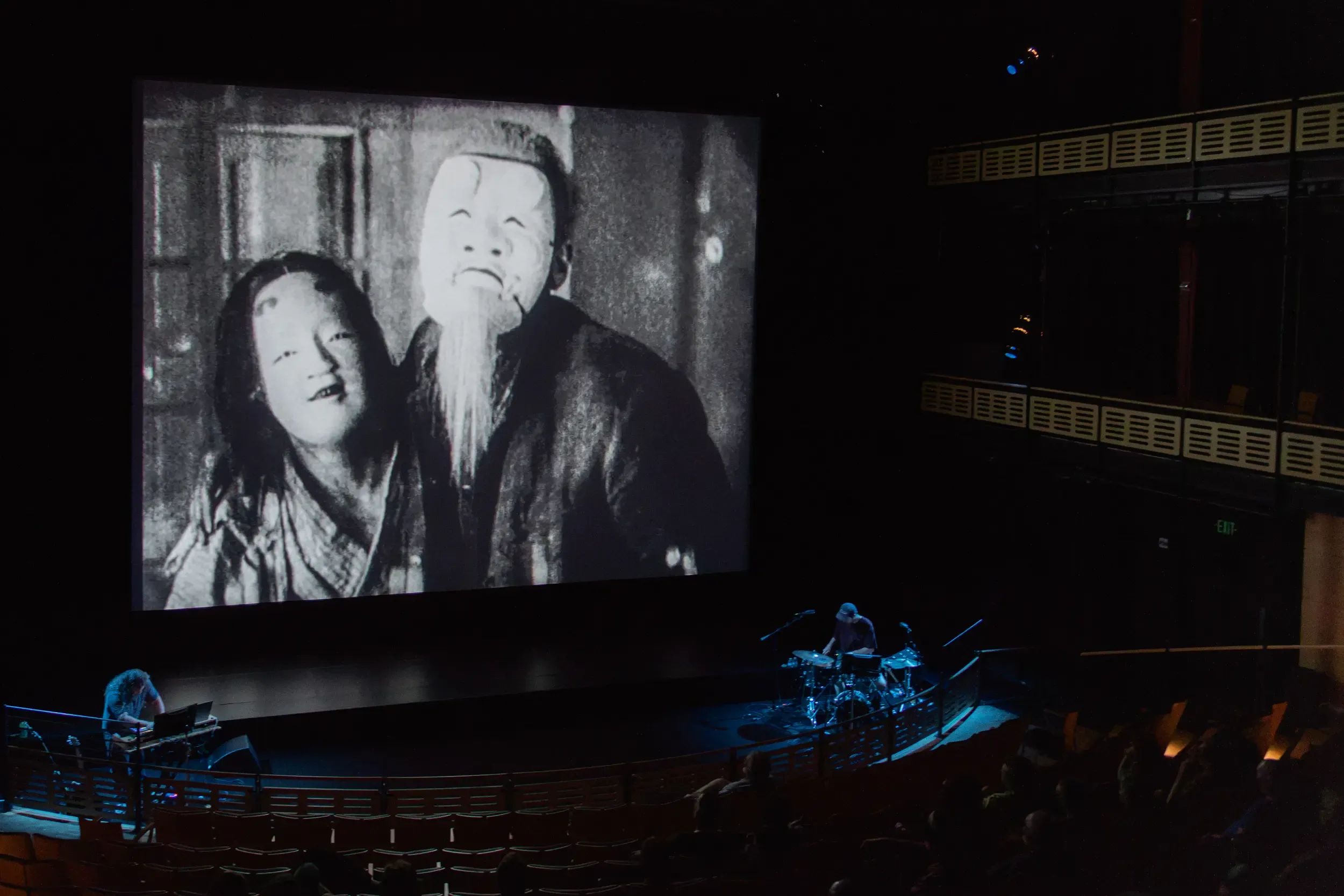
“The more you gather images that make a claim on beauty, the more you also get the visualization of horror,” that’s George’s overview of the film, and an unintentional introduction to the other highpoint of TOPOS, which came on the closing night. The metal duo The Silent Light composes original scores to silent movies, including Metropolis and Nosferatu, and performs them live with the films. Saturday night in the EMPAC theater, they presented A Page of Madness, a 1926 movie directed by Teinosuke Kinugasa. This was lost then rediscovered in 1971, apparently missing a third of its duration and without intertitles—original showings likely had live narration along with music.
The story is about a man who takes a janitorial job in a psychiatric hospital to watch over his wife, who is a patient. The film is astonishing, avant-garde in a way that exceeds most such cinema, while framed and edited with such clarity and sophistication—including depth of field and fluid camerawork that are as fine as can exist in the movies—that the story is always clear. This choice alone is expert curation from the band, who discovered the movie while students at Cal Arts, and the score was terrific. The Silent Light uses the style of metal for impact and sonic depth, while being acutely aware of atmosphere, narrative and visual details, pacing, and crucially when to be silent and let the images speak.
Between those two peaks, there were several valleys. George presented two live podcasts, The Strangeness of Jazz and The Strangeness of Drumming. The first was an exploration of how drummer Sly Dunbar developed his style, dipping into vinyl tracks of classic soul, funk, calypso, and other samples of drummers who were influences on Dunbar. The other was a look at rhythm-playing, concrete beats, and abstract colors, accompanied by drummer Paul Abbott. Neither had much depth for a deep listener, nor did they overcome the inherently uninteresting format of watching someone talk to themselves or one other person (Abbott) while playing records.
There were two other narrative works, And The Petals Burst Into Flames by the electro-percussive duo IMA, and Miho Hatori’s video performance piece Paris Syndrome. Both were stuck in clichés. With IMA, that meant a deliberate underlining of specific musical gestures as components of a ritual, but these were secondhand and without organic purpose. Hatori (co-founder of Cibo Matto and a former voice of Noodle in Gorillaz) made a kind of lecture on the extreme disappointment Japanese tourists can feel when they see what Paris is like in person. This was superficial and disorganized, outlining elements of the condition without ever conveying it.
The pure music events were quite fine. On Friday, before Paris Syndrome, Vijay Iyer and Wadada Leo Smith played from the music they made for their 2025 ECM album Defiant Life. These two are always surprising together. As leaders and solo artists, they usually project an extroverted force, expressive energy with swagger. As a duo, they turn inward—not quiet—and dig deep. The music goes down into the soul and intellect and expands, as if the center of the earth were larger than the crust. Their concentration together, the care they take to listen to each other, is engrossing and moving.
The following afternoon, again in the concert hall, was “Improv Spaces,” a double bill of local bands Rock City Falls Trio and Sun Dogs. The former made expert lessons in working with tonality to create clear, formal structures. The latter, a keyboard and winds duo, crafted a beautiful continuous flow of harmonies, electronic sound, and gorgeous timbres; music with the satisfying shape and feeling of a Constantin Brâncuși.
Those were the shows. Did TOPOS connect to the world close by? Attendance seemed light, a few dozen scattered around the main hall for the improvisations, roughly the same number for Black Atlas, and relatively substantial crowds for the events in the theater and studios and their far smaller capacities. There was a local, older cohort that made it to every performance, some students who seemed drawn to Hatori and The Silent Light, a handful of families with kids. Not enough to breach the glass case of EMPAC, but perhaps enough for a toehold.
--
George Grella has been the Brooklyn Rail’s music editor since 2013. He has played jazz, classical, and improvisational music from CBGB to Carnegie Hall, has written about music and culture for over thirty years for print and online publications, and has contributed to the Grove Dictionary of Music, the Library of Congress’ National Recording Registry, the Financial Times, The Wire, Bandcamp, VAN, Music & Literature, The New York Classical Review, The Strad, The New York Times, and others. He publishes the Kill Yr Idols newsletter, and is the author of Miles Davis’ Bitches Brew (Bloomsbury 2015).

Main Image: The Silent Light preforms A Page of Madness in the theater during TOPOS 2026. Photo: Michael Valiquette/EMPAC