Image
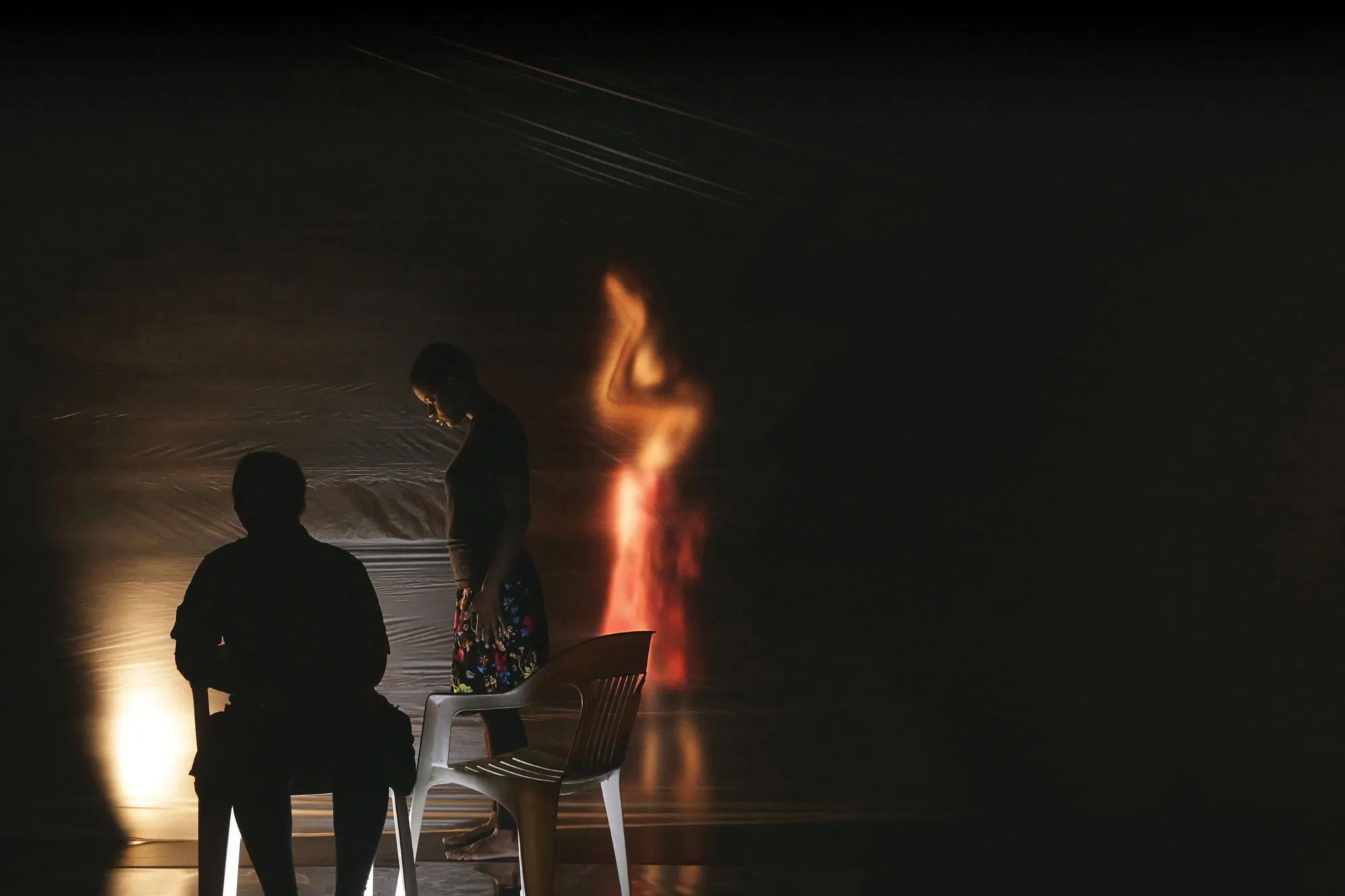
A Black woman and seated figure silhouetted against a sheer wall of plastic sheeting. Another figure is lit on the other side in a pose with a bent arm up.

Poor People's TV Room

Okwui Okpokwasili

Choreographer, writer, and performer Okwui Okpokwasili and director Peter Born presented their work, Poor People’s TV Room. Okpokwasili had been to EMPAC previously to perform for choreographers Nora Chipaumire and Ralph Lemon. As choreographer, Okpokwasili’s style transcends genre categories like experimental theater and conceptual choreography. The artist performed with three other women in a multifaceted work using live song, dance, and text amid other media including television, audio recording, light, plastic, cloth, and wood.

Poor People’s TV Room took inspiration from the Bring Back Our Girls campaign, started by a group of Nigerian women in 2014 to raise awareness about the Boko Haram kidnappings of 300 young Chibok girls. The campaign turned into a global movement after gaining widespread attention through social networking platforms such as Twitter. Since the speed of this online phenomenon ultimately overpowered the voices of the indigenous Nigerian women who started the movement, Okpokwasili used live performance to refocus our attention. Acknowledging a history of Nigerian women’s collective action, Okpokwasili wove the Bring Back Our Girls narrative with The Women’s War of 1929, an early anti-colonial revolt organized by women of six Nigerian ethnic groups.

Okpokwasili spent a week installing and finalizing Poor People’s TV Room for the New York City premiere of the work. 

Okwui Okpokwasili is a Brooklyn-based choreographer, writer, and performer who has shown her work at New York’s Lincoln Center, PS122, Danspace Project, New York Live Arts, and the Walker. She has toured her work internationally at Théâtre de Gennevillers and Theatre Garrone in France, The Zagreb Youth Theater in Croatia, and Arts House in Australia. Peter Born is a Brooklyn-based director, designer, and filmmaker who, in addition to working with Okpokwasili, has worked with clients including Vogue, Bloomingdales, and the Wall Street Journal, and with collaborators ranging from Kanye West to NoStringsUS Puppet Productions.

Musica de Profundis

2016 Rensselaer Holiday Concert

Troy, N.Y. —

Local residents are invited to join Rensselaer Polytechnic Institute students, faculty, staff, and alumni and alumnae for the Institute’s annual holiday concert on Sunday, Dec. 18, in the Curtis R. Priem Experimental Media and Performing Arts Center (EMPAC) Concert Hall. The program begins at 3 p.m. The Holiday Concert titled: Musica de Profundis brings together a collection of music by composers searching for meaning while probing the existential depths. “I think many people feel that 2016 has been an exceptionally challenging year, existentially speaking,” said Nicholas DeMaison, senior lecturer of music in the Department of Arts. “As our capacities for communication continue to increase in speed and scope, we find ourselves more often in contact with and immediately touched by events that may at one time have been beyond our survey, or may have only reached us long after their occurrence. “I hope this concert, at the end of the semester and end of the year, offers a chance to slow down, to escape the perpetual inundation of information, to be present with all of our uncertainties and our anxieties, as Ives, Shostakovich, and Tchaikovsky were as they wrote this music,” DeMaison said. “I hope that being present together for a few minutes, basking in the remarkable talents of our students, offers an opportunity for the mind and the heart to find solace and refreshment in a way they do not in our daily struggles.” DeMaison is a composer and conductor who has led dozens of premieres of new operative, instrumental, choral, and multimedia works, described as “consistently invigorating” (New York Times), “spine-tingling” (Feast of Music), and “enchanted” (Seen and Heard International). The Rensselaer Orchestra is an ensemble of undergraduate and graduate students. Established in 2013 by the Department of the Arts, the orchestra performs classics of the orchestral literature and regularly premieres new and experimental works. The group makes its performing home in EMPAC. The orchestra will perform Charles Ives’ “The Unanswered Question,” a programmatic work described by Ives as one of his “Two Contemplations” from 1908, exploring “the perennial question of existence.” Following that piece, Mary Simoni, dean of the School of Humanities, Arts, and Social Sciences (HASS), along with two Rensselaer students will then perform two movements of Shostakovich’s Piano Trio no. 2, in E minor, op. 67. The students are Russell Jones, a senior majoring in mechanical engineering and electrical engineering, who is also a Rensselaer Orchestra member; and J.V. Parin, a junior majoring in computer and systems engineering. Composed during the war-ravaged summer of 1944, the trio performance selection shifts between moods of somberness, simple folkishness, urgency, satirical stridency, and at times anger, all in a search for musical redemption. The program will finish with Tchaikovsky’s enormous Symphony no. 4, in F Minor, op. 36. Written at a critical juncture during Tchaikovsky’s mid-30s, the composer described the opening theme of the symphony as a representation of fate, and the rest of the piece as a search for one’s place in its grand scheme. “This year’s repertoire, brought to life through the musicianship of our students under the direction of Professor DeMaison, proclaims the noble resilience of the human spirit throughout time,” Simoni said. Members of the Rensselaer Orchestra will be joined onstage by members of the Grammy-winning Albany Symphony Orchestra. The 90-minute concert is free and open to the public. The full program is as follows: Ives: The Unanswered Question Shostakovich: Piano Trio no. 2 in E minor, op. 67 Tchaikovsky: Symphony no. 4 in F minor, op. 36 When DeMaison was hired in 2013, he brought the Rensselaer Orchestra and the Concert Choir forward to be offered as classes, added in a Chamber Ensemble course that could accommodate various iterations of smaller groups, and began developing and conducting a concert series each semester. “Having an orchestra and a choir and a chamber program that are functioning at a high level is really important for letting people know that we take all of this seriously,” said DeMaison. The ensembles are only the beginning, however, of how Rensselaer students can participate in the creative and collaborative possibilities of music making. The learning experience of contributing one part to a musical whole is one of the cognitive benefits of playing music, particularly for students who will find themselves in what Simoni calls a “transdisciplinary” field such as biomedical engineering. Tickets are not required and seating will be on a first-come, first-served basis. Attendees are asked to register online at https://webforms.rpi.edu/holiday-concert. To listen to recordings of the Rensselaer Orchestra, visit: https://soundcloud.com/rensselaer-orchestra The upcoming concert is vital to The New Polytechnic, an emerging paradigm for teaching, learning, and research at Rensselaer. The foundation for this vision is the recognition that global challenges and opportunities are so great they cannot be adequately addressed by even the most talented person working alone. The New Polytechnic emphasizes and supports collaboration across disciplines, sectors, and regions to address the great global challenges of our day, using the most advanced tools and technologies, many of which are developed at Rensselaer.The New Polytechnic is transformative in the global impact of research, in its innovative pedagogy, and in the lives of students at Rensselaer. To listen to recordings of the Rensselaer Orchestra, visit: https://soundcloud.com/rensselaer-orchestra - See more at: https://news.rpi.edu/content/2016/12/12/musica-de-profundis-music-searc…
Image
A man and a woman holding a large white piece of paper with a black diamond amongst other papers of various sizes strewn about the floor of a black box studio

One can make out the surface only by placing any dark-colored object on the ground

Hannah Rickards

One can make out the surface only by placing any dark-colored object on the ground is a performance that used navigational techniques to choreograph the interaction of a moving camera with two performers. 

The title refers to how one can travel in polar whiteout conditions by placing an object on the ground and continuing to place the object in front of you as you move forward. By this successive act, a pattern is formed, which can be viewed as a visual score for performance. Inspired by the graphic scores of Morton Feldman that explore musical composition as spatial terrain, London-based artist Hannah Rickards approached the media infrastructure of EMPAC’s Studio 1 in a similar fashion. A cable-suspended camera was maneuvered throughout the space in relation to the performers, capturing wide aerial shots as well as close-up detail of their gestures.

This performance was developed specifically for the production environment of Studio 1 and was the only time this work was performed live. Following the artist’s residency, One can make out the surface… toured solely as a video installation. 

Main Image: Production still, One can make out the surface only by placing any dark-colored object on the ground (2016). Image courtesy the artist and EMPAC.

Musica Humana/Musica Universalis

Michael Century and guest performers

A concert and multimedia lecture on the scientific and spiritual dimensions of music and health
 
Featuring music by:

Hildegard von Bingen                          O clarissima Mater sancte medicine
Steve Gorn                                         The transformative power of Indian music
Sergei Rachmaninoff                           Tarantella, from Suite #2 for Two Pianos
Eric Miller with Michael Century            Research demonstration of Ganzfeld effects­
Al and Jake George                              Medicine Music from the Cayuga Nation

Video segments featuring neurologist Dr. Oliver Sacks              

Curated and produced by Michael Century, Professor, Arts Department

Del McCoury and David Grisman

50th Anniversary Show

In 1966 bluegrass legends Del McCoury and David Grisman played their first gig together in Troy, NY at the Rensselaer Polytechnic Institute. On Dec. 10, 2016 they will return to RPI to celebrate 50 years of songs and stories. Presented by Guthrie Bell Productions

Image
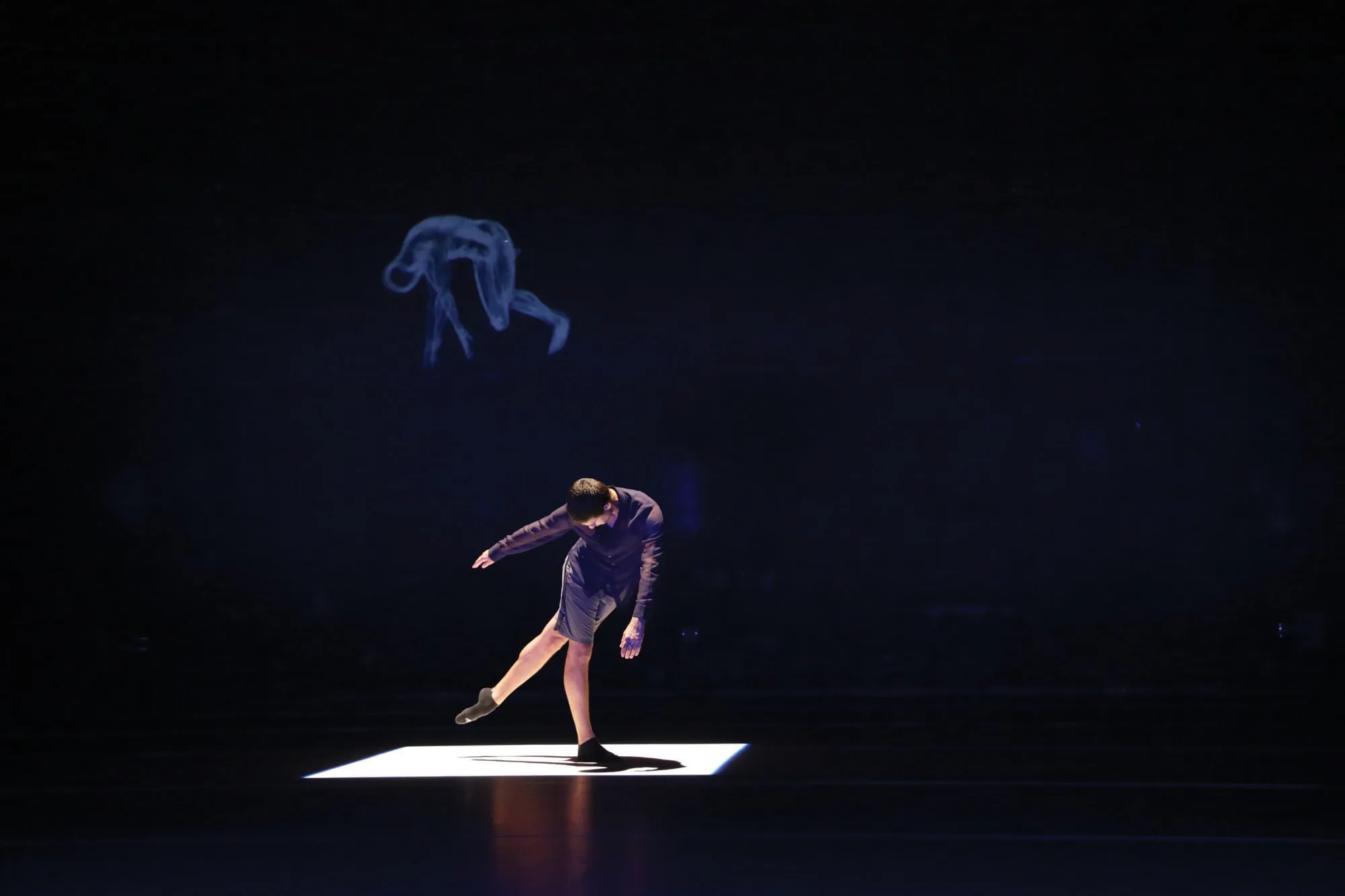
a dancer on a dark stage in a rectangular spot light in front of a projection of their body.

Three Cases Of Amnesia

Jonah Bokaer

Dancer, choreographer, and media artist Jonah Bokaer combined three of his iconic solos—False Start, Charade, and Nudedescendance—in a 60-minute performance titled Three Cases Of Amnesia. Rarely performed in the United States, the program showcased Bokaer’s pioneering work with choreography, and computer-generated animations.

Where does a movement begin? Where does it end? What, and who, does it leave behind? In these performances, Bokaer used a digital avatar to compose body movements that he might not have discovered working with a physical person, and then transposed that choreography onto his own body for live performance. Over the course of the three works, Bokaer and his animated double dance together, the uncanny precision of each one’s movements building upon the other’s. The result was an intimate portrait of a man and the various media he comes into contact with—not just a computer, its software and projections, but also a chair, a ladder, an apple, and clothing. Bokaer navigated these objects with a personal movement style that goes beyond any specific technique and dialogued with themes of play, memory, ephemerality, and disappearance.

Jonah Bokaer is an American choreographer and media artist known for addressing the human body in relation to contemporary technologies. Recruited to the Merce Cunningham company at the unprecedented age of 18, Bokaer is a John Simon Guggenheim Memorial Fellow in Choreography, a United States Artists Fellow in Dance (Ford Foundation), and a Bessie award-winner. In addition to his own work, he has also choreographed for Robert Wilson and danced for such choreographers as John Jasperse, Deborah Hay, and Tino Seghal.

Main Image: Jonah Bokaer on stage in 2016. Photo: EMPAC.

Image
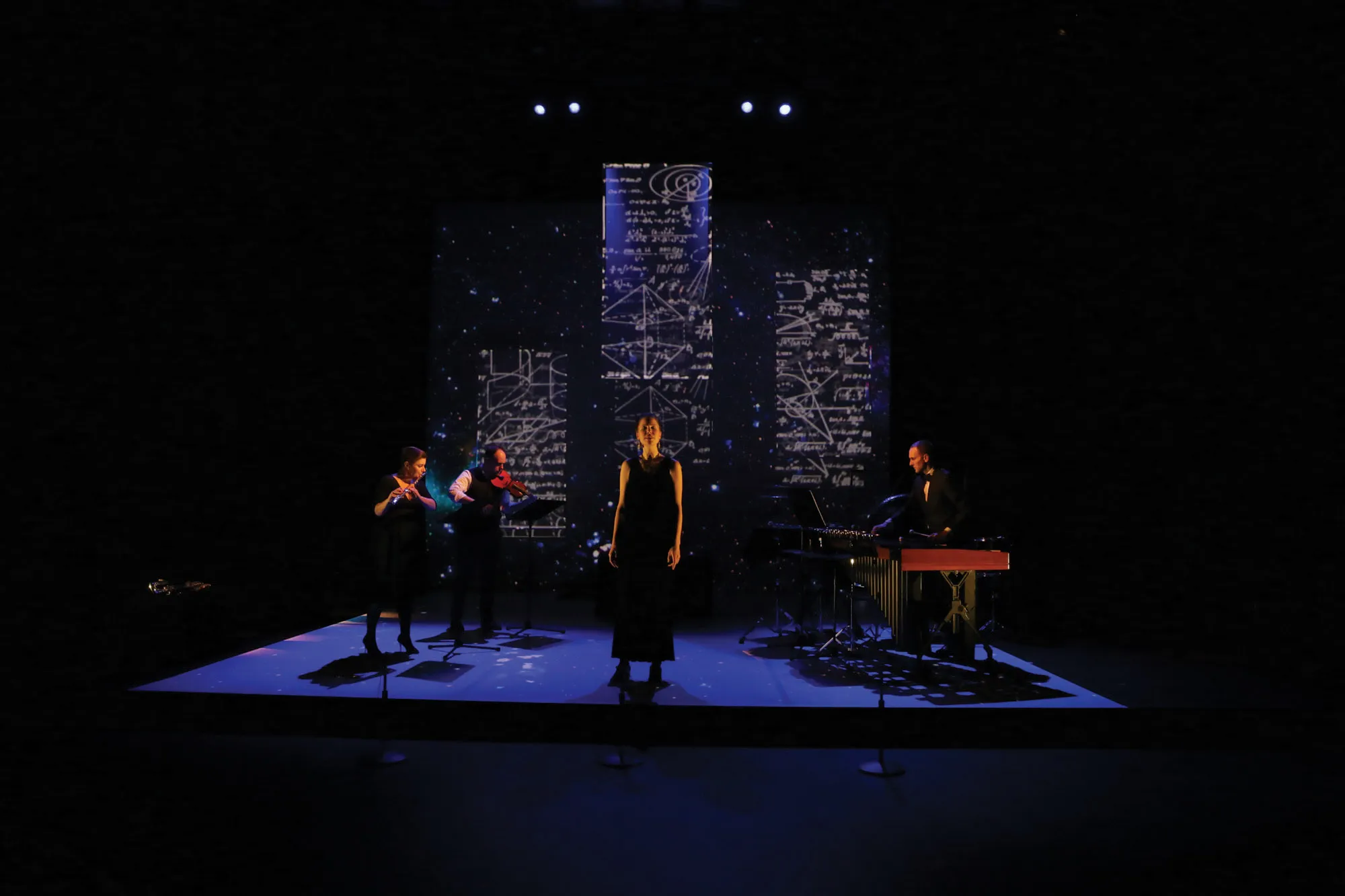
Kate Sopar on stage with three musicians in front of projections of mathematic equations.

Ipsa Dixit

Kate Soper

Ipsa Dixit is an evening-length work of theatrical chamber music by American composer Kate Soper. Exploring the intersection of music, language, and meaning, the piece blends elements of monodrama, Greek theater, and screwball comedy to skewer the treachery of language and the questionable authenticity of artistic expression. Each of the piece’s six movements draw on texts by thinkers such as Aristotle, Plato, Freud, Wittgenstein, Jenny Holtzer, and Lydia Davis, delivering ideas from the linguistic disciplines of poetics, rhetoric, and metaphysics through extended vocal techniques and blistering ensemble virtuosity. Developed in pieces since 2010, Soper’s EMPAC residency culminated in the first performance of the work’s entire cycle.

After premiering at EMPAC, Ipsa Dixit was nominated for the Pulitzer Prize in music. 

Main Image: Kate Soper on stage in the concert hall performing Ipsa Dixit in 2016. Photo: EMPAC.

Media