Image
Abstract rainbow streak, Rensselaer Lecture series Fall 2018

Fall Lecture Series

Architecture Rensselaer

FALL 2018 LECTURE SERIES

Thursday, September 6
Processes
GABRIELA CARILLO &  MAURICIO ROCHA

Tuesday, October 30
A New Urban Paradigm for the Future
CHRIS WARD / AECOM

Monday, November 5
Connections
ERIK FRANDSEN /
LUNDGAARD & TRANBERG ARKITEKTER

Wednesday, November 7
Behavioral Prototypes
ROLAND SNOOKS

Monday, November 12
Edge of Order
DANIEL LIBESKIND

All lectures start 6pm at EMPAC.
Admission is free.

Image
An Afghan woman wearing 1960's style clothing speaking frantically into a CB.

What We Left Unfinished

Mariam Ghani with Qasim Naqvi

A work-in-progress screening of Mariam Ghani’s feature film, What We Left Unfinished, which is currently in post-production at EMPAC. Following the screening, Ghani and the film’s composer Qasim Naqvi will discuss the relationship between sound and image in the film.

Based on the history of the Afghan Film Archive (the state film institute based in Kabul, Afghanistan), What We Left Unfinished reconstructs hidden and parallel narratives of both state propaganda and the experience of the Afghan Film Archive’s management and film directors during the period of Afghan Communism. Alongside his group Dawn of Midi, Qasim Naqvi has scored and recorded soundtracks for Mariam Ghani’s moving-image works for over a decade. The two artists began collaborating (with choreographer Erin Ellen Kelly) in 2006 with Performed Places—an ongoing site-responsive video and performance series.

Main Image: Mariam Ghani, What We Left Unfinished. Film Still: courtesy Mariam Ghani

Media
Image
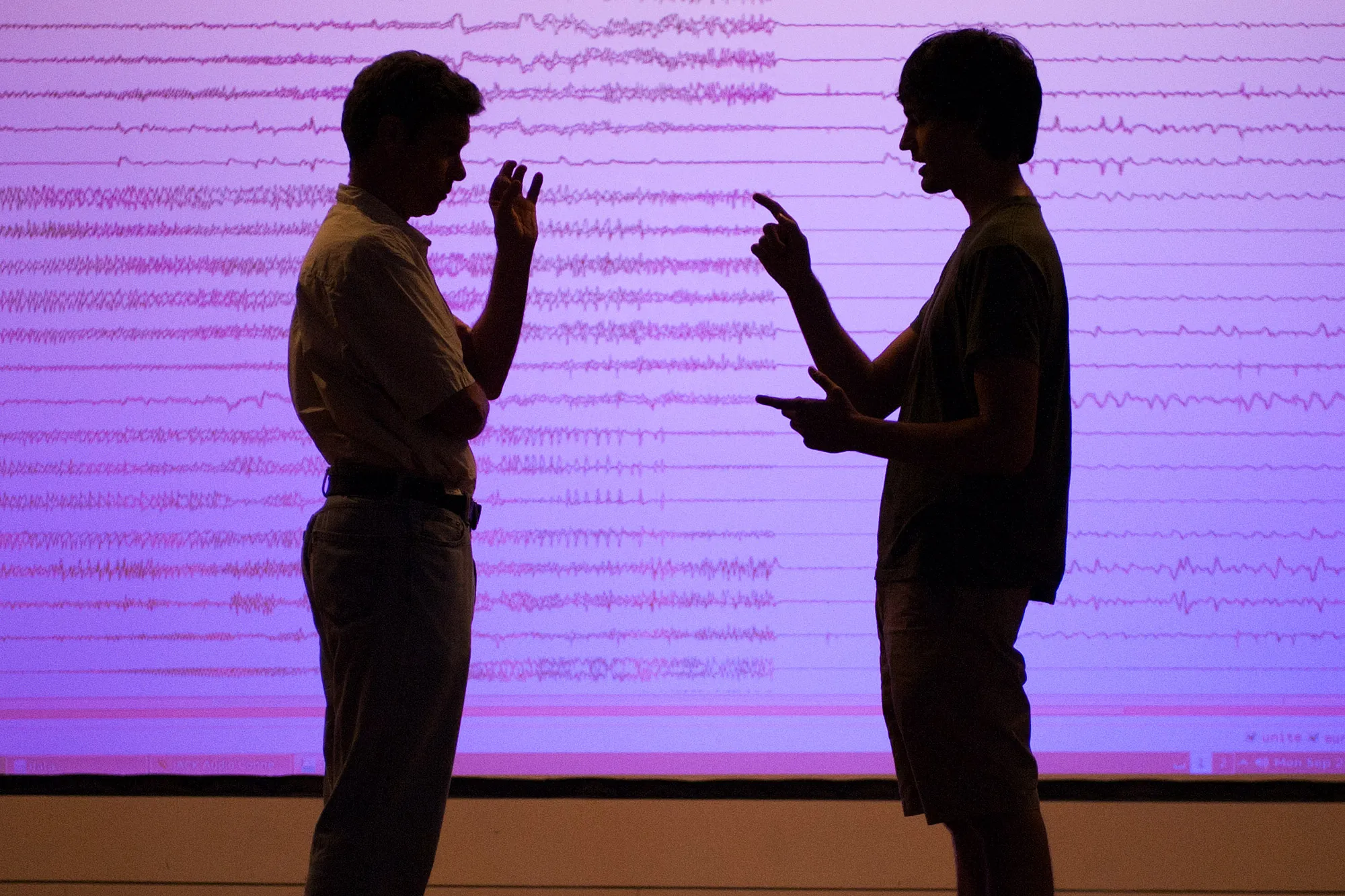
Two men standing in front of a pink projection of sound waveforms.

Sonification: Making Data Sound

Chris Chafe

Computers and music have been mingling their intimate secrets for over 50 years. These two worlds evolve in tandem and where they intersect they spawn practices that are entirely novel. One of these is “sonification,” turning raw data into sounds and sonic streams to discover new relationships within the data set by using a musical ear. This is similar to data visualization, a strategy that reveals new insights from data when it is made for the eye to perceive as graphs or animations. A key advantage with sonification is sound’s ability to present trends and details simultaneously at multiple time scales, allowing us to absorb and integrate this info the same way we listen to music.

This evening will include two events, a talk and a hands-on workshop. The talk will present an in-depth look into the potential and application of sonification. The workshop will offer participants an opportunity to work with their own data sets and explore sonification as a new approach to their data.

Chris Chafe is the director of Stanford University’s Center for Computer Research in Music and Acoustics (CCRMA) and approaches the practice of sonification from a background in computer-generated musical composition, using algorithms in the sculpting of musical detail. In much the same way, sonification uses datasets to generate sounds that can lead to a different or deeper understanding of patterns and processes in the sonified data. From global economic trends, atmospheric CO2 changes, or seemingly mundane events such as the ripening of fruit, sonification provides a means of gaining new perspectives on data through listening.

Main Image: Chris Chafe. Photo: Linda A. Cicero / Stanford University News Service.

Image
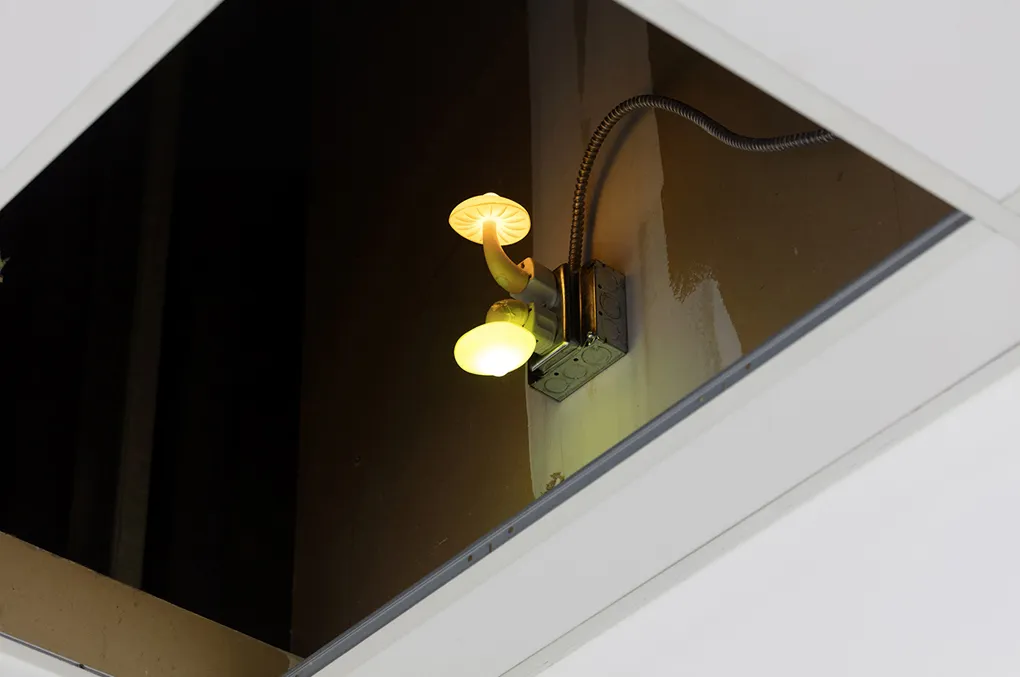
a mushroom shaped light plugged into a wall through a ceiling tile

Cancellations

Ghislaine Leung in conversation with Todd Vos

During her EMPAC production residency, artist Ghislaine Leung is experimenting with spatial audio for her upcoming exhibition at London’s Chisenhale Gallery. For this talk, Leung is joined by EMPAC’s lead audio engineer Todd Vos to discuss the technical and aesthetic considerations of “sound cancelation.” The method of “active sound cancellation” is common in the design of noise-cancelling headphones in order to eliminate unwanted environmental sounds. Leung is translating this technology into an architectural installation to experiment with its potential to produce an as yet unknown reality of sound.

At EMPAC Leung will be editing a new audio work KISS MAGIC HEART for this sound cancelling loudspeaker environment. Comprised of 18 hours of material from three UK commercial radio stations edited into a single compressed block, the recording will be distributed spatially in and through Studio 2 to cancel and clash sound polarities.

Main Image: Ghislaine Leung, Shrooms, 2016, Chinese night lights, plug adapters.
Photo: Courtesy the Artist and Essex Street, New York.

Media
Image
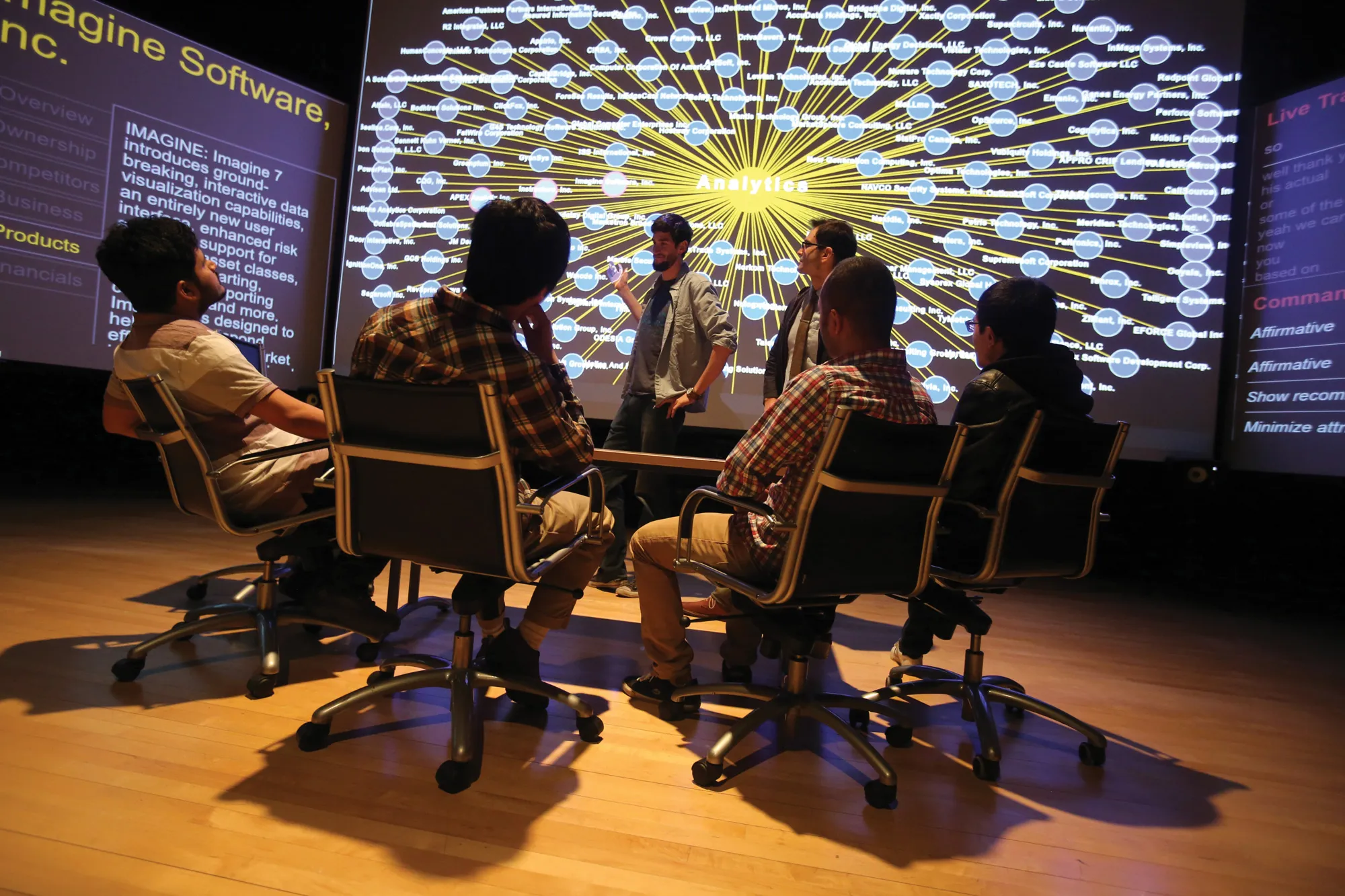
a group of four students facing two students giving a presentation in front of large screens with projections on them

The Cognitive and Immersive Systems Lab

Hui Su

The Cognitive and Immersive Systems Lab (CISL) is a collaboration between Rensselaer and IBM Research for the research and development of immersive cognitive systems. The core platform of CISL is the Cognitive Immersive Room (also called “Situations Room”), an immersive, interactive, reconfigurable physical environment. The future Situations Room will be able to augment group intelligence and performance by perceiving and understanding human intention in group activities, participating in learning and decision-making tasks, and communicating insight and discovery to humans. The domains investigated for the Situations Room include cognitive and immersive learning, corporate decision-making, cyber-enabled exploration and discovery, and intelligence analysis.

In this presentation, Director Hui Su will introduce the vision of CISL, the progress made by the CISL team in a few technical areas, and several technical demonstrations such as an occupant-aware cognitive environment enabled with multimodal interactions, cognitive and immersive environments for language teaching and decision making, and immersive narrative generation.

Main Image: CISL.

The Computer as Time Machine

Johannes Goebel

Over thousands of years, humans have carved into stone, painted on canvas, printed words in books, and captured images on film in order to pass information down the chain of generations. With digital data storage, we have reached the point where what is precious to individuals, families, and institutions only holds up for a fraction of a generation without constant care and expensive maintenance. For the ease of digital storage comes the cost of rapid obsolescence and “bit rot,” an ironic turn for a media format that seemed to promise longevity, if not permanence.

Digital archives depend on complex technological environments, electricity, chips, air conditioning, maintenance at quite short intervals, and are doomed by changing hardware, operating systems, applications, and data formats. Even if we have electricity and computers 100 years from now, what we have stored and hoped to pass along will be lost and forgotten without continuous, meticulous investment of time and money.

At EMPAC, we have created hundreds of events, commissions, and new works that are part of the larger cultural record. We have over 400 videos documenting these “time-based” productions accessible via two printed books that catalog this history. But if EMPAC were closed tomorrow, this knowledge would fade along with the funds and the interest needed to preserve it. As a result, EMPAC has researched a digital “time capsule” an individual or institution can create to make images, texts, sounds, and documents accessible for the next 100 years. This object would need attention every 10 years or so, would not need air conditioning, and would survive under the same conditions humans live in, at the cost of around $2,000.

This talk will describe our research as well as the philosophy and politics of digital memory behind the system we have developed. For more information please see 2021 essay The Computer as Universal Time Machine.

Image
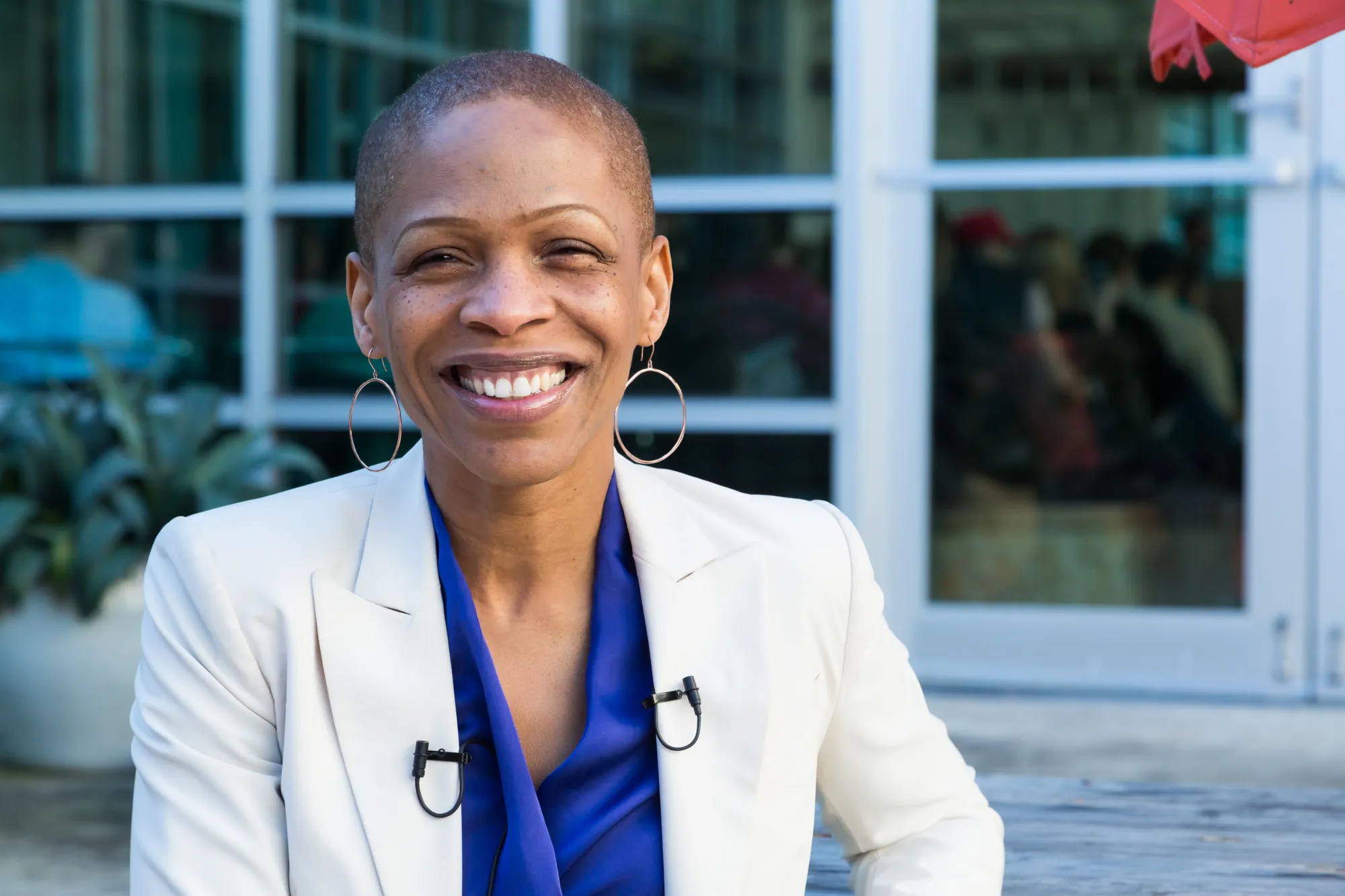
Dawna Ballard.

Creating Time Through Design

Dawna Ballard

Dawna Ballard presents a talk on “chronemics,” the study of the relationship between time and human communication. Ballard’s research focuses on how communication affects communities, organizations, and individuals. Her work explores the history and context of work-life balance in our contemporary “always-on,” information-overloaded, 24/7 multitasking culture. Particular to EMPAC, Ballard will explore a new perspective of chronemics in relation to time-based arts.

Dawna Ballard is Associate Professor in the Department of Communication Studies at the University of Texas Austin where she teaches courses on organizational communication, communication in groups, teams and communities, scale development, and chronemics. Ballard published and edited Work Pressures, a collection of research about the nature of pressure in the workplace. She is a Public Voices Fellow, Texas Program in Sports and Media Fellow, and a faculty affiliate at the Center for Identity as well as the Center for Health Communication at the University of Texas Austin.

Media
Image
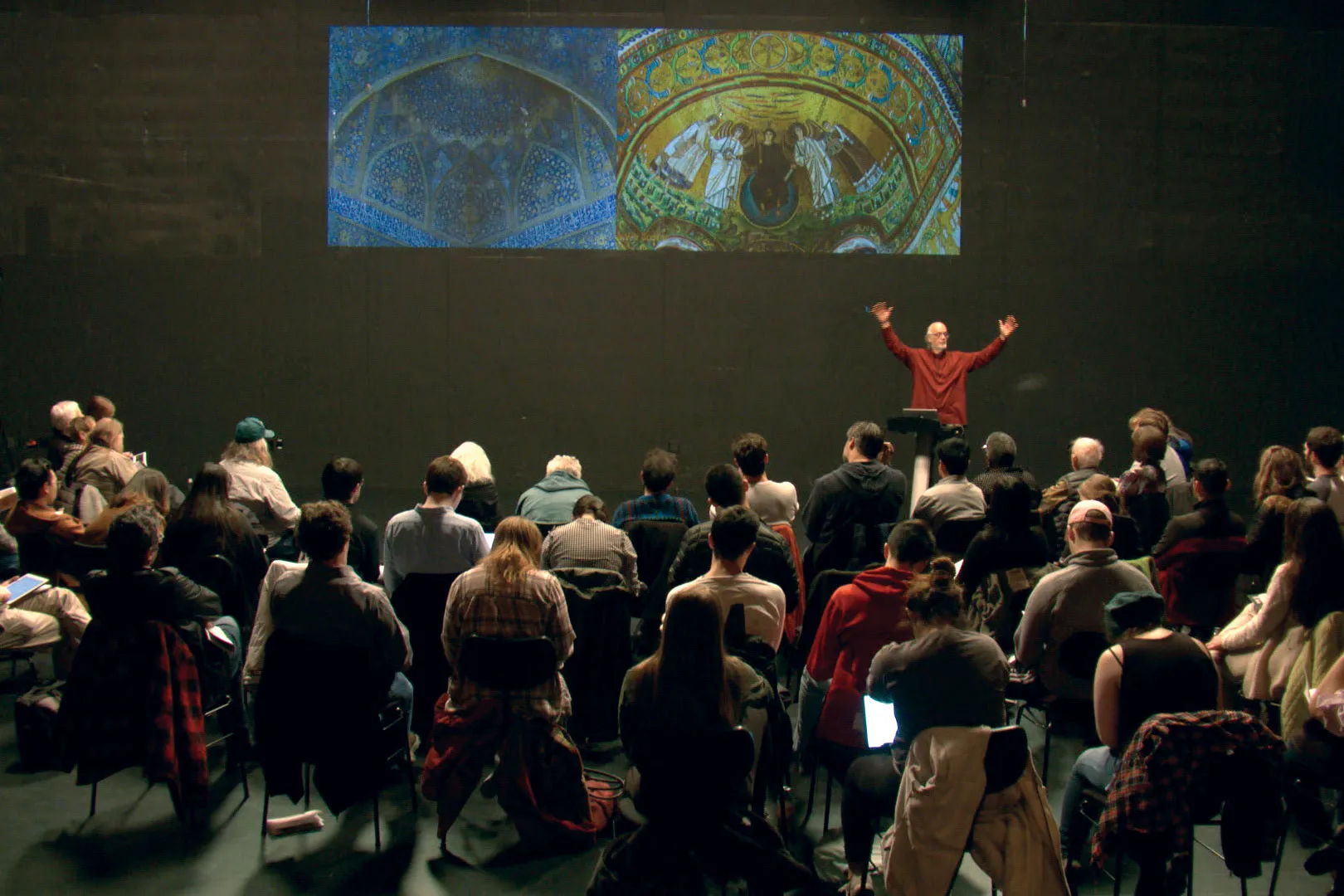
Johannes Goebel giving a talk to a small crowd in a black box studio.

ART!??!!!

A Discussion with Director Johannes Goebel

Why is there art at all? Why should anyone care? Isn’t everything art and everyone an artist? What is the place of art in this society and at Rensselaer? What is EMPAC’s place in all this? Is art meant to speak to my heart or is it all just elitist stuff? Isn’t art about self-expression with all value in the eye of the beholder? But then what is the return on investment? 

This event was an open conversation on the subject of art, jump-started by EMPAC Director Johannes Goebel. 

The founding Director of EMPAC, Johannes Goebel has published and lectured internationally on the arts, science, engineering, technology, and aesthetics. He has participated in the integration of digital technology with contemporary artistic theory and practice over the past few decades.

Main Image: Johannes Goebel, presenting ART!??!!! on the theater stage, 2018. 

Image
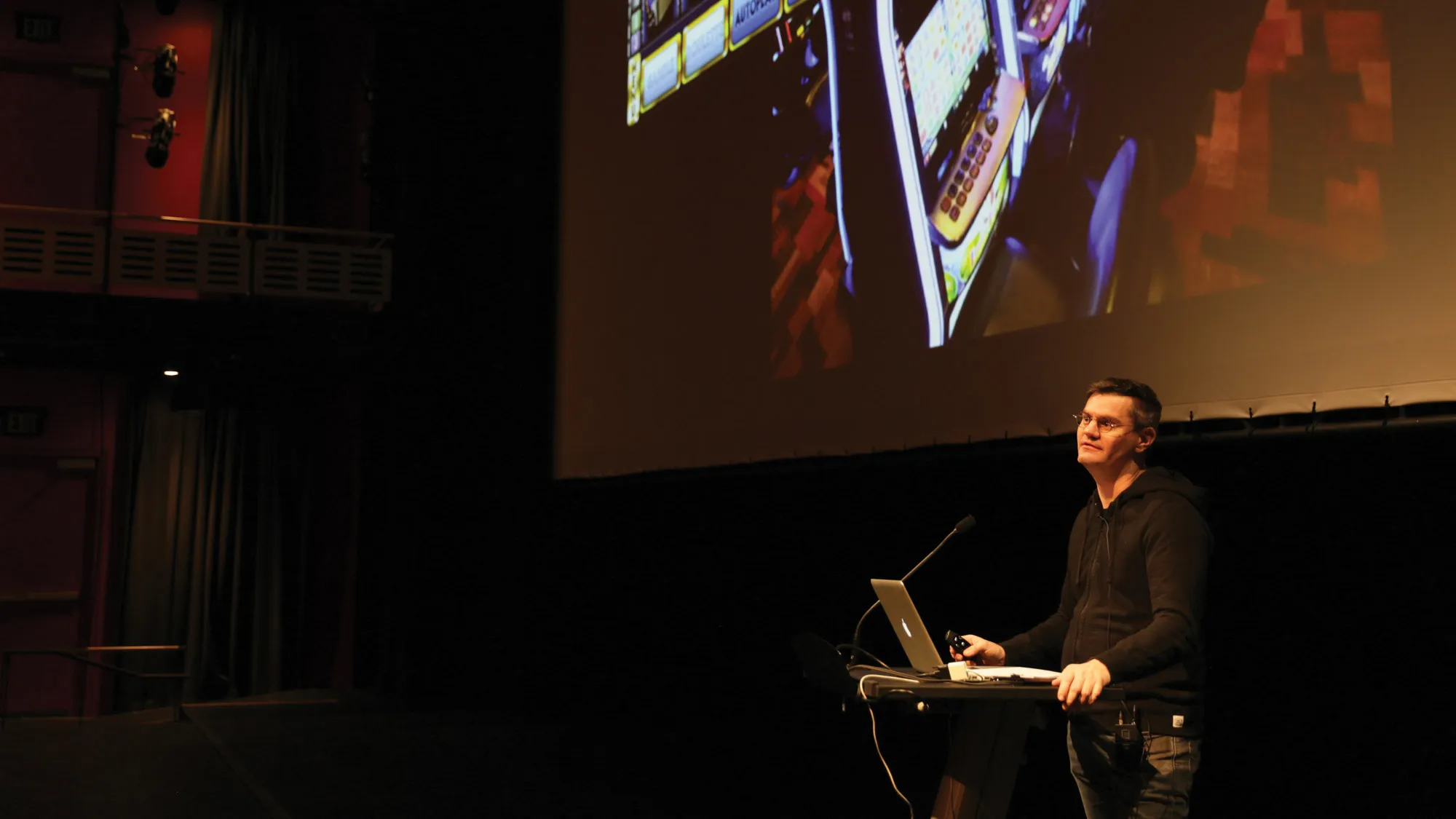
Patrick Keilty in the theater giving a lecture.

Pornography's Graphical Interface

Patrick Keilty

Online pornography is a $97 billion industry with more than 100 million people around the globe visiting pornographic video streaming sites every day. Within that industry, sophisticated technology companies employ hundreds of technical staff to design and develop interfaces, algorithms, data-mining and analytics software, video-streaming software, and database management systems. These designers are responsible for making strategic choices about information management and the graphical organization of content, which translates into large profits and the curation, distribution, and regulation of our sexual desire.

Information scholar Patrick Keilty studies the impact that design and information systems in the pornography industry have on desire and sexuality. His talk focused on one aspect of this strategy—the design of immersive viewing experiences that are aimed at increasing the retention of attention and “time on site”—while addressing questions such as: How does the pornography industry design for desire? How does this differ from similar practices in other industries? What can our understanding of desire add to our understanding of how these systems operate? 

Patrick Keilty is Assistant Professor in the Faculty of Information at the University of Toronto, with affiliate faculty positions in the Technoscience Research Unity, Cinema Studies Institute, Bonham Centre for Sexual Diversity Studies, and the Women and Gender Studies Institute. Keilty is the co-editor of the Feminist and Queer Information Studies Reader.

Main Image: Patrick Keilty during his talk in 2018. Photo: EMPAC.

Media

Patrick Keilty: Pornography's Graphical Interface. February, 2018.