Image
An informational slide showing a mathematic equation among pictures of different types of flutes.

engineering ± art ± science

Johannes Goebel

TRUE or FALSE: Everyone is an artist. Everyone is an engineer. Everyone is a scientist. Everyone is creative. Everyone is rational. Everyone believes in a power greater than the individual human being. Everyone likes anchovies and Picasso. Johannes Goebel, Director of the Experimental Media and Performing Arts Center (EMPAC) at Rensselaer Polytechnic Institute, will take a tour through motivations and goals of science, art and engineering with excursions to taste and religion. With this lecture, Goebel hopes to create an initializing spark for a continuing discussion of assumed truths, acquired prejudices, and boxes we like to put ourselves and others into. (And most certainly, the lecturer will present boxes of his own design.) With EMPAC, Rensselaer is engaged in establishing the most complex platform for experimental media and performing arts in the USA, spanning the infrastructures of a classical concert hall, a computer controlled theater, broadcast and recording studios, all placed within a prominent engineering and research school and all connected by their shared interests in integrating the “experimental” and “digital” with research, production and presentation. So, the discussion about communalities and differences is then a necessary basis for creating a professional environment for interdisciplinary projects.

Image
Black background with a gradient gray to white swish.

The Evolution of Reading and Writing in the Networked Era

Bob Stein

In Stein's words "Notions of authority are being challenged. The roles of author and reader are morphing and blurring. Publishing, methods of distribution, peer review and copyright - every crucial aspect of the way we move ideas around - is up for grabs. The new digital technologies afford vastly different outcomes ranging from oppressive to liberating. How we make this shift has critical long term implications for human society." Stein will present both the research he is carrying out in this domain as Director of The Institue for the Future of the Book as well as discuss what he sees as the shift in our world view from individual to network that he proposes holds the promise of a radical reconfiguraton in culture.

Image
A woman standing on stage with arms outstretched as her image is projected on to multiple screens behind her. A full audience looks on.

INTERFACE III: Troika Ranch

As Part of the Interface series

Troika Ranch is a dance theater company based in New York City, which uses interactive digital media and computer technology as an essential component of its performances. Founded in 1990, the company stages works in which projections and sounds are created through a specific process of interaction between live performers and digital media. In performance, movement sensing devices are coupled with a programming environment, with special emphasis on real-time signal-processing of digital video.

Troika Ranch will give two presentations: the afternoon lecture will focus on the movement sensor technology, computer processing and software development they implemented for their productions, and the evening presentation will show the technology in action in their stage works, with excerpts and demonstrations.

Photo: Shannon K. Johnson/EMPAC.

David Stork

Did the great masters "cheat" using optics?

In 2001, artist David Hockney and scientist Charles Falco stunned the art world with a controversial theory that, if correct, would profoundly alter our view of the development of image making. They claimed that as early as 1420, Renaissance artists employed optical devices such as concave mirrors to project images onto their canvases, which they then traced or painted over. In this way, the theory attempts to explain the newfound heightened naturalism or "opticality" of painters such as Jan van Eyck, Robert Campin, Hans Holbein the Younger, and many others. This talk will describe the application of rigorous computer image analysis to masterpieces adduced as evidence for this theory. It covers basic geometrical optics of image projection, the analysis of perspective, curved surface reflections, shadows, lighting and color. While there remain some loose ends, such analysis of the paintings, infra-red reflectograms, modern reenactments, internal consistency of the theory, and alternate explanations allows us to judge with high confidence the plausibility of this bold theory. You may never see Renaissance paintings the same way again.

INTERFACE III

Troika Ranch

Troika Ranch will give two presentations: the afternoon lecture will focus on the movement sensor technology, computer processing and software development they implemented for their productions, and the evening presentation will show the technology in action in their stage works, with excerpts and demonstrations.

Image
ning xiang

INTERFACE II

Brett Fajen + Ning Xiang

Perceiving and acting in real and virtual environments
Brett Fajen Assistant Professor, Cognitive Science

Almost every purposeful action that we perform involves the ability to perceive the environment and coordinate our movements with respect to it. The sophistication of our perceptual-motor system is evident in the performances of professional athletes, musicians, and dancers. But even routine tasks, such as reaching and walking, require the brain to solve many challenging problems in very little time. After providing a brief overview of the study of perception and action, I will discuss some of my own research on this topic, focusing on work that takes advantage of technology for creating virtual environments. I will close by speculating on some of the ways in which EMPAC will provide opportunities for collaboration among researchers in cognitive science, electronic arts, and computer science.

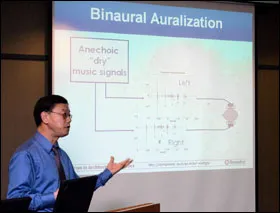
Acoustic Measurement Technique for Collaborative Research with EMPAC
Ning Xiang, Graduate Program in Architectural Acoustics, School of Architecture & ECSE

Binaural auralization and virtual auditory reality have been growing in part due to recent advances in computer modeling of acoustics for performing-arts spaces. A newly developed acoustic measurement technique using simultaneous multiple sound sources can help contribute to further growth. After a brief review of the state-of-art in binaural technology, from auralization to virtual auditory reality, this talk will describe possible applications of the new acoustics measurement technique to a wide variety of EMPAC projects. It is anticipated that EMPAC can provide optimal environments for research and development of the acoustic measurement technique, which in turn will make contributions to future EMPAC projects.

INTERFACE I

Suvranu De + Richard Radke

Suvranu De, Asst. Professor, Mechanical, Aerospace & Nuclear Engineering

Presenting: IN THE LAND OF THE FEELIES

From the learning of fine motor skills to the expression of intimate artistic emotions, touch plays an inextricable role in our everyday life. Current advances in science and technology are making it possible, for the first time, to reach out and interact with computer-generated environments, shake hands across continents and create phantasms where the sensory modalities intermingle and coalesce creating the illusion of "touching the sound" or "seeing the music"!

In this talk I will introduce the rapidly growing field of "haptics" and how it is finding an increasing role in design, modeling and other techno-artistic applications. The future, of course, can only be more exciting! It is anticipated that EMPAC will provide the perfect forum for these and other applications.

Richard Radke, Asst. Professor, Electrical, Computer and Systems Engineering

Presenting: LARGE-SCALE COMPUTER VISION, VISUALIZATION, AND GRAPHICS: OPPORTUNITIES FOR EMPAC

Speculating on ways in which researchers in computer vision, visualization, and graphics can benefit from the EMPAC environment and contribute to EMPAC projects.

Image
A captivated audience seated on the floor looking up at an unseen performance.

Fair Game: The Art of Video Game Engines

DEMOS - LIVE PERFORMANCE - SHOW AND TELL - + MORE

Fair Game features artists who use video game engines to create work that spans the landscape of cinema, video gaming, hacker art, immersive installation and software development. Unlike the usual panel discussion format - the night will include demos, show and tell presentations, film screenings, and of course, game playing. Watch the video games being played on MASSIVE screens, and then see how artists manipulate the software engines to create their own work entirely by using the tools of these virtual worlds.

THE PERFORMANCE

Kurt Hentschläger — will present his new audio-visual instrument and give a short live demonstration, with reference to his performance FEED, which premiered this September at the Theater Biennial in Venice. Friedrich Kirschner — will present ways in which the Unreal Tournament 2004 game engine has been modified to use it as a tool for animated movie productions, realtime audio-visual performances and other art related projects. Kirschner will give a brief overview of the tools generated through modifications made within the game's scripting environment as well as present some of the results of this work. Paul Marino (Executive Director, Academy of Machinima Arts ) — With the expanding accessibility and proliferation of computer game/virtual world technologies, an increasing amount of users have been using these interactive platforms as the basis for creative expression. Thus a young medium, known as Machinima, is breeding a new generation of digital filmmakers - creators who are crafting narratives that merge legacy cinema with newer production methods. The lecture will look at several examples of Machinima, showing its steady growth and how it is democratizing animated filmmaking. The ILL Clan — will be doing a live interactive machinima performance of their new show, Trash Talk with ILL Will. For a preview of the show, visit http://trashtalk.illclan.com or http://www.illclan.com/movies.htm for previous shorts by the ILL Clan. Workspace Unlimited — The Workspace Unlimited collective will present the Virtual World of Art project, a series of networked virtual worlds connected to physical public spaces. The collective will demonstrate a live walkthrough of its projects, comment the concepts and art works relating to game technology, social networks and hybrid space. The Fair Game event modules will be preceded by expert gamers from Rensselaer's Games Research Lab playing the games that the presenting artists are using to make their work (Unreal Tournament and Quake 3) on oversized screens for the audience.

Photo: Shannon K. Johnson/EMPAC.

William Kennedy + Richard Selzer

EMPAC plus H&SS

Noted authors discuss Capital Region arts and the influence of the arts of the region on their writing.

William Kennedy and Richard Selzer, noted authors and natives of Troy and Albany, whose fiction often speaks of the life of the creative imagination as it interacts with and confronts the arts and culture of our area, will discuss why and how these forces have shaped and emerged in their writings.