Image
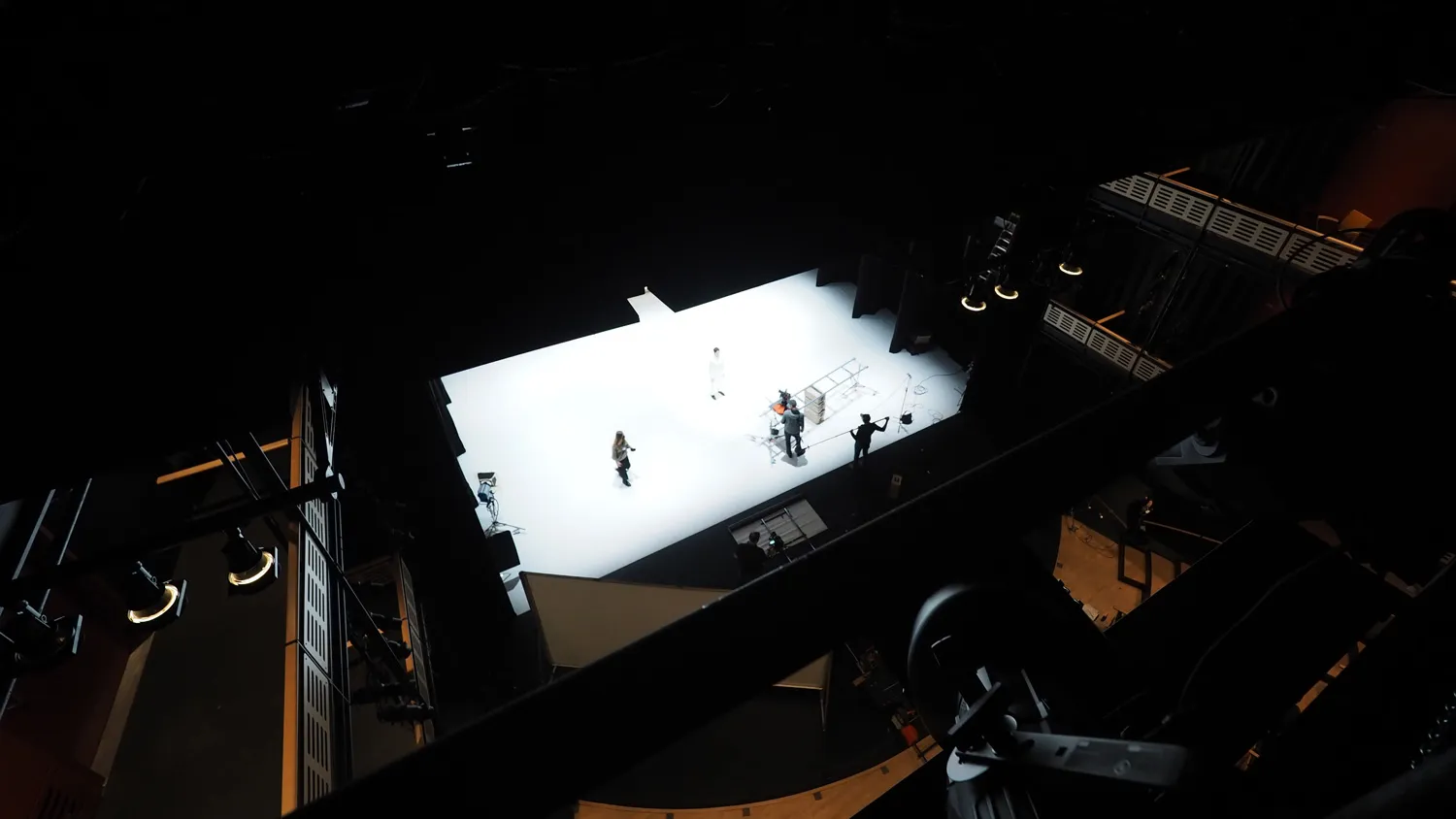
The wave field synthesis rig suspended from the ceiling of a black box studio.

Exploring Wave Field Synthesis in Dance

Yanira Castro and Stephan Moore

Choreographer Yanira Castro is in residence at EMPAC with sound collaborator Stephan Moore to explore possible uses of the Wave Field Synthesis (WFS) Array in participatory dance work.

Volunteer Day—Friday, December 6th at 2:30PM

EMPAC welcomes volunteers to assist the artists in the exploration of Wave Field Synthesis. Volunteers will be welcomed into the WFS Array to hear whispers and movement instructions that they can follow. As the bodies move through the space the sounds might follow them, or begin to sound different as others leave and enter the space.

At the end of participants’ time exploring the sounds, we will have a conversation with the artists about what people heard, perceived, and felt throughout their experience to consider the efficacy of using Wave Field Synthesis in live performance with audience members sharing a stage with performers.

How to Participate

If you are interested in participating, please meet in the EMPAC lobby at 2:30pm on Friday, December 6th. 

Main Image: An early version of the Wave Field Synthesis array in Studio 1 in 2017. Photo: EMPAC / Eileen Baumgartner.

Image
A man standing on a black stage pointing up as another person lays on the floor tipped over in their chair. A green rectangle is projected on to the floor.

less than no time

Taldans

Filmed in residence in 2019, contemporary dance duo Taldans worked in Studio 1—Goodman on sound, rhythm and motion in their new production examining the dynamics of the music technique and theory Serialism.

The duo, who prepared their choreography by using mathematical scores, sets and loops, directed their questions to their source of inspiration; Serialism: where can series created by Serialism’s use of features such as tone, rhythm, timbre lead images of the body and movement? How would Serialism’s approach, having previously been reflected in music, literature, architecture and art, affect a choreographic structure? How is the system of structures built and how can creativity enter this process? How to move from one discipline to another using series and sets? Can these series be used when transitioning from dance to video, from music to dance?

In this new project, Taldans explored the mathematics of nature and emotions through series and sets and aims to reflect this exploration on the stage.

Main Image: Taldans in residence in Studio 1, October 2019. Photo: EMPAC / Sara Griffith.

No food No money No jewels

Eve Sussman & Simon Lee

Eve Sussman, an award-winning film director and visual artist and Simon Lee, a film director and installation artist, along with their full creative team, engaged in research and development for this EMPAC commission. During a three-week film production residency, the team installed a large structural set, prepared all the props, costumes, lighting setup, as well as camera testing, leading up to a week-long filming period that transformed EMPAC’s Theater stage into a full-scale soundstage.

Eve Sussman creates work that incorporates film, video, installation, sculpture, and photography. In 2003 she began working in collaboration with The Rufus Corporation—an international ad hoc ensemble of performers, artists, and musicians—producing motion picture and video art pieces including 89 Seconds at Alcázar (2004) and The Rape of the Sabine Women (2007). With humble materials and straightforward means—found snapshots, plastic toys, pinhole cameras, and projectors—Simon Lee creates evocative, dream-like videos, projections, and photographs.

No food No money No jewels is a cinematic event in three episodes loosely inspired by the Andrei Tarkovsky film Stalker and the A.A. Milne book The House at Pooh Corner that conflates the “Zone” and the “100 Acre Wood” and the themes of escaping daily life to get ‘lost in the woods’ or ‘go to the zone’ that pervades both stories.

No food No money No jewels creates parallel characters that are sometimes human, sometimes anthropomorphic. The plot suggested by both the film and the book details a journey and an adventure. Episode 1 – At the FifthStroke introduces the protagonists as some of them attempt to escape their daily lives. Episode 2 – The Zone/The Hundred Acre Wood takes the characters in and out and around in circles on a journey that finally lands them in Episode 3 – Barroom Radio or “the room” (the goal of the protagonists in Stalker) that turns out to be the radio station, first heard as an audio broadcast during Episode 1 – At the FifthStroke.

Like the film and the book the characters strikeout on adventure only to end up where they started, back in the bar in time for “tea”. Each episode will have its own distinct set built for the EMPAC theatre space – the creation of Episode 1 is detailed below as the first part of our proposed three stage residency, the sets for Episodes 2 & 3 are to be developed.

Media
Image
 A room with walls, ceiling, and floor covered in child drawings of various people and doodles.

Chalkroom

Laurie Anderson

Laurie Anderson with artistic and technical collaborators Jason Stern, Amy Koshbin, Jim Cass, and Bob Currie, were in residence recreating the virtual reality work Chalkroom into a human-scale video installation for the Hirshhorn Museum, Washington, DC.

Main Image: A rendering inside the VR experience of Chalkroom. Rendering courtesy Laurie Anderson. 

Vecino Vecino

Camila Galaz / Australia Council for the Arts

The 2019 Australian Arts Council artist in residence, Camila Galaz will be at EMPAC to continue the post-production on her installation Vecino Vecino (Neighbour Neighbour). The video work is based on a 1986 French TV documentary about the MAPU-Lautaro, a Chilean student resistance group who fought against the Pinochet dictatorship, that included the the artist’s father.

Using archival footage, re-performance and (mis)interpretations of this footage, and documentary footage of my own, Vecino Vecino stitches together multiple historical moments and viewpoints to highlight the gap between generations caused by political violence. By reading historical movements, sounds, gestures, and speech as languages that can be transposed and translated into present day, Vecino Vecino both draws awareness to, and actively participates in what Judith Butler calls “the tasks that follow political violence.”

International residencies organized by Australia Council for the Arts provide a unique opportunity for Australian artists to immerse themselves in a new international arts context, community and culture. The experience enables artists to articulate their practice within a global context and build knowledge, networks and partnerships that support future international arts activity.

Image
A dancer suspended 40 feet up among the theater fly tower line sets in a black box theater.

Void

A.K. Burns

A.K. Burns will be in residence to film collaborator Savannah Knoop among the line-sets and technical infrastructure in the Theater’s fly tower. This will be the final production in a series of residencies, which has included a shoot with performer Shannon Funchess in the catwalks above the Concert Hall and experiments with light, haze, sound, rigging, and video.

The scenes produced at EMPAC over the past two years will be incorporated into a long-form, multichannel image work for exhibition, which is premiering at the Julia Stoschek Collection in Dusseldorf in Fall 2019.

Main Image: A.K. Burns was in residence in May, 2019 to film collaborator Savannah Knoop among the line-sets and technical infrastructure in the Theater’s fly tower. A.K. Burns, Production Still, 2019. Courtesy the artist. Photo: Mick Bello/EMPAC.

Image
a hand holds a mold

Cuando las nubes eran las olas (When the clouds were waves)

Ana Navas and Mirtru Escalona-Mijares

Spring 2023

Artist Ana Navas and composer Mirtru Escalona-Mijares are back in residence in the concert hall with percussionists Taylor Long, Robert Cosgrove, and Clara Warnaar to rehearse for the premiere of Cuando las nubes eran las olas (When the clouds were the waves).

--

Cuando las nubes eran las olas is a forthcoming artwork by Venezuelan-Ecuadorian artist Ana Navas (b. 1984, Quito) and Venezuelan composer Mirtru Escalona-Mijares (b. 1972, San Felix). The two artists are in residence in EMPAC's Concert Hall with percussionists Taylor Long, Robert Cosgrove, and Clara Warnaar to workshop Escalona-Mijares' electro-acoustic score composed for Navas' recently fabricated sculpture-instruments. 

Cuando las nubes eran las olas is an expansive work inspired by the Aula Magna, the Central University of Venezuela’s main auditorium. The building was designed by architect Carlos Raúl Villanueva in 1953 and lies at the heart of his University City campus in Caracas. The Aula Magna houses Alexander Calder’s sculptural Acoustic Ceiling, completed in 1953 and known locally as “Nubes” (clouds) or “Platillos voladores” (flying saucers). The work was commissioned by Villanueva to be suspended above the audience in order to correct the acoustics of the hall. Although designed in consultation with pioneering American acoustic engineering firm Bolt Beranek & Newman, the ceiling was fabricated in Caracas by local artists, artisans, and technicians. Some of those involved in its fabrication included skilled boat builders who migrated from Portugal to Venezuela, attracted to the country’s oil-fueled mid-twentieth century construction boom, while the current economic collapse of the country has produced a marked reversal of migration. 

Deeply embedded in the afterlives of iconic modernist artworks, Navas’ sculptures, installations, and performances often trace the use and misuse of such works over time as they are circulated as reproductions and appropriated, away from the site and context of their original making. For Cuando las nubes eran las olas, Navas’ research focuses attention on the production history of the Aula Magna and its Acoustic Ceiling, interweaving analysis of its material and architectural properties with its social and sonic history in an exploration of the psychoacoustic potential of sculpture. 

Courtesy of the artist.

Media

When the Clouds Were Waves: Ana Navas in conversation with Vic Brooks. December 2020

Mouth Room

James Richards

Berlin-based artist James Richards is in residence to develop his EMPAC-commissioned work for the Theater. 

James Richards’ artworks reveal connections between people, practices, and private, hidden, or suppressed histories through archival and online research. Working with a vast array of media materials, often generated during long-term exchanges with other artists, such as American media artist Steve Reinke and filmmaker Leslie Thornton, Richards produces sound and video installations that invite the audience into an intimate encounter with private worlds and queer communities. 

Image
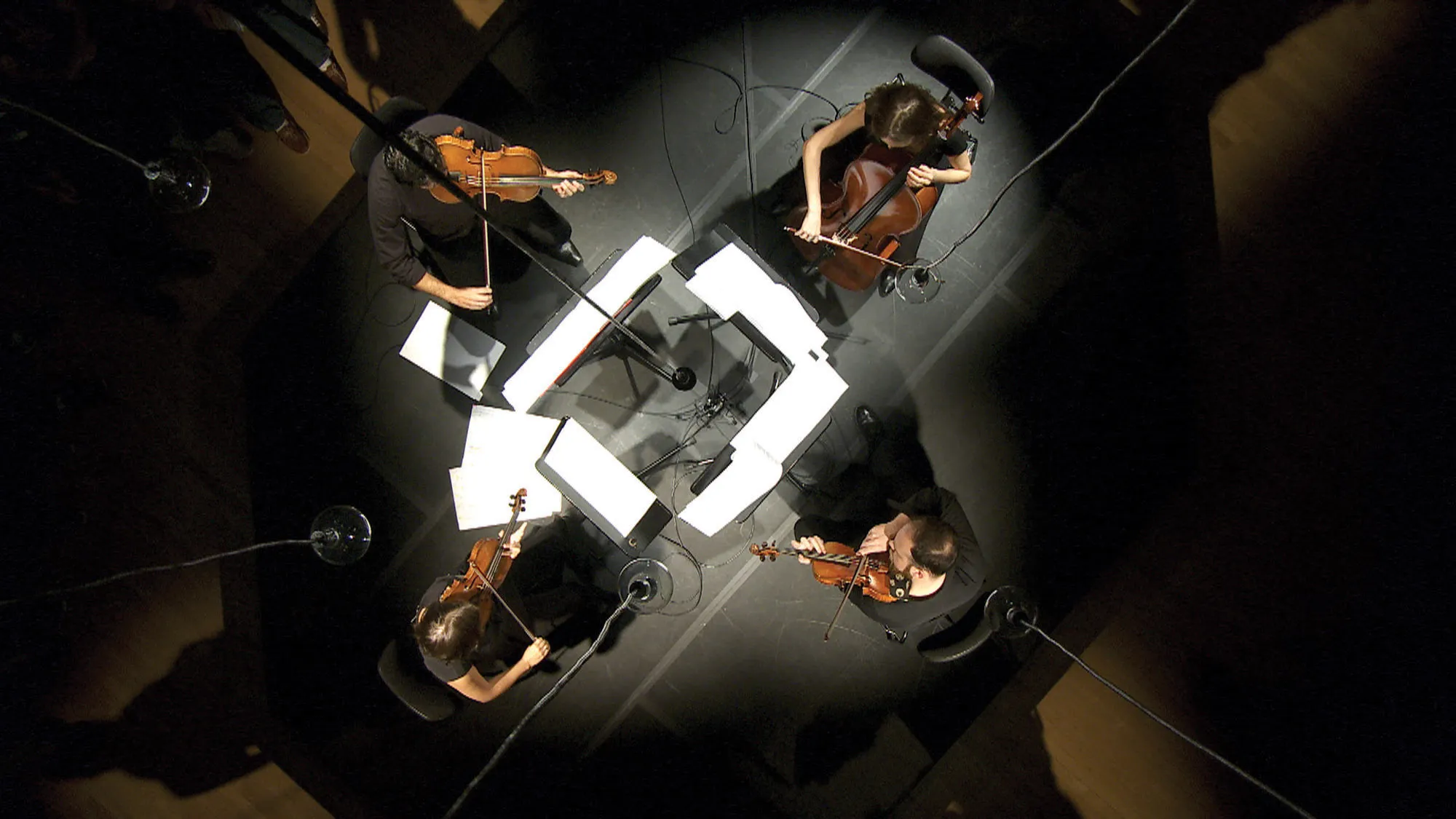
 The Jack Quartet in rehearsal on the concert hall stage.

Sonare and Celare

Cenk Ergün and JACK Quartet

Turkish composer Cenk Ergün will be in residence with the JACK Quartet (Christopher Otto, Austin Wulliman, John Pickford Richards, Jay Campbell) to record a pair of string quartets—Sonare and Celare—for future release on the label New Focus Recordings.

Main Image: Production still from Jack Quartet's recording residency in the Concert Hall in May, 2019. Photo: Mick Bello/EMPAC.

Image
A performer in a squatting position on a black platform wearing a mask of sensors in front of two large screens projecting red and blue abstract scenes. Two people look on, one directing the scene with arm outstretched toward the screens.

Carrion

Justin Shoulder

Multidisciplinary artist Justin Shoulder will be in residence with support from the Australia Council for the Arts. Working with animation/virtual reality collaborators Sam and Andy Rolfes, the project Carrion aims to develop green-screen video content that the artist will manipulate live with a body sensor system.

International residencies organized by Australia Council for the Arts provide a unique opportunity for Australian artists to immerse themselves in a new international arts context, community and culture. The experience enables artists to articulate their practice within a global context and build knowledge, networks and partnerships that support future international arts activity.

Main Image: Justin Shoulder in Studio 1 as part of his residency with support from the Australian Council for the Arts. May 2019. Photo: Mick Bello/EMPAC.