Index

Jennifer and Kevin McCoy

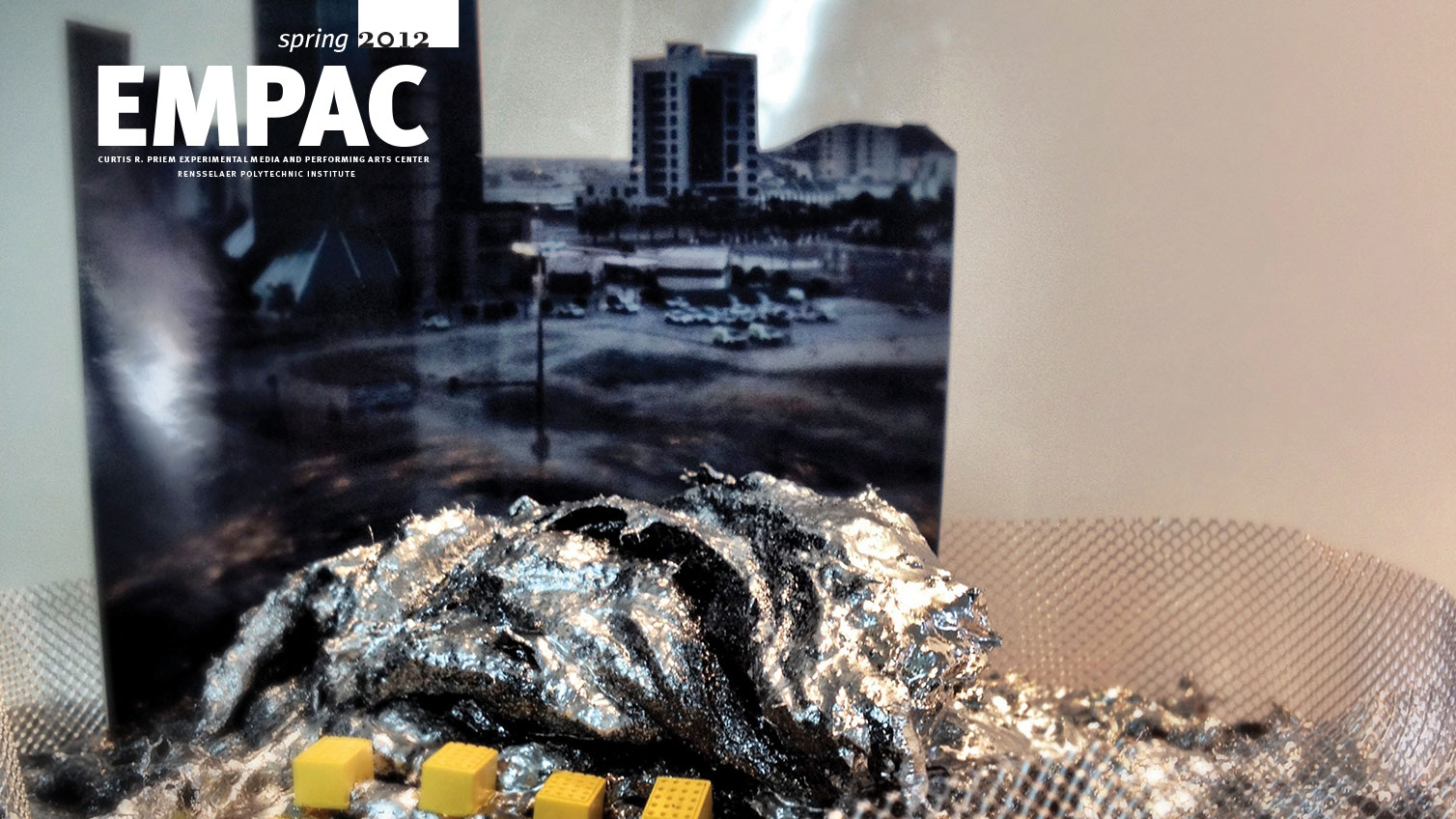
Index was an EMPAC-commissioned public art installation by Rensselaer arts alumni Jennifer and Kevin McCoy, consisting of multiple sculptures filmed via small cameras. The resulting live video projections, as well as the models, were presented throughout EMPAC’s public spaces during an extended residency with the artists. Inspired by a J.G. Ballard short story that consists primarily of an alphabetized index of people and places suggesting a global conspiracy, the McCoys’ list spans the 1960s to today, referencing globalization, technology, mass migrations, and war. Corporate campuses, film sets, Spanish Colonial Revival architecture, and factories all collide in a globalized, mediated framework that exists to support utopian goals, even as it rests upon resource depletion, financial instabilities, and entropic decay. Jennifer and Kevin McCoy’s multi-media artworks examine the genres and conventions of filmmaking, memory, and language. They are known for constructing subjective data-bases of existing material and making fragmentary miniature film sets with lights, video cameras, and moving sculptural elements to create live cinematic events.

Quote Unquote was an interdisciplinary series presenting work by artists that use an existing text as a departure point for time-based works including installation, film, and performance.
A Shakespeare Accelerator: Experiments in Kinetic Language

Ben Rubin

In this residency and exhibition, artist Ben Rubin transformed EMPAC’s interior into a laboratory of words and motion: projecting glowing white text from Shakespeare’s complete dramatic works onto walls, walkways, and other surfaces. Designed as a permanent site-specific installation for the building’s lobby, the artist sought to “create a kind of supercollider for Shakespeare’s texts, where the particles to be accelerated and smashed together are scenes, lines, and phrases. Which words, when hurled toward each other, will cause a reaction? Which collisions will most likely provide traces of the incandescent energy, wit, and emotion that existed at the moment of these plays’ creation?”

Ben Rubin is a New York City-based media artist who has worked with composer Steve Reich, architects Diller Scofidio & Renfro and Renzo Piano, performers Laurie Anderson and Arto Lindsay, theorists Bruno Latour and Paul Virilio, and artists Ann Hamilton and Beryl Korot. He frequently collaborates with UCLA statistician Mark Hansen.

Quote Unquote was an interdisciplinary series presenting work by artists that use an existing text as a departure point for time-based works including installation, film, and performance.

nonextraneous sounds

Mariel Roberts

American cellist Mariel Roberts was in residence for the recording, mixing, and mastering of her first solo album, nonextraneous sounds. Roberts took over the Concert Hall with an assortment of microphones and a KVM station (keyboard, video, mouse) that allowed her the autonomy to operate on her own schedule. Afterward, the material was assembled and mixed in EMPAC’s audio production room. nonextraneous sounds features music by Andy Akiho, Sean Friar, Daniel Wohl, Alex Mincek, and Tristan Perich.

Roberts has performed at the Kennedy Center, the Guggenheim Museum, Zankel Hall, MoMA, The Stone, Issue Project Room, and Roulette, and has performed internationally as a member of the Mivos String Quartet, as well as with a variety of other ensembles in venues around the world.

Image
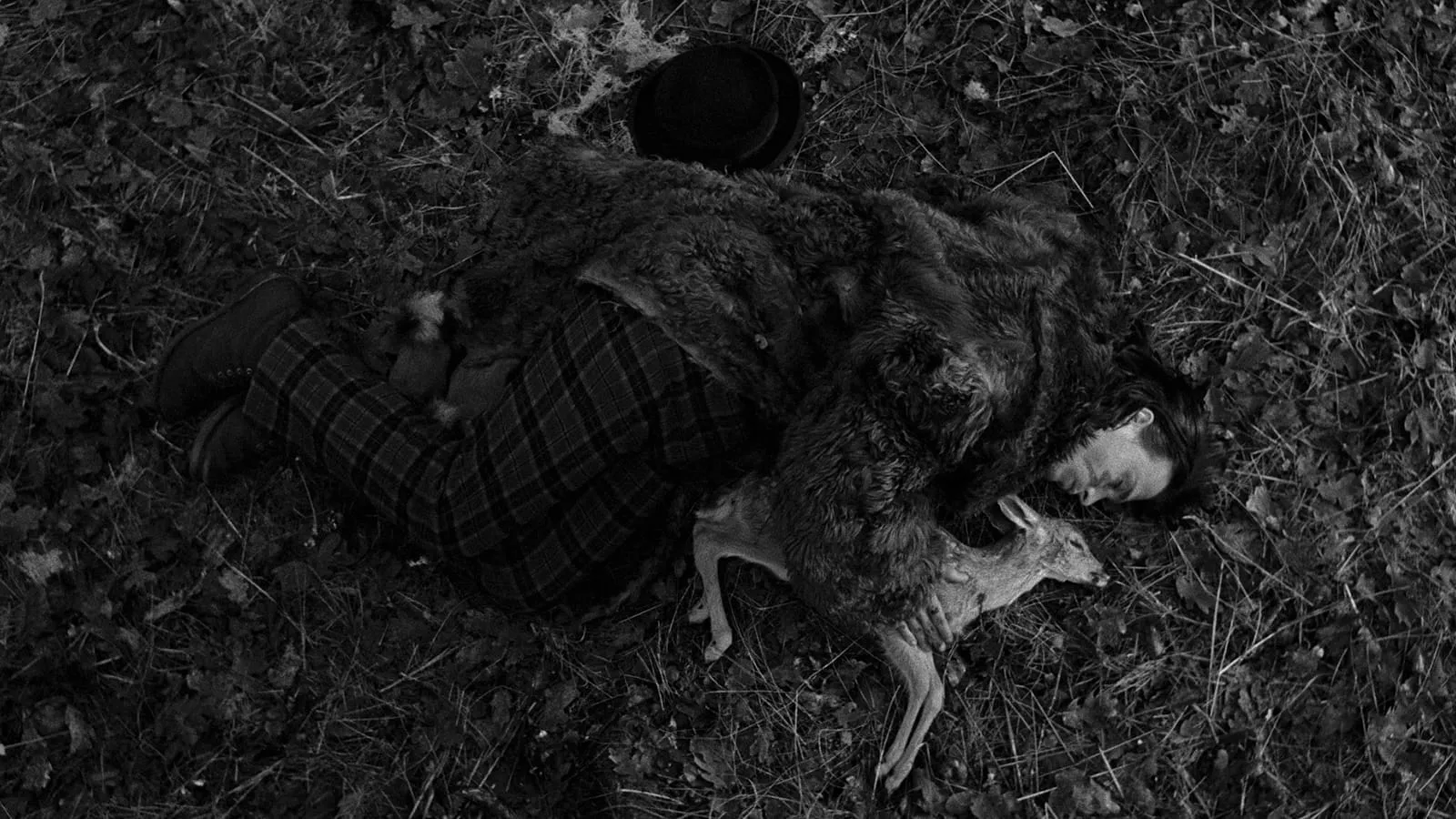
A man wearing a fur coat and tartan pants laying on the ground next to a deceased fawn in a cuddling position.

The Eternal Return

This collection of films begins with the idea that time is a lie. Reveling in déjà vu and non-linear timelines, the series is inspired by such varied sources as Nietzsche’s notion of the eternal recurrence and the multiverse hypothesis in physics. Each of the films in the series is structured by a central narrative loop and a thematic focus on the incommensurability of the momentary and the eternal.

Actual Reality

Lucky Dragons

An audiovisual performance developed in residency by Lucky Dragons, Actual Reality is an ongoing collaboration between Los Angeles-based artists Sarah Rara and Luke Fischbeck. Connecting a Google alert archive of the phrase “actual reality” to the acoustic sounds of musicians and audience, it created a type of call and response using re-synthesized sounds to answer each query. Along with the “real” performance, collected source material—video and audio from previous performances, rehearsals, and incidental audio—was processed and layered on top in real-time, creating an endless loop of what is, and has been. This version of Actual Reality was staged for bassoon, three flutes, percussion, moiré table, and electronics.

Fischbeck and Rara have presented interactive performances and installations at MOCA Los Angeles, Smithsonian’s Hirshhorn Museum and Sculpture Garden, the Whitney Museum of American Art (as part of the 2008 Whitney Biennial), the Kitchen, the Walker Art Center, REDCAT, ICA London, ICA Philadelphia, and the Centre Pompidou in Paris.

CORE

Kurt Hentschläger

This installation has been described by the artist as an “orchestral aquarium” with images of floating, weightless bodies accompanied by ethereal sound. It is a reflection on the contemporary human body in an era of technological enhancement and desire for immortality. In this generative installation, figures or clones (they are all identical) interact sometimes instinctually, like a school of fish or a flock of birds, and other times like intricately choreographed modern ballet or synchronized swimmers. By their fluidity, speed, and endurance, they appear as super humans, exhibiting both the sensation and sensuality of dynamic bodies in extreme motion but locked inside a virtual holding tank something like an aquarium. The movement of the bodies is infinitely variable and never repeats.

Chicago-based Austrian artist Kurt Hentschläger creates audiovisual performances and installations. Between 1992 and 2003 he worked collaboratively as one half of Granular Synthesis, whose performances and installations confronted viewers on both a physical and emotional level, overwhelming them with sensory stimulation.

Flat

Rodrigo Pardo

Tethered: This vertical performance program featured two residencies and work-in-progress performances that navigated vertical space through aerial performance.

Flat is a dance-theater work based on a Borges short story and designed to be performed outdoors on the side of an apartment building, four stories up. Flat combines storytelling, video projection, and aerial performance. The performance at EMPAC simulated this site-specific version, with the audience lying on the floor looking up at an apartment in an aerial view, like an architect’s sketch, with some real objects, some drawn, and others projected. A man wakes up in his apartment feeling strange, not knowing he is upside down. The audience hears his inner monologue via headphones as he discovers his new reality: he must either learn how to live anew or change the world back to a familiar state. Flat immerses both the performer and the audience in an intimate situation, shifting our perspective on what constitutes reality.

Pardo’s work combines dance, video, and mixed media into site-specific projects in urban spaces. Originally from Argentina, Pardo is currently based in Brussels.

Flota

Barbara Foulkes

Tethered: This vertical performance program featured two residencies and work-in-progress performances that navigated vertical space through aerial performance.

Flota is a study in falling and floating: a dance performance that takes place on freestanding walls built to form a corner, with live video projections of the suspended dancer on other surfaces. The audience chooses where to position themselves and where to look. Flota existed as a solo performance; at EMPAC, Foulkes experimented with site-adaptive iterations of the set-up, as well as shooting footage for an installation version.

Foulkes is a choreographer and contemporary dance artist who performs and teaches vertical dance with harness. She is part of Colectivo AM and teaches composition and vertical dance with harness at Casa de Artes y Circo Contemporáneo. Foulkes is originally from Argentina and now lives in Mexico City.

The Periphery of Perception

Ryan and Trevor Oakes

Ryan and Trevor Oakes engage in probing studies of visual perception and light, discovering methods that advance the representation of visual reality. The Periphery of Perception was an exhibition looking at the development of the Oakes’ work over the past 10 years, and featured a commissioned drawing of EMPAC’s Concert Hall. Created in residence over the course of a month, the drawing used a method they invented: a binocular tracing technique that does not rely on optical devices. Their method has been described by Columbia University’s perceptual historian Jonathan Crary as one of the most original breakthroughs in the rendering of visual space since the Renaissance. The EMPAC drawing also marked the first time that the Oakes brothers expanded the scale of their canvas to encompass the entirety of the human visual field. The exhibition was complemented by a panel discussion on optics, the nature of light, and the rendering of visual reality with writer Damien James, photographer Michael Benson, and the artists.

Work by Ryan and Trevor Oakes is held in the permanent collections of the Field Museum and the Spertus Museum in Chicago, and the New York Public Library. Their public art projects include a large-scale outdoor sculpture that debuted in Chicago’s Millennium Park in the summer of 2009, and is now installed at O’Hare International Airport.