ἄσφαλτος — Metabolizing Time

Allie Wist

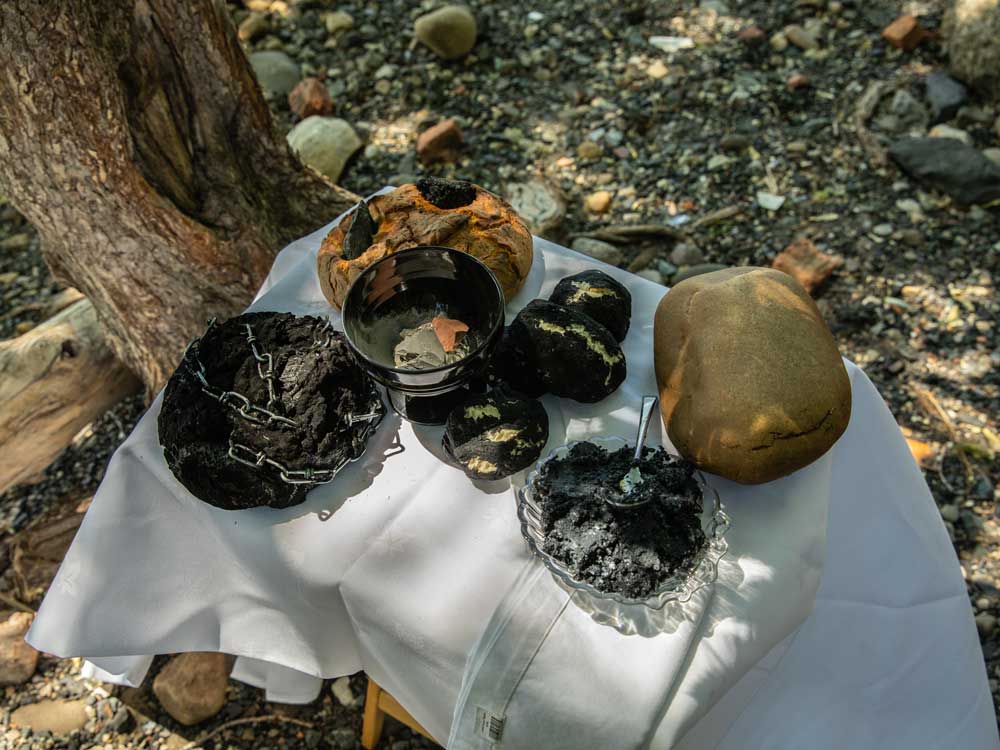
On view will be a 360-degree panoramic film and a participatory sensorium installation. The piece explores anthropocene geology and the mutual metabolism that occurs between landscapes and bodies. The artist considers toxins and materials that humans input into the earth for digestion across deep time, and how we ask our own bodies to process geologic materials (often for potential detoxification). The work situates asphalt as a kind of speculative future geology and suggests forms of intimacy with industrial detritus. The word asphalt (asphaltos, ἄσφαλτος) comes from the greek sphállō— “to fall, cast down." The installation acts as an open-ended communal feast, where guests are invited to consume edible clay and geologically-inspired foods.

small table outside set with bread, rocks, and asphalt

Image: Courtesy the artist.

Image
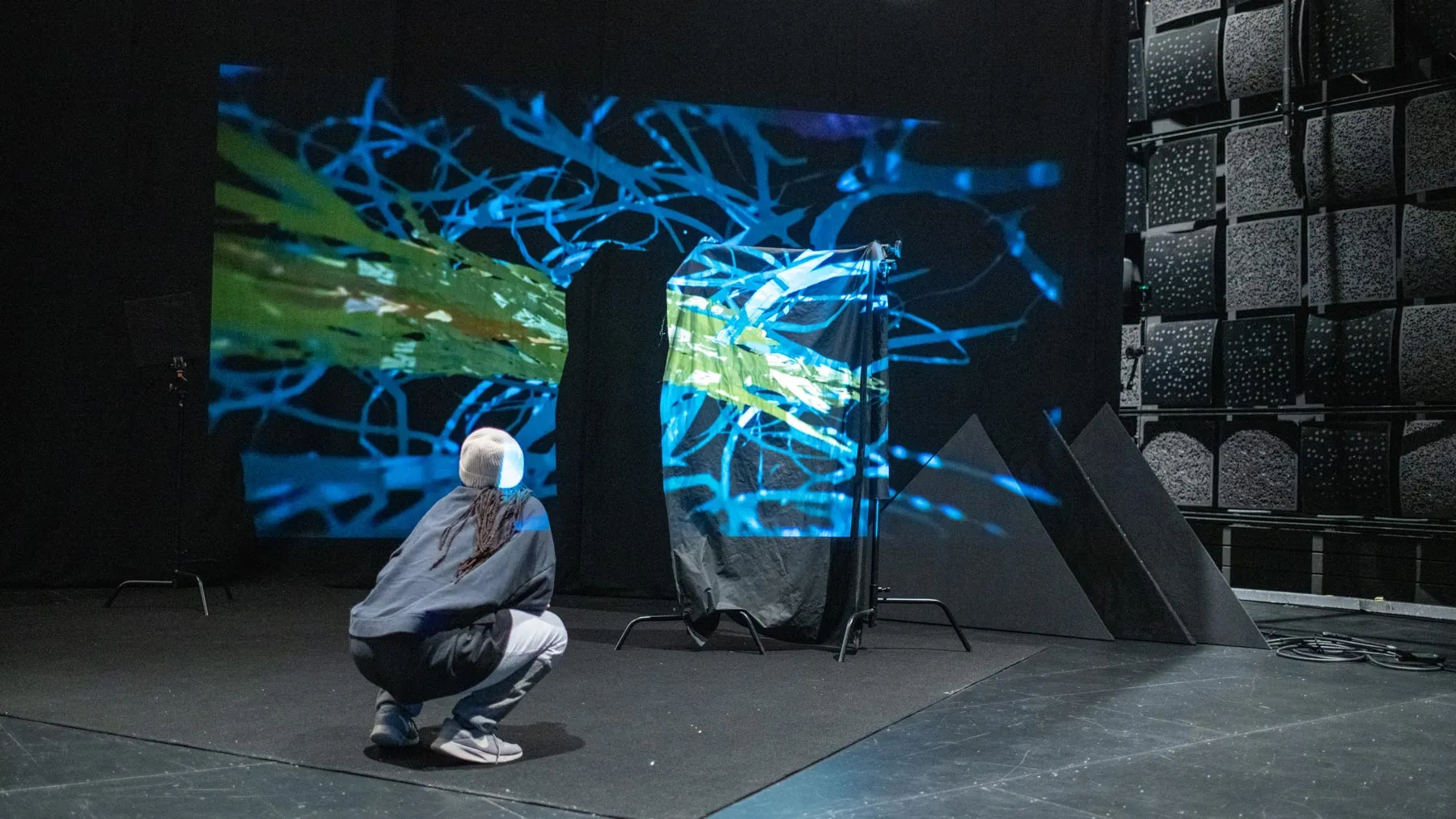
sage whitson looking on toward a projection in studio 1

Transtraterrestrial

A prequel and premiere of The Unarrival Experiments—Unconcealment Ceremonies

Transtraterrestrial, a prequel and premiere of The Unarrival Experiments – Unconcealment Ceremonies is a new live performance work by artist Sage Ni’Ja Whitson designed to amplify the dark. In dialogue with Yorùbá Cosmology, Astrophysics, and research on the “blackest black,” the work centers the mysteries of dark matter and dark energy through a Black, Queer, and Transembodied lens. Dark matter and dark energy serve as portals to interrogating spaces of the unknown, yet have an unequivocated impact on the composition of the universe. The performance and its environment takes an audience through an otherworldly dive into the dark. Led by space conductor, Trans Trappist the Extraterrestrial, this work traverses the dark as an ancestor, embodied transgender technology, and cosmic intervention.

Transtraterrestrial happens inside and outside of a custom-built space|ship, which is uniquely designed as a futuristic space vessel covered in painted organic matter. Whitson worked with architect Valery Augustin to realize the first prototype of this space|ship during an EMPAC residency in 2022. For the space|ship environment of the 2023 prequel and premiere, Whitson worked in collaboration with DNA Architecture + Design, Inc. and Gordon Clement. Its design and fabrication aids in visualizing darkness while also allowing for the seamless integration of immersive VR, projection, and spatial audio. The space|ship cradles performers and witnesses in encounter, collectivity, medicines, and invisibilities.

Main Image:  Sage Ni’Ja Whitson. Photo: Michael Valiquette/EMPAC

Work-in-Progress

Jude Abu Zaineh

Rensselaer iEAR graduate student and interdisciplinary artist Jude Abu Zaineh is in residence at EMPAC to design and install a moving-image installation that asks:

What kind of planetary space would a microbiome occupy?

What does digestive memory feel like?

What would our ancestral foods that we digest tell us from beyond?

How do we experience interspecies relationships between human-microorganisms? 

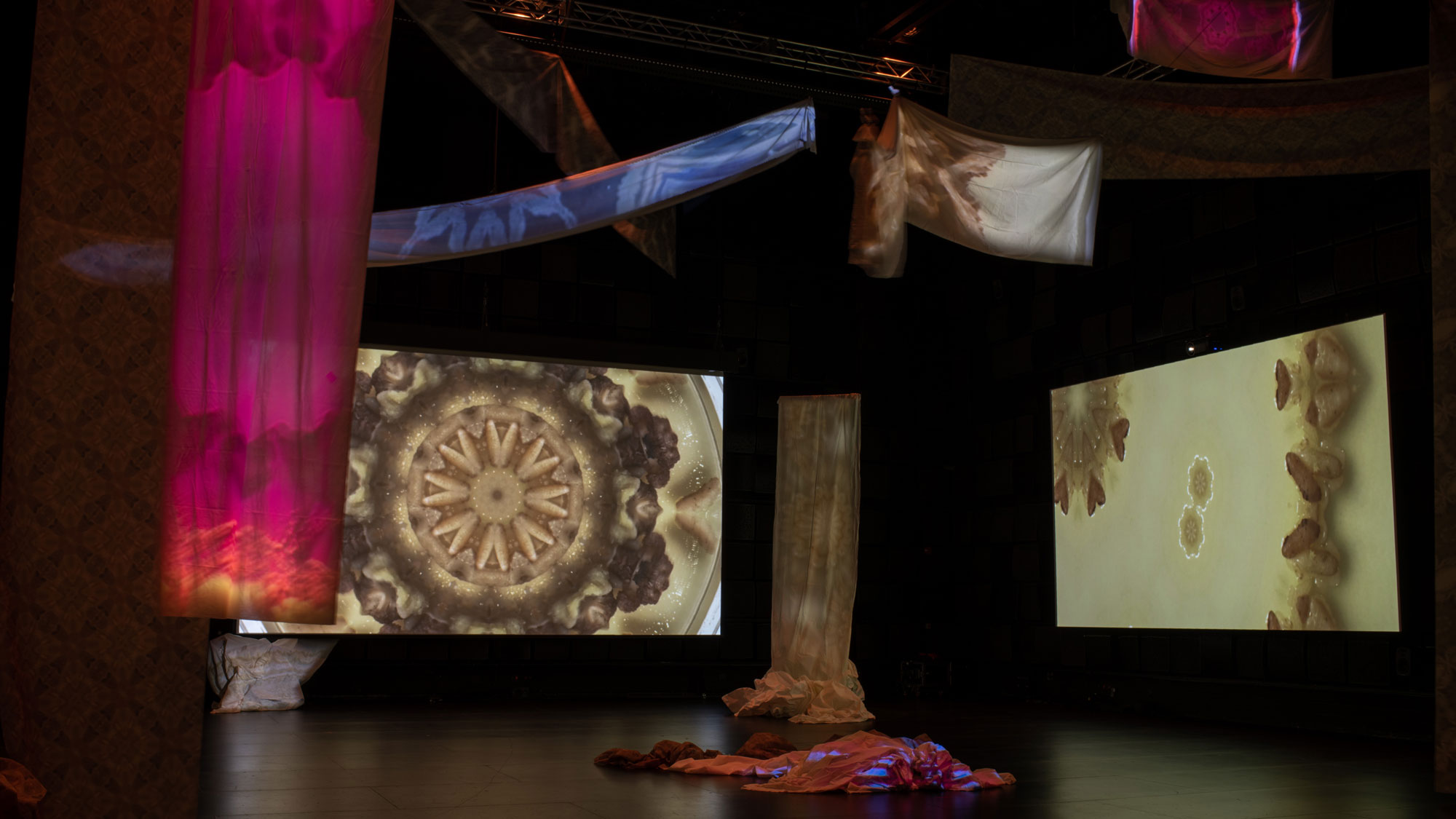
The installation consists of moving-image artworks and large-scale textiles that originate from Abu Zaineh’s site-specific installation at the Ontario Science Centre in collaboration with MOCA Toronto (2018–19). In this original installation Abu Zaineh derived pattern and images from a traditional Palestinian meal, maqlouba, which the artist documented growing, decaying, and changing in petri dishes; an aesthetic metaphor for the pace and experience of inter-generational cultural inheritance.

a room with tyedye colorful fabric hanging and geometric / biologic patterns projected on the fabric

Main Image: Jude Abu Zaineh, Work-in-Progress installation shot, 2022. Photo: Michael Valiquette

Image
Berthe Grimault

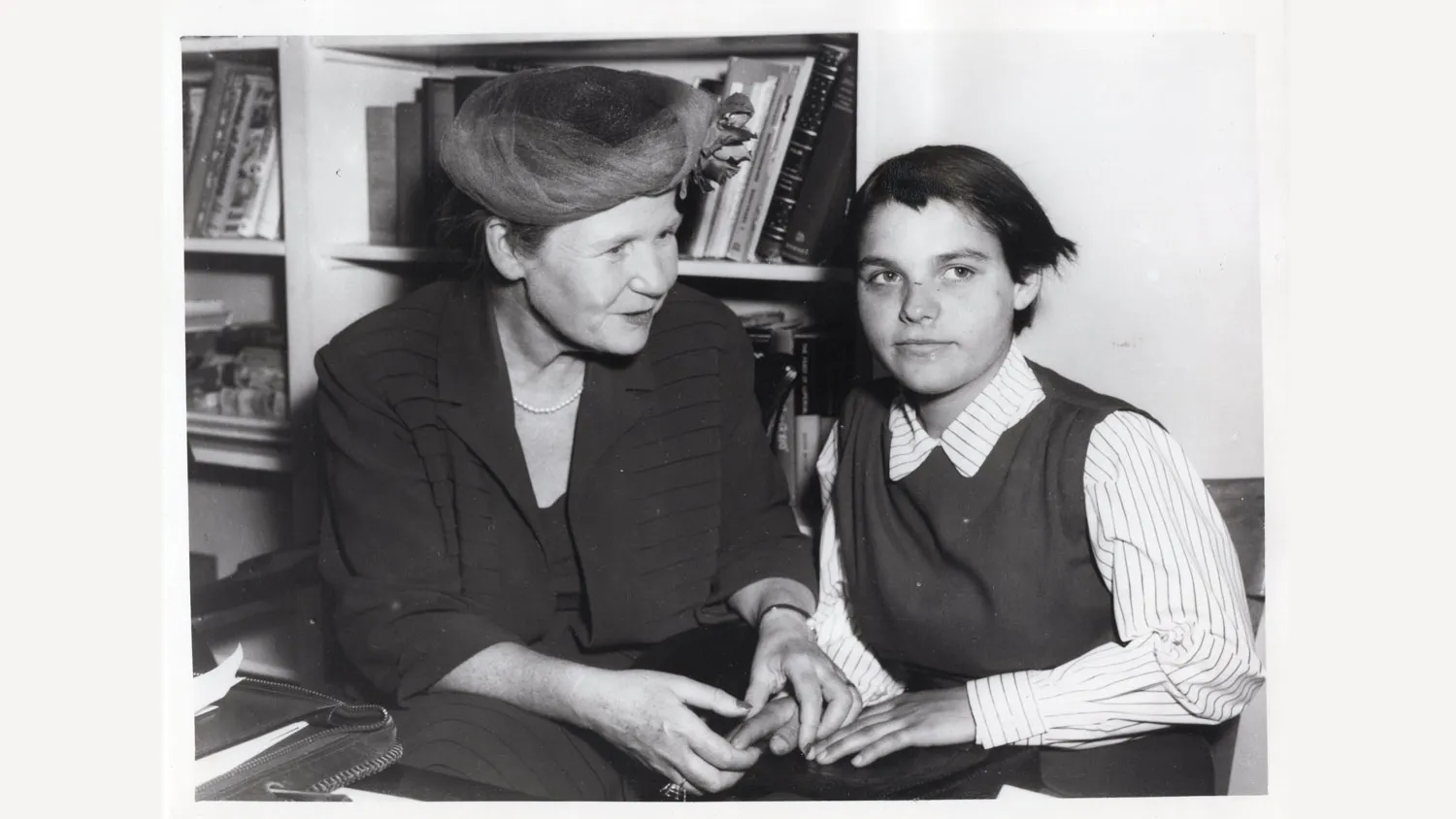
Berthe: "Pig girl among the debs"

Carolyn Tennant

Please join us today — Friday April 2, 2021 at 3:30PM EST — Live on ZOOM for a live screening and Q&A to follow.

ZOOM Information:

On a computer: Join Zoom Meeting

Meeting ID: 859 9003 0639
Passcode: 411921

On a phone:

+16465588656,,85990030639#,,,,*411921# USA
+496938079883,,85990030639#,,,,*411921# Germany

Find your local number: https://us02web.zoom.us/u/kbvo5MQPr9

For more information about this event please visit https://www.facebook.com/events.

Every year, the Rensselaer Department of the Arts programs seven events utilizing the infrastructure and support of the production teams at EMPAC. These productions often include final graduate thesis projects that are developed in the venues themselves.

Main Image: Berthe Grimault. Courtesy the artist / Berthe Grimalt Archive.

Image
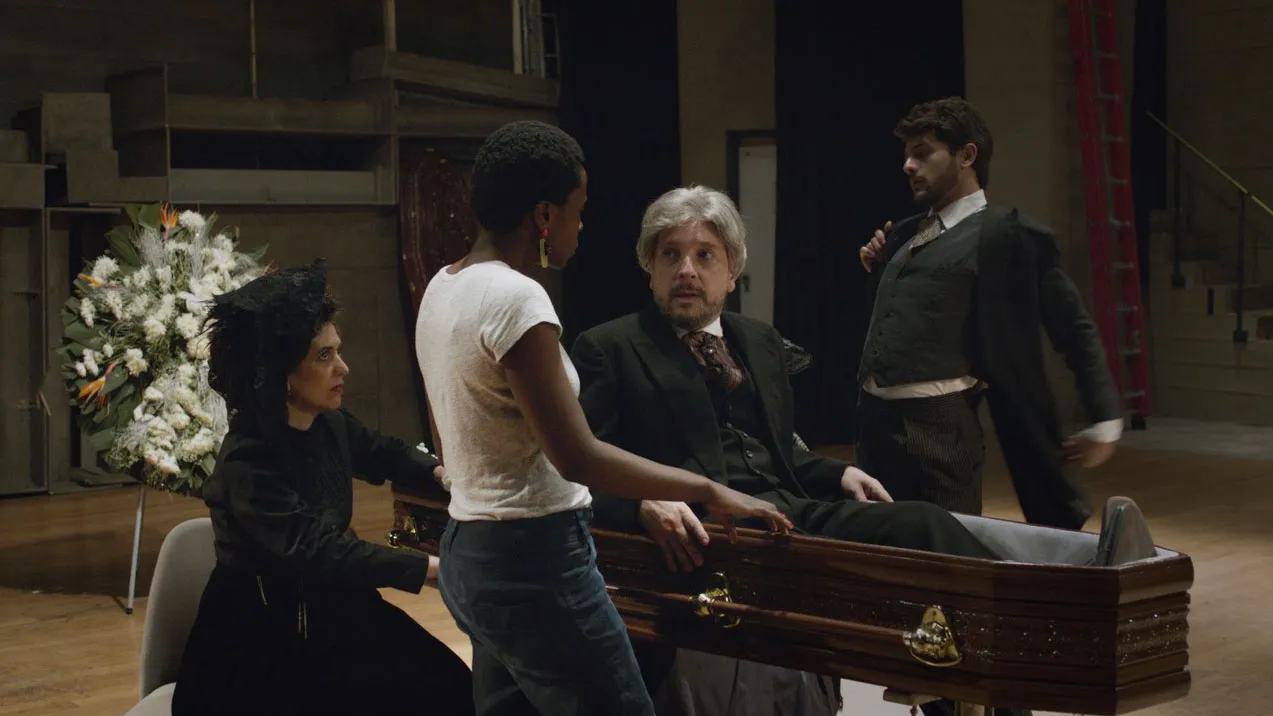
Two people in Victorian era mourning clothing and one woman in modern clothing gathered around a coffin. A man with white hair is sitting up in the coffin talking to the people around him.

Jump the Line

Eric Baudelaire, Gerard Byrne, Stan Douglas, Tamar Guimarães, Onyeka Igwe, Ruchir Joshi, and Trinh T. Minh-ha

To “jump the line” in filmmaking means to break a basic rule of cinematic realism—moving the camera across an imaginary 180° line that normally allows viewers to maintain their natural sense of left and right within the film. This week-long film series celebrates jumping the line by presenting moving image works whose directors deliberately break the rules to reveal the unquestioned structural and stylistic conventions of image and sound production.

Jump the Line is a reflexive take on the multiple timescales and varied technical and dramaturgical strategies that make up films, recordings, performances, and broadcasts. By focusing on how, why, and for whom such things are made, Jump the Line represents what EMPAC stands for as an institution: the daily work of producing new artworks behind studio doors, invisible to the public until completion.

Spanning the week of film events, Gerard Byrne’s installation In Our Time is open to the public in Studio 1 where the film’s temporal reality is synched to the actual hours of each day. A radio host goes about the repetitive activities of a daily live broadcast, reinforcing Byrne’s questions around synchronicity, (in)visibility, and the dramaturgy of production.

In much the same way, Stan Douglas’s legendary jazz epic Luanda-Kinshasa (2013) is presented for the first time ever as a single six-hour theatrical screening. Luanda-Kinshasa depicts a fictional 1970s jazz-funk band engaged in a seemingly endless real-time jam turning EMPAC’s Concert Hall into the recording studio.

Two further screening programs are presented using the double-and triple-bill format: The first framed by Trinh T. Minh-ha’s Shoot for the Contents that renders “the real in the illusory and the illusory in the real” in a journey through Chinese storytelling, and the second anchored by Eric Baudelaire’s newly released documentary, Un film dramatique, that charts the artist’s four-year collaboration with a group of Parisian middle-school artists, who learn to use the camera in ways unique to their burgeoning points of view.

Main Image: Tamar Guimarães, O Ensaio (2019), Courtesy the artist and Arsenal-Institut Für Film Und Videokunst E.V.
Image
Gerard Byrne speaks into a 70's era radio microphone while wearing white vintage style headphones.

In Our Time

Gerard Byrne

Irish artist Gerard Byrne’s video installation In Our Time unfolds, in real time, the inner workings of a recording studio during the golden era of analog radio. 

On first look, the video has the familiar register of a period piece set in a meticulously recreated control-booth of a radio station of its day. However, the linear timeline of the broadcast—with its repetitions of commercial breaks, the lilt and timbre of the radio host’s voice, the classic pop, and the weather segments—slowly disengages and falls apart. Soon, the songs played are not those that have been announced, the station’s name sounds different, the news events skip from decade to decade, and all the while the band simply continues to tune-up. In this radio booth, where the repetition of broadcast rhythms dictates the consecutive daily events, the image and soundtracks appear to remain resolutely synchronous. But the gradual disconnection between what is seen and what is heard produces a surreal uncertainty around the fixity of time within the temporal monotony of the radio station.

In Our Time brings into focus not only the time of broadcast—its rhythms, in-jokes, and pop riffs—but reinforces the temporal reality in which we all exist, on the sublevel of our daily routine to the looping of political and historical cycles. The record might change, but our cultural and technological concept of time remains constant. 

Main Image: Gerard Byrne, In Our Time (2017). Courtesy the artist and Lisson Gallery.

Media

Gerard Byrne, In Our Time (2017).

Image
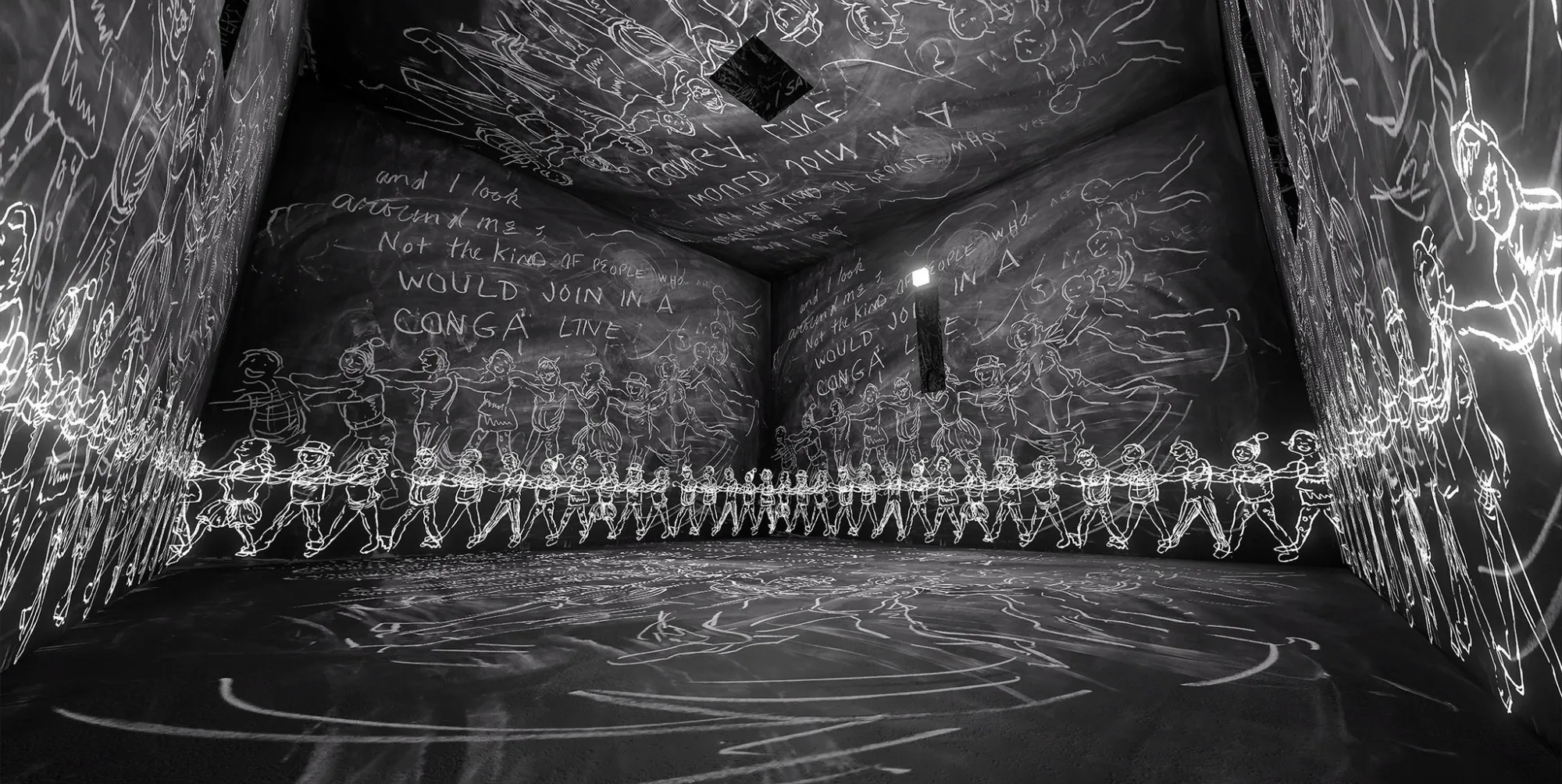
 A room with walls, ceiling, and floor covered in child drawings of various people and doodles.

Chalkroom

Laurie Anderson

Laurie Anderson with artistic and technical collaborators Jason Stern, Amy Koshbin, Jim Cass, and Bob Currie, were in residence recreating the virtual reality work Chalkroom into a human-scale video installation for the Hirshhorn Museum, Washington, DC.

Main Image: A rendering inside the VR experience of Chalkroom. Rendering courtesy Laurie Anderson. 

Mouth Room

James Richards

Berlin-based artist James Richards is in residence to develop his EMPAC-commissioned work for the Theater. 

James Richards’ artworks reveal connections between people, practices, and private, hidden, or suppressed histories through archival and online research. Working with a vast array of media materials, often generated during long-term exchanges with other artists, such as American media artist Steve Reinke and filmmaker Leslie Thornton, Richards produces sound and video installations that invite the audience into an intimate encounter with private worlds and queer communities.