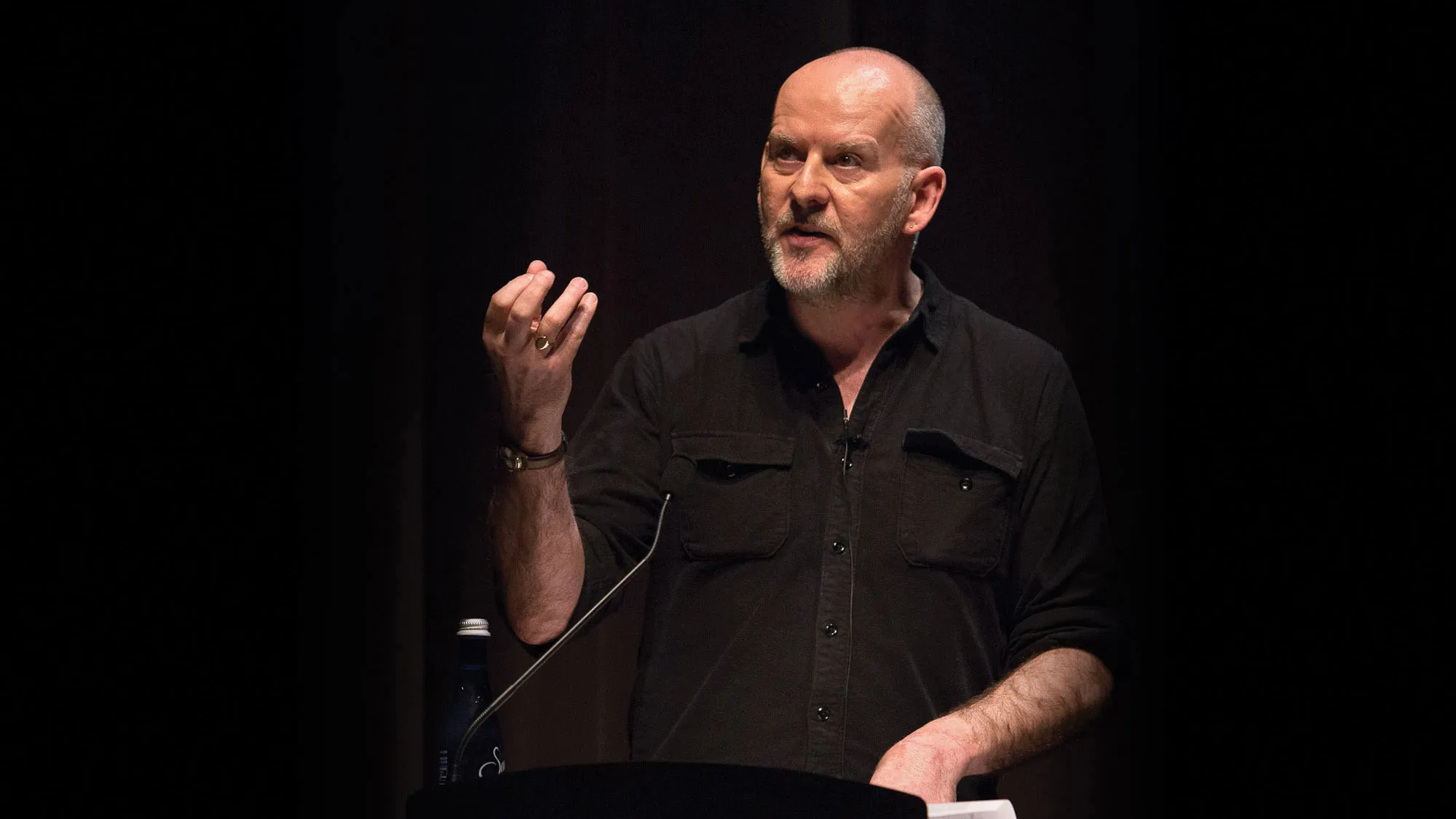
Dr. Gavin Schmidt

What are climate models good for?

“If we had observations of the future, we obviously would trust them more than models, but unfortunately observations of the future are not available at this time.” (Knutson and Tuleya, 2005)

Climate change is ongoing, and trying to explain what is happening now, and what might happen in the future are key tasks that require large-scale complex climate models of the atmosphere, ocean, land surface and cryosphere. But how well do such models perform? Can they predict climate changes in the face of the chaotic dynamics of weather? How have they performed so far? I will discuss how the credibility of model results can be established and what are the current limitations. This involves assessing short term climate variability, the response of the climate system to external factors (such as variability of the sun or large volcanic eruptions), paleo-climate information and how model-data discrepancies get resolved. I will (hopefully) demonstrate that while climate models are by no means perfect, they can be very useful.

Bio

Gavin Schmidt is a climate modeller and deputy chief at the NASA Goddard Institute for Space Studies in New York and is interested in modeling past, present and future climate. He received a BA (Hons) in Mathematics from Oxford University, a PhD in Applied Mathematics from University College London and was a NOAA Postdoctoral Fellow in Climate and Global Change Research. He has worked on education and outreach with the American Museum of Natural History and the New York Academy of Sciences. He has over 100 peer-reviewed publications and is the co-author with Josh Wolfe of “Climate Change: Picturing the Science” (W. W. Norton, 2009), a collaboration between climate scientists and photographers. He was awarded the inaugural AGU Climate Communications Prize in 2011.
Marina Zurkow

The Haunting: Challenging Our Environmental Relations

Abstract

Everything is broken. We have become lethargic, complacent, consumptive, elegiac: completely disenchanted. Through multi-disciplinary visual art work, Zurkow seeks to explore enchantment and haunting as a way of challenging and changing our environmental relations. Citing influences such as science studies philosopher Bruno Latour, ecocrotic Timothy Morton, and social scientist Jane Bennett, for her RPI presentation Zurkow will frame several recent art projects that explore human entanglement with non-human/animal agents. In order to question common perceptions of friends and enemies, and the environmental polemics that still centralize the human/nature split, Zurkow explores topics such as invasive species, hydrocarbons, and thelivestock/predator conflict on Western United States public lands. Zurkow’s works include Heraldic Crests for Invasive Species, The PetroleumManga, Gila 2.0: Warding Off the Wolf, the Mesocosm series of 144-hour long animated ecosystems, and associated performative and participatory food events that bring research and mediated materials more intimately to one’s senses.

Bio

Crossing multiple disciplines with her practice, Marina Zurkow builds animations and participatory environments that are centered on humans and their relationship to animals, plants and the weather. Engaging audiences using film and video, sculpture, print graphics and public interventions, Zurkow’s work is by turns humorous and contemplative. Through the experience of her projects it is clear that nature has long been a stage upon which we project ourselves, making ourselves other.

In 2011 a solo exhibition of Zurkow’s work was featured at the Montclair Art Museum. Past exhibitions of her work have also been featured at FACT, Liverpool; San Francisco Museum of Modern Art; Walker Art Center, Minneapolis; Smithsonian American Art Museum, Washington D.C.; Museum of Fine Arts, Houston; Wave Hill, New York; National Museum for Women in the Arts, Washington D.C.; Bennington College, Vermont; Borusan Collection, Istanbul; Pacific Northwest College of Art, Oregon; Marian Spore, New York; 01SJ Biennial, San Jose; Brooklyn Academy of Music; Museum of the Moving Image, New York; Creative Time, New York; The Kitchen, New York; Ars Electronica, Linz, Austria; Transmediale, Berlin; Eyebeam, New York; Sundance Film Festival, Utah; Rotterdam Film Festival, The Netherlands; and the Seoul Media City Biennial, Korea, among others. She is represented by bitforms gallery in New York.

Marina Zurkow is the recipient of a 2011 John Simon Guggenheim Memorial Fellowship. She has also been granted awards from the New York Foundation for the Arts, New York State Council for the Arts, the Rockefeller Foundation, and Creative Capital. She is on faculty at ITP at Tisch School of the Arts, NYU.

Andrea Polli

Ecomedia: Environmental Science and Technology and Interaction in Public Art

Abstract

In the 21st century, there has been a resurgence of ecologically conscious art using new media technologies. Like Eco-art, this recent Ecomedia movement is interdisciplinary and global. Ecomedia is heavily influenced by developments in science, particularly remote imaging and other Earth sensing (for example, the widespread use of GPS data) and developments in computer modeling (for example, detailed models that not only model the physics of the Earth and solar system, but also explore the Earth’s chemistry and biology). This presentation will include a series of public art work case studies, both permanent and temporary, that could be considered ecomedia.

While Ralph Waldo Emerson in the 1840’s saw wilderness as ‘essences unchanged by man: space, the air, the river, the leaf’ and as perpetually regenerative, in the 21st century many scholars like Bill Mckibbon have expressed concern that we are facing ‘the end of nature’. Clearly this speaks to an urgent need to re-examine the connection between humanity and our wild spaces. The ecomedia case studies gathered for this presentation require deep reflection, a historical foundation and critical analysis. What have been the historical precedents for this kind of work? How have these prior initiatives succeeded or failed and what can we learn from this history? What can we learn from the case studies of collaborations and other models internationally? How can we move forward to a more sustainable context for art and science collaborations in the field nationally and internationally?

Updates on Disaster Research

Moderated by Michael Mascarenhas

Panelists include Deborah McGuinness, Jose Holguin-Veras, David Mendonca, and Kim Fortun.

Earth Week Festival Poster Session

A poster session showcasing sustainability-oriented research at Rensselaer will be an important part of the festival. Posters should address a diverse, interdisciplinary audience. Posters should include short bios describing authors’ broader research programs, and a description of the field/s in which the authors work. Posters should also include a description of the problem that the research responds to, the methods and data used to advance understanding of the problem, key questions and/or findings, and both the research and societal significance of the research.

Pauline Oliveros

Listening In and Out

Pauline Oliveros began her exploration of listening as a child fascinated by sounds of nature, music and daily life. She noticed early on that others seemed to ignore the sounds that she loved. As a composer Oliveros began to address the direction of attention with Sonic Meditations (1970) – compositions written in prose. Sonic Meditations was a radical departure from conventionally notated music. Oliveros considers “ear training” to be a misnomer for what should be “brain training”. These compositions are directions for ways of listening (hearing plus attention) and ways of responding (vocalizing aloud or mentally).

Listening is not the same as hearing and is not as well understood as hearing. Hearing is physical and can be measured. Listening is more mysterious and as yet can only be measured subjectively.

So what does it mean to listen. Further what is Deep Listening? Deep Listening practice was created by Oliveros to experience and share what is heard in order to gain understanding of our primary sense.

Listening In can be understood ambiguously as over hearing sounds or listening inwardly. Listening Out could be directing attention to what is understood as sounds external to the self.
In any case listening requires attention and choice whereas hearing happens involuntarily.

Image
Greg Moynahan

Greg Moynahan

Experience and Experiment in Early Modern Europe

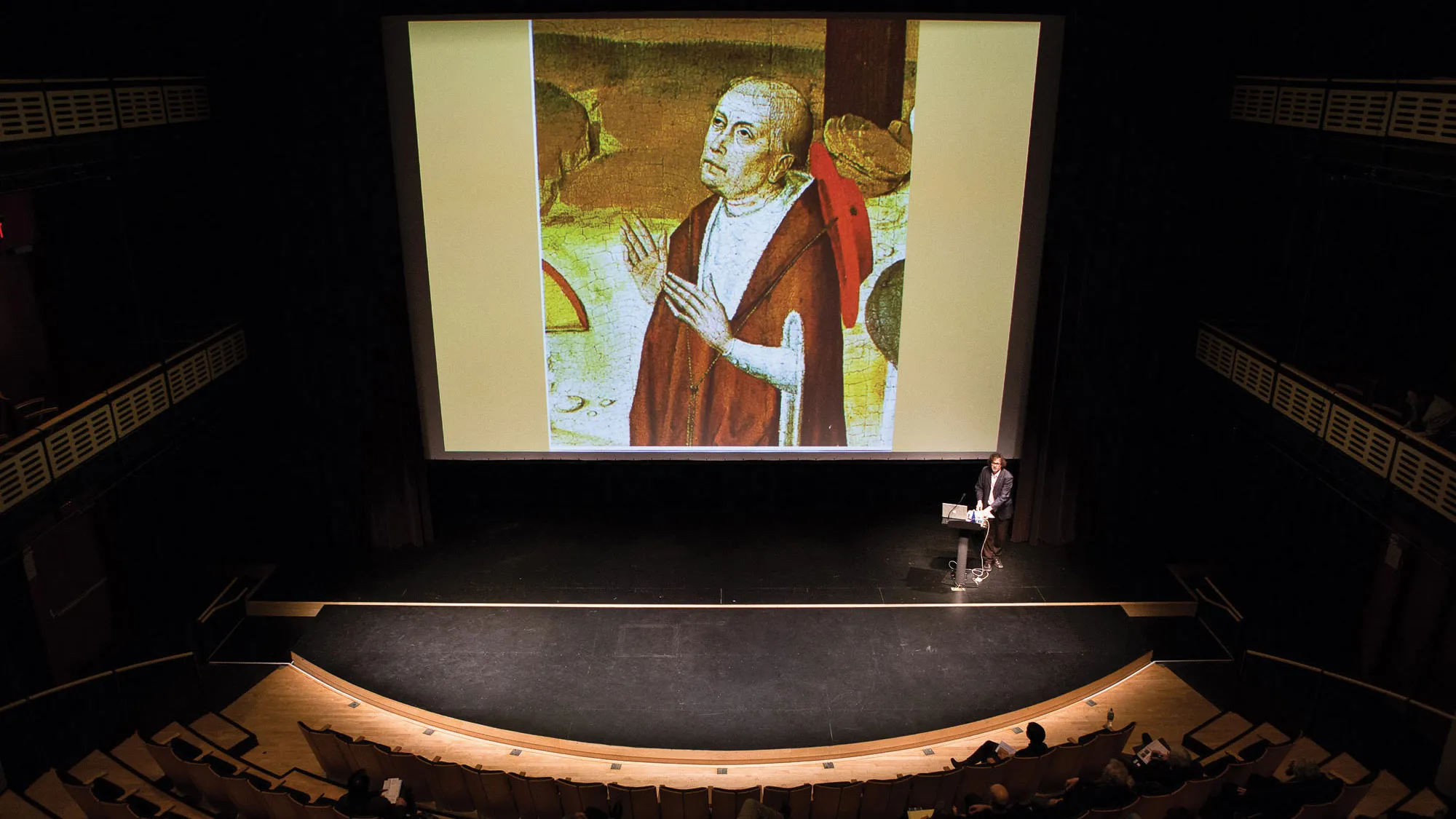
Greg Moynahan addressed the rise of scientific experimentation and its relation to experimentation in the arts. He considered the early history of both through their common location in collections and museums, suggesting that the appearance of the problem of infinity in natural philosophy was important for the modern relationship between scientific and artistic experimentation. The talk focused on thinkers such as Nicholas of Cusa and Gottfried Leibniz. 

Moynahan has taught in the history and science, technology, and society (STS) programs at Bard College since 2001. He specializes in modern European intellectual and cultural history and the history of technology, and his research interests include the history of theoretical biology, systems theory, and “scientific” racism and political history of computing and cybernetics in the two Germanys. His book, Force and Form: Ernst Cassirer and the Critical Science of Germany, 1902-1919, was published by Anthem Press (London) in 2013.

Observer Effects offered a dialogue between the fields of art and science. The title was derived from the principle in physics that the act of observation transforms the observed, an idea   psychology, and politics.

Main Image: Greg Moynahan on the theater stage in 2013. Photo: EMPAC/Rensselaer.

Image
laurie anderson

Designing + Customizing Instruments for Performance and Recording

Laurie Anderson

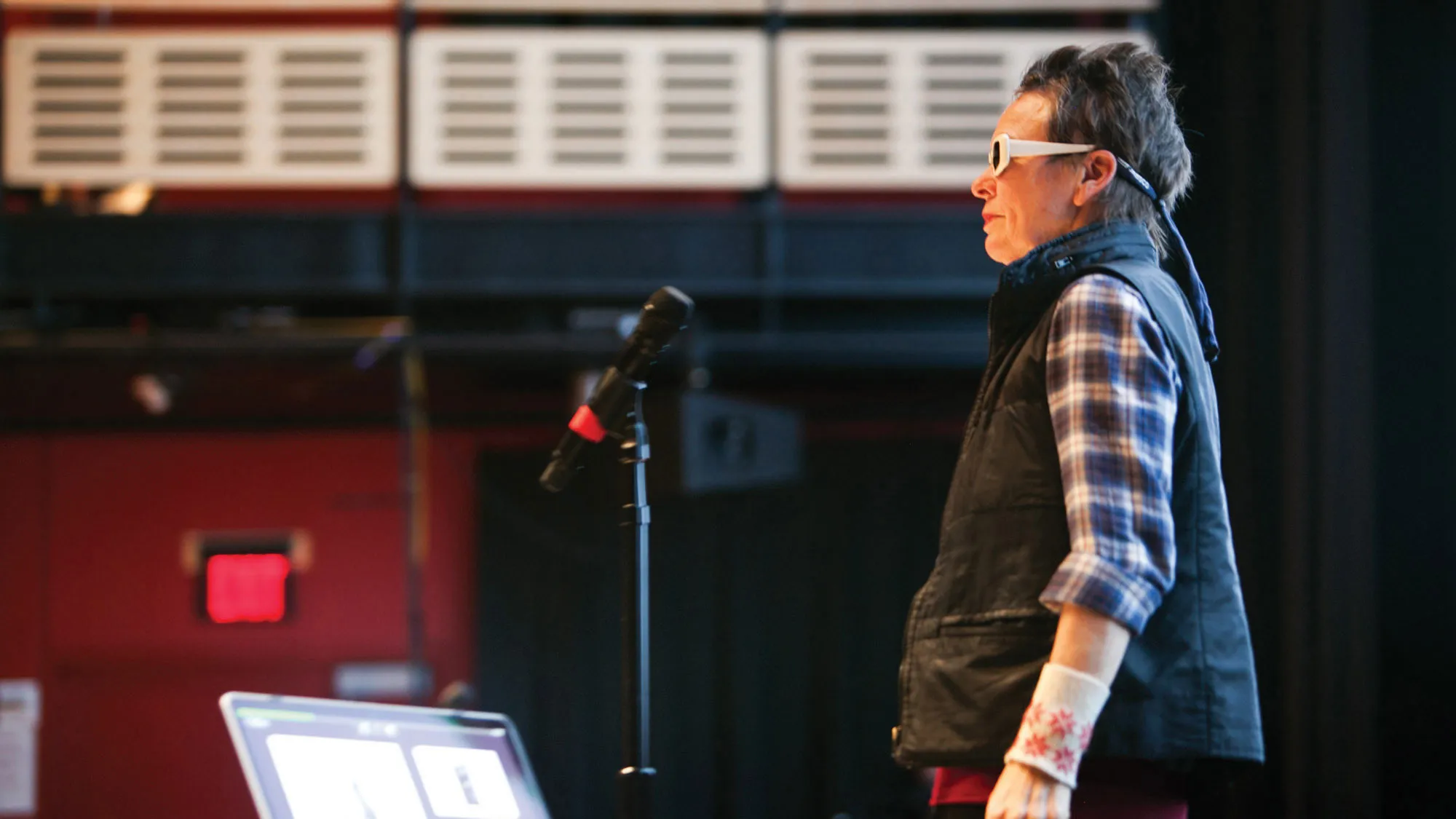
Laurie Anderson discussed the ever-evolving development of new instruments and interfaces for her productions and performances, and her “new rig,” which finally allows her to travel with her custom configuration of instruments in a suitcase. She was joined by her software and hardware collaborators: Konrad Kaczmarek, Liubo Borissov, and Shane Koss. She also discussed her new work with the Kronos Quartet, Landfall, one of the projects she was working on in residence at EMPAC.

Throughout her genre-crossing career, Anderson has invented several technological devices for use in her recordings and performance art shows, including voice filters, a tape-bow violin, and a talking stick. In 2002, she was appointed NASA’s first artist-in-residence, and she was also part of the team that created the opening ceremony for the 2004 Olympic Games in Athens. She has published six books, produced numerous videos, films, radio pieces, and original scores for dance and film. In 2007, she received the prestigious Dorothy and Lillian Gish Prize for her outstanding contribution to the arts. 

Laurie Anderson, EMPAC’s inaugural distinguished artist-in-residence, presented a series of events focusing on topics unique to her practice as an artist. 

Main Image: Distinguished artist-in-residence Laurie Anderson during her talk in 2013. Photo: Kris Qua/EMPAC.

Image
Simon Critchley

Simon Critchley

Philosophy and the Art of Dying

Simon Critchley, author of The Book of Dead Philosophers, recounted anecdotes of philosophers’ deaths since antiquity that range from the noble to the ridiculous. Through the lens of their last moments, Critchley reflected on the relationship between a philosopher’s work and his death, in the process questioning the adage “to philosophize is to die well” and meditating on the role that philosophy plays in living a good life in a society like ours—one that spends so much time and space denying the reality of death. 

Critchley is the Hans Jonas Professor of Philosophy at the New School for Social Research, where he has taught since 2004. He is the author of more than a dozen books; The Book of Dead Philosophers (Vintage, 2009) was on the New York Times extended bestseller list and has been translated into 15 languages. Critchley is a series moderator of and regular contributor to “The Stone,” an online philosophy column for the New York Times. He also writes for The Guardian. 

Observer Effects offered a dialogue between the fields of art and science. The title was derived from the principle in physics that the act of observation transforms the observed, an idea that has been influential in philosophy, aesthetics, psychology, and politics.

Main Image: Simon Critchley in the theater in 2013. Photo: Mick Bello/EMPAC.

Media
Image
a beam of light coming out of an observatory overlooking the RPI campus at night.

Detail View

Campus Perspectives

Detail View provides an opportunity for Rensselaer professors and researchers to share in-depth perspectives on their fields of inquiry. Inviting an exchange of ideas on campus and providing a window into a singular vision, these events are geared toward experts and non-experts alike.

Main Image: The Hirsch Observatory projects a beam of light into space as part of The Color Out of Space, Rosa Barba’s collaboration with Rensselaer astrophysics professor Heidi Newberg. Photo: Kris Qua / EMPAC.