Image
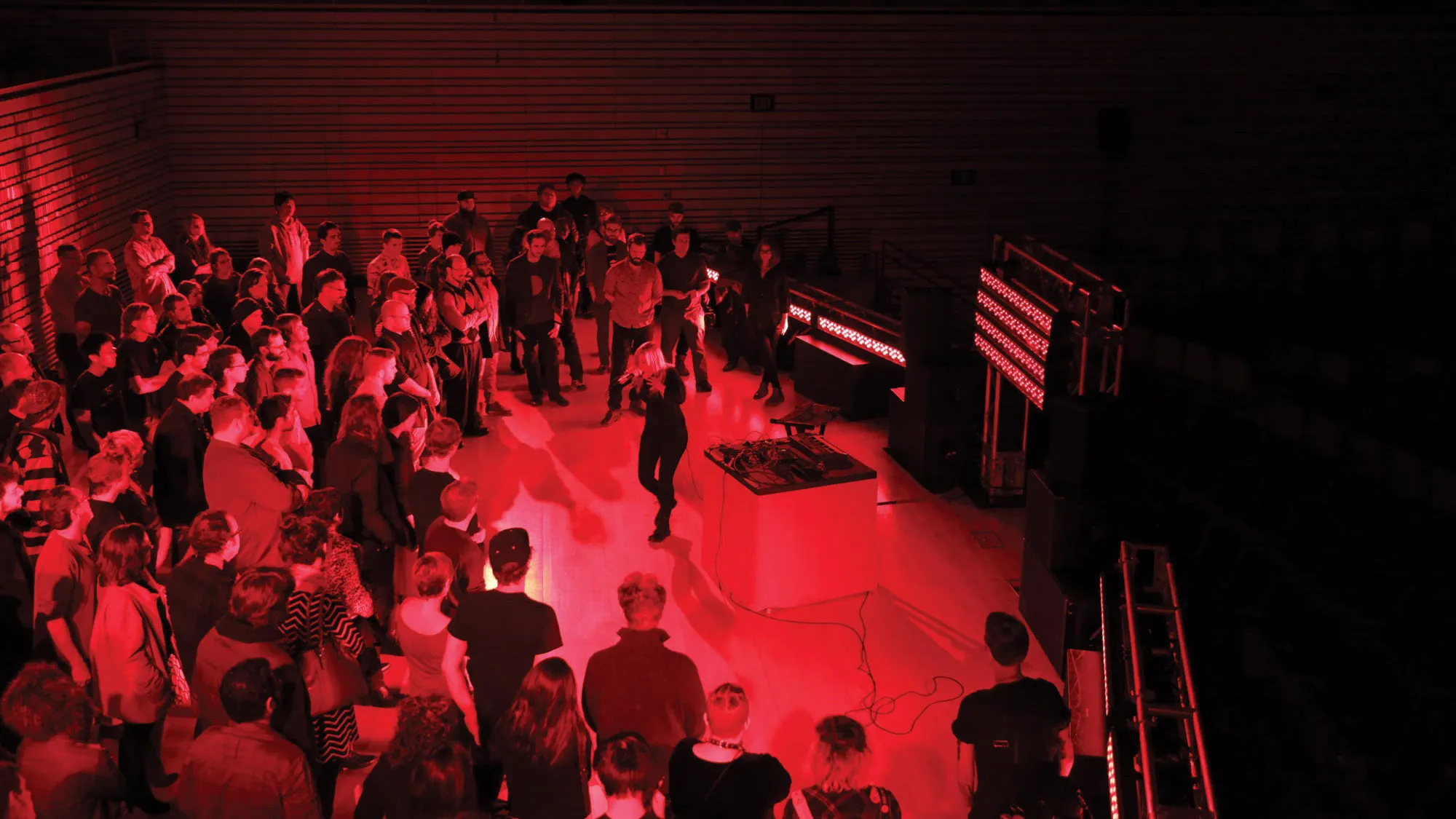
Pharmakon performing on the concert hall stage with an audience standing around her washed in red light.

Pharmakon

An intensely intimate and confrontational performance by Pharmakon, a death industrial music project from Margaret Chardiet. Chardiet describes her drive to make noise music as a kind of exorcism, making it possible to express her “deep-seated need/drive/urge/possession to reach other people and make them FEEL something [specifically] in uncomfortable/confrontational ways.” In addition to being one of the few females working in a male dominated noise scene, Chardiet stands out for her meticulous rigor and attention to form, with every performed element methodically planned out in advance for maximum emotional impact.

Main Image: Pharmakon in the Concert Hall. Photo: EMPAC

Bloopers #1

Michael Bell-Smith, Sara Magenheimer, & Ben Vida

Brooklyn-based artists Michael Bell Smith, Sara Magenheimer, and Ben Vida were in residence to produce a new video for their commissioned performance Bloopers #1. Using EMPAC’s Black-magic 4K camera, they filmed multiple house-hold objects, as well as actors, on a custom-built rotating platform embedded into a vinyl green screen. Close-ups, wide angles, and tracking shots were then edited in post-production onto multiple backgrounds to create the effect of stock footage in the style of commercials and television shows. The video was incorporated into a live multimedia performance presented later at EMPAC. With the question “Why do we hate some objects and love others?” as its starting point, Bloopers #1 used set pieces, dance-pop, cinematic cliché, and live performance to playfully tease the boundaries of language, crowds, and the nature of things that draw them.

Image
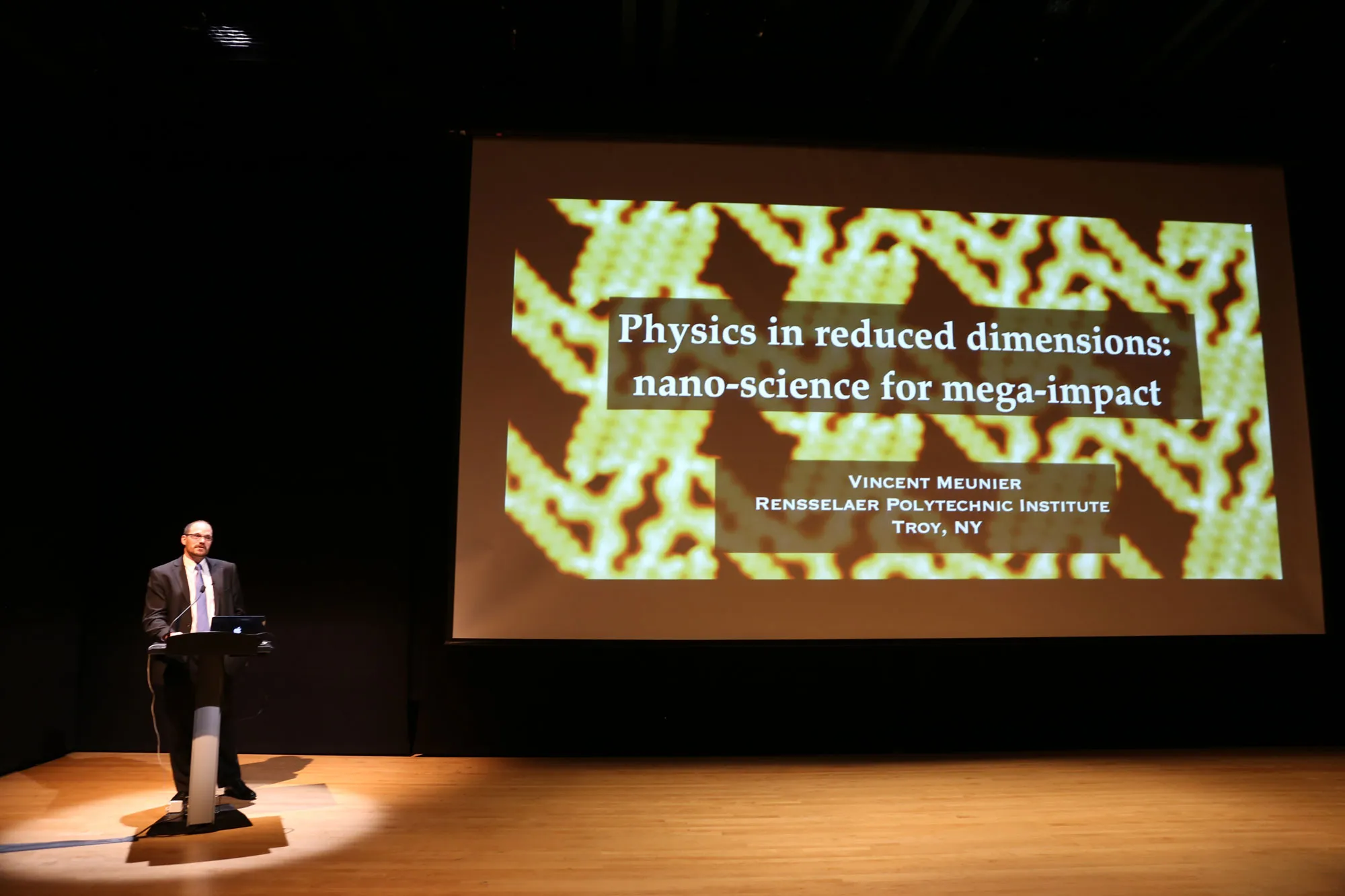
Vincent Meunier in discussion on a stage in front of a projection that reads 'Physics in Reduced Dimensions: Nano-Science for Mega-Impact'.

Vincent Meunier

Physics in reduced dimensions: nano-science for mega-impact

“There is plenty of room at the bottom,” Richard Feynman told a group of physicists in 1959, in a famous call for new investigations into subatomic science. The many new wonders of nanoscience demonstrate the prescience of Feynman’s claim. Over the last few decades, the effort to turn molecular and atomic building blocks into functional materials has energized scientists and engineers, and eventually led to the field of nanotechnology. With the emergence of nanotechnology, scientific scrutiny must now shift again, tracing these nano-level discoveries back up to a larger scale, where materials with predictive functionality can be assembled atom by atom. Manipulations at the sub-nanometer scale are extremely promising, making it possible to express the intricacies of quantum physics at the device level. These manipulations are also extremely challenging, requiring technical mastery at many different levels. In this talk, Rensselaer professor Vincent Meunier will present examples from the quest to optimize properties at the nanoscale for macroscopic applications in areas such as energy harvesting, storage, water purification, and nanomaterials design. The use of large-scale supercomputing will be highlighted, showing how current capabilities are quickly closing the gap between realistic length and time scales with those amenable to state-of-the-art modeling.

Main Image: Vincent Meunier. Photo: Emily Zimmerman

Yarn/Wire

Fall 2014

Centered around two pianists and percussionists, Yarn/Wire uses a combination of thundering rhythms, unconventional sounds, and precision execution. The ensemble has quickly become a key player in the American new music scene, driven by their adventurous programming and dedication to performing music from young composers. Returning to EMPAC, this performance included two movements of Davið Brynjar Franzson’s the Negotiation of Context (recorded and produced at EMPAC and released by WERGO), as well as a series of shorter new works by Thomas Meadowcroft, Ann Cleare, and Øyvind Torvund.

Yarn/Wire frequently presents US premieres by leading international composers, in addition to premieres of music written specifically for the ensemble, and maintains an active performing and teaching schedule at festivals, chamber music series, and universities across the country.

Yarn/Wire:

Laura Barger, piano

Ning Yu, piano

Ian Antonio, percussion

Russell Greenberg, percussion

Program

Davið Brynjar Franzson - the Negotiation of Context (C)

Ann Cleare - I should live in wires for leaving you behind

Thomas Meadowcroft - Walkman Antiquarian

~Interval~

Davið Brynjar Franzson - the Negotiation of Context (B)

Øyvind Torvund - Untitled School

Media

Sensory Ethnography Lab Program

Lucien Castaing-Taylor, Ernst Karel, + Véréna Paravel

A day of programming devoted to the Sensory Ethnography Lab, including a master class with Lucien Castiang-Taylor, Ernst Karel, and Véréna Paravel, a premiere of a new sound work by Ernst Karel entitled Morning and Other Times, a screening of Leviathan, and a panel discussion with the filmmakers.

The day begins at noon with a master class with Lucien Castiang-Taylor, Ernst Karel, and Véréna Paravel, and the premiere of Morning and Other Times, a new sound work by Ernst Karel. Morning and Other Times is a multichannel sound piece, made from location recordings, which takes up the relationship of nonhuman animals to the urban environment of Chiang Mai, Thailand.

Programming continues at 7 pm with a screening of Leviathan and a panel discussion with Lucien Castiang-Taylor, Ernst Karel, and Véréna Paravel. An immersive portrait of the contemporary commercial fishing industry, Leviathan was filmed off the coast of New Bedford, Massachusetts—once the whaling capital of the world and Melville’s inspiration for Moby Dick. Today, it’s the country’s largest fishing port with over 500 ships sailing from its harbor every month. Leviathan follows one such vessel, a hulking groundfish trawler, into the surrounding murky black waters on a weeks’ long fishing expedition. Instead of romanticizing the labor or attempting to turn fisherfolk into mythic caricatures of themselves, Castiang-Taylor (Sweetgrass) and Paravel (Foreign Parts) present a vivid, kaleidoscopic representation of the sea, the work, the machinery, and the players, both human and marine.

Employing an arsenal of cameras that passed freely from film crew to ship crew, swooping from below sea level to astonishing bird’s-eye views, the film is unlike anything seen before. Entirely dialogue-free, but mesmerizing and dramatic throughout, Leviathan presents a cosmic portrait of one of mankind’s oldest endeavors.

A panel discussion with the filmmakers will follow the screening.

Lucien Castaing-Taylor and Véréna Paravel collaborate in the Sensory Ethnography Lab. Their work is in the permanent collection of New York's Museum of Modern Art and the British Museum, and has been exhibited at the Museum of Modern Art, the Tate, London's Institute of Contemporary Arts, the Whitney Museum, the Centre Pompidou, the Berlin Kunsthalle, the Whitechapel Gallery, PS1, X-Initiative, and elsewhere. Their films and videos have won awards at Berlin, Locarno, New York, Toronto, and other film festivals. Other works include The Last JudgementStill Life/Nature MorteSweetgrass, and Foreign Parts.

Ernst Karel's multidimensional audio work includes electroacoustic improvisation and composition, location recording, sound for nonfiction film, and solo and collaborative sound installations. His work has been exhibited in the 2012 São Paulo Biennial, MIT List Visual Arts Center, the Museum of the Moving Image in Queens, New York, and in the 2014 Whitney Biennial. Karel is currently technical advisor and sound engineer for Non-Event, and lab manager for the Sensory Ethnography Lab at Harvard University, where he teaches a course in sonic ethnography and is lecturer on anthropology.
Image
Karen Barad

Karen Barad

Histories of Now: Time Diffractions, Virtuality, and Material Imaginings

In this talk, physicist and feminist theorist Karen Barad discussed her recent work on time and her reflections on the entanglement of time and materiality. 

Karen Barad is professor of feminist studies, philosophy, and history of consciousness at the University of California at Santa Cruz. Barad holds a PhD in theoretical particle physics and quantum field theory, and was tenured in the Physics Department at UCSC before moving into more interdisciplinary spaces. Barad is the author of Meeting the Universe Halfway: Quantum Physics and the Entanglement of Matter and Meaning (Duke University Press, 2007) and numerous articles in the fields of physics, philosophy, science studies, poststructuralist theory, and feminist theory. She is the co-director of the Science & Justice Graduate Training Program at UCSC.

Material Performance was a series of talks focused on materiality and time—how material and passing time can be seen as reciprocal conditions for each other’s qualities. The series brought together material scientists, biochemists, philosophers, curators, and media theorists to unravel the relationship of time and materiality within each discipline.

Image
A young white woman looking into the camera with mouth slightly open.

Visitors

Directed by Godfrey Reggio

Presented by Steven Soderbergh, Visitors reveals humanity’s trancelike relationship with technology, which connects humans in extreme emotional states to experiences far outside themselves. Beyond simply relaying information about the historical moment in which we live, the film is a visceral exploration of the senses and the kinds of machinery we’ve built to expand them. Visitors, the fourth feature-length collaboration between filmmaker Godfrey Reggio (Koyaanisqatsi, Powaqqatsi and Naqoyqatsi) and composer Philip Glass, was made with filmmaker Jon Kane.

The screening will be followed by a panel discussion with Reggio and Langdon Winner, Rensselaer professor of science and technology studies. A panel discussion with Director Geodfrey Reggio and Rensselaer Professor Langdon Winner will follow the screening.

Main Image: Still image of Bug Eyed Girl from Godfrey Reggio’s VISITORS. Photo Credit: VISITORS. Courtesy: Cinedigm 

Image
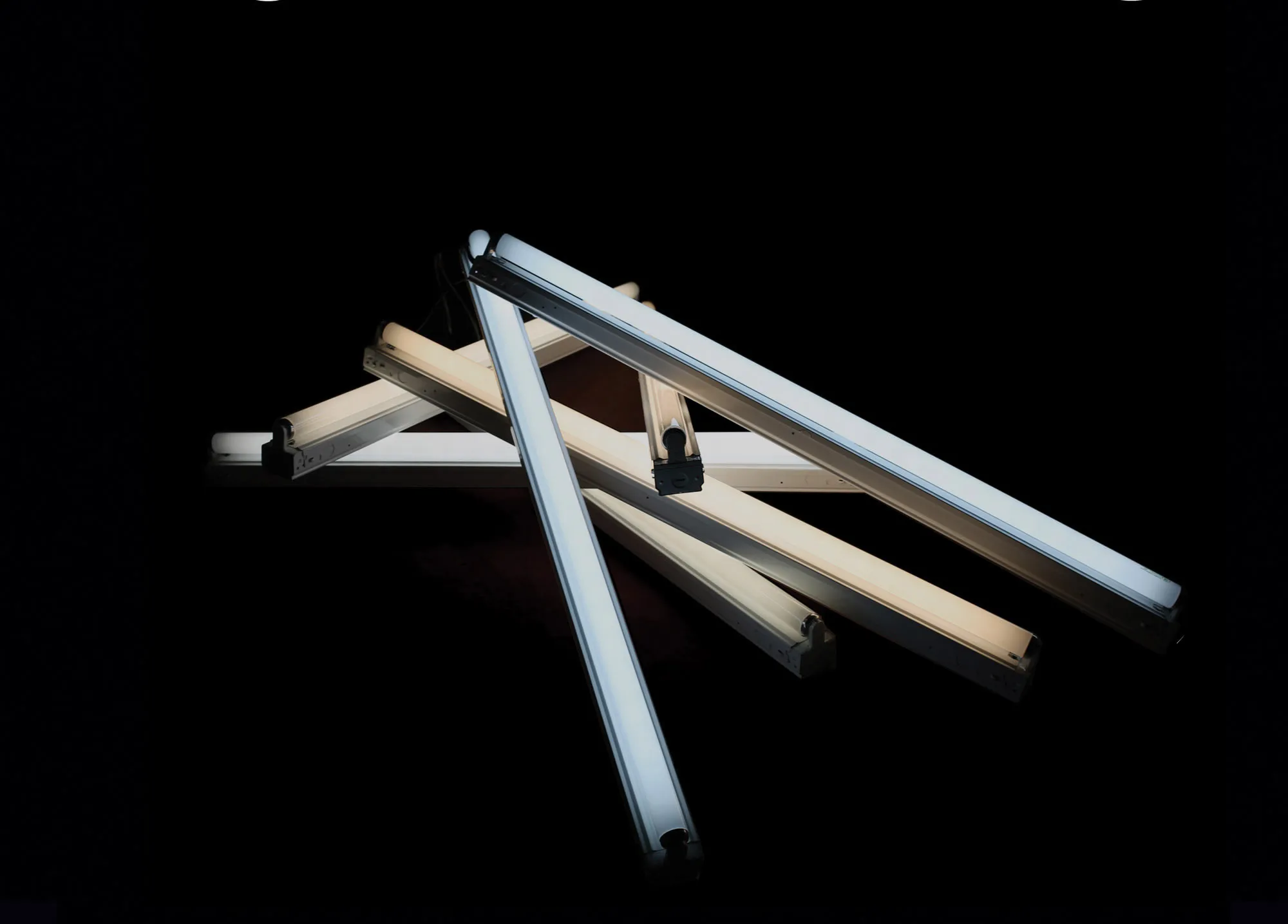
a pile of long florescent lights

Obsolescere: The Thing is Falling

Anthony Marcellini

Obsolescere: The Thing is Falling is a performance that captures objects at the moment their usefulness becomes uncertain. Drawn from the Latin obsolescere—“falling into disuse,” the idea that an object falls out of use over the course of time reveals that obsolescence is not a fixed point, but an active and fluctuating state.

Over the course of 25 minutes, a house cat, a Ford Taurus, seven fluorescent light bulbs, a goldfish, several cornstalks, the Encyclopedia Britannica, and a rusted portrait bust will speak about their conditions, narrating perspectives on utility, breakdown, and contradiction. This series of conversations addresses the condition of all objects, humans included, when they outlive their usefulness.

Anthony Marcellini is an artist and writer whose practice examines the social relationships of seemingly disparate objects, artworks, individuals, historical events, and natural phenomena. He is particularly interested in the moment of collapse or breakdown, specifically how our understanding of objects or events changes when they crash or lose their intended purpose. His work has been exhibited internationally at museums, galleries, and art institutions, including Galerie Michael Janssen, Singapore (2014); Witte De With, Rotterdam (2013, 2014); Yerba Buena Center for the Arts, San Francisco (2013); The Gothenburg Konsthall (2013); and Wilkinson Gallery, London (2012-13), among others.

From 2000-2004 Marcellini co-founded and directed the collaborative art group It Can Change with John Hoppin, a collective that produced art, interventions, and performances in public spaces and art institutions.

He has participated in several biennials and festivals and has held residencies at the Valand Centre for Artistic Research, Gothenburg (2012) and the Sparwasser HQ residency program, Berlin (2010). His writing has been published in Paletten Art Journal, the web-based publication Nowiswere, and the online journal Art Practical.

Main Image: Production still from Obsolescere: The Thing is Falling (2014). Image: EMPAC/Rensselaer.

Mick Barr

Mick Barr presented a solo performance of his electric guitar works. A guitarist of the highest technical caliber, Barr makes music that exists somewhere between progressive black metal, hardcore, and avant-jazz. Alternating between witheringly complex and gutturally primal, Barr is at the center of the extreme sound scene with works of unrivaled experimental improvisation.

Noted for his relentless speed and agility on guitar, and avant-garde compositions, Barr has been an active musician for almost 20 years and has released over 50 recordings. He is most known in the experimental and metal worlds for his work with the technical duos Orthrelm and Crom Tech, the progressive black metal band Krallice, and for his two solo projects, Octis and Ocrilim. He has released records with notable labels such as Tzadik, Ipecac, Profound Lore, Hydrahead, and Kill Rock Stars.

Image
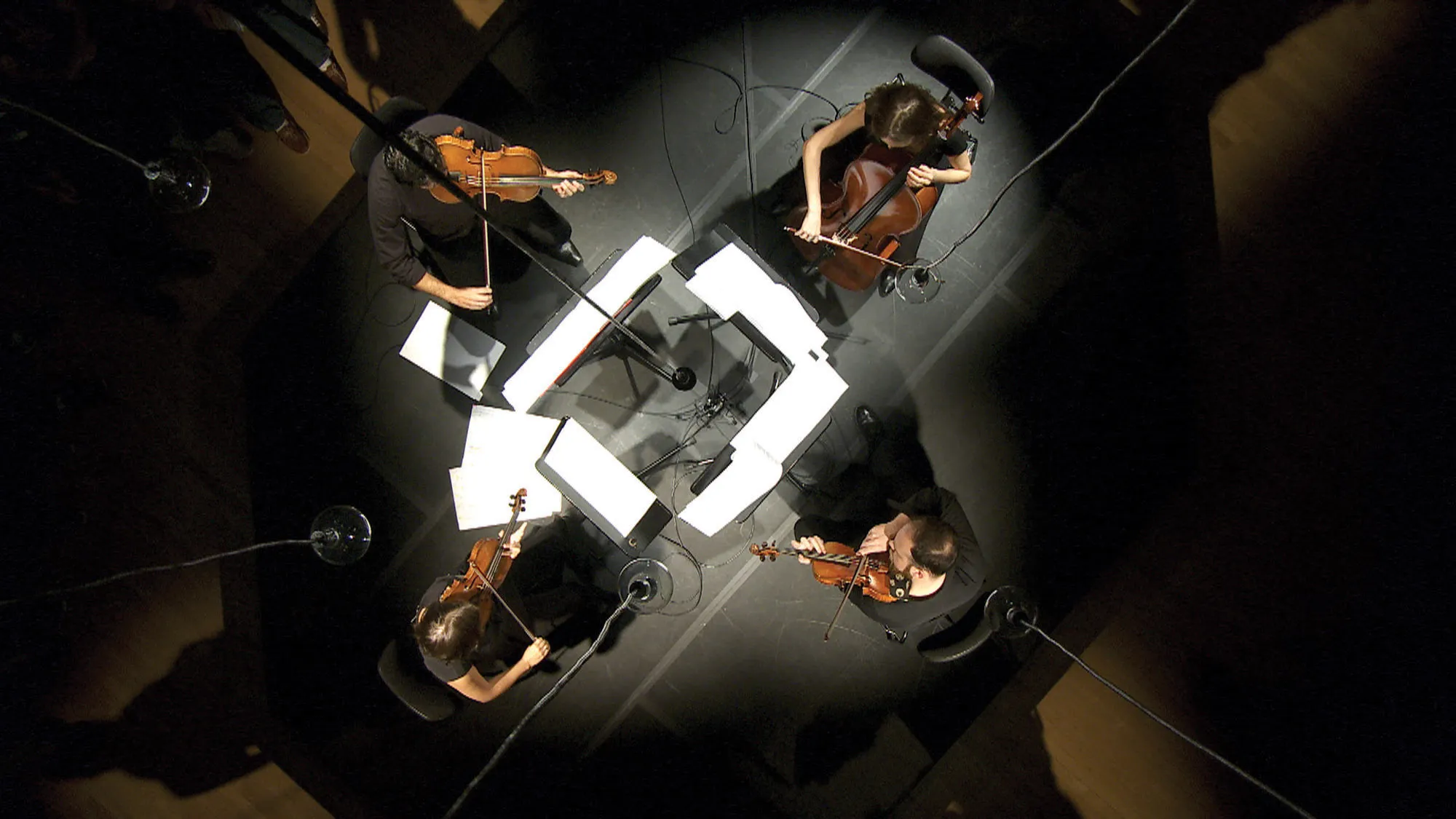
Above shot of a string quartet sitting with white sheet music on music stands in a square.

Mivos Quartet

Eric Wubbels — being time

The Mivos Quartet, one of the most sought-after string quartets in the international new music scene, will be in residence at EMPAC to develop and perform a new work by American composer Eric Wubbels. Titled being time, the piece is an audio variation on the psychological experience of time. Extending nearly an hour, it moves from sections of extreme slowness and static sustains to high-energy plateaus of dense, saturated sound textures. In the final sequence, quadraphonic electronic sound pushes the performance into an altogether new dimension, creating vivid psychoacoustic illusions by using extremely high sine waves. Mivos Quartet: Olivia De Prato, violin Joshua Modney, violin Victor Lowrie, viola Mariel Roberts, cello

VIDEO