Image
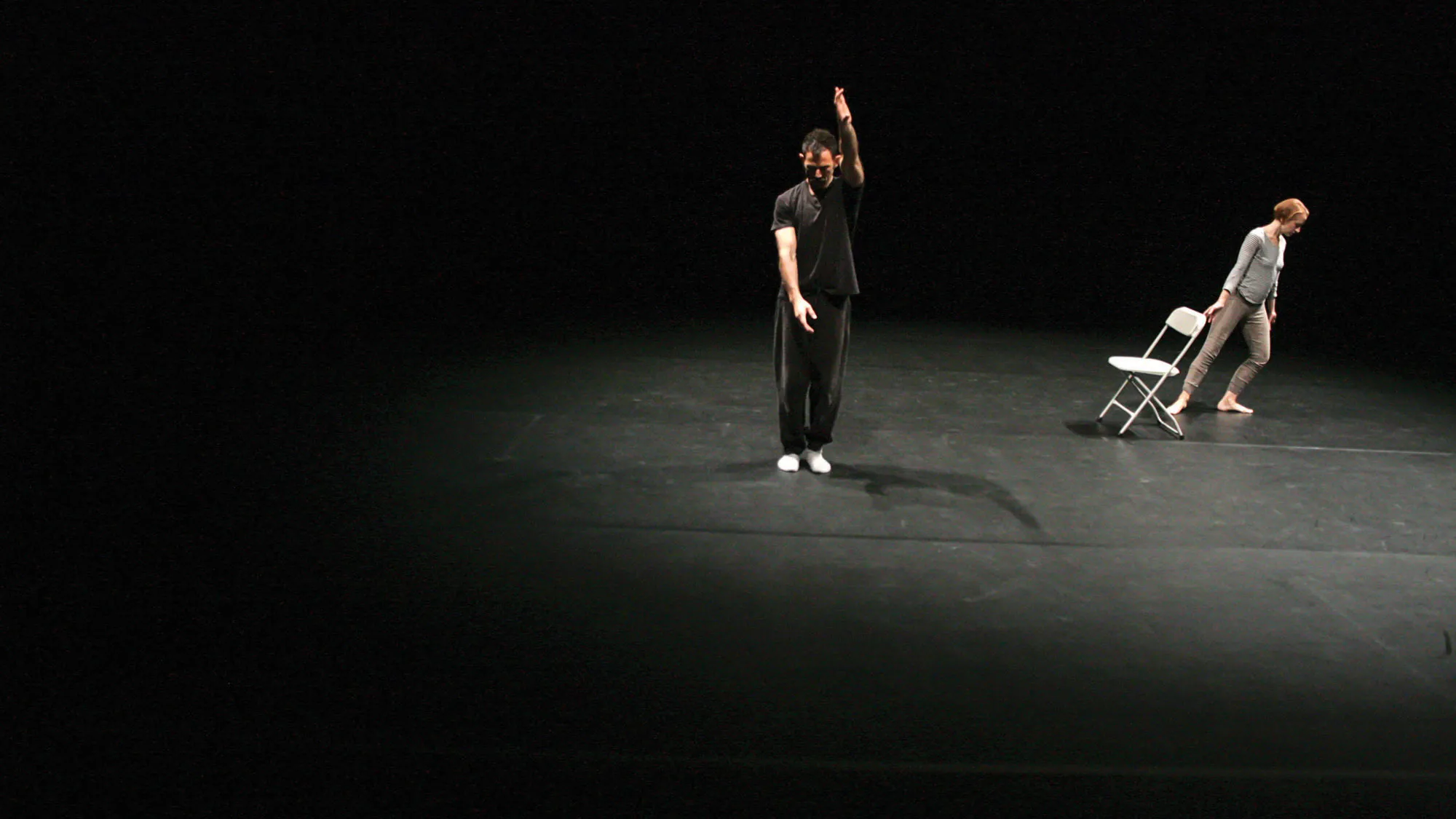
A male dancer wearing all black standing with one arm outstretched towards the ceiling as a female dancer wearing white drags a chair with body in a diagonal pose on a black stage.

TOOL IS LOOT

Wally Cardona & Jennifer Lacey

Choreographers/dancers Wally Cardona and Jennifer Lacey come together in TOOL IS LOOT with their identities simultaneously undone and strengthened. They ask the question: What comes after you don’t know anymore? For one year, Cardona and Lacey worked apart, in the US and France, respectively. Each solicited weeklong encounters with non-dance experts, allowing the opinions and desires of an “outsider” to shift what they knew about creating short solos. These experts included a sommelier, an architect, a film editor, a medical supply salesman, a kinetic sculptor, a baroque opera singer, an art critic, an acoustician, and a social activist.

An encounter with one expert, Dr. Heidi Newberg, Rensselaer professor of physics, applied physics, and astronomy, resulted in a solo dance that was performed as part of our biennial Filament festival. Cardona and Lacey worked together this past summer while in residence to build their disparate experiences into this duet.

Image
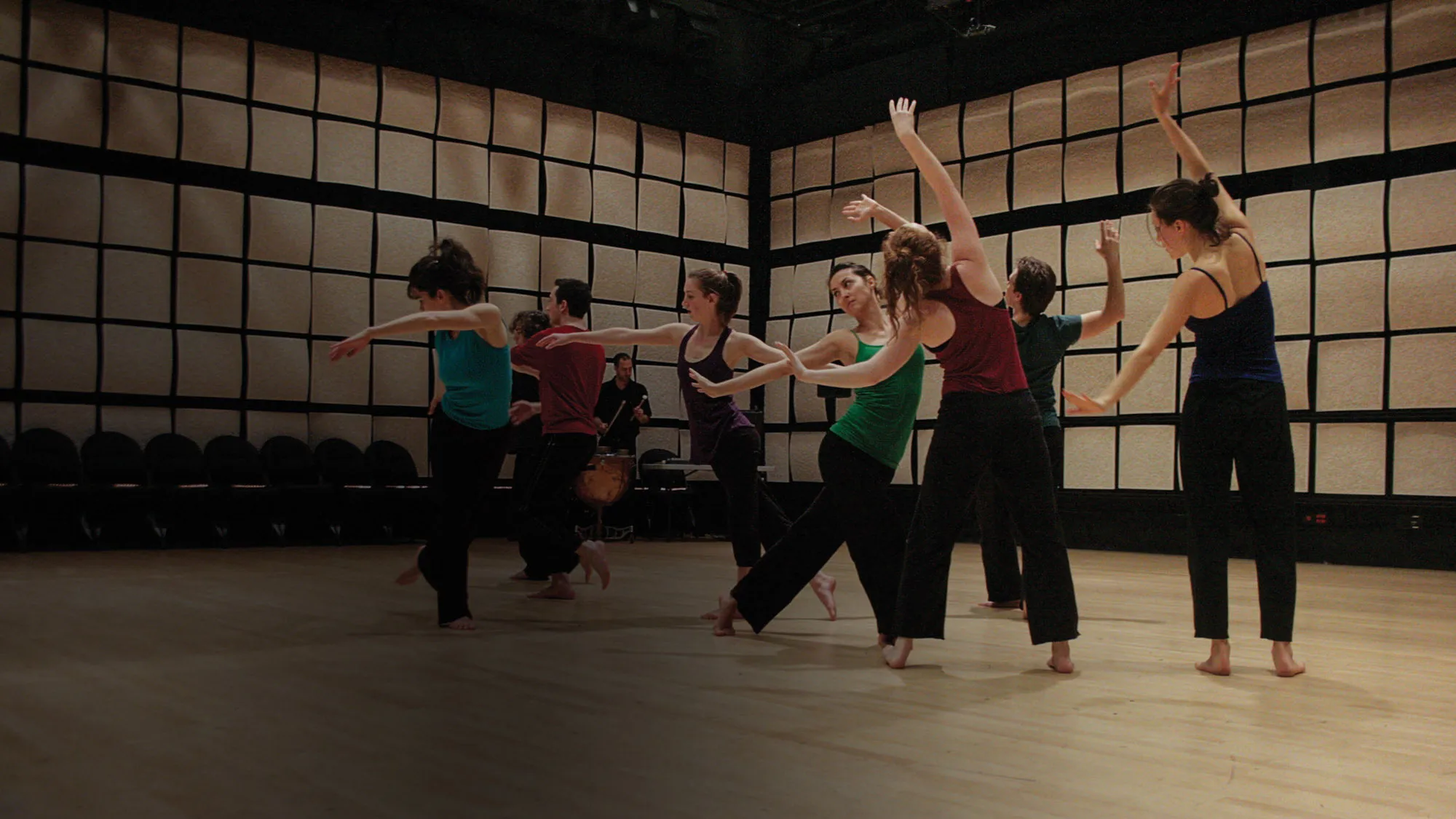
Eight dancers wearing jewel toned tops with black bottoms, moving with arms outstreched in a room with tan acoustic tiles on the walls.

Susan Sgorbati

Emergent Improvisation

Susan Sgorbati invites visitors to observe her work with an ensemble of six dancers in Emergent Improvisation. She will introduce the concepts behind the work and show how they manifest in dance. The practice and performance of Emergent Improvisation addresses the nature of improvisation in dance and music. In this context, improvisation means the spontaneous creation of integrated sound and movement by performers who are adapting to internal and external stimuli, impulses, and interactions. The phenomenon of emergence is also found in a wide variety of natural settings. Emergent forms appear in complex, interconnected systems, where there is enough order and interaction to create recognizable pattern, but where the form is open-ended enough to continuously bring in new differentiations and integrations that influence and modify the form. Evolution and brain function are two examples. In linking the creative work of art making to the emergent process evident in nature, there is basis for a rich and textured inquiry into how systems come together, transform, and reassemble to create powerful instruments of communication, meaning, and exchange.

Main Image: Susan Sgorbati in studio 1, 2012. Photo: EMPAC/Rensselaer.

Image
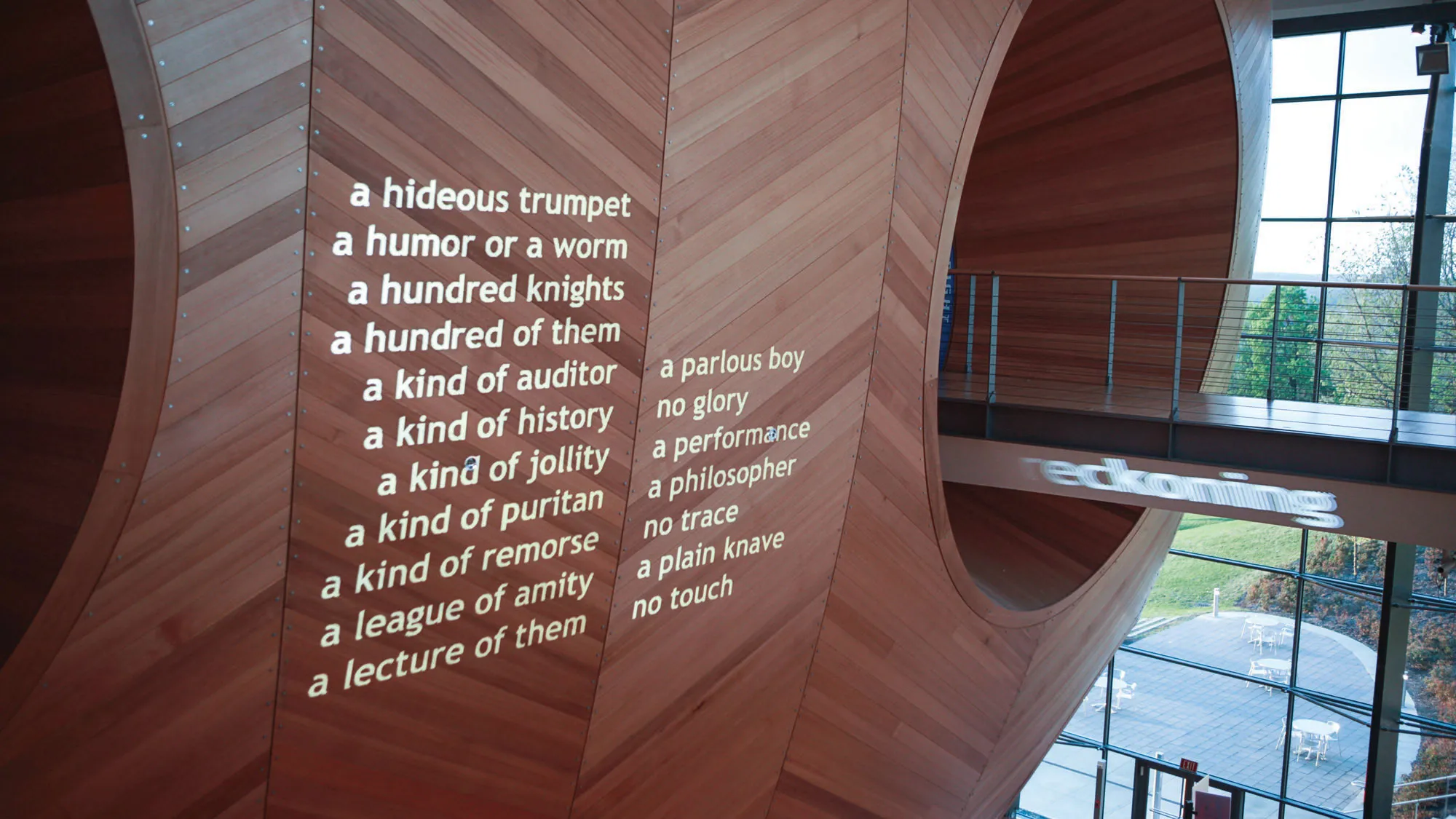
White text projected on to the wood hull of the concert hall that read "a hideous trumpet, a humor or a worm, a hundred of them, a kind of auditor, a kind of history, a kind of jollity, a kind of Puritan, a kind of remorse, a league of amity, a lecture of them, a parlous boy, no glory, a performance, a philosopher, no trace, a plain knave, no touch"

A Shakespeare Accelerator: Experiments in Kinetic Language

Ben Rubin

As Ben Rubin works out concepts and algorithms for Shakespeare Machine, a permanent installation that will open at the Public Theater in New York in fall 2012, he will transform our public interior into a laboratory of words and motion, projecting glowing white text from Shakespeare’s complete dramatic works onto walls, walkways, and other surfaces. Shakespeare’s plays are structured around the powerful forces of love, death, family, trust, jealousy, fate, and desire. But in the universe of Shakespearian physics, the subatomic forces that hold words together encompass puns, rhymes, alliteration, rhythms, and unexpected constructions. “These subtle forces of language are essential to the transcendent power of Shakespeare’s work,” says Rubin. I want to create a kind of supercollider for Shakespeare’s texts, where the particles to be accelerated and smashed together are scenes, lines, and phrases. Which words, when hurled toward each other, will cause a reaction? Which collisions will most likely provide traces of the incandescent energy, wit, and emotion that existed at the moment of these plays’ creation?”

March 5-9 — Shakespeare Readings

Beginning Monday, March 5th and continuing through March 9th, we will celebrate the opening of A Shakespeare Accelerator with a week-long continuous reading (by groups of students from Rensselaer and the surrounding community) of Shakespeare’s 67 plays, used in the installation. FREE coffee, tea and hot chocolate will be served. The readings will take place from 2–5 PM in the Context Space and are FREE.

April 9 — Typography Class Exhibition Opening

Beginning Monday, April 9, EMAC Typography class projects, inspired by this work, will be on view in the Context Space. FREE.

May 2 — Typography Class Exhibition Closing Reception

Please join us for the closing of the typography exhibition from 2-5 PM. In addition to celebrating the projects curated into the Context Space for the three week exhibition, be ready to try your hand at magnetic advice; test a piece of interactive typography software; take part in a musical and emotional survey; and watch in awe as the Reverse Graffiti Calligraphy project is performed outside in the East campus entrance driveway. FREE.

Main Image: A Shakespeare Accelerator, 2012.
Image
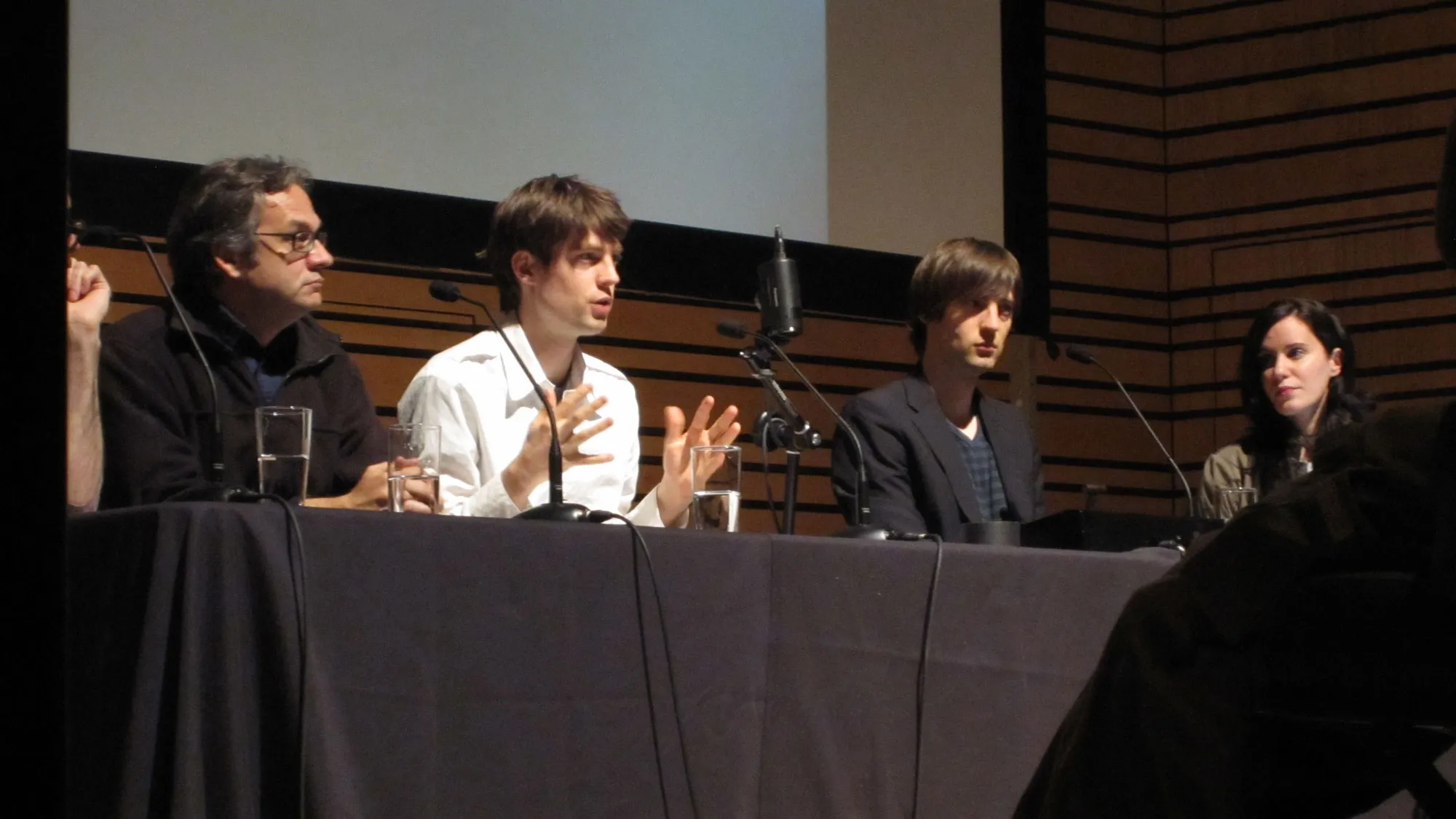
A panel of three men and one woman seated behind a table with a black table cloth. A man in a white shirt is speaking into a microphone with his hands outstretched.

Ryan + Trevor Oakes

Ryan and Trevor Oakes have held a lifelong conversation about the nature of visual perception, resulting in a complex new method for drawing reality. In this panel discussion, writer Damien James and photographer Michael Benson join the Oakes brothers to discuss their drawing method, as well as their approach to thinking about light, optics, and vision.

Main Image: Ryan + Trevor Oakes during their talk in 2012. Photo: Rebecca Raha Radparvar.

Image
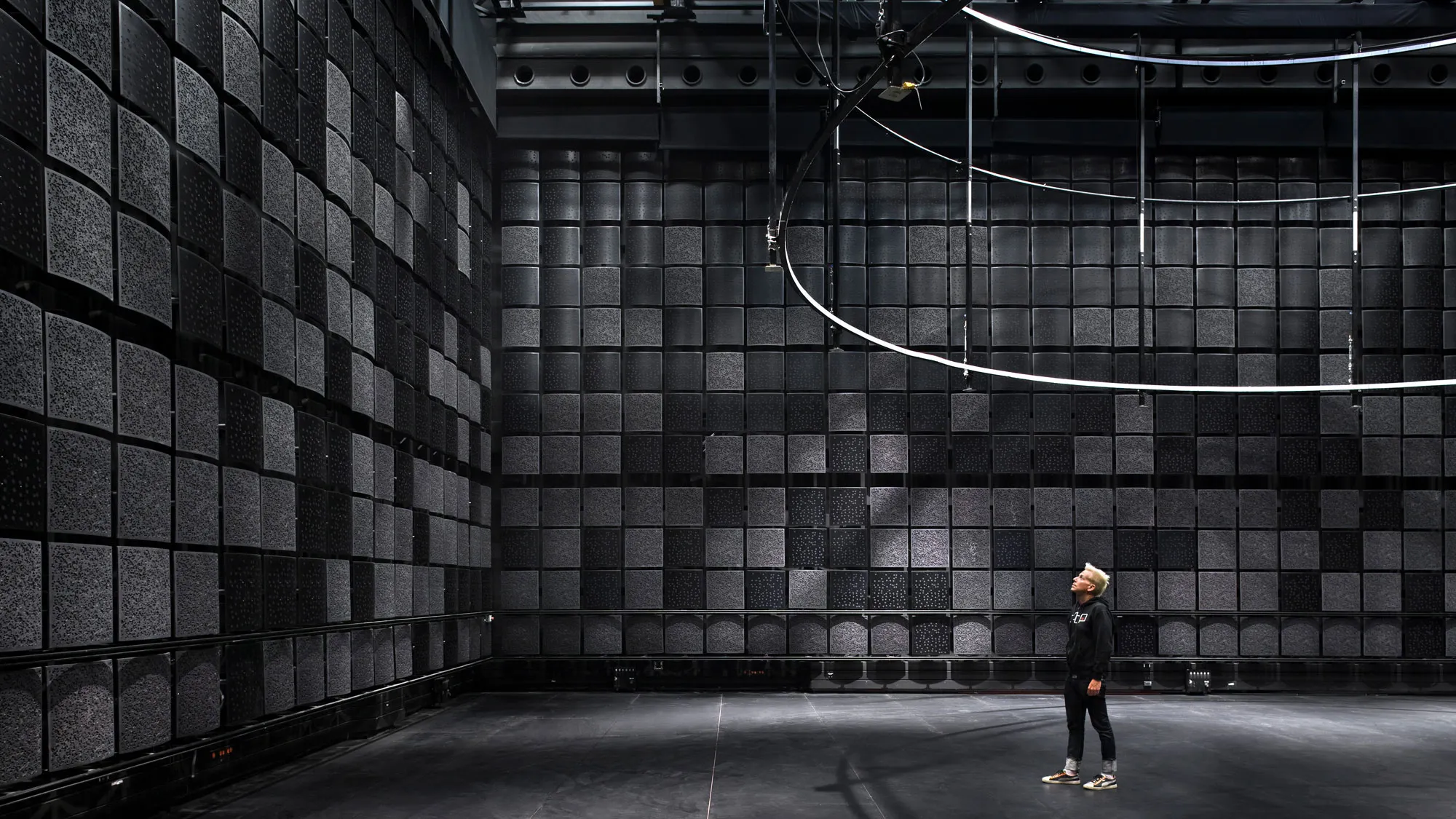
A man in a room full of black acoustic tiles with a rigging apparatus hanging above.
Main Image: © Peter Aaron/ESTO.

EMPAC: A Public Exchange

An evening of information and discussion. There are many ideas of what EMPAC should be—and the mission and program it pursues. EMPAC was conceived 12 years ago. Our team and program ramped up in parallel to the planning and construction of the actual building. Three and a half years ago the Curtis R. Priem Experimental Media and Performing Arts Center opened its doors and our full program was initialized. The evening will start with an overview from EMPAC’s Director, Johannes Goebel, establishing the link between our overall mission as part of Rensselaer, our place in the various communities we serve, current activities and future developments, and our team and operation. Most importantly, how do the many pieces of this puzzle merge to create a multi-faceted picture? The majority of the evening will be an exchange with the audience. We hope that everyone who is interested will join us. Of course, snacks will be available to fuel the discussion.

Image
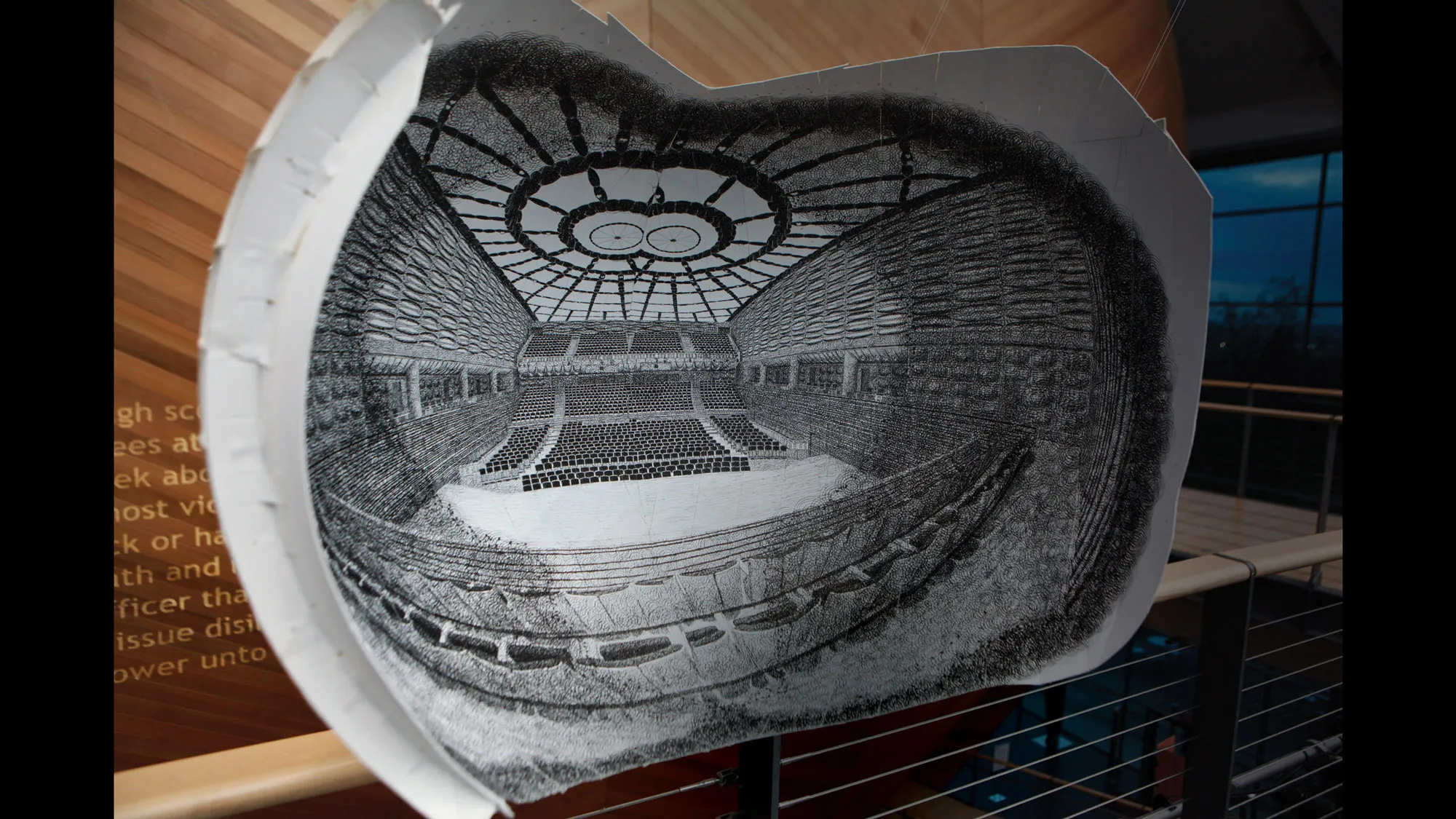
A black and white sketch model of the concert hall set in front of the completed concert hall.

The Periphery of Perception

Ryan + Trevor Oakes

Identical twins Ryan and Trevor Oakes engage in probing studies of visual perception and light through material investigations, discovering methods that constitute key advancements in the representation of visual reality. This winter they will be in residence, creating a commissioned drawing of our Concert Hall. This drawing will mark the first time the Oakes brothers re-envision the structure of their drawings to trace the perimeter of binocular vision. This new work will be shown as part of The Periphery of Perception — an exhibition looking at the development of the Oakes’ work over the past 10 years.

Panel Discussion

A conversation on optics, the nature of light, and the rendering of visual reality with writer Damien James, photographer Michael Benson, and artists Ryan and Trevor Oakes.

Main Image: Installation view: The Periphery of Perception, 2012. Photo: Kris Qua/EMPAC.

Media
Image
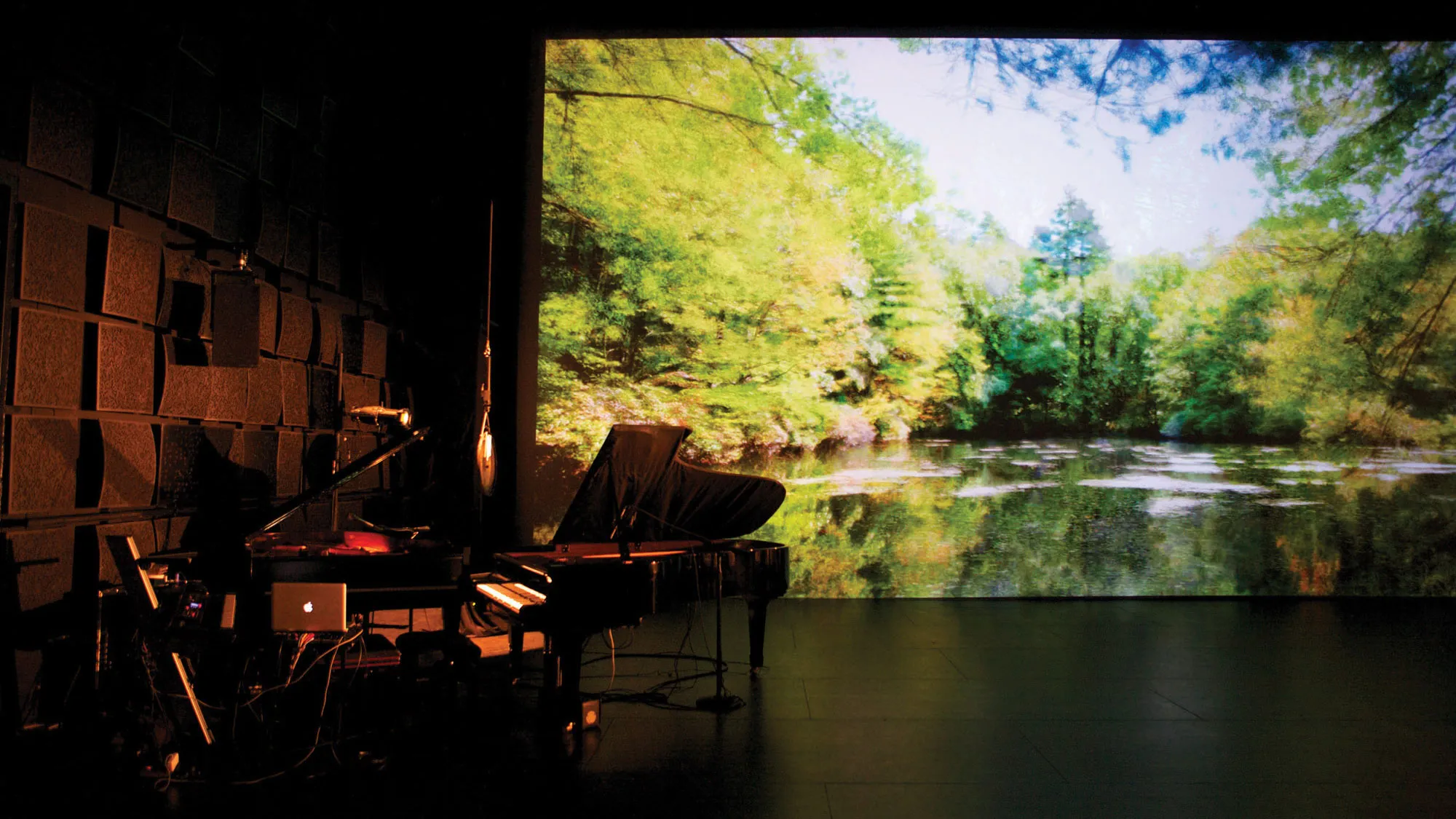
Two grand pianos among various wires, microphones, and recording devices in a black box studio in front of a projection of a tranquil green pond.

RE: Walden

Jean-François Peyret

Inspired by the writings of transcendental philosopher Henry David Thoreau and the two years he spent living by Walden Pond, RE: Walden melds theater, music, live performance, and large-scale video projection. Images from Walden Pond overlap with sound and text in an integrated experience that joins an intricate automated orchestra playing with the live piano score, a single performer, and interactive video. Using voice and movement, the performer influences, triggers, and interacts with the complex web of sonic and visual elements at play to create a multi-layered interpretation of Thoreau’s revolutionary musings of Walden Pond. Directed by Jean-François Peyret, this project brings together a stellar group of collaborative artists, many of whom have never been presented in the United States.

Main Image: RE: Walden in Studio 1, 2012. Photo: EMPAC.

Media
Image
Colin Stetson

Colin Stetson + Tyshawn Sorey

with Sarah Neufeld

Saxophonist Colin Stetson and percussionist Tyshawn Sorey, each performing a set of their own works, used extraordinary techniques to take their instruments into uncharted territory, creating music that exists in a cross-genre realm, drawing from jazz, classical, and pop with equal measure. Special guest Sarah Neufeld opened with a solo violin set. Colin Stetson has worked with dozens of artists including Tom Waits, Arcade Fire, TV on the Radio, Feist, Laurie Anderson, Lou Reed, David Byrne, LCD Soundsystem, The National, Angelique Kidjo, and Anthony Braxton, and is member of the band Bon Iver. 

Tyshawn Sorey is a composer, performer, educator, and scholar who works across an extensive range of musical idioms. As a percussionist, trombonist, and pianist, Sorey has performed with his own ensembles and with those led by Muhal Richard Abrams, Steve Coleman, Butch Morris, Michele Rosewoman, Steve Lehman, Vijay Iyer, Peter Evans, and Ellery Eskelin, among many others. Sarah Neufeld began playing the violin at the age of three; she is best known as a member of the indie rock phenomenon Arcade Fire, as well as the instrumental post-rock ensemble Bell Orchestre. 

Main Image: Colin Stetson in studio 1, 2012. Photo: EMPAC/Rensselaer.

Media
Image
Tim McGee in discussion

Tim McGee

Biomimicry

How are the technologies we have created different from the technologies nature evolved over 3.8 billion years? The science of biology has grown by massive leaps and bounds in the past 200 years, and we are just beginning to put together fascinating stories of how nature works. Yet much of this wisdom is obscured, and relegated to scientific journals or dusty biology volumes. Dusting off these tomes, and offering up the insights of biology to other fields has proven to be an exciting and thrilling field that is helping us understand and connect to the world, as well as to ourselves. Through examples and stories, biologist Tim McGee will share where biological wisdom is changing the way we work, think, and create, and where increasingly our technologies have more in common with 3.8 billion years of evolution.

Main Image: Tim Mcgee presents Biomimicry in the theater in 2012. Photo: Rebecca Raha Radparvar.

Image
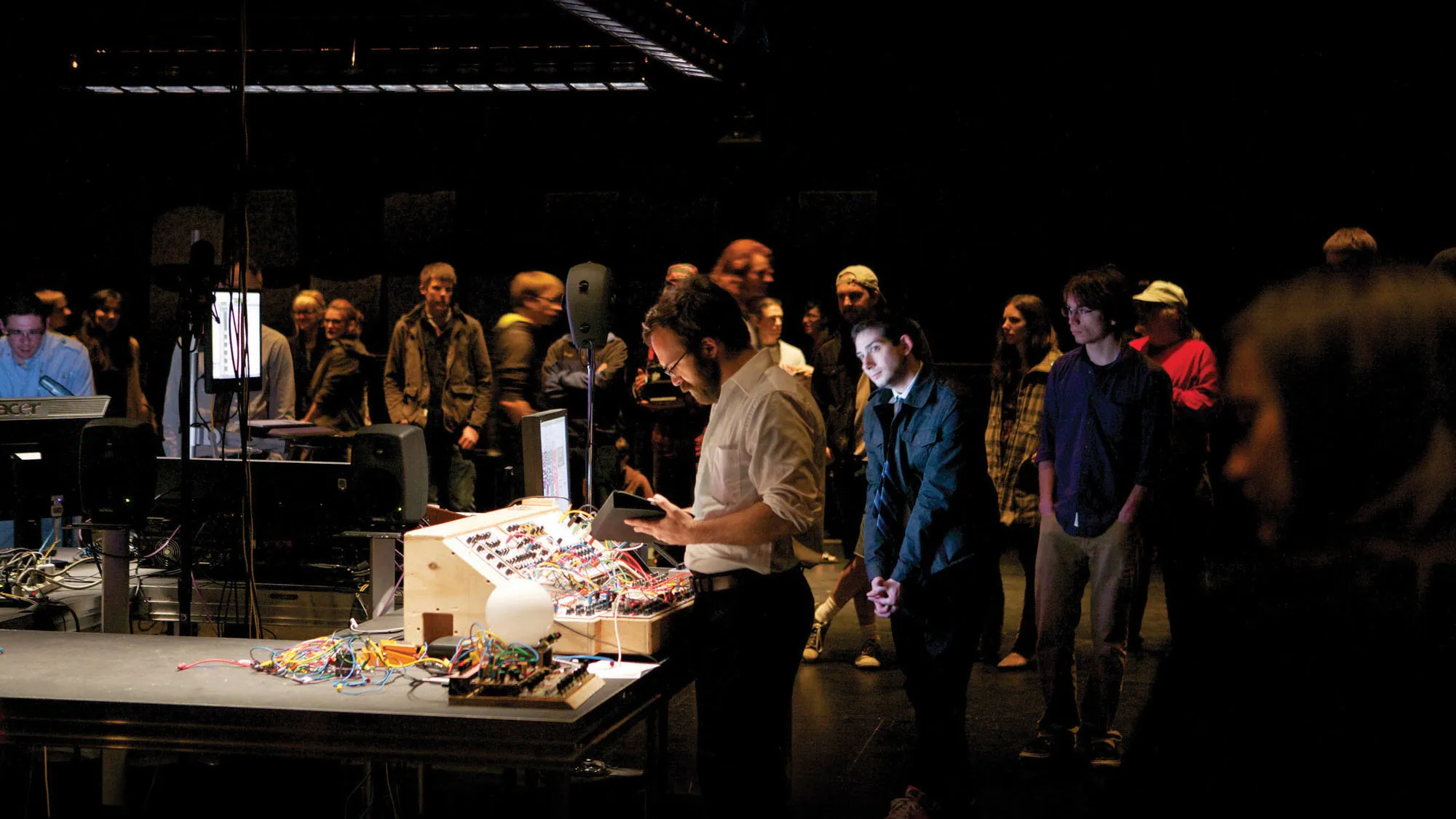
Peter Edwards amongst a crowd.

The Hant Variance

Peter Edwards + Sabisha Friedberg

A work in progress performance as part of a residency in which Pete Edwards (Casper Electronics, Troy, NY) and Sabisha Friedberg develop a composition influenced by the audience’s movement through space. Using array of loudspeakers distributed in three-dimensional space throughout Studio 1, they explore how frequency waves interact with one another and physical bodies, canceling each other out or making sounds audible.

Edwards and Friedberg will be controlling the piece from stations in the center of the room, reacting to the sonic environment created around them. The score is inspired by various scientific and metaphysical sources, including the writings of Vic Tandy, which suggest that certain sonic equations yield supernatural experiences. This exploration of the aural and the physical—informed scientifically, logistically and intuitively—will be the basis of this experiential performance.

Main Image: The Hant Variance in studio 1, 2012. Photo: EMPAC/Rensselaer.

Media