Image
WITHIN
Tarek Atoui
The final EMPAC presentation of sound artist Tarek Atoui’s multi-year research and performance project to develop tools and techniques for performing sound to a hearing-impaired audience.
Atoui has been working in collaboration with Distinguished Research Professor of Music Pauline Oliveros and her students from the New Instrumentation for Performance seminar to think through propositions for new instruments and performance techniques. Several instruments that Atoui has been developing concurrently will be played throughout the public spaces of EMPAC and broadcast into the Concert Hall. The audience will be encouraged to explore the acoustic relationships between individual instruments and the architecture that they inhabit.
During this time, Atoui has also worked in partnership with UC Berkeley Art Museum and Pacific Film Archive, Center for New Media at University of California, Berkeley, and Meyer Sound to develop the Zero Point Nine an instrument that was premiered in a series of performances presented by BAMPFA in November 2015. The Zero Point Nine will be traveling to EMPAC for this presentation to be played alongside a new prototype interactive square wave synthesizer The Sit-thesizer by Julia Alsarraf, and the SubBassProtoTon developed by Johannes Goebel. The instruments from these two research and development phases in Troy and Berkeley respectively, will be presented together during Norway’s 2016 Bergen Assembly, organized by Atoui as artistic director.
Atoui presented the project’s first incarnation, WITHIN, as a series of performances and workshops during the Sharjah Biennial in 2013 and has continued to research principals of sonic architecture (in particular, the system of DeafSpace, developed by Hansel Bauman at Gallaudet, Washington) in the development of instrument-building techniques.
WITH:
- Julia Alsarraf
- Jad Atoui
- Johannes Goebel
- Jeff Lubow
- Matt O'Hare
- Pauline Oliveros
- Evan-Daniel Rose-González
SubBassProtoTon
This musical instrument was invented by director Johannes Goebel and has been installed for this performance. When inside, you can experience frequencies that dip below the human audible limit.
Sit-Thesizer
Rensselaer Arts grad Julia Alsarraf, has developed the Sit-thesizer as part of this performance.
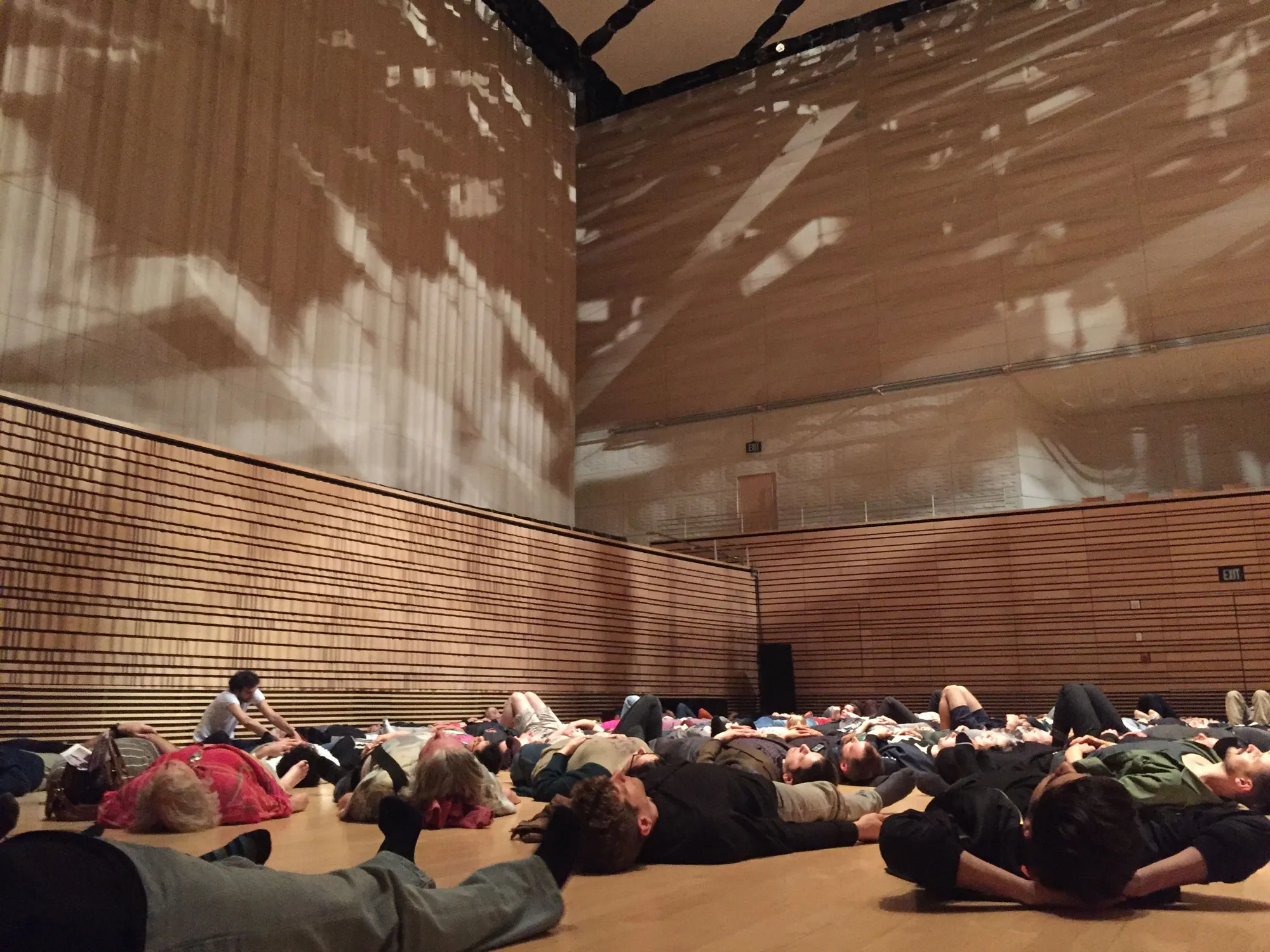
Main Image: Participants of Pauline Oliveros' Deep Listening workshop lie across the Concert Hall stage during WITHIN in 2016. Photo: Argeo Ascani, 2016.
Image

You Sad Legend
Moved by the Motion: Wu Tsang and boychild, featuring Patrick Belaga
Moved by the Motion is a performance collaboration between artists Wu Tsang and boychild, featuring experimental cellist Patrick Belaga. As part of an ongoing series of such performances, Moved by the Motion explores different modes of storytelling through an improvisational structure of voice, movement, and music. The series began as a poetic interpretation of the science fiction world in Tsang’s forthcoming feature film, A day in the life of bliss, and has since evolved into its own form.
In the performance, Tsang, the film’s director, plays the voice, an evocative and commanding vocal performer, who uses language to manipulate the scene like a puppeteer pulling strings. boychild, the film’s principle actor, plays the mover, a visceral dancer who is bound to the voice but is constantly breaking down language with her ineffable physicality. All the while, Belaga plays the improvisational score live. "Play" is a central part of this performance—both play as an activity, and play as it defines a space for flexibility and leeway.
Main Image:You Sad Legend (2016). Image: Mick Bello/EMPAC.
Image
Atlas Revisited
Karthik Pandian and Andros Zins-Browne
In 2012, visual artist Karthik Pandian and choreographer Andros Zins-Browne visited the Atlas Film Studios in the desert of Ouarzazate, Morocco. There, in front of film sets from previous Hollywood productions, they hired a group of studio camels and tried to persuade them to dance. The result of this endeavor can be seen in their 2014 video Atlas/Inserts, a choreography that casts the camel both as a political animal and a technology of movement.
Now with Atlas Revisited, their latest collaboration, the artists look back at the project and beyond. In a performance using text, movement, and moving image, they question their own motivations and the consequences of their pursuit of an “image of freedom.”
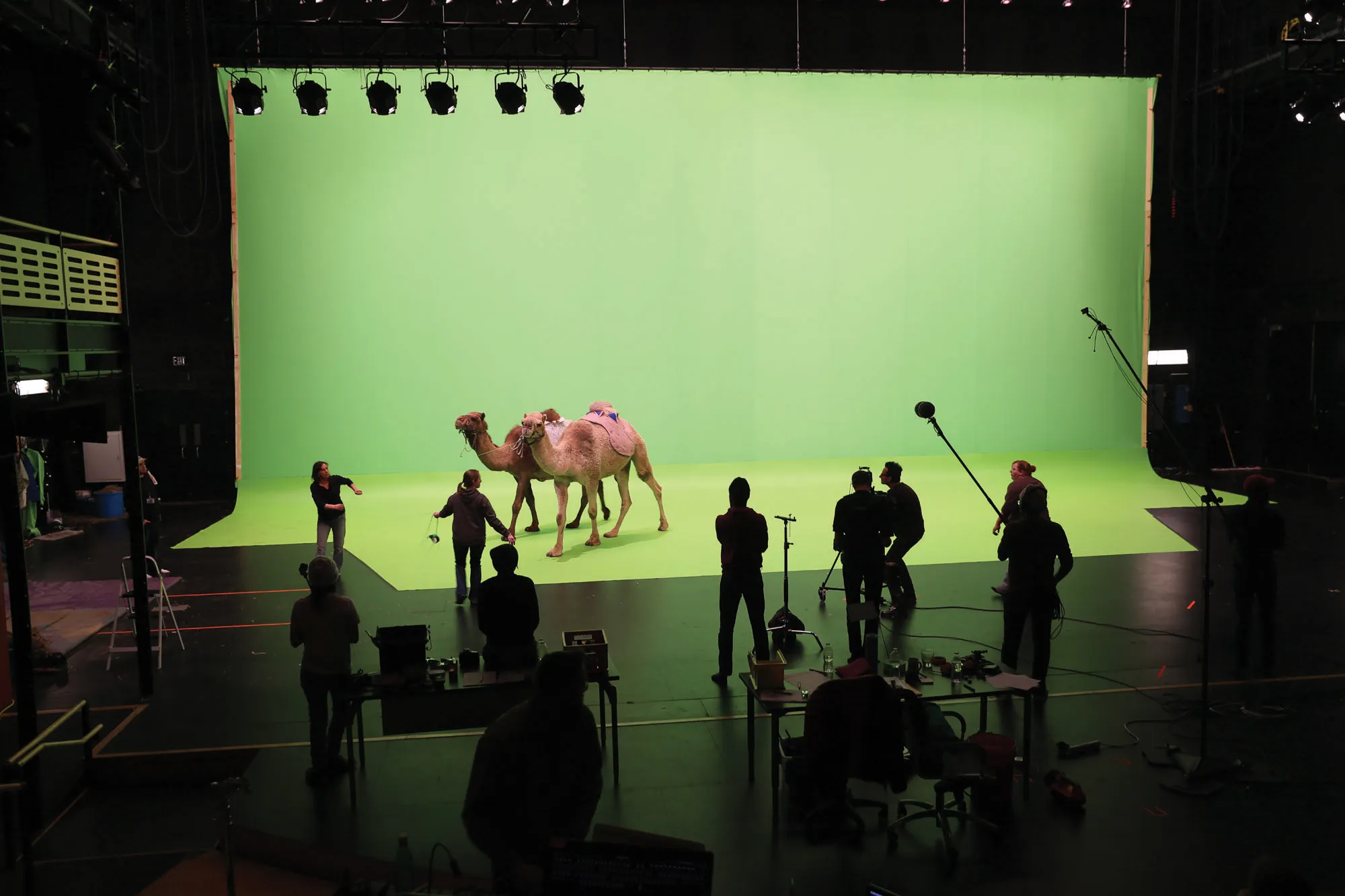
Drawing on new video material, shot at EMPAC in front of a green screen with American camel-actors, they pose the question of whether Atlas/Inserts was actually a ruse. Was the coercion depicted actually the performance of high-priced American talent keyed into background footage from Morocco? Were the artists documenting a shoot or acting in one?
In Atlas Revisited, Pandian and Zins-Browne stage the making, unmaking, and remaking of a dance about freedom and the treachery often required to realize images of it.
Main Image: Production still from Atlas Revisited (2016). Courtesy the artists. Photo: Mick Bello/EMPAC.
Media
We the New Community
Matt O'Hare
The current wave of virtual reality purports to usher us into a time of new possibilities and experiences, yet echoes many of the conversations that took place in the 1990s when immersive computer environments, artificial intelligence, and digital immortality were fresh in the minds of scientists, religious zealots, and the public at large. We the New Community is a live theater event that splices together music, computer graphics, and monologue to explore a potential future where the body and physical reality may be discarded in pursuit of a new and technologically-supported form of immortality.
Field Cuts: Encounter 6
Jeremy Stewart
Field Cuts is an electronically mediated movement project that attempts to build upon the invisible connections and communications between performers, who influence each other at a distance as movement changes, degrades, and evolves. Arts MFA candidate Jeremy Stewart premieres this new work in collaboration with artist K. Michael Fox and performers Meghan Anderson, Jacob Regan, Haley Day, and Alex Davis.