Image
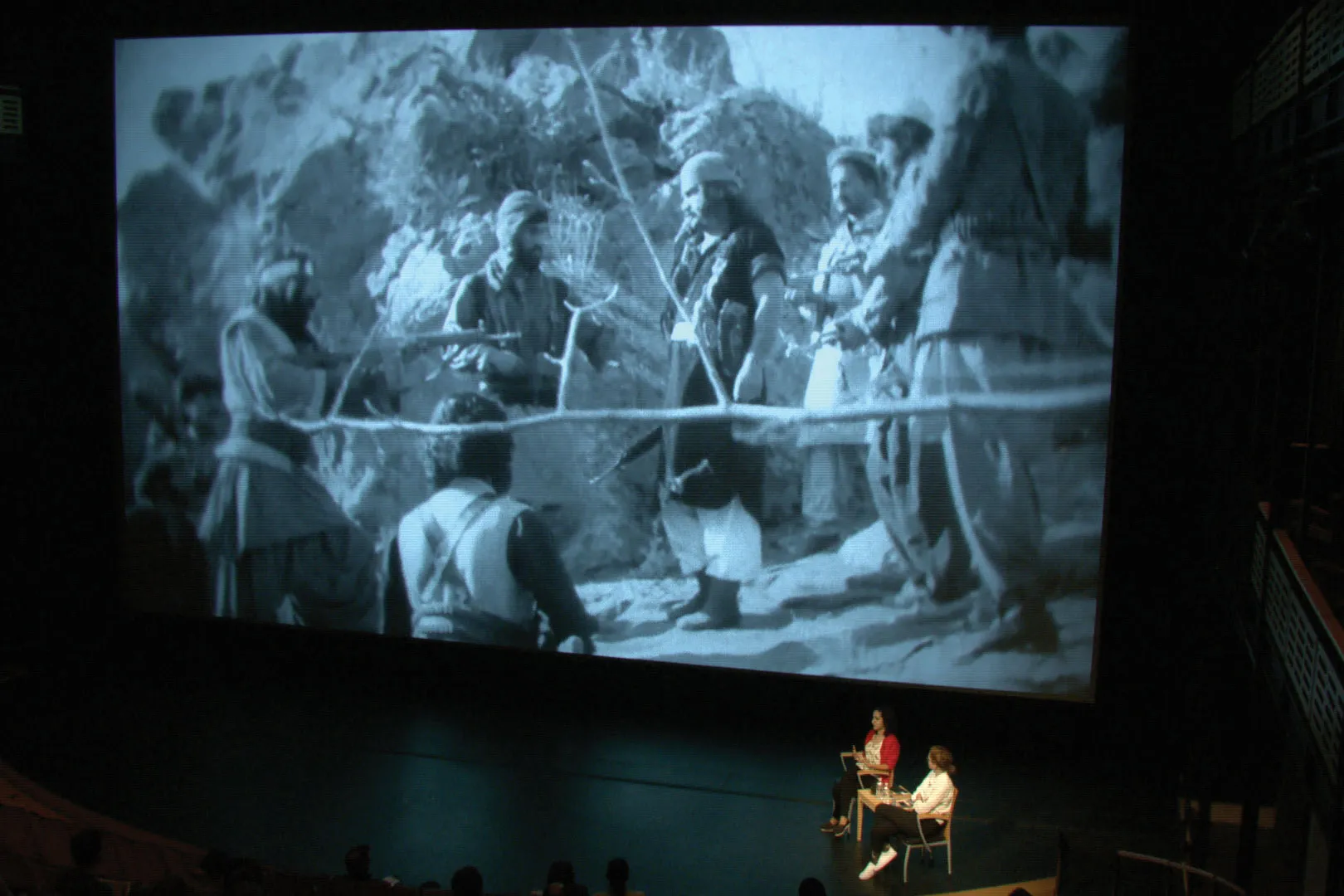
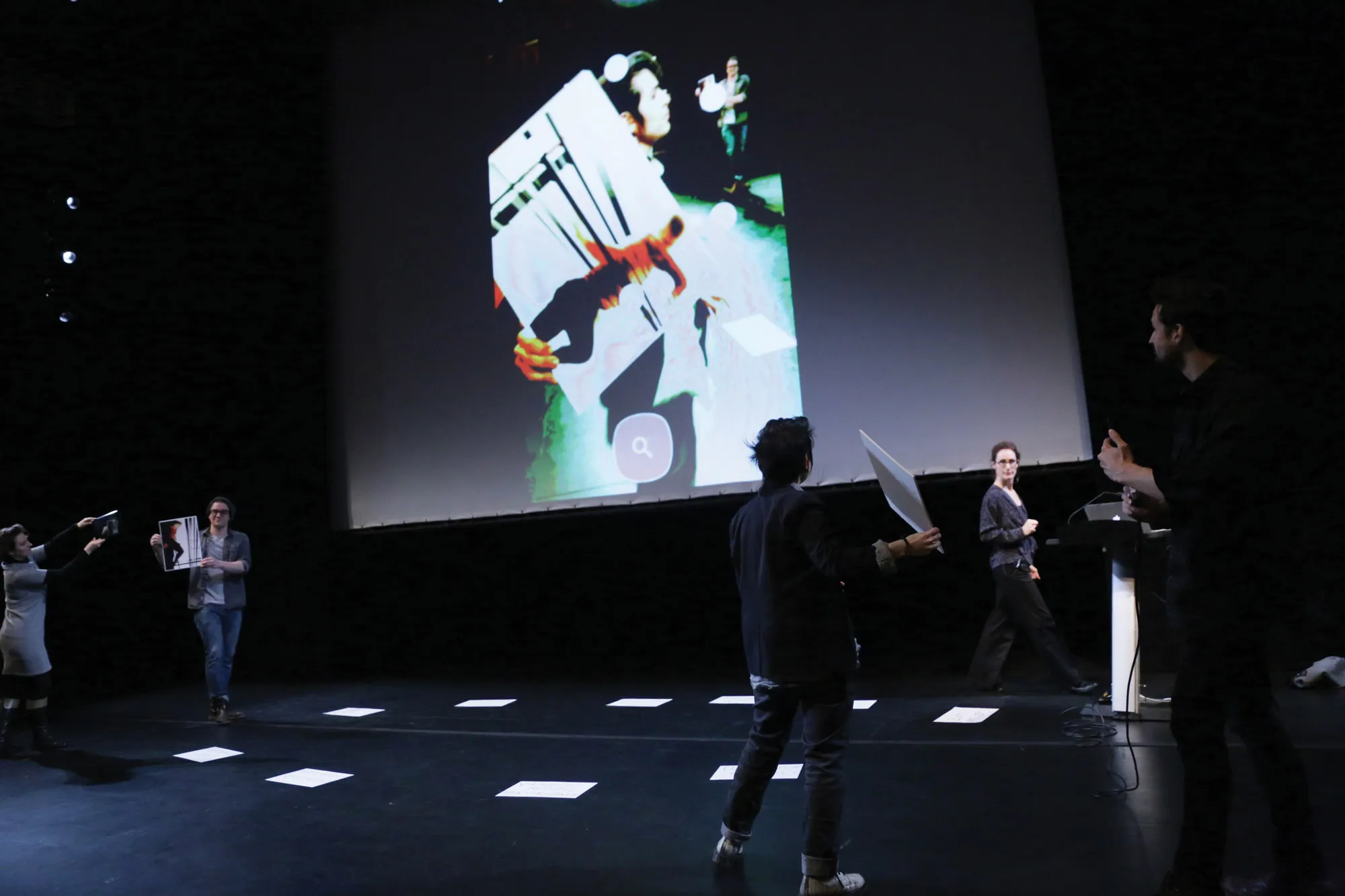
miriam ghani and Vic Brooks on stage in front of a large projection of an Afghan film.

What we Left Unfinished

Mariam Ghani

Mariam Ghani introduced several films from the Afghan Film Archive—the state film institute based in Kabul, Afghanistan—as part of her ongoing research project What we Left Unfinished. The New York-based artist also screened her own in-progress film, which explores five unfinished feature films that were made between 1978-1991, during the years of Afghan Communism. These films and her archival research gesture towards the possibility of reconstructing hidden and parallel narratives that draw on both what the images of state propaganda tell us about the political and social upheaval during a specific moment in time, and the day-to-day lived experience of the Afghan Film Archive’s management, film directors, and governmental players during this period. 

“In the research project What we Left Unfinished, I will be looking for some of these unfinished films and the people who made them, trying to decipher, from the gaps between what was finished and unfinished, some clue to the gaps between how the Afghan Left imagined its re-invention of the state and how that project went so terribly wrong—the gaps between revolution, reconciliation, and dissolution […] What, then, is the task of an artist in an archive, as she balances between the roles of archivist, historian, translator, and narrator? Perhaps it is to understand which of the archive's preserved pasts relate to the present moment of danger, and find a way to translate and narrate that past into the present, not casually, not haphazardly, and not nostalgically, but just when and where it is most needed.” —Mariam Ghani, “Field Notes for What we Left Unfinished,” IBRAAZ (June-September 2013)

Mariam Ghani’s work spans video, installation, performance, photography, and writing, and frequently turns on memory, history, language, loss and reconstruction. Ghani’s projects often engage with places, ideas, or institutions over long periods of time, and she maintains several long-standing collaborations: the experimental archive Index of the Disappeared (with Chitra Ganesh, since 2004), the video series Performed Places (with choreographer Erin Kelly and composer Qasim Naqvi, since 2006), and the Afghan Films online archive (with Pad.ma, since 2012). 

Watering the Flowers was a year-long screening program. Each evening focused on a recent film or video by an EMPAC-affiliated artist, and was succeeded by a program of other shorts or features that were influential in the making of their work, whether fiction or documentary, experimental or commercial.

Main Image: Miriam Ghani and curator Vic Brooks on the Theater stage in 2017 during her screening and talk. Photo: EMPAC.
Image
Susan Kozel in discussion in the theater.

When Performance and Philosophy Become Design Materials

Dialogues Between Dance and Interaction Design / Susan Kozel

Can we re-enact the experiences and histories of others? Are there ethical implications when affect becomes a design material? Can the performative methods currently used in human-computer interaction (HCI) design be refined and expanded using dance improvisation?

These divergent questions were starting points for media scholar Susan Kozel’s talk about body-based approaches to design and HCI. Kozel’s method is informed by the Scandinavian design context and draws from a range of somatic and improvisatory practices that feed into movement and dance improvisation. This talk emphasized the applied qualities of performativity and phenomenology, exploring the potential for practical and material performances of bodies, memories, and data. Kozel’s personal research opens out various strands from the Living Archives research project at Malmö University in Sweden. 

Susan Kozel is a Professor with the School of Arts and Culture at Malmö University whose work explores the convergence of philosophy, dance, and media technologies. Kozel’s research is foundational to understanding the body and phenomenology in digital culture. She teaches for the Interaction Design program and is Project Leader of the major research project Living Archives funded by the Swedish National Research Council. Kozel has an active artistic practice and has published widely on topics from affect to archiving, ubiquitous technologies to electronic music. Publications include the monograph Closer: Performance, Technologies, Phenomenology; and the articles “Devices of Existence: Contact Improvisation, Mobile Performances, and Dancing through Twitter” in Improvisation and Social Aesthetics, and “AffeXity: Performing Affect using Augmented Reality” in Fibreculture Journal. Kozel’s current research considers politics, philosophies, and embodied practices of what Kozel calls Affective Choreographies.

Image
a silhouetted man sitting on a bench viewing two large video screens with projections of a brick wall concrete arches.

Modern Living

Gerard & Kelly

Modern Living is a multi-chapter project by choreographers Gerard & Kelly made in collaboration with L.A. Dance Project to explore themes of queer intimacy and domestic space within legacies of modernist architecture. The project began as two site-specific dance performances, which the duo then took to EMPAC to translate into a gallery installation integrating architectural forms and video projection. This work-in-progress presentation took audiences behind the scenes of Modern Living.

In 2016, Gerard & Kelly choreographed nine dancers in performances at the landmark Schindler House in West Hollywood, CA, the site of an early experiment in communal living, and Philip Johnson’s Glass House in New Canaan, CT, where the architect and his partner David Whitney lived for over 40 years. The performances investigated the livability of queer space—
its pleasures, tensions, and impossibilities—and were filmed for the next iteration of the project. Gerard & Kelly were in residence with their technical and artistic collaborators to build the installation to scale, experimenting with architecture, projection mapping, and sound. 

Brennan Gerard and Ryan Kelly have collaborated since 2003 to create installations and performances interrogating the formation of the couple and exploring the critical potential of intimacy. Driven by an inquiry of their own partnership, the duo uses choreography, language, video, and sculpture to address questions of sexuality, memory, and the formation of queer consciousness.

Main Image: Photo: Courtesy the artist.

Image
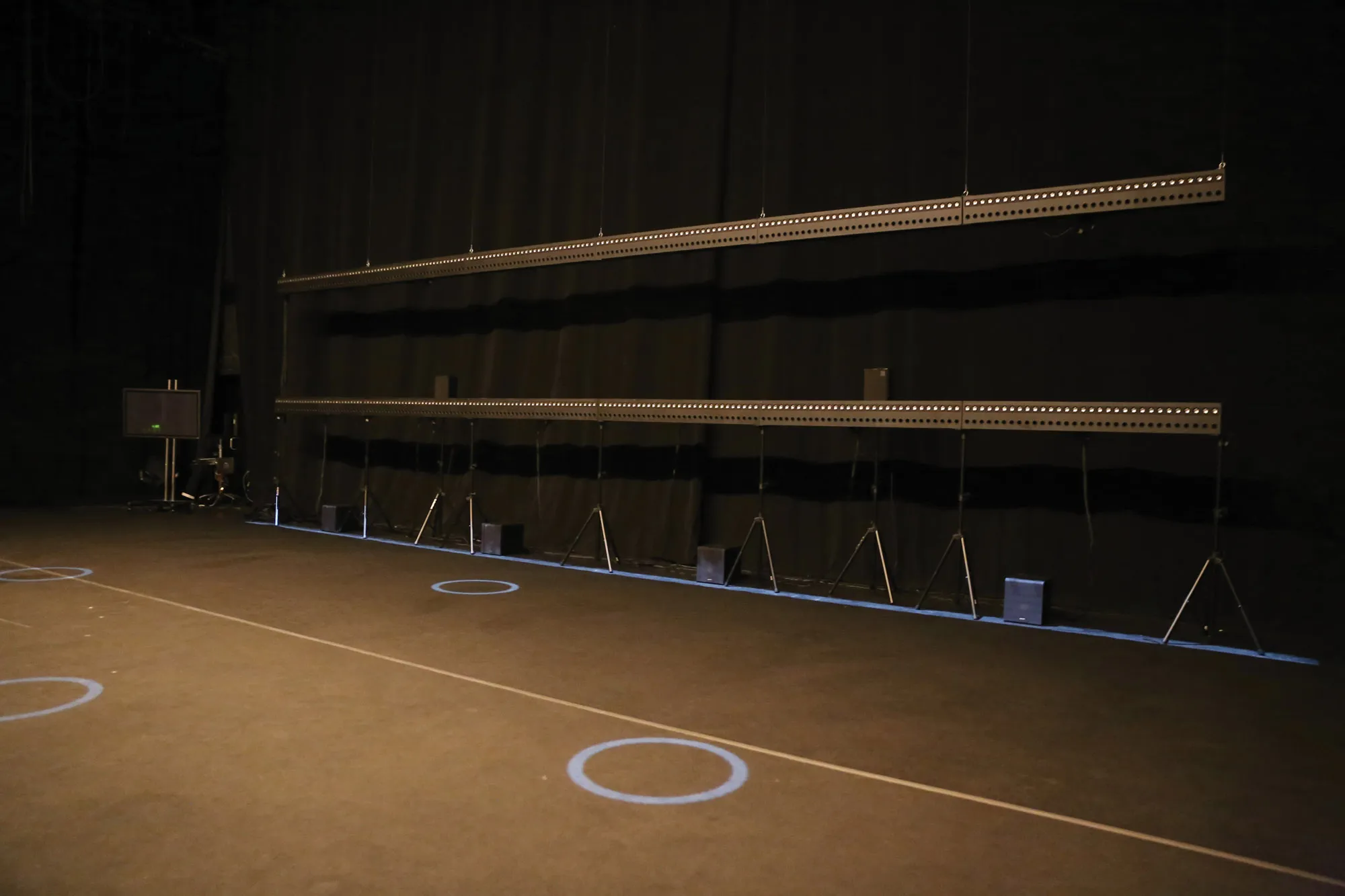
wave field synthesis in a black box studio with project blue rings of light on a black floor.

Introduction to Wave Field Synthesis

Argeo Ascani, Todd Vos, and Jeff Svatek

EMPAC’s music curator Argeo Ascani and audio engineers Todd Vos and Jeff Svatek presented a series of in-depth demonstrations and discussions of EMPAC’s 496-speaker Wave Field Synthesis audio system.

One of the most extensive systems of its kind in the world, EMPAC’s wave field array was constructed by the EMPAC audio engineering department in 2016 and the curatorial program has begun developing new work for the system in conjunction with leading electronic composers. Consisting of a large field of small speakers oriented very closely together, the system produces a virtual audio environment by localizing the source of individual sounds in space with an extreme level of precision.

In preparation for these demonstrations, the audio team undertook a series of recordings with a string quartet consisting of Leah Zelnick (violin), Brooke Quiggins (violin), Stefanie Taylor (viola), and Caleigh Drane (cello). The recordings were spatialized using the Wave Field array and integrated with overhead lighting that gave listeners a visual cue for where to find each instrument virtually positioned in the room.

Main Image: The wave field synthesis array in studio 1, 2017.

Image
sarah Juliet lauro.

Kill the Overseer! Playing the Rebel Slave in Videogames

Sarah Juliet Lauro

In a video game demo and talk, Sarah Juliet Lauro will discuss how resistance to slavery is represented in video and computer games. Lauro will profile many games that feature this narrative and will demo an art game being developed by students at the University of Southern California called Thralled, which focuses on a runaway slave in Brazil. During the day leading up to her evening talk, Lauro will demo chapter one of Thralled in Evelyn’s Café on EMPAC’s 5th floor. This chapter features the playable character Isaura, who attempts to flee slavery through the rainforest with her infant in her arms. On her journey, Isaura encounters many obstacles as she is pursued by a ghostly specter. Lauro will then expand on this storyline in her talk Kill the Overseer! Playing the Rebel Slave in Videogames, which will consider race, empathy, and power dynamics between players and characters in game-based digital commemorations of slave revolt.

Main Image: Sarah Juliet Lauro speaking in the theater in 2017.

Media

Sarah Juliet Lauro presenting her talk in the Theater in February, 2017.

Image
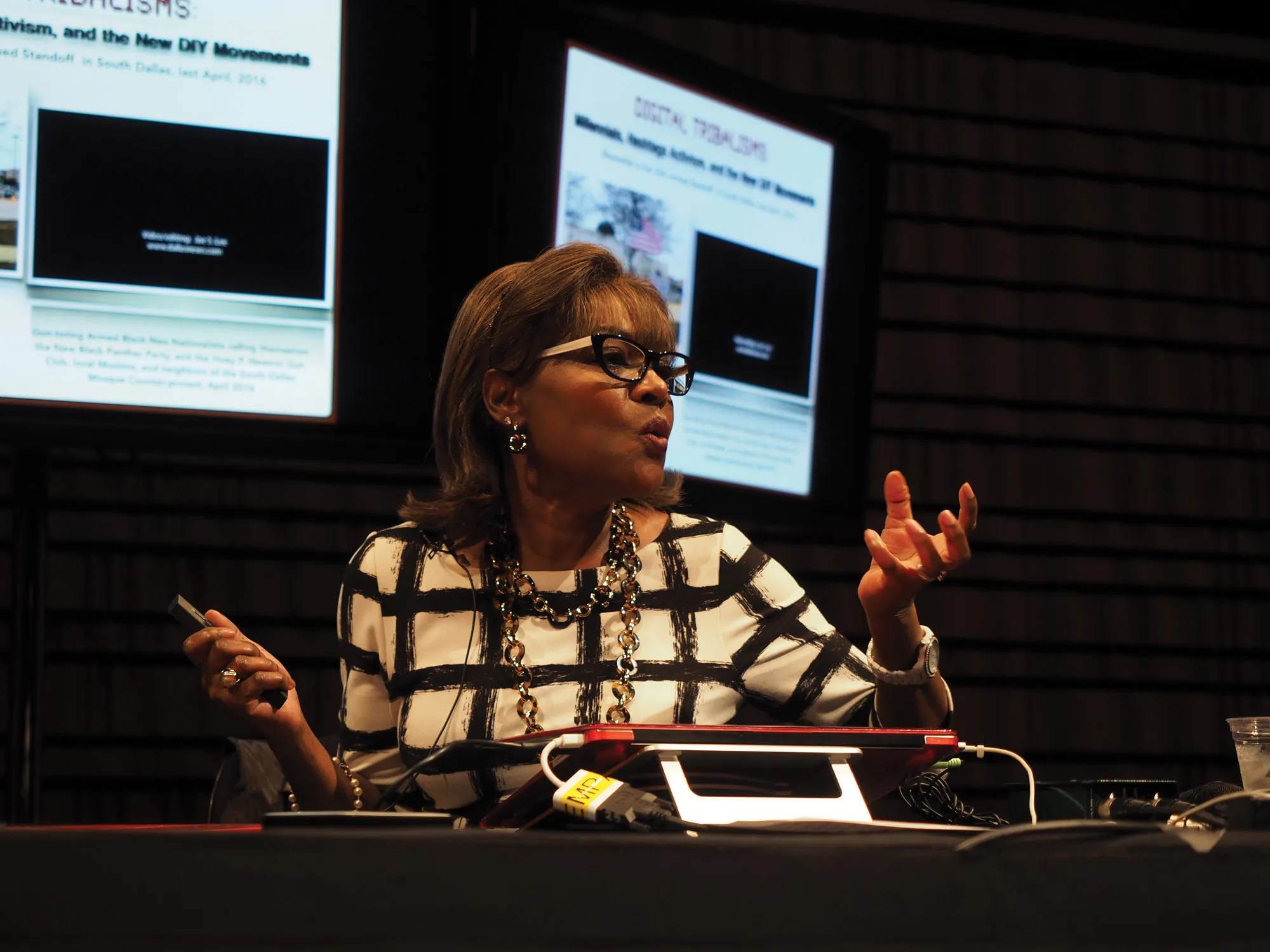
anna everett.

Digital Tribalisms

Millennials, Hashtag Activism, and the New DIY Movements / Anna Everett

What do Pokemon GO and Black Lives Matter have in common? Anna Everett will look at how Millennials simultaneously negate and nurture contemporary moral panics about the dangers of excessive computer use. From fears of violent video game addiction, distracted driving, sexting by minors, online terrorist radicalization, to charges of arrested basic social skills and more, stereotypes of selfie-obsessed youths abound. And yet, there is an important sociocultural recalibration occurring among youth of the 21st century who have harnessed the power of ubiquitous computing to transform interactive media culture and reinvent participatory democracy.

At its core, Everett’s talk considers today’s do-it-yourself tech-toting cultural practitioners who have ushered in a dizzying array of new social formations and relations, including social media proliferation and innovation, hashtag activism, and other transnational activist movements. Everett will unpack how DIY creative ethos has enabled tech-savvy Millennials to reshape society and culture in their own image of inclusive digital tribalism, exemplified by the Black Lives Matter, Occupy, Bring Back Our Girls, and even the Pokemon GO movements.

In so doing, she will suggest that Millennials’ practices of digital nativism represent a new promise and a new hope for sociocultural cohesion and multicultural unity, especially at this urgent time of political upheaval and social uncertainty.

Main Image: Anna Everett speaking in the concert hall in 2017. Photo: EMPAC

Magic Electronics

Laure Prouvost

Magic Electronics is a 2014 work by French artist Laure Prouvost, in which she installed moving lights and synched audio into a gallery in order to animate and narrate her exhibition of objects. In doing so, she transformed the static exhibition into a stage. Magic Electronics is exemplary of an approach that slips between formats (video, sculpture, installation) and reg- isters (speech, image, object, light), deliberately mistranslating and misunderstanding as it goes.

Magic Electronics figured as the center of an evening-long conversation between Prouvost and EMPAC curator Vic Brooks during which the pair screened and discussed a selection of Prouvost’s work, taking the audience on a jour- ney from the pre-recorded and situated to the live and one-off. Prouvost was in residence at EMPAC to develop a new performance, which will be premiered alongside her solo exhibition at Walker Art Center in 2017–18.

Image
two women hold their arms in a bent T shape in a black box studio.

Black Power of Hip Hop Dance: On Kinesthetic Politics

Naomi Bragin

Hip hop dancer, choreographer, and scholar Naomi Bragin led a workshop on the dance style known as the Robot, Robotting, or Botting. She introduced the basic steps and movements of Robotting and contextualized them within the history and practice of street dance. Participants were invited to take part in a dance workshop featuring the freestyle circle, a collective improvisation fundamental to black expressive dance practices. Bragin also addressed the complex relationship between kinesthesia, politics, and technology, and how this relationship enables our understanding of hip hop culture. The workshop explored what happens when the body is the robot and the robot is the body on the street.

Naomi Bragin is assistant professor in the school of Interdisciplinary Arts and Sciences at University of Washington Bothell. Drawing from 20 years dancing in clubs, the streets, and onstage, she researches the intersections of dance, popular culture, media, and black political theory, attending to issues of cultural appropriation and aesthetic politics. Bragin is the founder of DREAM Dance Company, for which she was the recipient of a Ford Foundation Future Aesthetics Artist Award, a Zellerbach Foundation Grant, and was a California Arts Council Artist-in-Residence.

Main Image: Ms Bragan during a workshop at EMPAC during Fall, 2016.

Media

Naomi Bragin presenting her talk in the Theatre in October, 2016. 

Image
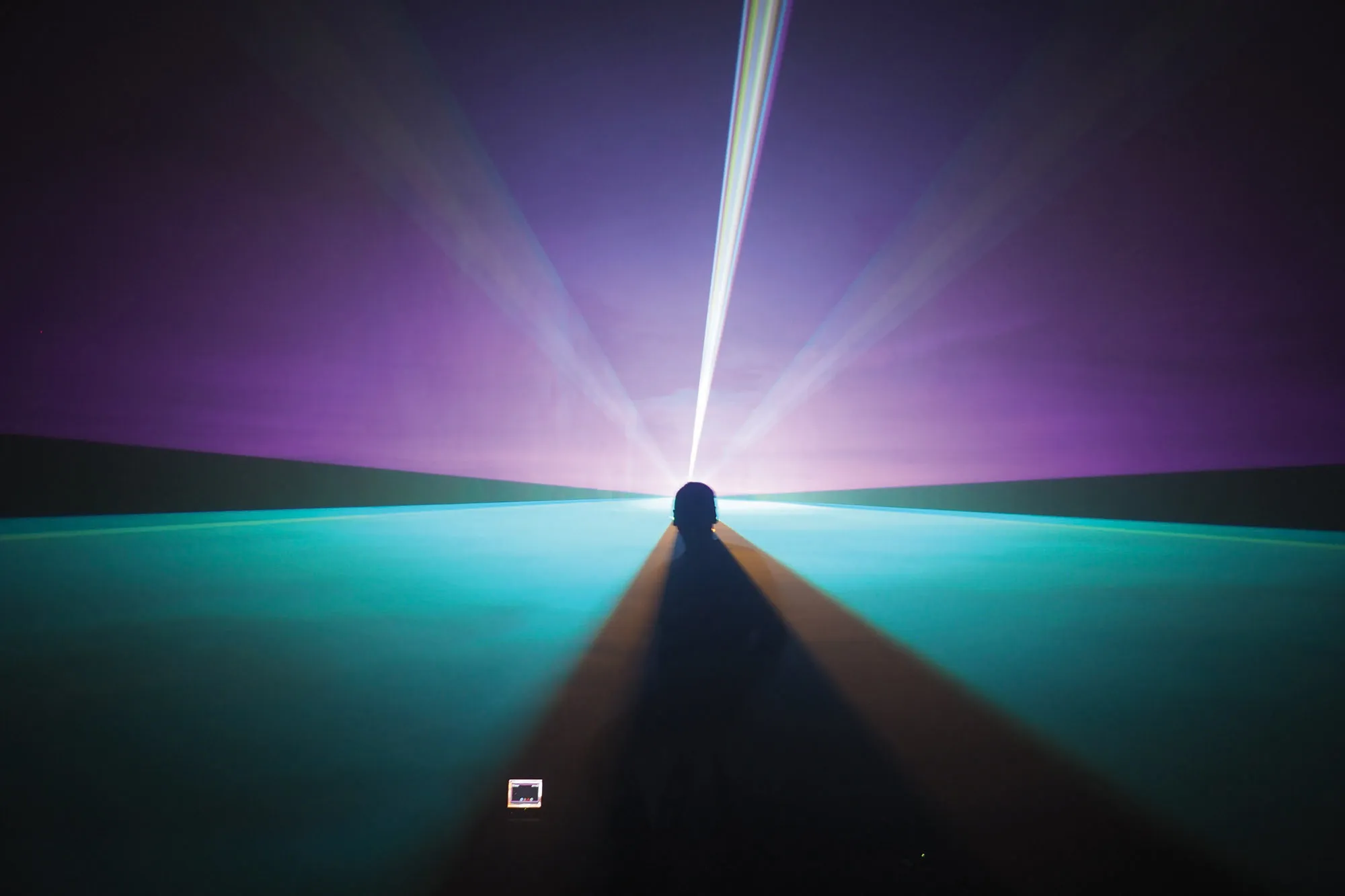
teal and purple light converging at a single point on stage in the theater.

Magic Electronics

Laure Prouvost

Magic Electronics is a 2014 work by French artist Laure Prouvost, in which she installed moving lights and synched audio into a gallery in order to animate and narrate her exhibition of objects. In doing so, she transformed the static exhibition into a stage. Magic Electronics is exemplary of an approach that slips between formats (video, sculpture, installation) and registers (speech, image, object, light), deliberately mistranslating and misunderstanding as it goes.

Magic Electronics figured as the center of an evening-long conversation between Prouvost and EMPAC curator Vic Brooks during which the pair screened and discussed a selection of Prouvost’s work, taking the audience on a journey from the pre-recorded and situated to the live and one-off. Prouvost was in residence at EMPAC to develop a new performance, which will be premiered alongside her solo exhibition at Walker Art Center in 2017–18. 

Main Image: Magic Electronics 2016. Photo: Courtesy the artist.