Image
Karen Barad

Karen Barad

Histories of Now: Time Diffractions, Virtuality, and Material Imaginings

In this talk, physicist and feminist theorist Karen Barad discussed her recent work on time and her reflections on the entanglement of time and materiality. 

Karen Barad is professor of feminist studies, philosophy, and history of consciousness at the University of California at Santa Cruz. Barad holds a PhD in theoretical particle physics and quantum field theory, and was tenured in the Physics Department at UCSC before moving into more interdisciplinary spaces. Barad is the author of Meeting the Universe Halfway: Quantum Physics and the Entanglement of Matter and Meaning (Duke University Press, 2007) and numerous articles in the fields of physics, philosophy, science studies, poststructuralist theory, and feminist theory. She is the co-director of the Science & Justice Graduate Training Program at UCSC.

Material Performance was a series of talks focused on materiality and time—how material and passing time can be seen as reciprocal conditions for each other’s qualities. The series brought together material scientists, biochemists, philosophers, curators, and media theorists to unravel the relationship of time and materiality within each discipline.

Luca Turin

Why Does Consciousness Dissolve in Chloroform? The Story of an Enduring Mystery

What is time? Does our understanding of time depend on the human mind in some fundamental way? Biophysicist Luca Turin investigates one of the stranger mysteries of human consciousness in this presentation, using images and 3D animations to share the many unusual discoveries from his research with general anesthesia and its influence an internal sense of duration. Unlike sleep, time essentially stops for the anesthetized subject, who frequently wakes with a feeling of “the next thing I knew...” In Why Does Consciousness Dissolve in Chloroform, Turin will combine his characteristic wit and scientific rigor to unwind this bizarre phenomenon, finding at its heart a richer understanding of the human mind and the strange conditions we’re given to understand through it.

Biophysicist Luca Turin was born in 1953 in Beirut, Lebanon. He received his French baccalauréat in 1970, and his PhD in physiology and biophysics in 1978 from University College London. Turin worked at The French National Center for Scientific Research from 1982 to 1992, and was a lecturer in biophysics at University College London from 1992 to 2000. He was the CTO of a startup company creating new fragrance and flavor molecules until 2009. He's the author of Perfumes: The Guide, and the subject of Chandler Burr's 2003 book The Emperor of Scent. He worked at MIT from 2009 to 2011 and at the Alexander Fleming Institute in Athens, Greece from 2011 to 2013. Turin is currently a visiting professor at the Institute for Theoretical Physics in Ulm, Germany, and writes a column for the Zurich-based monthly NZZ Folio. He is also the perfume critic of Style Arabia.

Material Performance was a series of talks focused on materiality and time—how material and passing time can be seen as reciprocal conditions for each other’s qualities. The series brought together material scientists, biochemists, philosophers, curators, and media theorists to unravel the relationship of time and materiality within each discipline.

Image
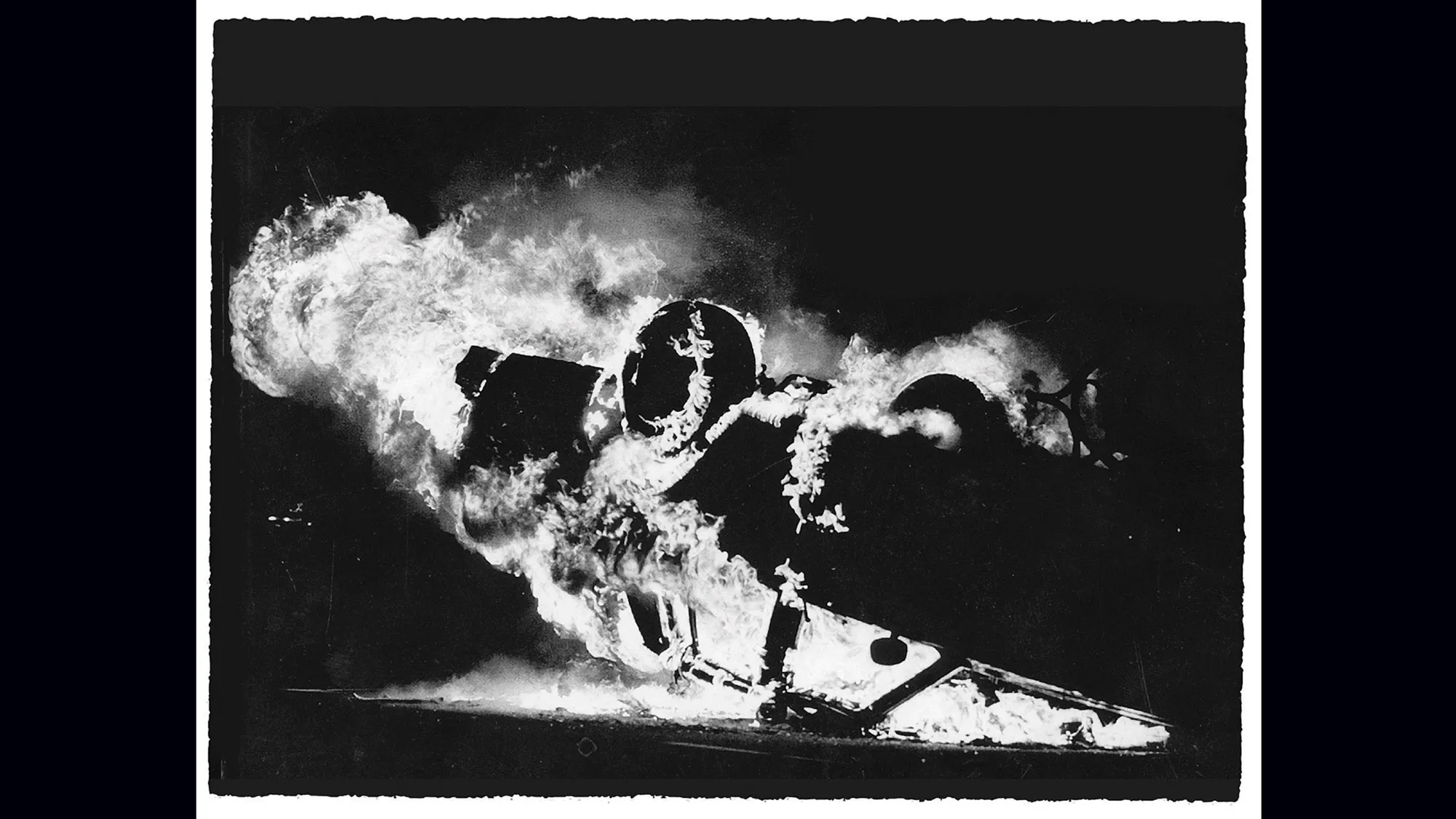
A car engulfed in flames, flipped on its back.

Thomas Zummer

On the Notion of ‘Capture’: arché, techné, epistemé

What happens when one writes about or photographs another? In this talk, artist and scholar Thomas Zummer addressed the idea of “capturing” subjects in media—photography, cinema, radio, digital video, transmission—and how the captured subject is drawn into the fabricated media space while its own world is forcibly occluded. Zummer traces this phenomenon through the depiction of places, people, and events in all such media—how the media start to “speak for” the captured, take the place of the captured, and make the otherness of the captured disappear. 

Thomas Zummer is a scholar, writer, artist, designer, and curator. He is the founder and director of Z-Grafik, a design bureau based in Brussels and New York City. His drawings and sculptural works are exhibited worldwide.

Material Performance was a series of talks focused on materiality and time—how material and passing time can be seen as reciprocal conditions for each other’s qualities. The series brought together material scientists, biochemists, philosophers, curators, and media theorists to unravel the relationship of time and materiality within each discipline.

Image
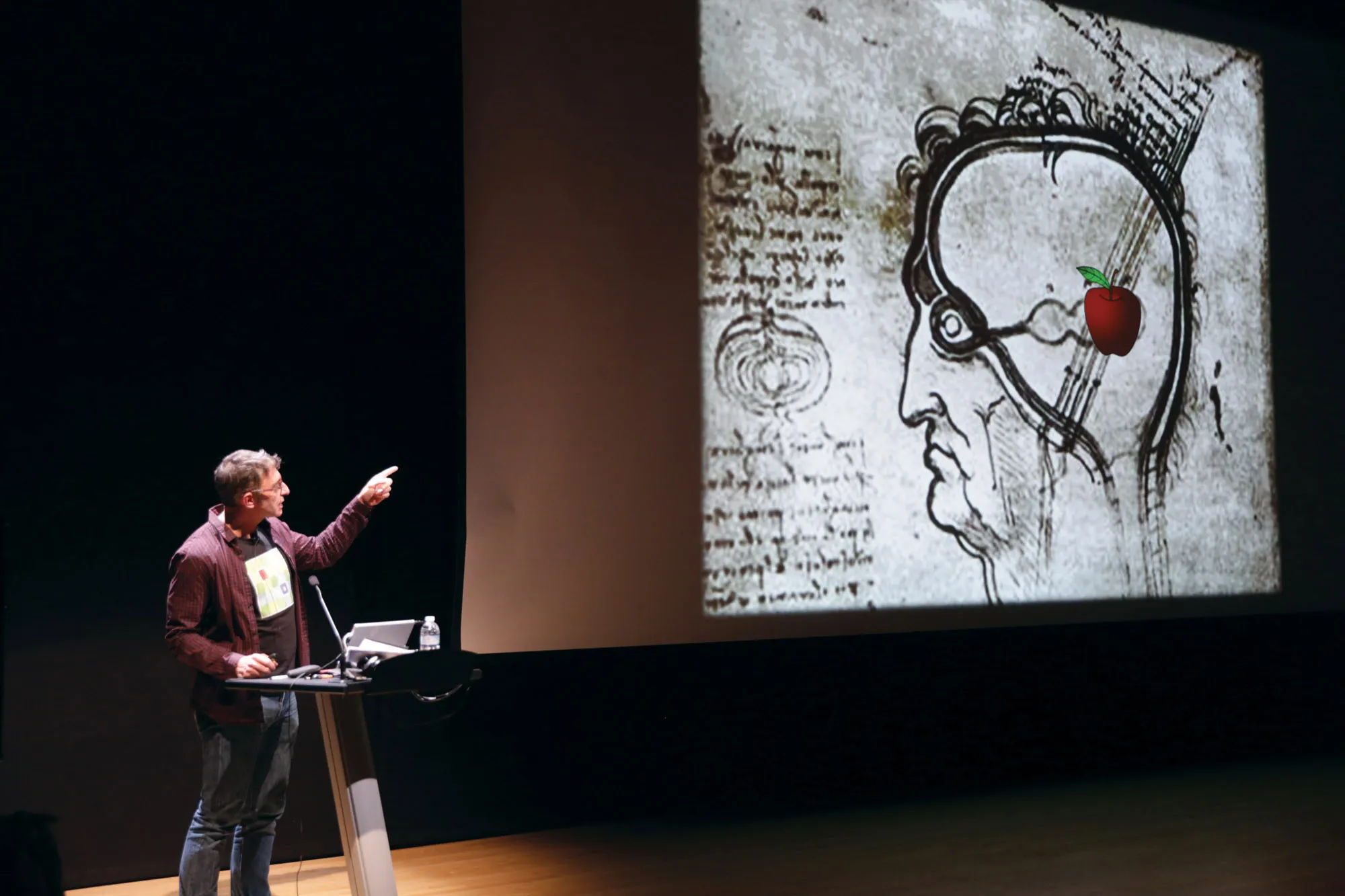
A man on stage pointing at a large screen to his left that is projecting a profile of a man, drawn by Leonardo da Vinci with an emoji apple

Riccardo Manzotti

The Spread Mind

According to popular wisdom, consciousness takes place inside the mind, something with which Galileo, neuroscience, and the movie The Matrix would all agree. How are neurons able to create this internal mental world? Scientists have gone so far as to conclude that most of what we see around us exists only as an acquired image in the mind of the spectator, separated from what is perceived.

In this talk, Riccardo Manzotti will make the case for “externalism,” or consciousness that spreads beyond the brain, out into the world. Our minds exist both in front of our eyes and behind them. The individual doesn’t see a world; he is part of a world process. To support this claim, Manzotti will demonstrate a causal account of the object, examining several “internalist” arguments (e.g., illusions, phosphenes, hallucinations, Charles Bonnet syndrome, phantom limb pain, and dreams), showing how each is actually compatible with an “externalist” view of the mind.

Manzotti will contrast this externalist view with known empirical evidence and the most widespread models of the mind, both in philosophy and in neuroscience, to show that our minds cannot be said to have any one true owner.

Presented in conjunction with Melvin Moti's installation The Vision Machine

Riccardo Manzotti is a philosopher, psychologist, and artificial intelligence scholar. He earned his PhD in robotics and is currently a Fulbright visiting scholar at MIT’s Department of Linguistics and Philosophy. His work has made significant contributions to the problem of consciousness, the possibility of outlining a physical model of phenomenal experience, and the relationship between mind and world. Much of Manzotti’s research has focused on the concept of the “Spread Mind,” which challenges the traditional separation between subject and object. This view suggests that the conscious mind is larger than any single body.

Manzotti has published more than 100 scientific papers, and has written two books that explore the place of consciousness in the physical world: Conscienza e Realtà (2001) and L’esperienza (2008). He also co-edited two books for Imprint Academice: Artificial Consciousness (2008) and Situated Aesthetics (2011).

Born in Parma, Italy, Manzotti attended the University of Genoa, where he received degrees in computer science and philosophy. He conducted postdoctoral research on artificial vision and artificial intelligence at the LIRA-Lab in Genoa, Italy, and has held positions at Northwestern University, Trinity College, and KAIST in Dajeon, South Korea.


Main Image: Riccardo Manzotti on the Theater stage. Photo: EMPAC/Rensselaer

Speaking So To Speak

Johannes Goebel

The point of departure: without language there is no art. Art is not congruent with language. And certainly art can be made with words. This talk will be many words about words to create a view of what is beyond that which is said.

Art, any kind of art, was only possible once we had language and were wondering about the meaning of life. Art can be a sword that cuts through language. It can let us experience something beyond language, beyond right and wrong, on this side of yesterday and tomorrow.

There is a lot of talking and thinking before art is made.

There is a lot of speaking after experiencing art. There is a lot of past and a lot of future outside of an artwork, which in turn shapes how the work appears and approaches us and how we approach it. A work of art can only be alive in the moment when we experience it. We use language to shape past and future. When we talk or write and reflect and ponder on art, we are outside of the experience. Which is just fine—but different.

Johannes Goebel has been chasing the moment between past and future, even though it was always present. He started with words and music and then built instruments out of wood and metal and digital code. He did many things during the chase, like everyone does. Stop the chase, he was told. For the past 14 years he has been lucky and happy, having been hired to contribute to creating EMPAC at Rensselaer as a building and program.

Image
Avital Ronell

Avital Ronell

The Test Drive

New York University professor Avital Ronell explored our contemporary cultural obsession with testing. We increasingly use tests to determine what is true, in fields ranging from science to athletics to law and education. What is the origin of this incessant drive to test? 

Ronell is a professor of humanities and of German, English, and comparative literature at New York University, where she co-directs the Trauma and Violence Transdisciplinary Studies program. She is also the Jacques Derrida Professor of Media and Philosophy at the European Graduate School in Switzerland. She is the author of Dictations: On Haunted Writing, The Telephone Book, Crack Wars, Finitude’s Score, Stupidity, The Test Drive, and Fighting Theory.

In Other Words included six artists who delivered lecture-performances, juxtaposed with talks by six thinkers in order to cross boundaries and make dialogue a continuous process of renewal. This talk was presented in conjunction with Xavier Le Roy’s performance Product of Circumstances (see page 100).

This talk is presented in conjunction with Xavier Le Roy’s performance Product of Circumstances.

Media

Christel Vesters

CANCELED

This talk has been canceled due to illness. We apologize for any inconvenience this may cause. -- In her talk, Christel Vesters will reflect on the concept of ‘visual art as knowledge’ and the idea of art as resistant knowledge, or, as the South African art historian Sarat Maharaj formulates it, art generating its own epistemological map. The lecture will explore different examples in which artists and other cultural producers over the years have challenged the dominant ideas around knowledge and knowledge production, especially those projects that adopt or imitate the structures, systems and devices of ‘official’ knowledge systems and tweak, question or subvert their ‘canonical’ status, whilst at the same time proposing an alternative.

Image
Thomas Keenan on stage in front of a large projection of an image of Patricia Hearst robbing a bank

Thomas Keenan

New Media, New Documents: On Images, Examples, and Evidence

In this EMPAC commissioned talk, Thomas Keenan will consider new forms of documentary in relation to the rise of social media.

This talk is presented in conjunction with Rabih Mroue’s performance 33RPM.

Thomas Keenan teaches media theory and human rights at Bard College, where he directs the Human Rights Project and helped create the first undergraduate degree program in human rights in the United States. He is the author of Fables of Responsibility (Stanford University Press, 1997), and co-author with Eyal Weizman on Mengele’s Skull (Sternberg, 2012). He is co-editor, with Wendy Chun, of New Media, Old Media (Routledge, 2006), and of The Human Snapshot (Luma/Sternberg/CCS, 2013) with Tirdad Zolghadr. He curated Antiphotojournalism with Carles Guerra (Barcelona and Amsterdam, 2010-11), and Aid and Abet (Quebec, 2011). Keenan has served on the boards of a number of human rights organizations and journals, including WITNESS, Scholars at Risk, the Crimes of War Project, the Journal of Human Rights, and Humanity.

Main Image: Thomas Keenan on stage in the theater in 2014. Video still: EMPAC/Rensselaer.

Media
Image
A group of nine people sitting around a conference table in active discussion in a dark room.

Held In Trust

Caitlin Berrigan, Annie Dorsen, David Levine, Ryan McNamera, Laura Mott, Michael Oatman, and Marnix Rummens

Held in Trust examined the intangible economies of trust that underpin participatory, performative, and interactive works. Hybridized works that exist between the structures and behavioral codes of visual arts and performing arts, and that challenge inherited forms of spectatorship, ask individuals to act outside of familiar parameters. These situations can be riddled with anxiety, and place pressure on the tacit trust between the audience, the artist, and the institution.

This colloquium was an interdisciplinary inquiry into the nature of trust, and considered its inflection within power relations, raising issues such as agency, ethics, and hospitality. It considered polarizing theoretical terms used to conjure audiences, and the critical concepts that limn discussions around these artistic practices. 

The Jaffe Colloquia were a series of exchanges bringing together small groups of artists, curators, and theorists to informally discuss ideas centered around the conditions of, and perspectives on, time-based arts. 

Image
a woman giving a talk on a black stage in front of a projection of a 1500's sketch.

Low Relief

Lucy Raven

In this illustrated lecture, Lucy Raven investigated depictions of spatial depth and the roots of 3D image making. An introduction to one aspect of her extensive research into how we see images and how images are made, Low Relief focused on the history and evolution of contemporary applications of 3D film technologies. Winding through a wide range of research and materials, Raven linked two lines of inquiry: an art-historical reading of both American and Indian bas-relief sculpture, and the outsourcing of the laborious 2D-to-3D conversion process of Hollywood movies to Mumbai-based production houses. In doing so, she explored the fluid cultural perception of spatial depth and uncovered the mechanisms of industrial cinema processes through analysis of the transnational circulation of labor and materials.

Lucy Raven’s work has been included in exhibitions and screenings internationally including Curtains, Portikus, Frankfurt (2014); Hammer Projects, the Hammer Museum, LA (2013); Whitney Biennial, Whitney Museum of American Art, New York (2012); and 11 Rooms, Manchester International Festival, Manchester, United Kingdom (2011). She teaches at the Cooper Union School of Art and the School of Visual Arts in New York City.

Main Image: Lucy Raven presents Low Relief in the theater, 2014. Photo: Mick Bello/EMPAC.