Image
a nude woman on a black stage laying face down with arms under her body

Serpentine

Daina Ashbee

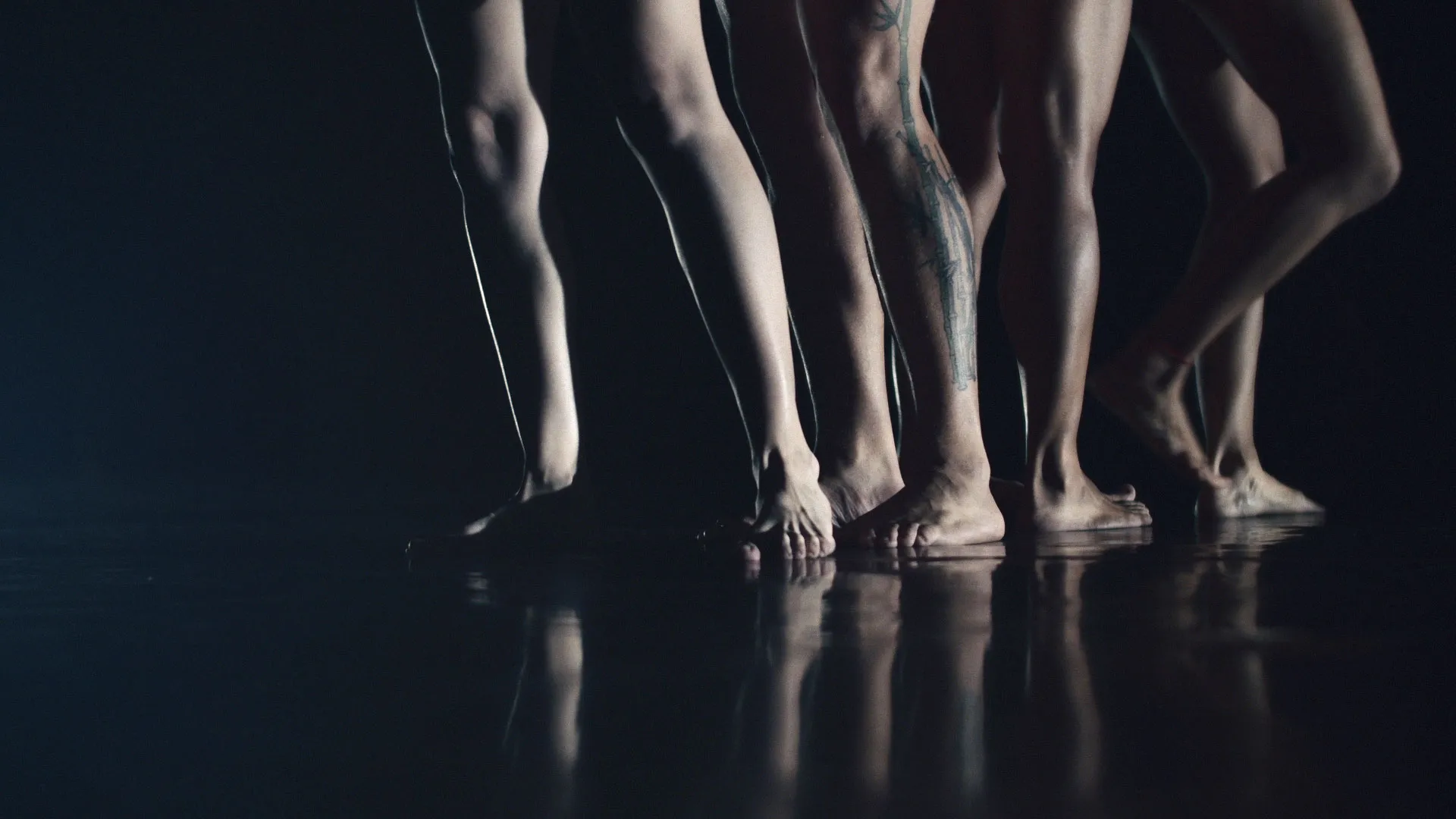
Serpentine is a solo performance that centralizes choreographic repetition and insistence to explore the occupation of space, time, and attention over the course of two hours. It will be installed in the Lobby of EMPAC. What is designed as a cathartic work for a performer, or interpreter, is staged in close proximity to an audience who might be moved to find their own relationship to repetition and insistence. 

The work vibrates the essence of choreographer Daina Ashbee’s dark and feminine oeuvre and intensely summarizes the artist’s previous three works, Unrelated (2014), When the ice melts, will we drink the water? (2016) and Pour (2016). Each of these performances features subtly specific choreographic exploration and simple imagery that is meant to resonate with many different viewers. At its core, the work is a deep study of bodies in movement as they relate to their environment; cultural, social, performative, and natural circumstances. 

Serpentine includes original electric organ composition by Jean-Francois Blouin. The haunting electric organ creates sonic space for slow, sensual movement to escalate in its violence.

Main Image: Serpentine (2022). Photo: Arnaud Caravielhe

Image
a drone flying with a walkie talkie

Title 42, or, The Flight of the Pallindrone

Ricardo Domingeuz & Amy Sara Carroll

The talk tonight at EMPAC is canceled due to weather delays from tropical storm Nicole. Please join Ricardo and Amy for their workshop at the Sanctuary for Independent Media Thursday at 7PM. Check the Sanctuary website for the most up-to-date information on Thursday.

--

In this talk, Ricardo Dominguez and Amy Sara Carroll of the collective Electronic Disturbance Theater 2.0 discuss a brief history of the collective’s previous work in relation to borders; the relationship between NAFTA, US Prevention through Deterrence philosophy, the binational War on Drugs, and the emergence of border art as genre. 

Each decade of the twentieth century triggered draconian refinements of the “border horror” of U.S. immigration policy. Resulting borderization in the twenty-first century continues as such, now with blurred divides between the flow of goods and the blockage of human beings. Supply chain disruptions and queued shipping containers and the US invocation of Title 42 and “Stay in Mexico” policies, while never comparable, are in equal measure “products” of COVID-19.

Among others, the artists will reflect on the influences, production and distribution challenges, and discordant reception of the collective’s Transborder Immigrant Tool, a project that debuted fifteen years ago. This project consists of an app designed to provide sustenance in grueling desert conditions like those that abut the US-Mexico Border. The app consists of poetry and a navigational system that points users toward water sources provided by humanitarian aid organizations like Water Station Inc.

The talk concludes with a discussion of Carroll and Dominguez’s new work-in-progress theater production, “The Flight of the Palindrone.” This project instrumentalizes drone activity to provide a sonic theatrical intervention that plays on surveillance technologies in the Mexican-U.S. borderlands, the participation of the University of California, San Diego (the artists’ own institution) in the research and development of unmanned aerial vehicles, and regional eco-catastrophe—all within the context of Carroll and Dominguez’s continued commitment to translanguaging and the artivist gesture. 

In addition to this talk, Amy Sara Carroll and Ricardo Dominguez will host a workshop from 7-9PM on Thursday November 10, 2022 at The Sanctuary for Independent Media in North Troy, NY. 

The Flight of the Palindrone by Electronic Disturbance Theater 2.0. Courtesy the artists. Photo: Gallery@QI (2022).

Image
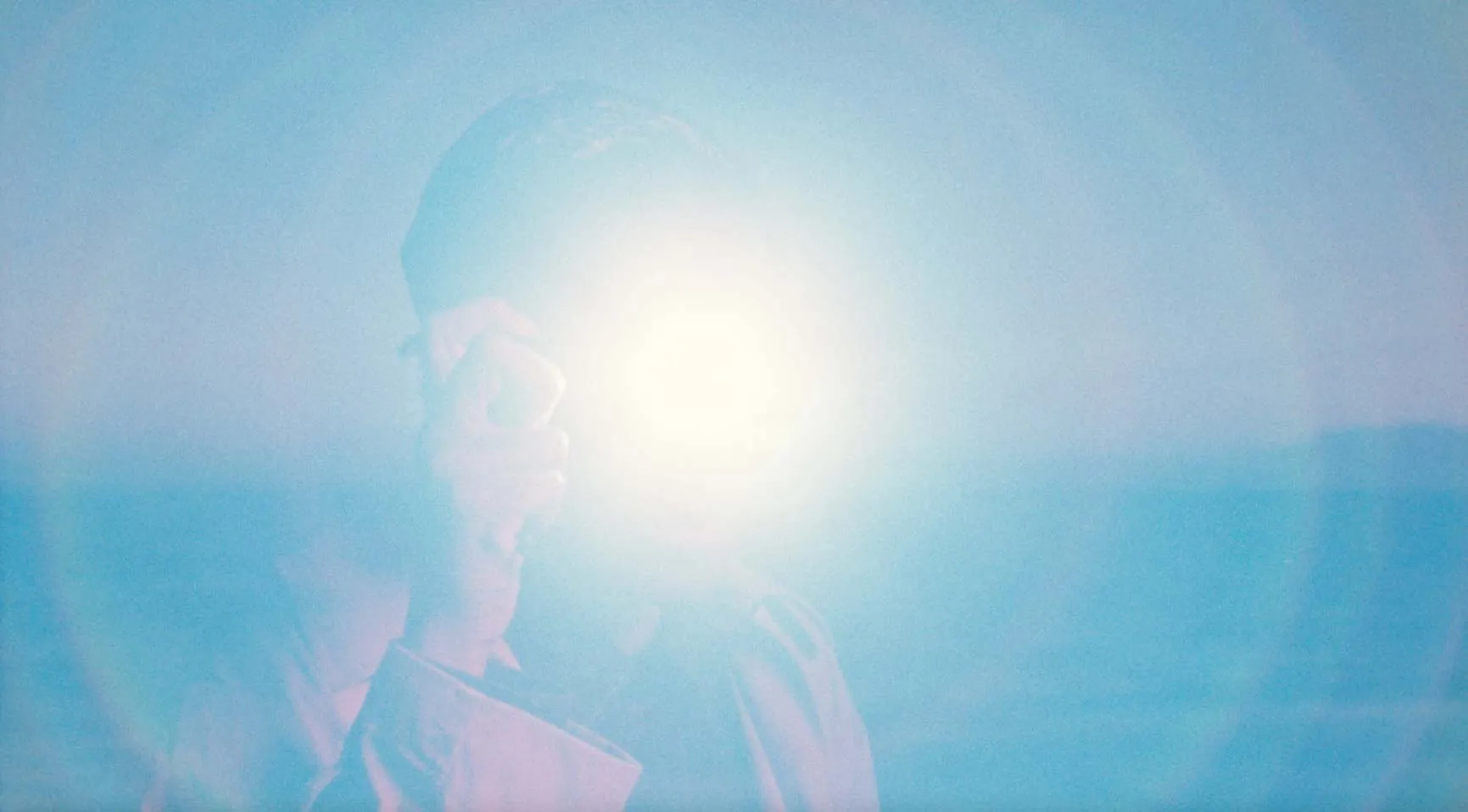
Adam Weinert Film Still

ANTHEM

Adam Weinert

What would our anthem be if we wrote it today? What would it sound like, look like, and who should it serve?

Adam Weinert spent years investigating imagery of The American Dream and the radical patriotism of early American modern dance. In his new EMPAC-commissioned ANTHEM, Weinert seeks to reconcile dewy Americana with our society’s deep fissures, inequalities, and environmental degradation.

The movement in ANTHEM draws from a fake news article describing imagined original choreography from 1916 meant to accompany the national anthem. The performers begin to dissect the song and its various incarnations to relate it to a 21st-century America. The choreography reinforces the familiar and patriotic sounds of American nostalgia, yet, the work takes us into new territory that is only achievable through systems of mutual support.

Main Image: Video still from trailer for Adam Weinert’s ANTHEM. Cinematography by Zia Anger.

Media
Image
A Black woman wearing glasses and long braids looks toward the camera with head cocked in a room with red walls and patterned drapes.

The Inheritance

Ephraim Asili

Join us for a special screening of Ephraim Asili’s debut feature-film The Inheritance (2020), produced at EMPAC on a film set constructed in Studio 1—Goodman. The screening will be followed by a Q&A with the artist. 

Ephraim Asili’s The Inheritance weaves histories of the West Philadelphia–based MOVE Organization, the Black Arts Movement, and dramatizations of the life of the filmmaker when he was a member of a Black activist collective. Centering on what Asili describes as a “speculative reenactment” of his time in a West Philadelphia collective, the actors scripted lives on set are entwined with cameos by MOVE's Debbie Africa, Mike Africa Sr., and Mike Africa Jr., and poet-activists Sonia Sanchez and Ursula Rucker.

After the EMPAC preview of The Inheritance in Spring 2020 was postponed due to COVID-19 protocols, it premiered at Toronto International Film Festival and went on to screen at festivals and museums around the world including the New York Film Festival and the National Gallery of Art. The film was awarded the Grand Prize at Paris film festival Cinéma du Réel in 2021.

Main Image: Ephraim Asili, Production still from The Inheritance. Photo: Mick Bello/EMPAC.

Media

Trailer: Ephraim Asilis' The Inheritance (2020). 

Image
Pauline Oliveros triptych

Deep Listening: The Story of Pauline Oliveros

Daniel Weintraub

Join us for a special preview of director Daniel Weintraub's new feature-length film, Deep Listening: The Story of Pauline Oliveros, a documentary that traces the life and work of visionary composer, musician, teacher, technological innovator, and Rensselaer distinguished research professor of music Pauline Oliveros (1932–2016).

An electronic music pioneer, Oliveros' approach to composition sought to produce a place, sound, and experience outside the normative conventions of Western music. Dispensing with the primacy of the concert hall, the virtuosic musician, and the hierarchically disciplined relationship of audience and performer, Oliveros instead approached music through Deep Listening, her meditative practice of sound and body experiments structured by concentrated attention to the acoustic environment. 

Produced in collaboration with executive producer IONE, Oliveros' partner in life and work, and the Ministry of Maåt, Inc., the film combines rare archival footage, including recordings from her performances at EMPAC, with intimate interviews that illuminate Oliveros' radical experiments with sound, technology, and philosophy that define her life of listening. 

A Q&A with Daniel Weintraub and IONE will follow the screening. 

Main Image: Pauline Oliveros. Courtesy of IONE

Radical Ecology

Ashish Ghadiali & Lucia Pietroiusti

How does art need to conceive of itself to be an agent of environmental justice? In this online talk, filmmaker and activist Ashish Ghadiali and curator Lucia Pietroiusti discuss projects including Scorching Suns, Rising Seas and Equilibrium (2019). By focusing on artworks, methodologies and conceptual frameworks, the talk will outline the principles behind Radical Ecology, an organization dedicated to supporting climate justice through creative practice.

Ashish Ghadiali is a filmmaker and activist who works for racial justice and environmental justice in diverse contexts. He is Strategic Advisor on Climate Justice at the University of Exeter’s Global Systems Institute and co-chair of the Black Atlantic Innovation Network at UCL’s Sarah Parker Remond Centre for the Study of Racism and Racialisation.

Lucia Pietroiusti is a curator working at the intersection of art, ecology and systems, usually outside of the gallery format. Pietroiusti is the founder of the General Ecology project at Serpentine Galleries, London, where she is currently Strategic Advisor for Ecology.

Main Image: Ashish Ghadiali; Lucia Pietrouiusti.
Lucia Pietrouiusti photo: Thaddäus Salcher.

Image
Heather Bruegl

Surveying the Land Back: How a Problematic History can Help Indigenous Nations

Heather Bruegl

Land surveying, often utilized to establish maps and boundaries of ownership, has a long and problematic legacy as a tool used in the ongoing theft of land from Indigenous Nations across the Americas. Rensselaer Polytechnic Institute was established in 1824 as a center for science and engineering in which the teaching of surveying—a technique that contributed to the forced displacement of the Indigenous peoples in the region—was a central part of the curriculum.

In this talk, Heather Bruegl, historian of American history, legacies of colonization, and Indigeneity, charts the history of how land surveying was used to cause great harm to Indigenous Nations and how that same profession can be practiced today to support the “Land Back” movement.

Main Image: Heather Bruegl. Photo: Frances Cathryn.

Image
a woman in a jumpsuit with a mirrored mask standing on a precipice above a jungle

Oriana

Beatriz Santiago Muñoz

In Beatriz Santiago Muñoz’s EMPAC-commissioned feature-length film Oriana, a band of feminist militants takes refuge in a thriving Puerto Rican landscape. The film relocates Monique Wittig’s infamous novel Les Guérillères to the island in the wake of Hurricane Maria, where its protagonists work and cook, dance and rest, and prepare for battle amidst the abundant tropical vegetation.

Suffused with unexplainable encounters, Oriana unfolds across forests, caves, rivers, and the ruins of industry and colonial infrastructure abandoned and fallen into disrepair. Encompassing both delirious choreographic interludes and attention to quiet rituals, the film maps a world of perceptual distortions, obscure gestures, and collective processes, one where quotidian objects transform into arcane weapons and where ancestral spirits and the recently dead alike become phantasmatically present.

Performed by a cast of Santiago Muñoz’s collaborators who come from music, performance, art, and poetry, Oriana was filmed on location in Puerto Rico and at EMPAC, where the Center’s theater itself becomes a site of temporary shelter and respite from a struggle that remains at once omnipresent and unspecified. Nevertheless, against this backdrop of exhaustion and threat, the film strives to visualize the ecstatic and unsettling potential of new social forms, languages, and ways of living in the aftermath of a slow exit from long legacies of colonization and patriarchy.

Main Image: Film still from Oriana (2022). Courtesy the artist. Photo: Bleue Liverpool.

Image
words spelled out by lights in a large black studio: furniture, clothes. in tu es.

Only Breath, Words

Anna Craycroft

Only Breath, Words is a theatrical production about language and intimacy by Anna Craycroft, commissioned and produced by EMPAC.

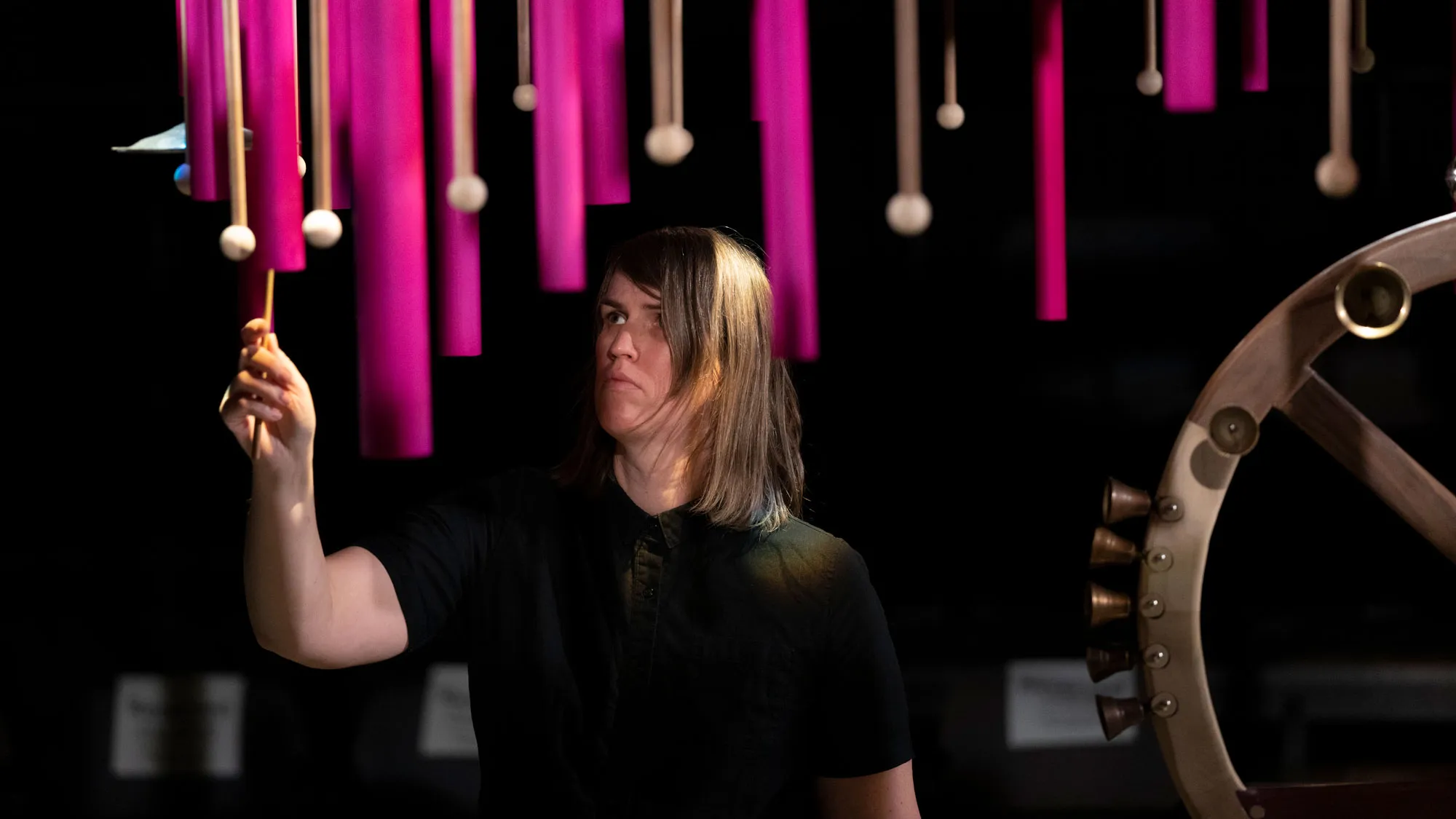
Only Breath, Words is a performance without actors in which the voice is delivered by the theater itself, as its air-handling system “exhales” through flue pipe sculptures created by the artist. These instruments create coos, whirrs, hums, and moans while words and fragments of phrases flash and glow on grids of lights that are moved across the stage. Pushing at the limit of language’s capacity to transmit emotion and to articulate nuanced thoughts, these fragmentary idioms, instructions, and vernacular phrases suggest an elusive author, one whose meaning teeters between legibility and opacity.

The score for this first iteration of Only Breath, Words is composed by Sarah Hennies to generate a chorus of sounds. Hennies’ approach is informed by the dynamic nature of Craycroft’s instruments, in which each pipe can be played to produce a multitude of drones and noises, whose loudness, timbre, pitch, and quality are necessarily designed to react to the ever-changing flow of air produced by theater's ventilation system as it conditions the temperature and humidity of the space. Hennies' score results in a sequence of slow but incremental changes as the players attend as much to the movements of the instruments' unique components as to the tone the vibration produces.

The performance gives agency to the theater’s constitutive parts: its architectural features and technical infrastructure, the people necessary to operate it, and the very air that circulates through it. It dwells in the physical act of production. In this way, Only Breath, Words conjures theatrical allusions through the exchange of light, sound, and space and points back to the fundamental processes by which we, through the construct of the theater, seek to communicate.

Conceived as a performance and installation that activates and extends the specific architectural infrastructure of the theater, Only Breath, Words continues Craycroft’s ongoing dramaturgical approach to interdisciplinary collaboration. Craycroft's work frequently engages with and supports works by other artists, composers, writers, and performers through her sculptural installations and protocols for research and participation.

Main Image: Anna Craycroft working in residence on Only Breath Words in the Theater in 2019. Photo: EMPAC/Mick Bello.

Media
Image
custom flutes sitting on EMPAC's HVAC system

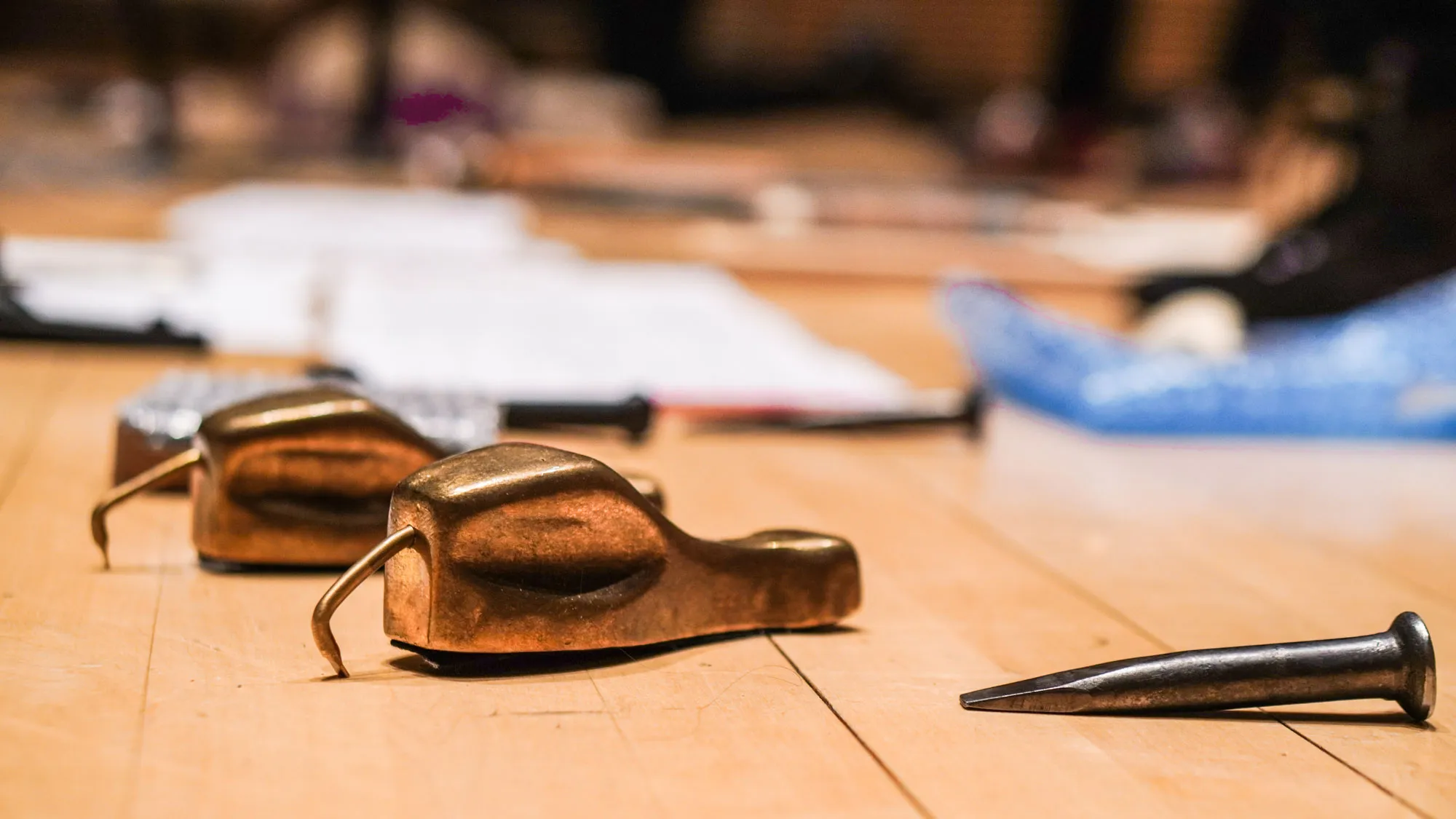
Only Breath, Words, Production Still. Photo: Anna Craycroft. 

Image
a woman holds an indigenous mayan flute in front of her face

Mojo’q che b’ixan ri ixkanulab’ / Antes de que los volcanes canten / Before the Volcanoes Sing

Clarissa Tossin

Commissioned and produced by EMPAC, Mojo’q che b’ixan ri ixkanulab’ / Antes de que los volcanes canten / Before the Volcanoes Sing undertakes a richly sensory journey across moments, languages, and music, roaming through architectural spaces that are variously imagined and real, cosmological and colonized. The film centers on the capacity of Maya cultural belongings, and wind instruments in particular, to give voice to Indigenous systems of knowledge. Grappling with the history of Western architects using Indigenous motifs without significant reference to or engagement with their source, the film works to restore these absent sounds, utilizing 3D-printed replicas of Maya wind instruments held behind glass in Pre-Columbian museum collections.

Told through the personal histories of its Maya protagonists, K’iche ’Kaqchiquel poet Rosa Chávez leads us through her Guatemalan community’s vernacular architectures. Through poetry and conversation, she traces a densely interwoven set of practices that have long articulated and preserved systematic understandings of time, language, and cosmology across cultural forms, ranging from ancient temples to systems of healing, and from weaving techniques whose patterns encode complex information to the physical structure of the traditional ‘temazcal’ steam room. As if in echo, the film follows Ixil Maya artist Tohil Fidel Brito Bernal inside the “Mayan Revival” Sowden House in Los Angeles, as he works on his rigorously researched drafts of ancient Maya glyphs and calendars while surrounded by sculptural copies of the same motifs appropriated by the architect Lloyd Wright.

The poetry and artwork of Chávez and Brito Bernal is interwoven by spirited performances of the instruments by Mexican flautist Alethia Lozano Birrueta. From tiny bird ocarinas to flutes that sculpturally represent monkey, jaguar, and other deities of Maya mythology, each breath activates layers of music that expand the slippery temporalities of the film’s themes and which are heightened further through the film’s kaleidoscopic visual effects. Premiering in EMPAC’s Concert Hall, where several of Birrueta’s performances were recorded, Before the Volcanoes Sing seeks to reclaim space for Indigenous traditions in the present. Projected onto the undulating surface of the acoustically ornamented curtain wall, the film’s score and sound design by composer Michelle Agnes Magalhães is dramatized through an immersive Ambisonic* array of 64-loudspeakers that surround the audience.

*The moving image work utilizes a "higher-order Ambisonic" spatial audio system that EMPAC has implemented in its venues. Ambisonics is an audio format developed to record, mix, and playback immersive audio that surrounds the audience in a much more precise way than traditional “surround sound.” The listeners in the Concert Hall are surrounded by more than 60 loudspeakers distributed across the wall and ceiling surfaces, each contributing to the soundfield with their own audio channel.

Main Image: Clarissa Tossin, Before the Volcanoes Sing (2022), video still 

Media

An introduction to Mojo’q che b’ixan ri ixkanulab’ / Antes de que los volcanes canten / Before the Volcanoes Sing, a new EMPAC-commissioned moving image work by Clarissa Tossin that is currently in production at Sowden House in Los Angeles and at EMPAC/Rensselaer in Troy, NY.