They Are Waiting for You

Laure Prouvost, Sam Belinfante, Pierre Droulers

A behind-the-scenes look at the development of Laure Prouvost’s performance collaboration with artist Sam Belinfante and choreographer Pierre Droulers. While she had until then worked primarily in the context of visual art, this new work marked Prouvost’s first major commission for the stage.

In this performance, theatrical and cinematic technologies—projection, light, and haze—interact with dancers, musicians, objects, and the audience in a characteristically surreal and perceptually disorientating performance. Prouvost is known for her films and installations, characterized by richly layered stories, acts of mis-translation, and surreal moments. Engaged in an ongoing conversation with the history of art and literature, Prouvost often makes use of humor and the fantastical to explore the boundaries between fiction and reality and to unhinge commonplace and expected connections between language, image, and perception.

Listening Creates an Opening: Work-in-Progress

Mary Armentrout Dance Theater

Mary Armentrout Dance Theater was in residence over the course of two years to develop a new EMPAC commission, Listening Creates an Opening, which premiered in Fall 2018. This work-in-progress showing included a performance of choreography as well as footage from a year-long video time lapse taken onsite at EMPAC. The central focus of the work is how our relationship to technology changes when we are conscious of our physical movements with and around it. Leading the audience between different performance sites, Listening Creates an Opening also explores what types of histories and contexts reveal themselves from this consciously embodied perspective.

This work-in-progress showing took the audience from the newly renovated Rensselaer Off Campus Commons building to the contemporary EMPAC building. The final piece extended this journey to various performance sites on Rensselaer’s campus and in downtown Troy.

Image
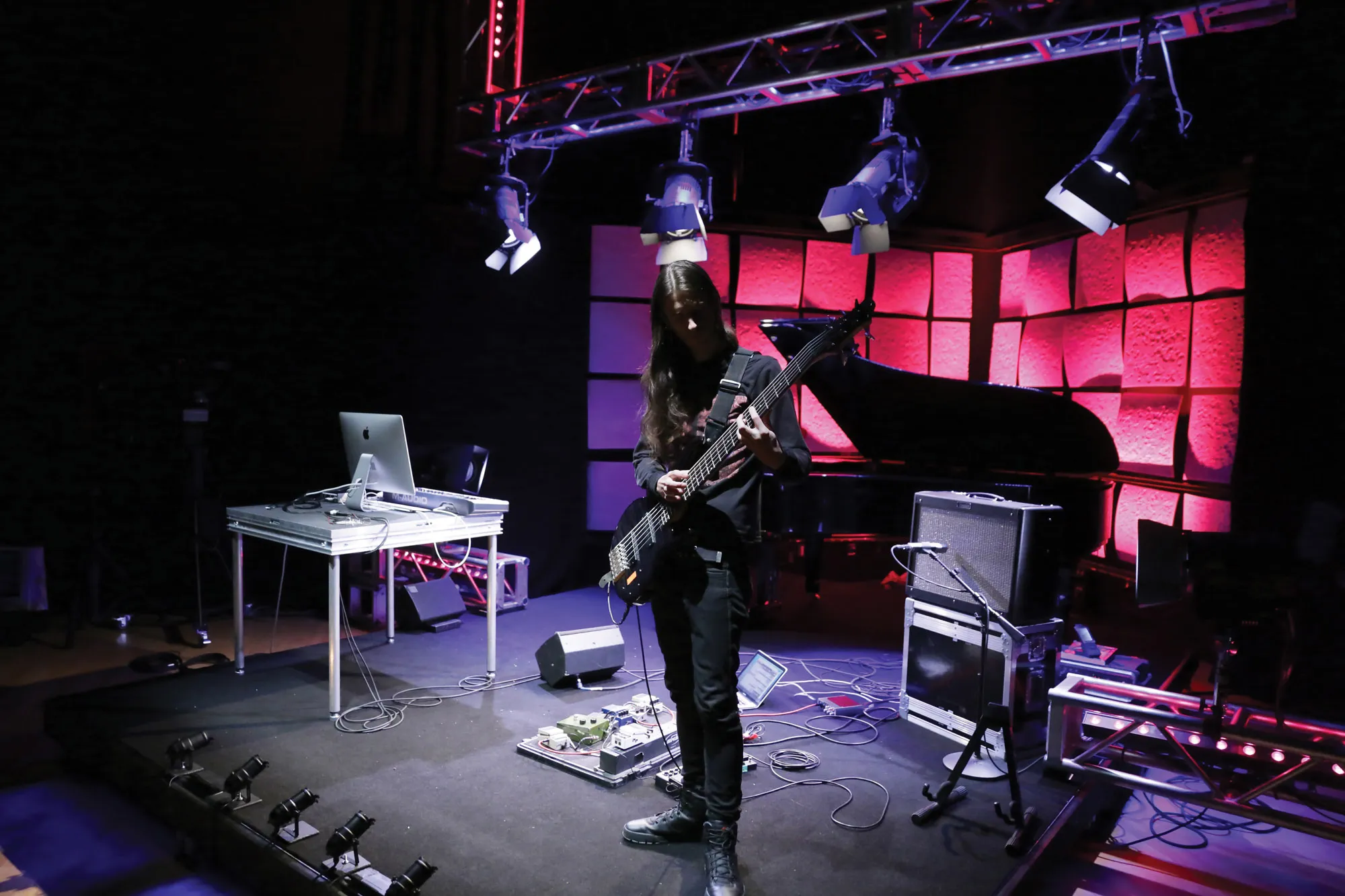
Colin Marston playing bass on a stage cluttered with amps washed in red and blue light.

Colin Marston

Death–metal bassist Colin Marston was in resi- dence to record his complete works for player piano and feedback. Known as a powerful figure in the New York death-metal scene, Marston plays with groups such as Behold...The Arc- topus, Dysrhythmia, Krallice, and Gorguts. His complex and technically demanding music weaves jagged rhythms with unrelenting energy to confront listeners with a wall of pure sonic force. His prolific output includes extreme metal, progressive/experimental rock, avant garde improvisation, free jazz, new music/modern classical, and ambient genres.

Image
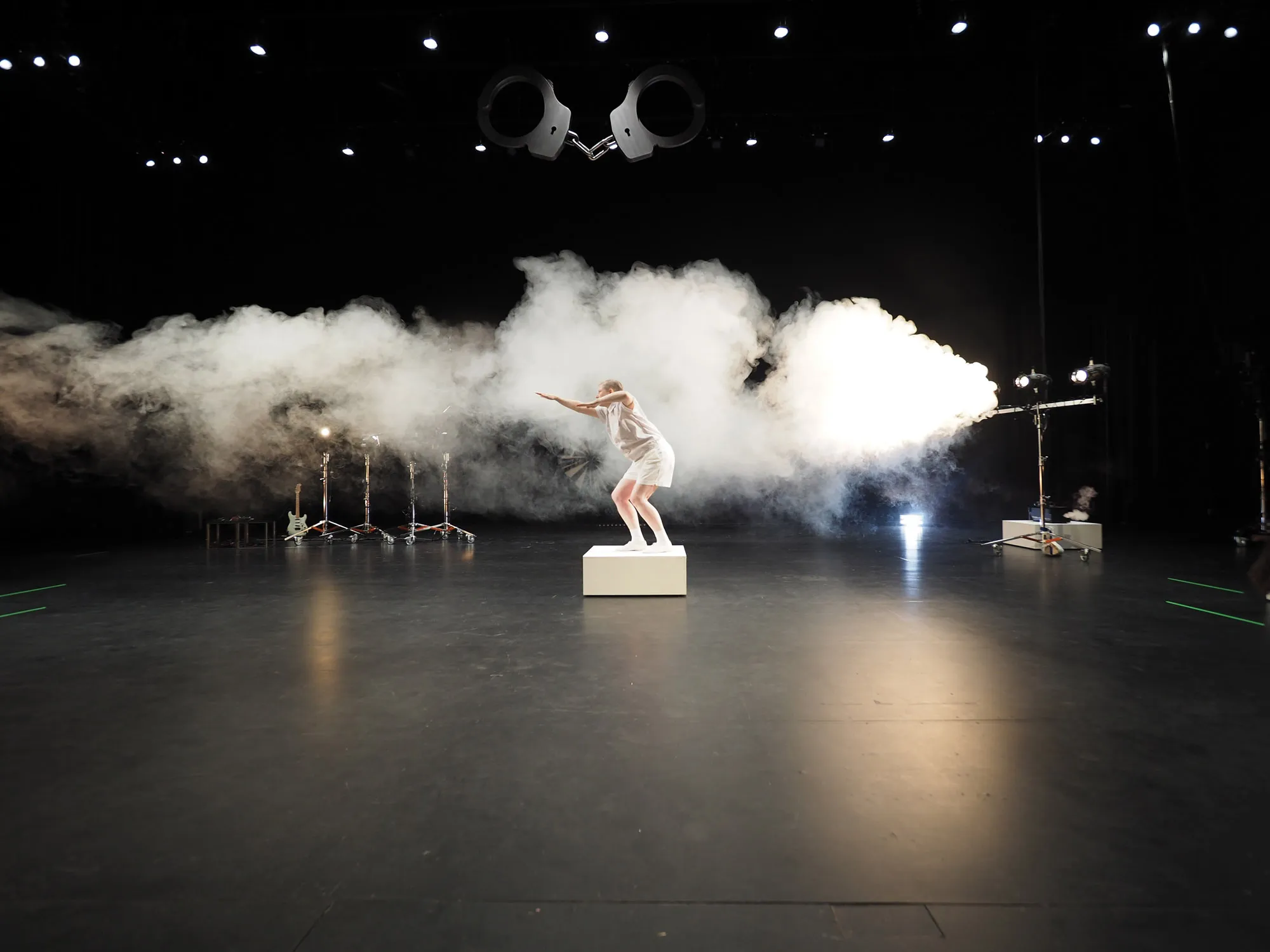
A dancer dressed in white standing on a white rectangular cube in front of white theatrical fog in a black box studio.

Telepathic Improvisation

Boudry / Lorenz

Boudry / Lorenz present their film Telepathic Improvisation produced at EMPAC in Spring 2017.

Boudry / Lorenz’s film, Telepathic Improvisation, takes as its starting point the late Rensselaer Professor Pauline Oliveros’ 1974 score of the same name. However, the audience for this filmed performance is not only called upon to telepathically communicate with the performers (as is the case with Oliveros’ original score), but also to communicate with the other elements on stage, from the theatrical lights to a group of autonomous white boxes that glide across the stage.

The film is bookended by two monologues: the Oliveros score, and a 1969 text by German revolutionary Ulrike Meinhof that prescribes resistance in the face of global capitalist oppression. Telepathic Improvisation attempts to disrupt historical narratives surrounding agency and action by elevating the technical, non-human actors to the equal status of their human counterparts.

Main Image: Production Still, Telepathic Improvisation in Studio 1. (2017). Photo: Mick Bello / EMPAC.

Mozart Recording for Wave Field Synthesis

Orpheus Chamber Orchestra

Members of the Orpheus Chamber Orchestra were in residence to record Wolfgang Amadeus Mozart’s Octet in E-Flat Major; K 375. The recording was created specifically for playback on EMPAC’s 500-speaker Wave Field Synthesis Array audio system, in order to precisely spatialize each instrument. This recording was subsequently presented for the first time at Rensselaer President Shirley Ann Jackson’s 2017 Campaign Launch Dinner on the theater stage. In her remarks, President Jackson told the audience, “As you walked across the stage to take your seats, you may have felt as if one of the eight woodwind instruments seemed to be playing right next to you, while music from other instruments seemed farther away—and each in its own location... What you have experienced is a revolution in placing sound in space known as Wave Field Synthesis.” 

Main Image:

Image
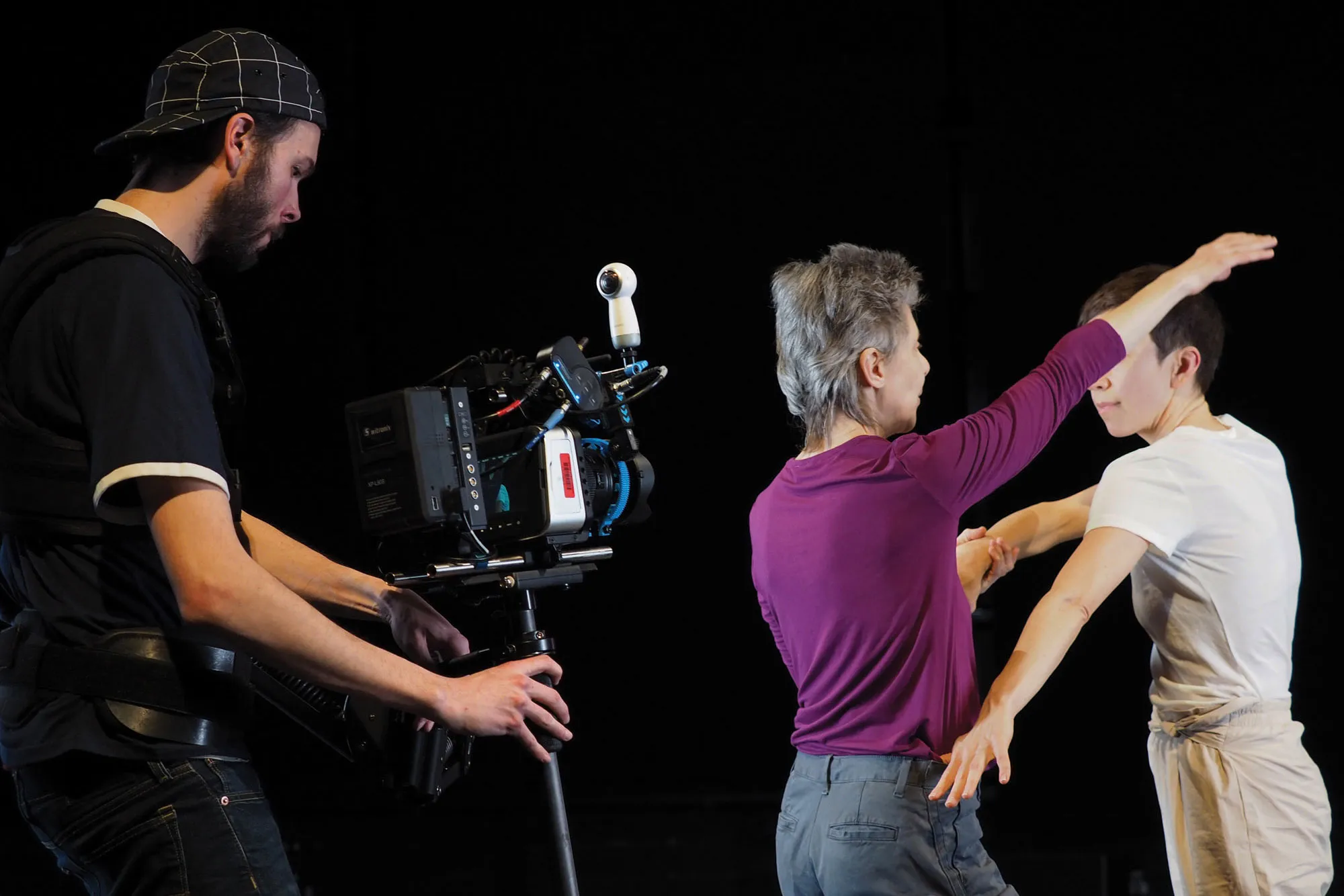
Two female dancers with short hair, one wearing purple the other wearing white and a steadicam operator shooting in a black box studio.

echo/archive

Elena Demyanenko & Erika Mijlin

Choreographer/performer Elena Demyanenko and filmmaker Erika Mijlin offered a work-in-progress performance of their EMPAC-commissioned collaboration, echo/archive.

echo/archive explores the notion of bodily heritage—how one’s sense and memory of their body may be felt and communicated over generations. Within dance, this is the process that carries movement invention and somatic perspectives from artist to artist. The piece also explores the role of the mediated image, live or recorded, as an intervention and a partner in the creative investigation of past and present. Incorporating lighting, audio, and video, Demyankenko and Mijlin worked with performers Dana Reitz, Eva Karczag and Jodi Melnick, as well as video designer Ray Sun. Karczag and Melnick, like Demyanenko, both worked with the late American choreographer Trisha Brown. The work-in-progress performance focused on one of the show’s three parts: Demyanenko’s duet with Melnick.

Image
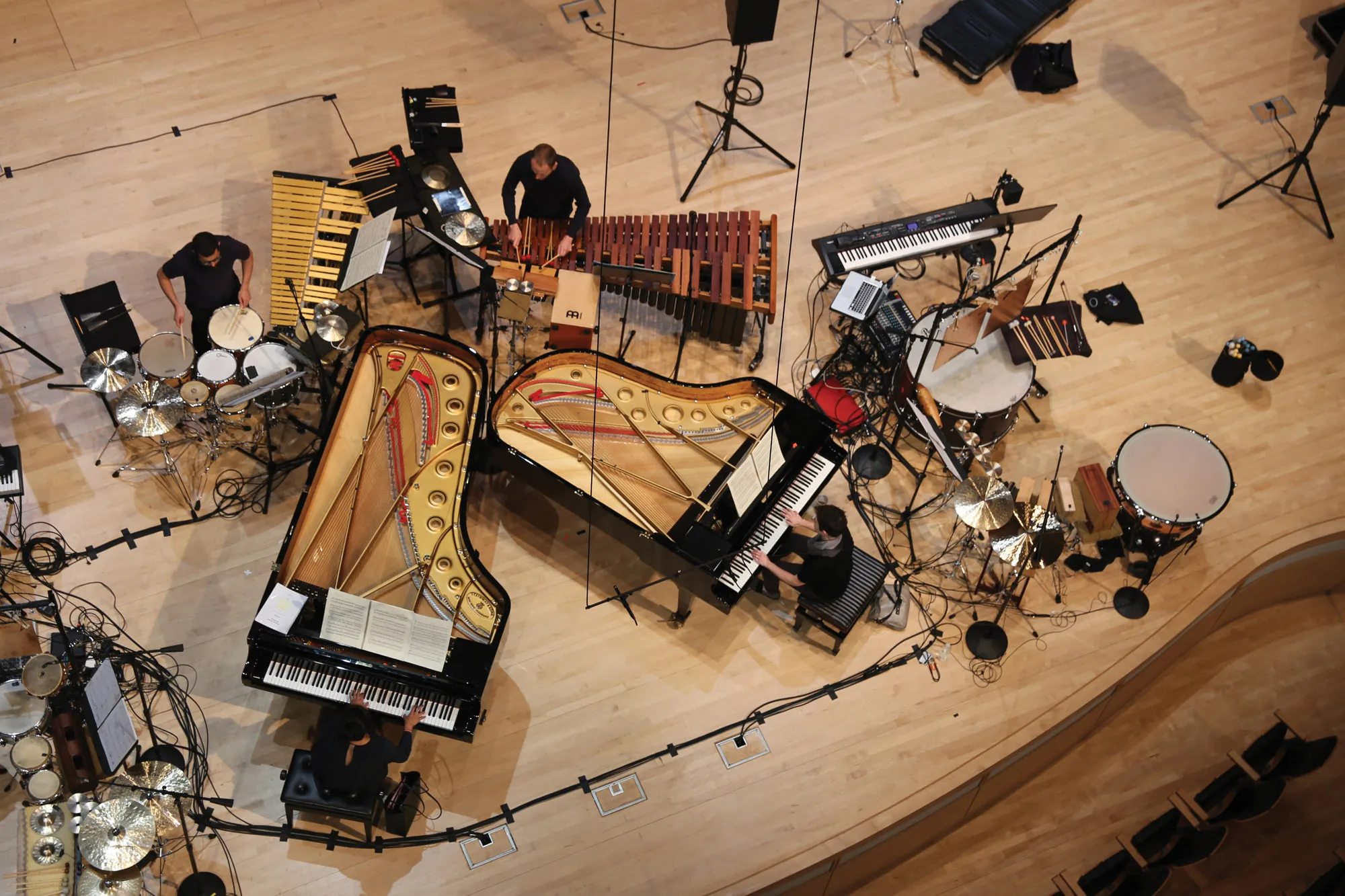
An aerial view of two people playing pianos and two people playing various percussion instruments on a clutter concert hall stage

The Music of Enno Poppe

Yarn/Wire

New York-based quartet Yarn/Wire performs an evening of work by contemporary German composer Enno Poppe, including the world premiere of the EMPAC-commissioned piece Feld. The program will also feature Tonband, Poppe’s co-composition with Wolfgang Heiniger.

Enno Poppe describes his music as “dented nature”: While grounded in compositional guidelines taken from the fields of acoustics, biology, and mathematics, his pieces gradually disobey their own rules, contorting and evolving through an almost hallucinatory atmosphere of unexpected sounds. Highly respected as both a composer and a conductor, Poppe has led the Berlin-based ensemble mosaik since 1998, and has presented his orchestral, chamber, and operatic works throughout Europe. In 2015, Poppe’s Speicher received its US premiere at EMPAC, performed by the Talea Ensemble.

Yarn/Wire is a quartet of two percussionists and two pianists: Laura Barger, Ning Yu, Ian Antonio, and Russell Greenberg. The ensemble is known for its flexibility to slip between classical and modern repertoire, and has become a leading group in the new-music world. Yarn/Wire were last at EMPAC in 2014 to premiere and record The Negotiation of Context by Davið Brynjar Franzson.

PROGRAM:
  • Enno Poppe Feld (2007/17) World Premiere
  • Enno Poppe + Wolfgang Heiniger Tonband (2008/12)

Main Image: Production still, FELD (2017). Photo: Mick Bello / EMPAC.

Media
Image
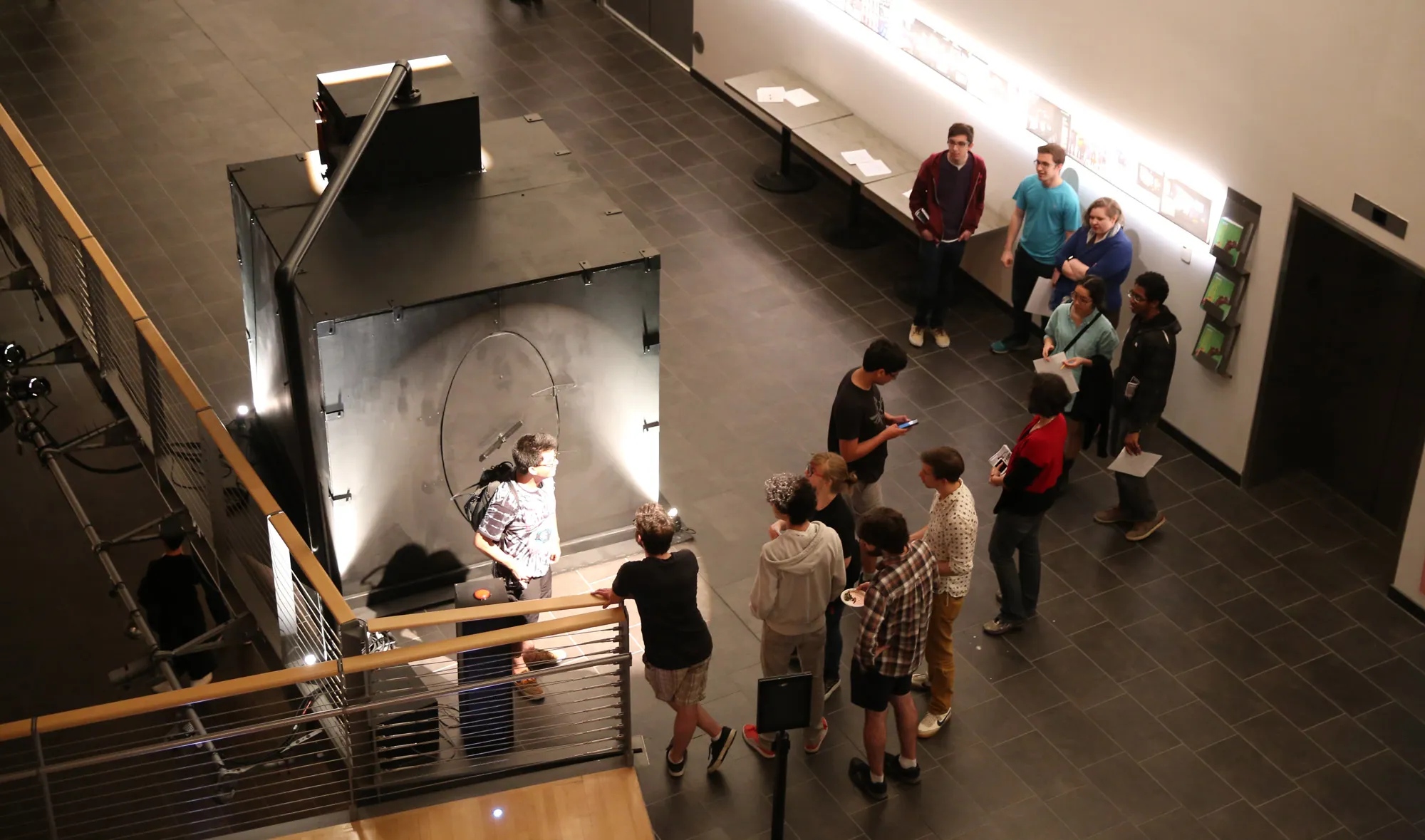
Students waiting in line out side of a black box with an oval door in a hallway.

SubBassProtoTon

Johannes Goebel

First invented in 1986 and recently reconstructed for artist-in-residence Tarek Atoui’s spring-season-closing performance WITHIN, the SubBassProtoTon is a walk-in bass generator that allows visitors to physically experience frequencies that are too low for audible perception and to interactively explore sound when it reaches the range of hearing.

The SubBassProtoTon (literally, “below-low-first-tone”) was first constructed by EMPAC’s Director Johannes Goebel for a large outdoor art event in Germany. Subsequently the ProtoTon traveled Europe as part of a sound exhibition for children and students, and other versions were built for exhibitions. Essentially a cubical organ pipe, the instrument consists of a wooden box large enough to comfortably accommodate two or three people.

When inside, participants can manipulate a sliding wooden wedge that opens and closes a window at the front of the box. Air is generated by a motorized organ blower outside the box and is channeled towards the wedge where different sounds are created depending on how far the wedge is opened or closed. This oscillating air pressure results in a sonic frequency that moves from the audible human range to below what can be heard, yet can be physically felt.

Although the SubBassProtoTon was used as a musical instrument for Atoui’s WITHIN, the box is more properly understood as a science-museum-style installation that allows visitors to explore some fundamental principles of sound while actually being immersed in the instrument itself. Anyone who interacts with the ProtoTon, regardless of age and musical or scientific aptitude, can come to understand the basic dynamic of sound behind instruments as diverse as the organ, flute, or ocarina, and enjoy the gentle massage that comes from standing inside these instruments’ vibrations.

Main Image: Students lined up for the SubBasProtoTon on the mezzanine during WITHIN in 2016. Photo: Shannon K. Johnson.
The Music of Enno Poppe

Yarn/Wire

New York-based quartet Yarn/Wire performed an evening of work by contemporary German composer Enno Poppe, including the world premiere of the EMPAC-commissioned piece Feld. The program also featured Tonband, Poppe’s co-composition with Wolfgang Heiniger. Yarn/Wire were in residence to record both pieces for future release.

2017 Fall

fall 2017

2017 Fall video reel. Courtesy the artists/EMPAC.