Image
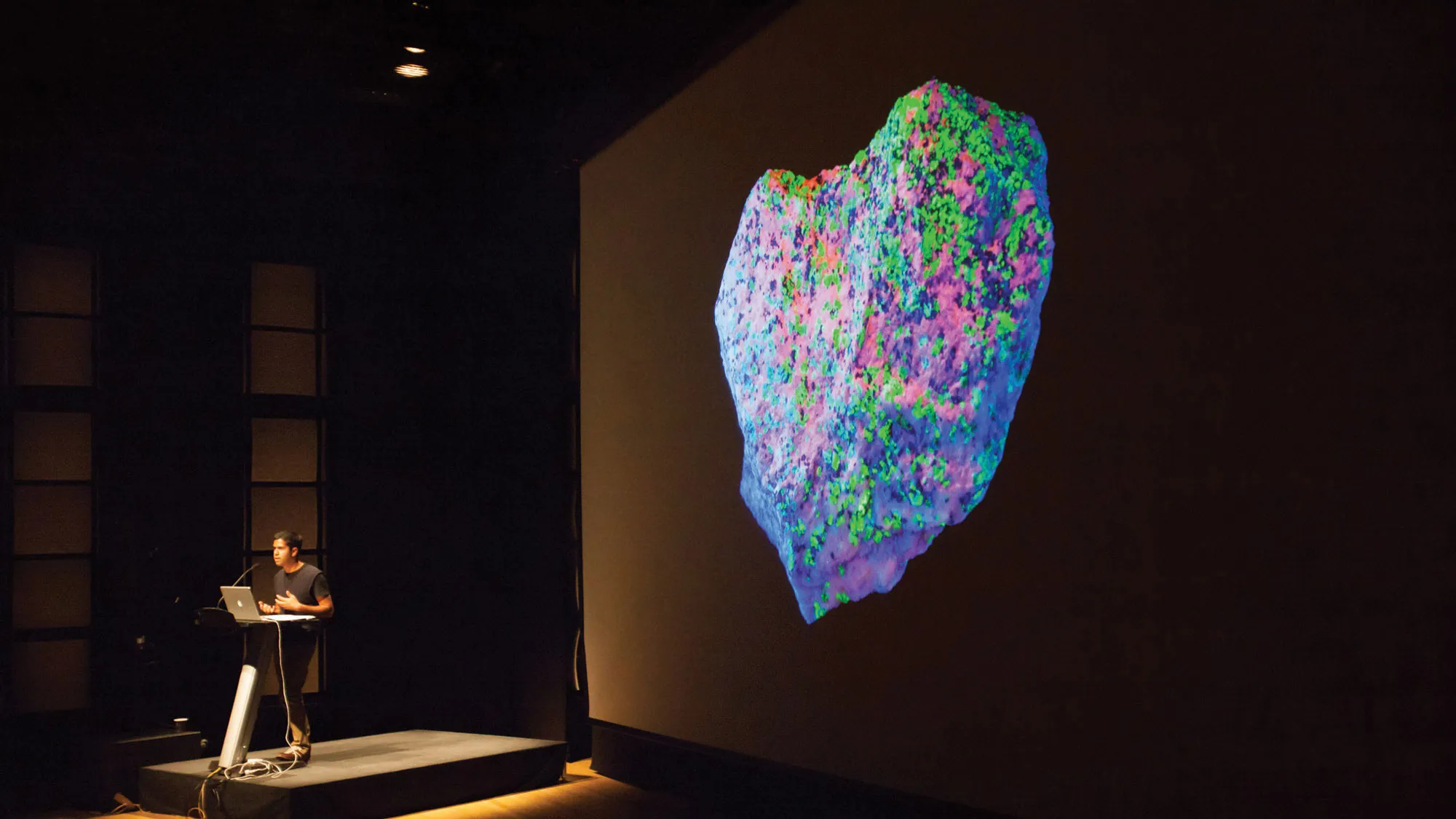
Melvin Moti

Melvin Moti

The Eye As I Can See

In this talk, Dutch artist Melvin Moti considered the nuances of visual perception and the paradoxical status of the eye, which acts as both a camera and a lens. 

As an artist, Moti primarily works with film, but also uses a range of media including photography, drawing, text, and installation. His pieces are often the outcome of extensive research into overlooked historical events that have a prophetic quality when reconsidered from a contemporary perspective. In response to our oversaturated visual culture, Moti explores conditions characterized by a reduction in sensory perception. Positioning the viewer as a witness, his non-narrative films open up a political space for imagination and creativity through the disjunctive clash between the moving image and its corresponding voiceover. In addition to producing films, Moti has exhibited artist books, objects, and drawings.

Observer Effects offered a dialogue between the fields of art and science. The title was derived from the principle in physics that the act of observation transforms the observed, an idea that has been influential in philosophy, aesthetics, psychology, and politics.

Main Image: Moti in studio 2, 2012.
Image
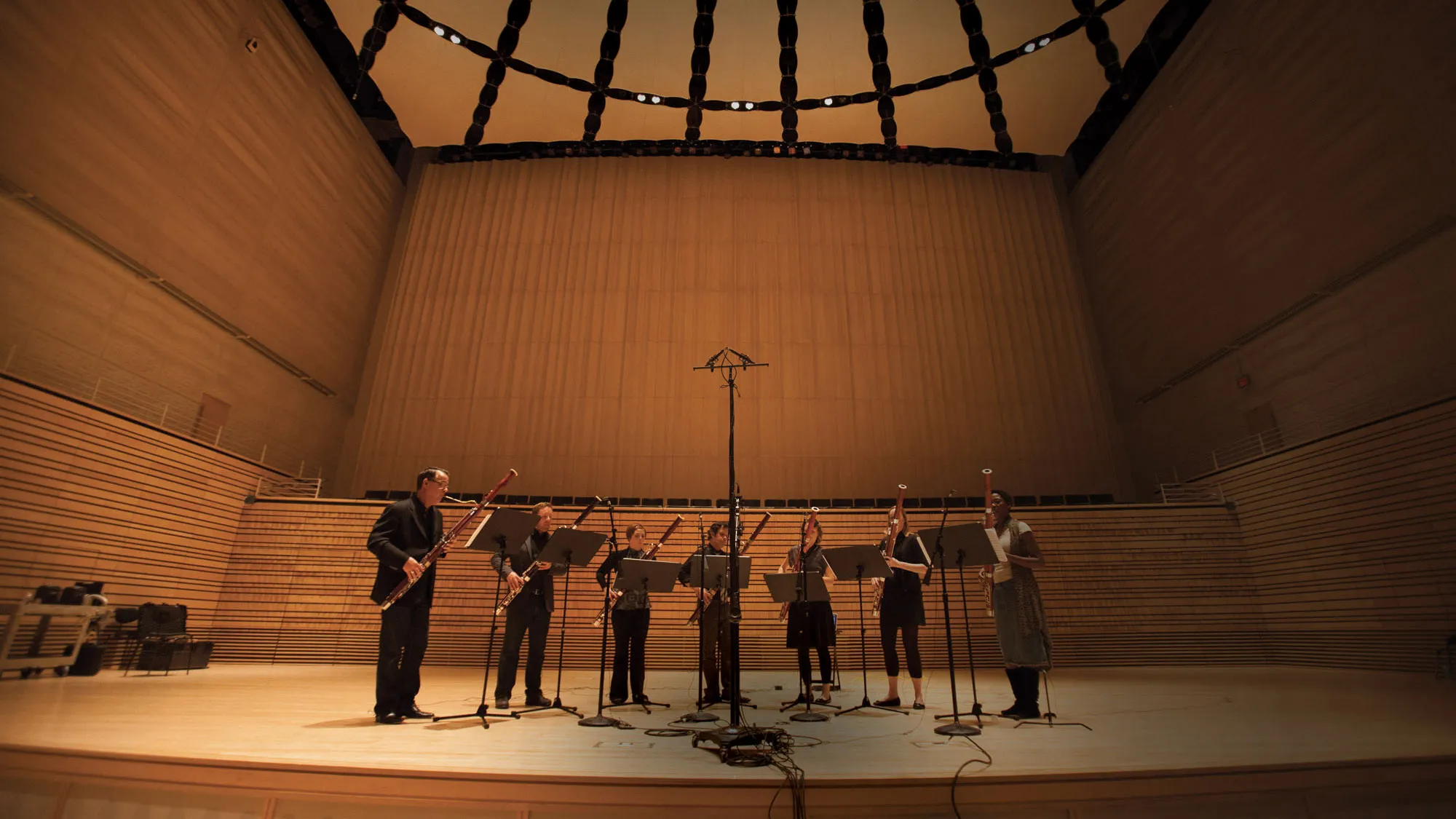
Seven bassoonists with music stands standing in a semi circle on the concert hall stage.

Rushes

Michael Gordon

Composer Michael Gordon rehearsed, recorded, and premiered his new work Rushes for seven bassoons. Composed with cascading waves of sound, Gordon’s composition transformed the woodwinds into something improbably electronic. A companion piece to his earlier composition Timber (which applied a similar sound layering technique to the Simantra percussion instrument), Rushes is a haunting convergence of digital and analog ambiance. 

Gordon is co-founder and co-artistic director of New York City’s music collective Bang on a Can, and has produced a diverse body of work, ranging from large-scale pieces for ensembles to major orchestral commissions to works conceived specifically for the recording studio. He has been commissioned by Lincoln Center, Carnegie Hall, the BBC Proms, the Brooklyn Academy of Music, and the Sydney 2000 Olympic Arts Festival, among others. 

Main Image: Rushes in the concert hall in 2012. Photo: EMPAC/Rensselaer.

Media
Image
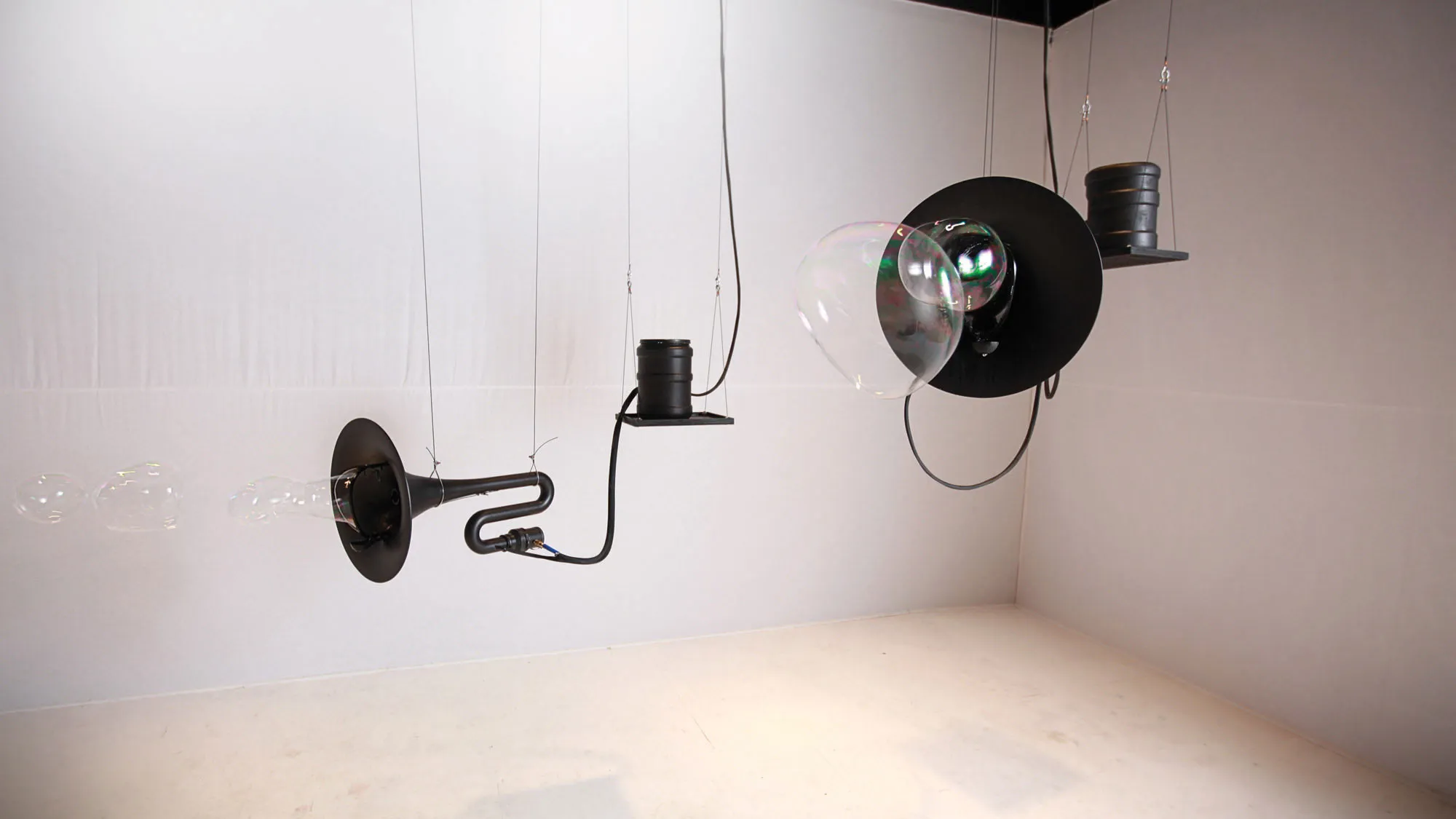
An installation of black horns suspended from wires blowing bubbles in a white room.

Thom Kubli

Black Hole Horizon

A sound installation by German artist Thom Kubli, Black Hole Horizon was designed and constructed at Rensselaer in collaboration with the School of Architecture and consultants Zackery Belanger (acoustic design) and David Jaschik (mechatronics). Using the university’s laser-cutting and 3D-milling equipment for the material creation, the production team designed a complex system of air compressors, fluid pumps, and Arduino-controlled mechanisms to create horns that produce tone-generated bubbles. Each bubble is deformed by the energy of the sound produced through the horn, and then bursts onto the room’s white floor. The shapes of the horns, some stretching eight feet long, were based on a model of a black hole geometrodynamic physics. In the installation, spectators could explore the space by walking through the room and witnessing the transformation of sound into ephemeral sculptures.

Main Image: Installation view: Black Hole Horizon (2012). Photo: Kris Qua/EMPAC.

Media
Image
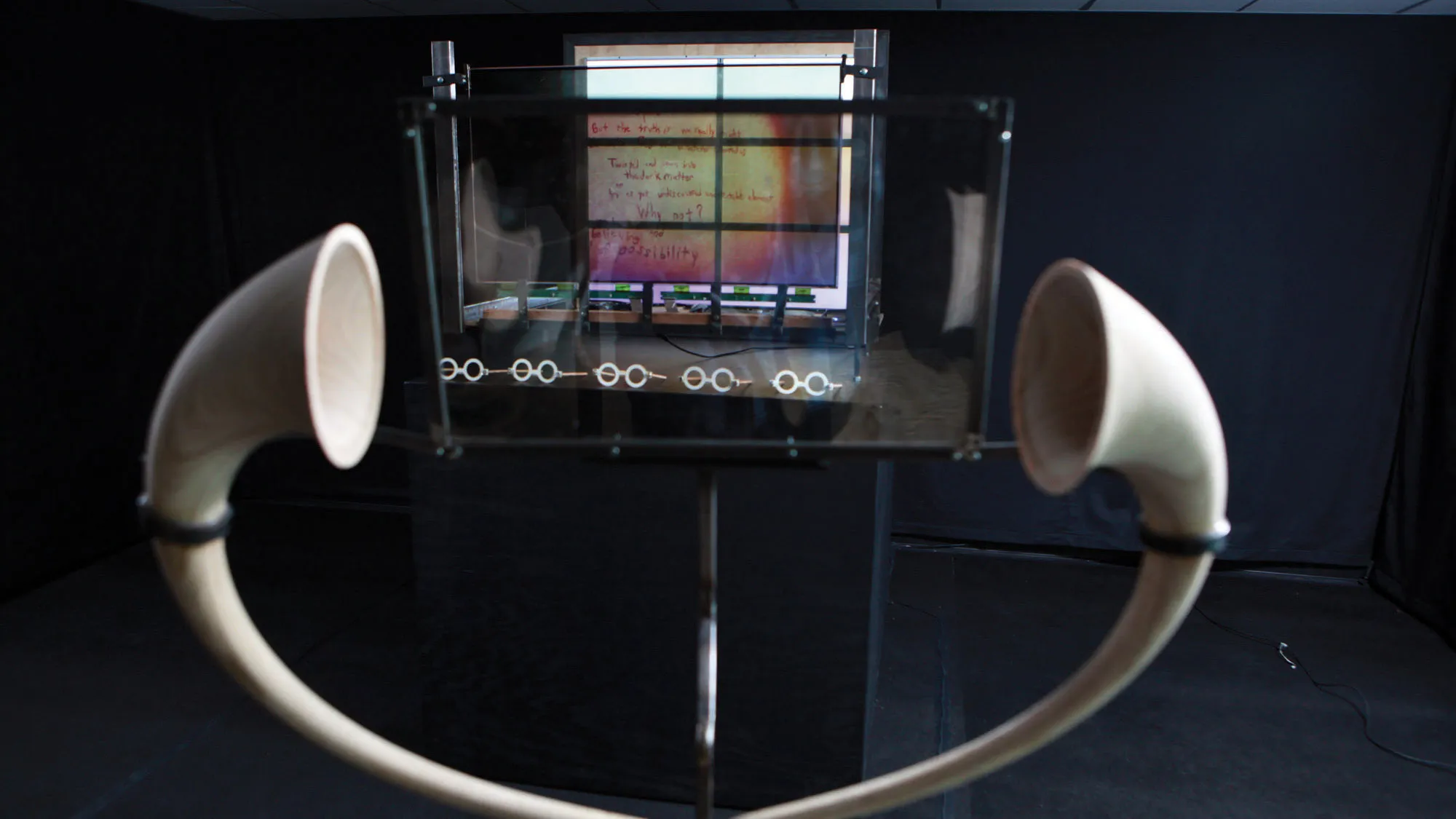
Two white listening horns in front of and framing a piece of polarized glass.

To Many Men Strange Fates Are Given

Brent Green

Brent Green’s new installation, To Many Men Strange Fates Are Given, presents a 12-minute animated film that tells the story of the woman who sewed the spacesuit for Laika, the dog launched into space in 1957 by the Soviets to test whether a living creature could survive space flight. The installation consists of a welded metal frame that holds wooden phonograph horns, multiple planes of polarized glass, and brightly glowing LCD screens. The animation is characterized by familiar elements from this self-taught artist, filmmaker, and performer—hand-drawn, “rickety” animation; wry, off-kilter storytelling; original music played by his band; and rustic sculptural elements—but also shows an evolution in subject matter and technique. Green’s poetic narration ultimately becomes a lament for the disenfranchisement of working people then and now: a theme that connects to his past protagonists—commonplace people who face toil and hardship, and sometimes, redemption and wonder.

Brent Green lives and works in the Appalachian hills of Pennsylvania. His films, live performances, and object-based art have been shown around the world. Most recently, he has had solo exhibitions of his films, along with sculptural and kinetic pieces, at the ASU Art Museum, the Berkeley Art Museum, and SITE Santa Fe. Green often performs his films with live musicians, improvised soundtracks, and live narration in venues ranging from rooftops to art institutions such as the Getty Center, the Walker Art Center, the Experimental Media and Performing Arts Center (EMPAC), the Hammer Museum, the Wexner Center for the Arts, The Kitchen, and MoMA. His films are often screened at film festivals, as well, including Sundance, Film Festival Rotterdam, and Rooftop Films, among many others. Green is currently embarking on his second feature, Anatomical Maps With Battle Plans, a film that will mold his family history through his unique visionary folk-punk style of storytelling and image.

Main Image: Installation view from To Many Men Strange Fates are Given (2012). Photo: Kris Qua/EMPAC.

Media

Jennifer + Kevin McCoy

Index

Index is an EMPAC-commissioned public art installation by Jennifer and Kevin McCoy, which consists of multiple sculptures filmed via small, live cameras. The resulting video projection, as well as the models, will appear throughout EMPAC’s public spaces during an extended residency with the artists. The first works will be exhibited on April 2.

Inspired by a J.G. Ballard short story called “The Index,” in which an alphabetized list of people and places are turned into an implied, overarching narrative, the McCoys’ list spans the 1960s to today, referencing globalization, technology, mass migrations, and war. Corporate campuses, film sets, Spanish Colonial Revival architecture, and factories all collide in a globalized mediated framework that exists to support utopian goals, even as it rests upon resource depletion, financial instabilities, and entropic decay. These problems of environmental and economic collapse persist in the face of the never-changing rhetoric of the assumed benefits of the technological future.

Image
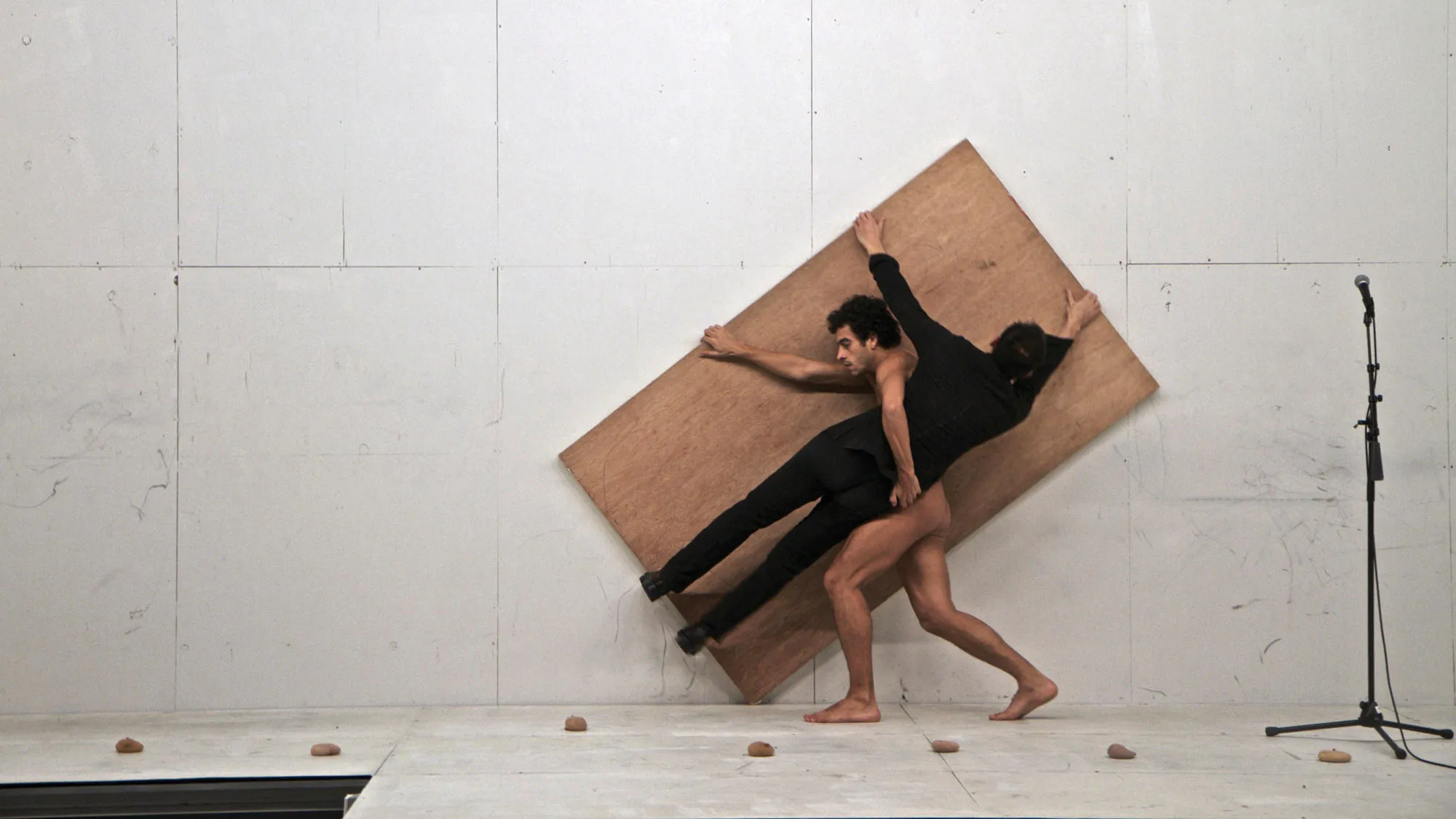
A nude man carrying another man wearing a black unitard while both hold a large piece of plywood on a white stage.

Primal Matter

Dimitris Papaioannou

Against the backdrop of economic and social crisis stretching from Greece to the US, Dimitris Papaioannou embarked on an artistic challenge: investigating personal and national identity using the least possible means. The result is Primal Matter, where two bodies on the stage are the starting point for a journey that weighs body and soul to determine what is truly indispensable—what constitutes the essence. To create Primal Matter at EMPAC, Papaioannou and his artistic team erected a custom-made wall with built-in fluorescent light, and created an intricate live audio design using input from contact mics positioned around the set and processed in real-time and sourced to different outputs. 

Papaioannou is an avant-garde stage director, choreographer, and visual artist who has worked across the boundaries of theater, dance, and the visual arts; he drew international acclaim for his direction of the opening ceremony of the Athens 2004 Olympic Games.

Main Image: Primal Matter in 2012.

Media

Fog City

Sam Green

Sam Green, a San Francisco-based documentary filmmaker, worked at EMPAC on post-production of a 30-minute experimental documentary about fog in San Francisco. Seemingly an unlikely topic for a movie, fog can be a profoundly interesting visual phenomenon, and it is often breath-takingly beautiful. Green sought to create a portrait that is as varied and rich as the feelings stirred by the fog itself: from the sublime to the quirky to the deeply existential. At the same time, the goal was to make people more aware of the complex systems of wind, air, and water that surround us. His residency at EMPAC allowed the filmmaker to edit his film while viewing it on a large cinema screen with a 30,000-lumens projector rather than on a computer monitor—a rarity for independent filmmakers—enabling him to make informed choices about the tempo and sequencing of the film, as it would be experienced by audiences. Produced in conjunction with San Francisco’s Exploratorium Museum, Fog City premiered there with live narration by the filmmaker and music composed for the film played live by the New York City-based band The Quavers.

RELAY

Wet Ink

The New York City-based Wet Ink Ensemble was in residence in the Concert Hall to record their album RELAY. The Ensemble used their signature mix of collaborative performance, mixing voice, strings, winds, percussion, and electronics. The album features the music of Alex Mincek, Rick Burkhardt, Eric Wubbels, Kate Soper, Sam Pluta, and George Lewis—works that were performed and toured for two years prior to being recorded.

The members of the Ensemble collaborate in a band-like fashion, writing, improvising, and preparing pieces together over long stretches of time. In addition to yearly performances in New York City, the ensemble has taken part in numerous tours and residencies, including a residency at Duke University for the 2011-12 and 2012-13 academic years, and residencies at UC San Diego and Northern Illinois University.

Albedo Prospect

Ed Osborn

Ed Osborn spent an intensive period at EMPAC editing video footage for his installation and performance, Albedo Prospect. Based in part on Arthur Koestler’s reports from a 1931 airship flight to the high Arctic, Albedo Prospect explores polar imagery using video, sound, still images, and text. Koestler’s newspaper dispatches from this journey are part of the public record; the radio transmissions were lost, but these broadcasts were noted for their vivid and entrancing accounts of the terrain. This piece reimagines these lost reports using audio and video, updated with an awareness of how personal, journalistic, and scientific narratives shape our knowledge and readings of polar geographies.

Osborn’s sound art pieces take many forms including installation, sculpture, radio, video, performance, and public projects. His works combine a visceral sense of space, sound, and motion with an economy of materials, and are by turns playful and oblique, engaging and enigmatic.

Image
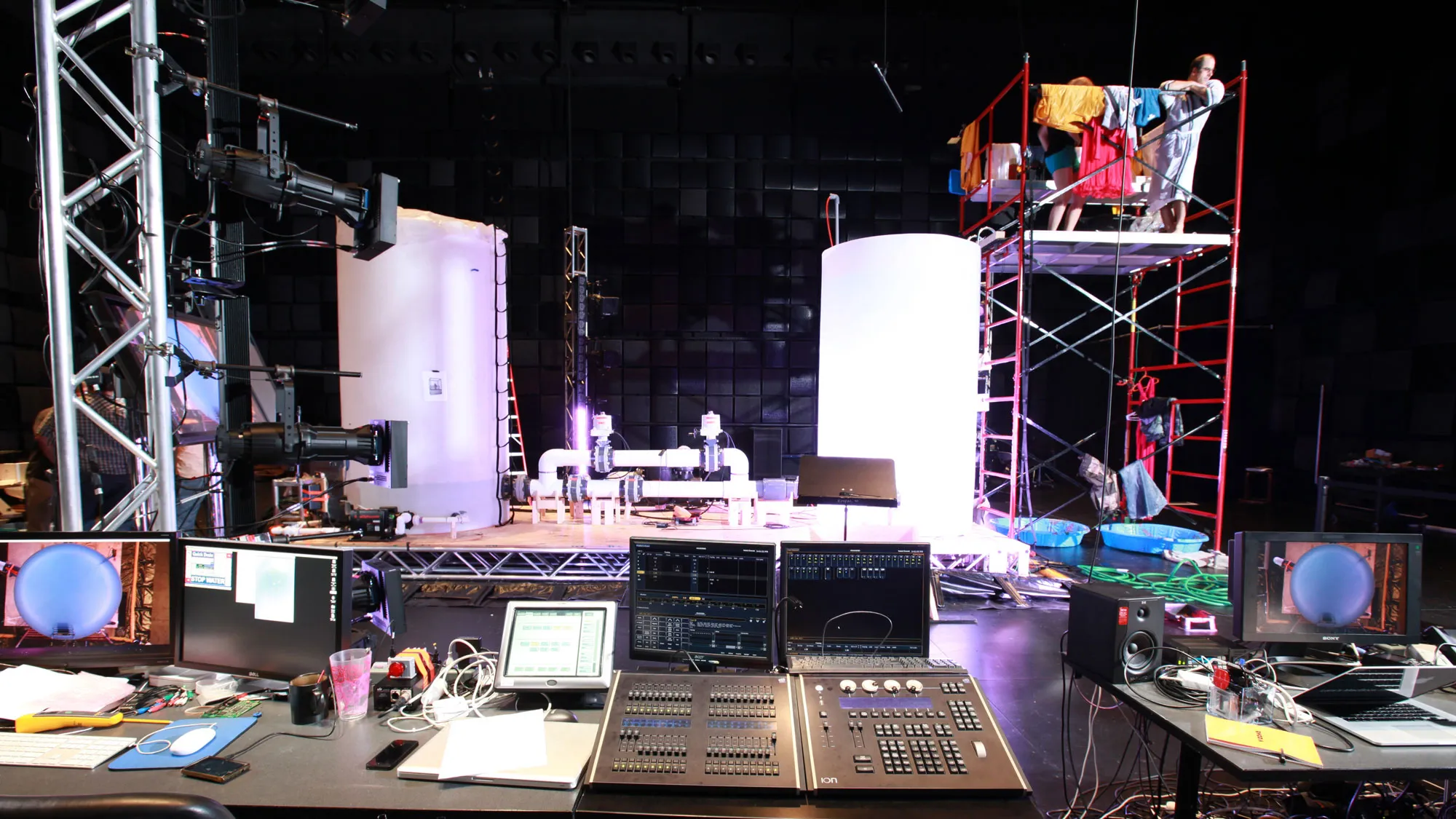
a huge plumbing and tank apparatus in production in a black box studio

Holoscenes

Lars Jan and Early Morning Opera

HOLOSCENES is a large-scale spectacle—a performance and installation—designed for public spaces that explores states of drowning, both literal and metaphorical. It is concerned with everyday behavior and long-term thinking, empathy, and our evolutionary future. The piece includes three large, transparent “aquariums,” each inhabited by a performer repeating a personal ritual: secular or sacred behaviors. The aquariums periodically fill with water and then empty; performers attempt to conduct their rituals submerged, and when the water drains, continue, soaked by these mini-floods. Through repetition, these behaviors conjure past and coming environmental tragedies, studies in adapted behavior and persistence rather than catastrophe. HOLOSCENES is part of a suite of multi-format artworks inspired by flooding; the name refers to our current geological epoch, the Holocene. During a month-long production and research residency, Jan and his designers, performers, and programmers worked with EMPAC’s production team to create a gigantic laboratory for the large-scale commercial water tanks and program the high-speed transfer of five tons of water between the two tanks by regulating hydraulic pumps.


Lars Jan and Early Morning Opera in residence in Studio 1—Goodman working on their project Holoscenes in late summer, 2014. Photo: Kris Qua / EMPAC.