Composing for Large Scale Multi-Channel Loudspeaker Environments

Hans Tutschku

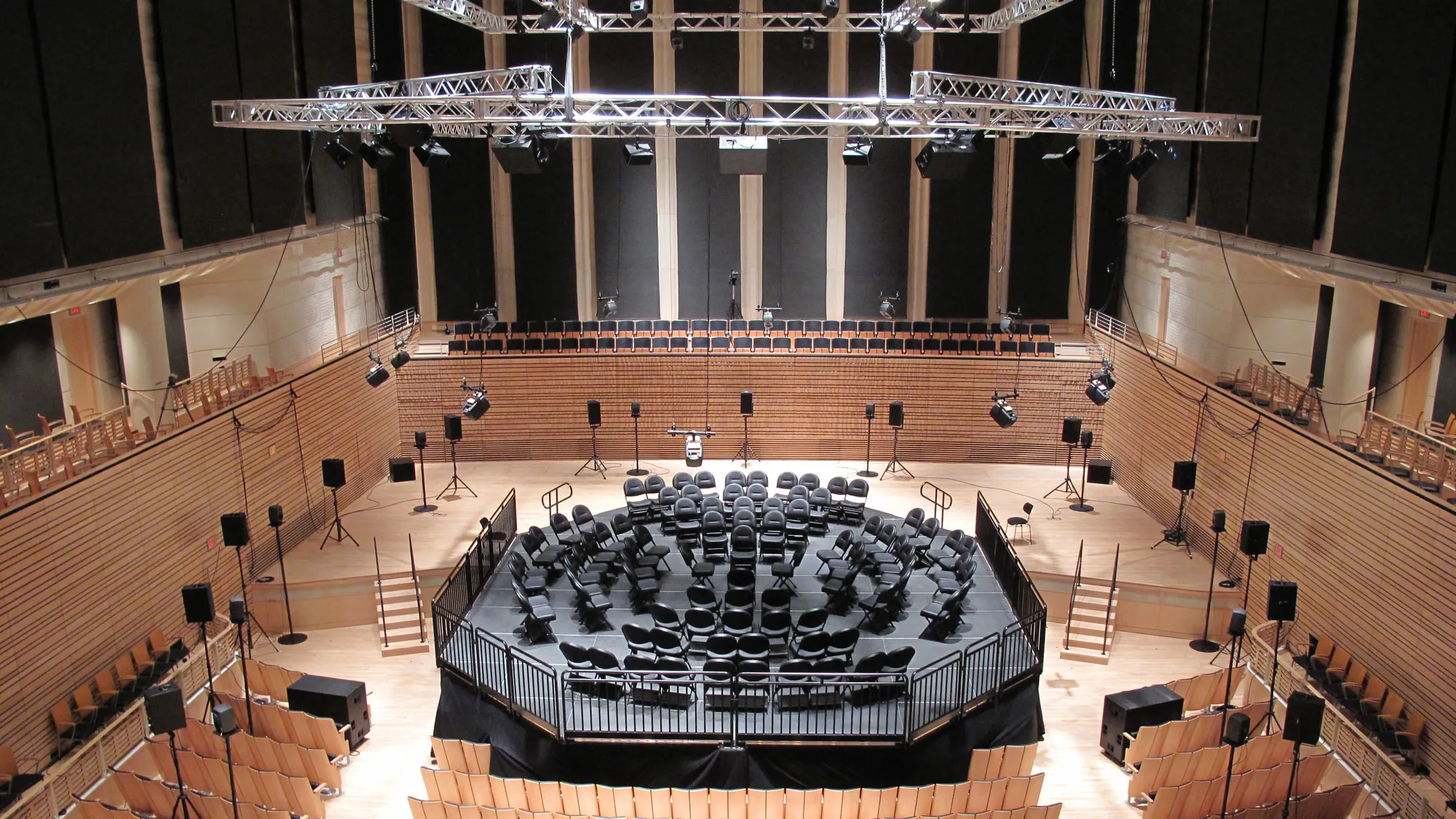
This six-day workshop will take place in the EMPAC studios, and will utilize multi-channel loudspeaker configurations set up specifically for the workshop. A powerful 24-channel system with three rings of eight speakers each, creating a “sound dome,” will be installed in the large studio (3,500 sq. ft. / 320 m2 and 30 ft. / 9 m height). Eight-channel and 16-channel systems also will be set up. Composing multi-channel electroacoustic pieces requires more than technical infrastructure; it also requires new approaches of compositional thinking and the use of sound material. Hans Tutschku has composed for such environments extensively and has taught the compositional and technical aspects of this work internationally. This workshop will provide participants access to the multi-channel setups for use in their own practical work. In lectures/demonstrations, working methods will be discussed and existing compositions will be played and analyzed. There will be two 90-minutes lectures and two 90-minutes presentations by participants each day. Throughout the workshop, all participants will have the chance to present their music and compositional ideas to the group. Late afternoons and evenings will be reserved for individual practical work. The final piece, or work in progress, will be presented during a concert at the end of the workshop. While limited to 10 participants the workshop is also open to auditors, who may sit in on all lectures and presentations. Applications are reviewed on a continuous basis until the available slots for the workshop are filled.

Compositions for a Sound Dome

On June 10 at 8:00 PM, with 24 loudspeakers suspended in the air as a sound dome, the eight composers who participated in this workshop will present their explorations of sound, music and space to the public. FREE + Open to the public

TOTAL ACTIVE PARTICIPANTS:

10

HOW TO APPLY:

To apply for active participation, composers are invited to send three examples of electroacoustic compositions (they do not need to be multi-channel pieces), as well as a CV and a short statement about their interest in multi-channel composition. They should also describe what project they would like to work on during the workshop and their technical needs. (Every participant is required to bring a laptop for their practical work; interfacing the laptop to the multi-channel systems may be supported by EMPAC.)

WHAT TO BRING:

Participants are required to bring their own laptop.

WORKSHOP FEE:

$500 for active participants; 50% payable after acceptance; no fee for auditors.

HOUSING:

Participants in the workshop will be able to choose single dormitory style housing near the Rensselaer campus for $60/night, or may organize their own housing in Troy.

SCHEDULE:

Check-in will be on June 4 and check-out is on the morning of June 11.
Tool is Loot

Wally Cardona and Jennifer Lacey

Tool is Loot was a collaboration made from the aesthetic disorientation arising from an elaborate, performance-based game between two dance experts willingly disenfranchised from their creative habits. Choreographers and dancers Wally Cardona and Jennifer Lacey created the work in two phases. In the first phase, Cardona and Lacey worked separately for a year, in the US and France, respectively. Each solicited weeklong encounters with experts in various fields, allowing the opinions and desires of a dance “outsider” to influence their approach to creating short dance solos. These experts included a sommelier, an architect, a film editor, a medical supply salesman, a kinetic sculptor, a baroque opera singer, an art critic, an acoustician, and a social activist. Cardona and Lacey then worked together while in residence at EMPAC to build their disparate experiences into a duet.

Lacey is an American choreographer based in Paris whose solo works often emphasize ambiguous borders. Cardona is an award-winning Brooklyn-based choreographer and dancer. Tool is Loot’s sound score was created by composer, musician, and singer Jonathan Bepler.

Image
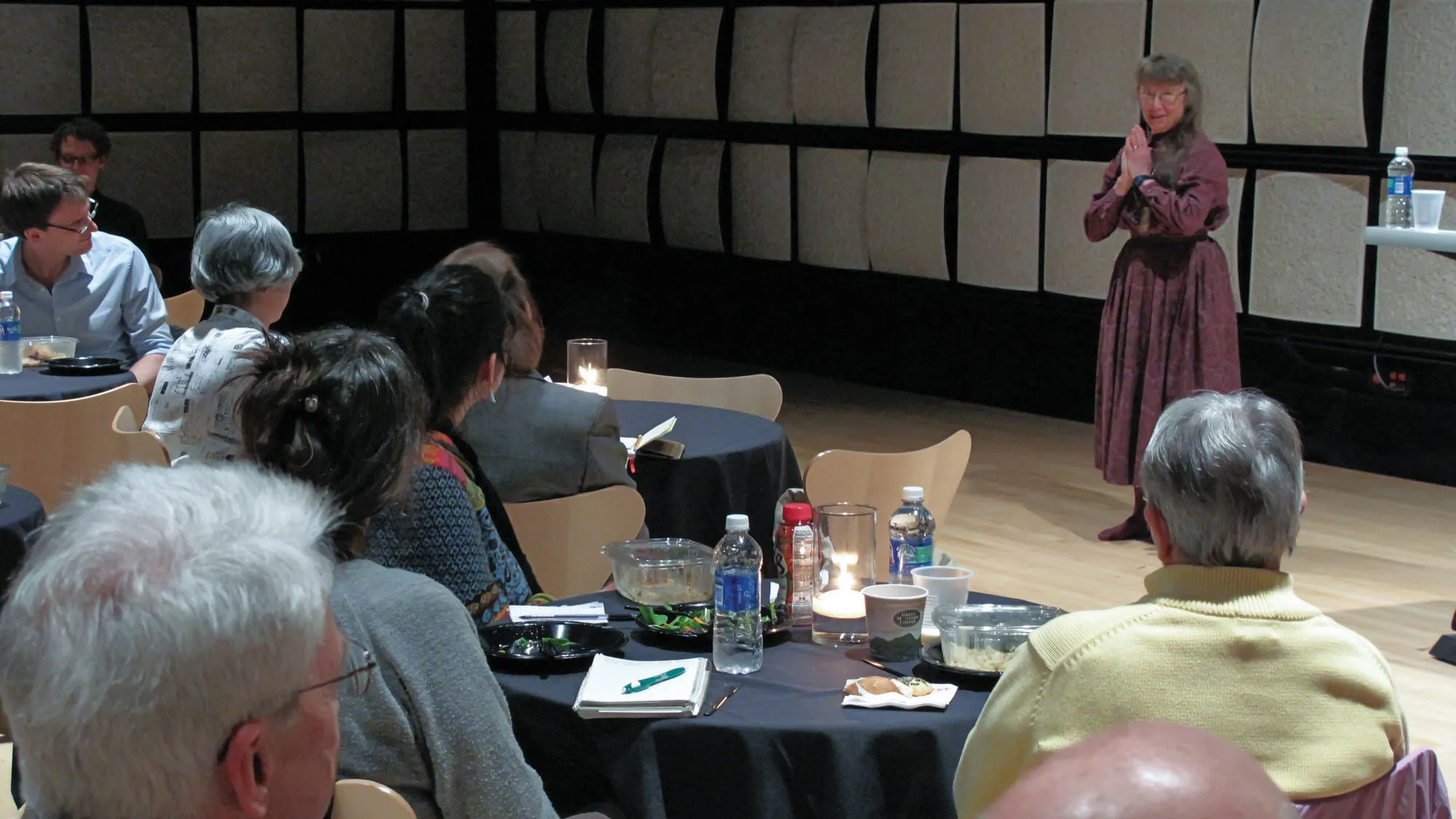
Maxine Sheets-Johnstone addressing people seated on round tables.

Maxine Sheets-Johnstone

Movement and Mirror Neurons: A Challenging and Choice Conversation

Dancer, choreographer, and philosopher Maxine Sheets-Johnstone will lead a discussion over dinner on the primacy of movement in perception and our fundamental understanding of aliveness. A topic rarely acknowledged in the history of western philosophy and science, Sheets-Johnstone will examine how our understanding of space and time is fundamentally conditioned by our experience of movement. Observer Effects invites thinkers to present their highly integrative work in dialogue with the fields of art and science. This lecture series takes its title from a popularized principle in physics that holds that the act of observation transforms the observed. Outside the natural sciences, the idea that the observer and the observed are linked in a web of reciprocal modification has been deeply influential in philosophy, aesthetics, psychology, and politics.

Image
Black folding chairs arranged in a multi ring circle on a constructed black stage in the concert hall orchestra pit.

Hyper-Rainforest

Francisco López

Rainforests are inhabited by an incredibly rich variety of sounds—much like a piece of electronic music: the astonishing variety of sounds comes from sources that are concrete yet overwhelmingly invisible. Hyper-Rainforest is a monumental sound piece, both in duration and in how the sounds are projected to the Concert Hall. All music in this performance stems from field recordings—but it does not simulate the natural reality of the original locations. Instead, the work creates a sonic hyper-reality, a virtual world of sound and music that goes beyond a trip to a rainforest. The original materials are observed, analyzed, and composed to create a piece that surrounds the audience, moving deep into the sounds themselves and toward new sounds still rooted in their origins. This world premiere commission was developed in residence at EMPAC.

Media

Over seven days: 80+ speakers, a whole lot of truss, platform, and some very very fast moving EMPAC staff make for the realization of Francisco's López's commissioned multi-channel composition Hyper-Rainforest.

index (v.4) for two pianos + untitled (series #3)

Céleste Boursier-Mougenot

French artist Céleste Boursier-Mougenot developed two sound installations while in residence untitled (Series #3) and index (v.4)—which were then presented as a single exhibition over three floors in EMPAC’s public spaces. Together, the pieces reflect on music composition’s relation to nature and technology as well as our perception of complexity, control, and authorship in time-based art. untitled (Series #3) was comprised of three wading pools filled with bowls and wine glasses; by calibrating the temperature of the water to increase the resonance of the floating objects, and by controlling the direction of the water flow with a small pump, ongoing, resonant collisions are created. The result is a chaotic, atmospheric music with a variety of small sounds surrounding the listener. For index (v.4) software designed by the artist was installed on computers throughout EMPAC, capturing typed letters, words, and punctuation into dynamics, pitch, and chords played by two mechanically actuated grand pianos. The real-time data stream became the chaotic generator of an ongoing score, in constant performance. Like untitled, this work conflated empirical, technological gestures with chaotic “natural” elements.

A native of France, Boursier-Mougenot’s works have been exhibited worldwide.

Image
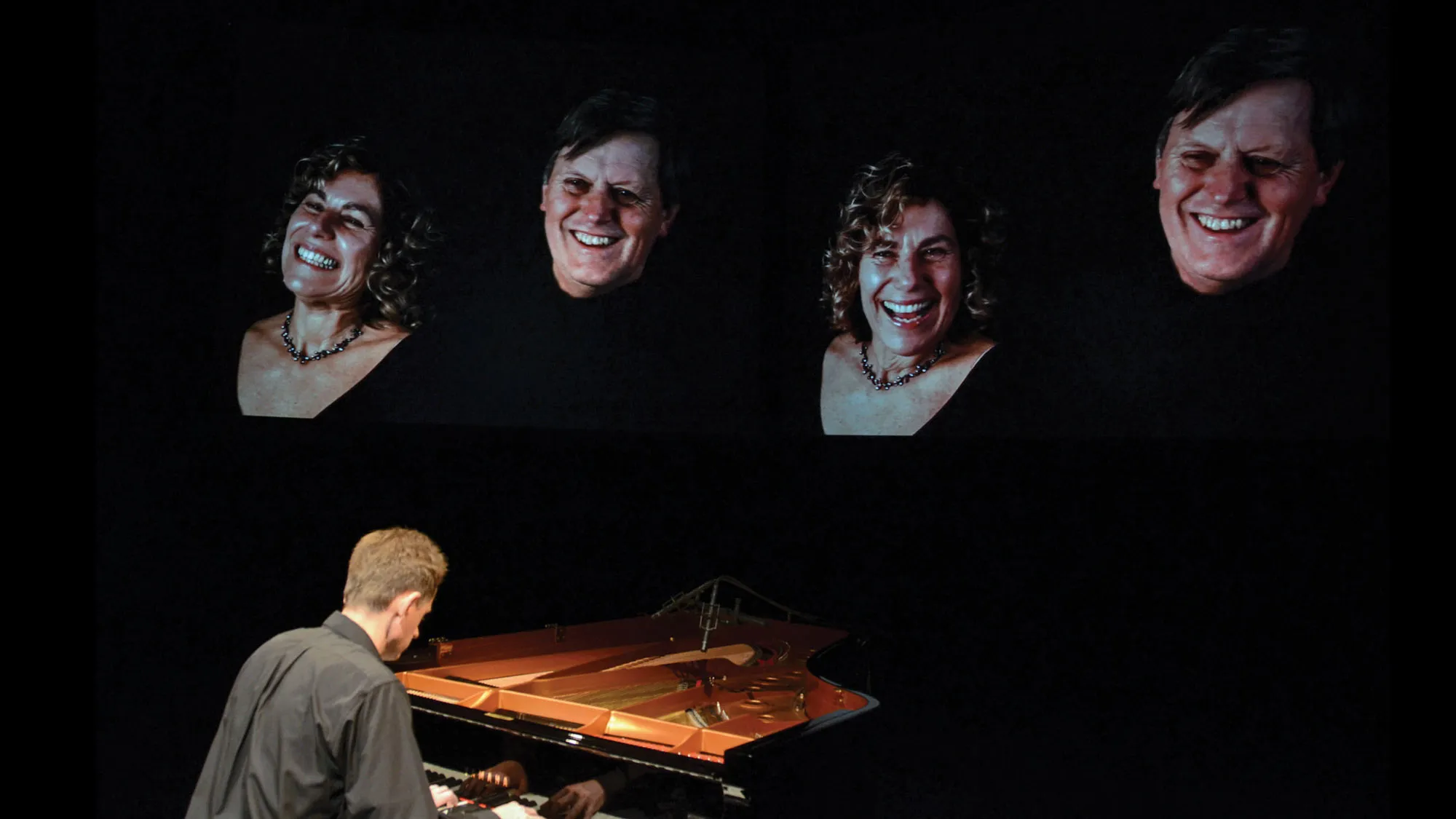
A man seated at a piano with back to the viewer as four projections of smiling people floor above him.

Catch the Tiger!

Jarosław Kapuściński

Intermedia composer and pianist Jarosław Kapuściński creates lighthearted and fanciful pieces in which musical instruments are used to control multimedia content. In these media compositions, he controls projections of videos and computer-generated graphics as he plays piano. The images, words, and music combine to entertain, but also provide insight into the artistic relationship between words and music. The witty integration of his virtuosic piano playing—he was first trained as a classical pianist and composer at the Chopin Academy of Music in Warsaw—with a precisely timed flow of images informs his latest work, Where is Chopin, in which he plays excerpts from Chopin’s 24 Preludes in conjunction with videos of people in various countries listening.

Jarosław Kapuściński is an intermedia composer and pianist whose work has been presented at New York's MoMA; ZKM in Karlsruhe; the Museum of Modern Art, Palais de Tokyo, and Centre Pompidou in Paris; and Reina Sofia Museum in Madrid, among others. He has received numerous awards, including at the UNESCO Film sur l'Art festival in Paris, VideoArt Festival Locarno, and the Festival of New Cinema and New Media in Montréal. He was first trained as a classical pianist and composer at the Chopin Academy of Music in Warsaw and expanded into multimedia during a residency at the Banff Centre for the Arts in Canada (1988) and through doctoral studies at the University of California, San Diego (1992-1997). Kapuscinski is actively involved in intermedia education. Currently, he is an assistant professor of composition and director of the Intermedia Performance Lab at Stanford University.

Catch the Tiger!

Jaroslaw Kapuscinski

Intermedia composer and pianist Jaroslaw Kapuscinski creates lighthearted and fanciful pieces in which musical instruments are used to control multimedia content. In these media compositions, he controls projections of videos and computer-generated graphics as he plays piano. The images, words, and music combine to entertain, but also provide insight into the artistic relationship between words and music. The witty integration of his virtuosic piano playing—he was first trained as a classical pianist and composer at the Chopin Academy of Music in Warsaw—with a precisely timed flow of images informed his latest work Where is Chopin, in which he plays excerpts from Chopin’s 24 Preludes in conjunction with videos of people in various countries listening.

Kapus´cin´ski work has been presented at MoMA; ZKM in Karlsruhe; the Museum of Modern Art, Palais de Tokyo; and Centre Pompidou in Paris. Kapus´cin´ski’s is actively involved in intermedia education, leading the Intermedia Performance Lab at Stanford University where he is assistant professor of composition.

Twice Through the Heart

The OpenEnded Group

The OpenEnded Group created a 3D stage environment for a live chamber opera, Twice Through the Heart. Originally composed in 1997 by English composer Mark-Anthony Turnage and sung by mezzo-soprano Sarah Connolly, the staging was newly directed by Wayne MacGregor. The English-language libretto by poet Jackie Kay depicts the misery of a working-class English housewife imprisoned for killing her abusive husband. The OpenEnded Group worked in residence to create floating imagery (viewed through 3D glasses) suggestive of the protagonist’s mental state: the suffocating fear and violence she endured for years in a cramped council flat, along with brief mirages of the happy life she had once hoped for. To create the imagery, The OpenEnded Group traveled to Dartington in the UK to photographically capture a council housing flat from the 1970s.

Image
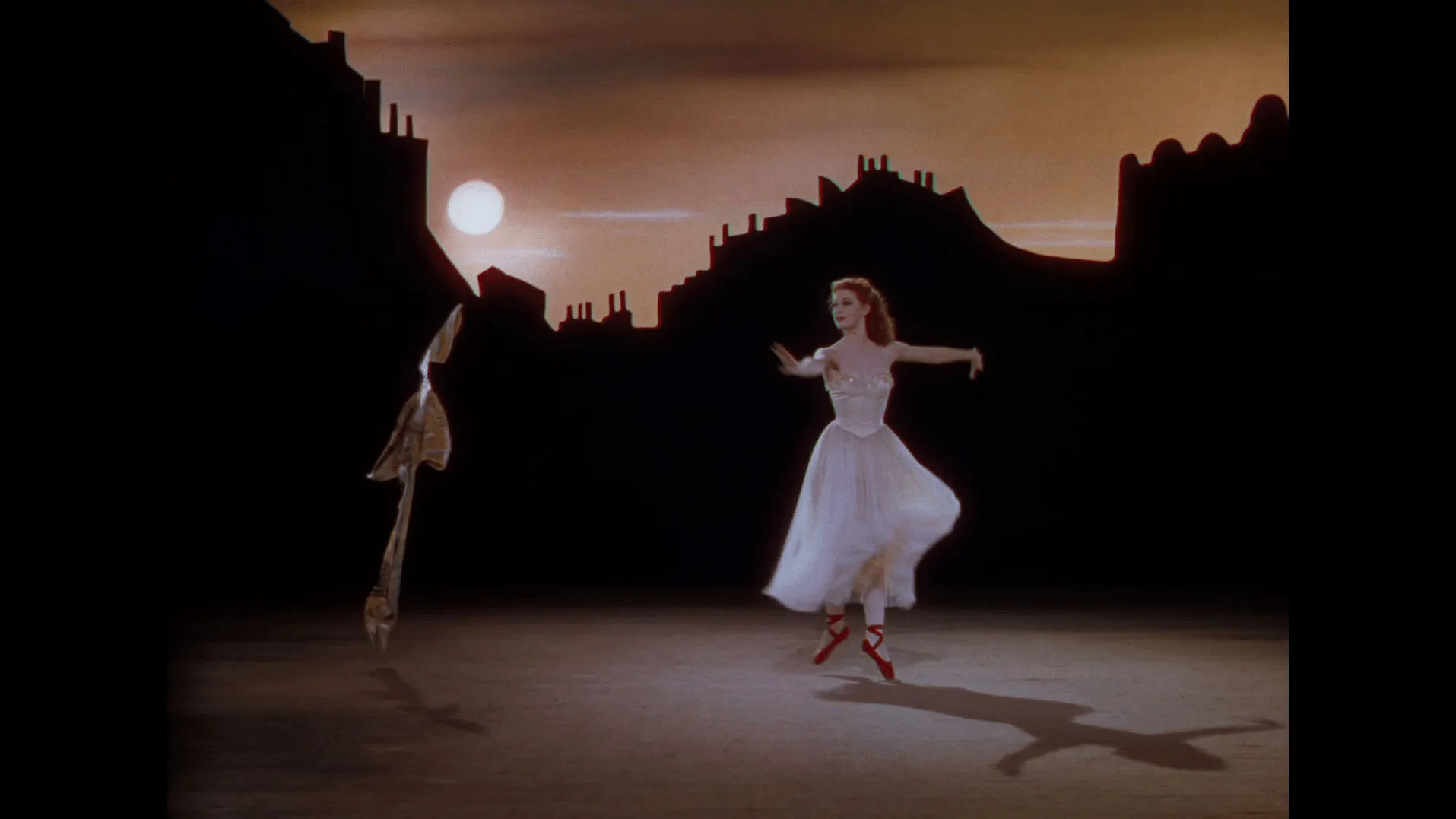
A white woman with red hair in a 40s style white ballet costume and red pointe shoes dancing with arms outstretched across a scene of a cityscape at dusk.

The Red Shoes

Directed by Michael Powell + Emeric Pressburger

Based on the Hans Christian Andersen’s fairy tale about a young girl caught in an endless dance by a pair of magical shoes, The Red Shoes is Powell and Pressburger’s celebrated film about the life of an artist. Set in a ballet production of The Red Shoes, the film follows a ballerina struggling with dueling allegiances to love and career.

The Red Shoes was unprecedented in its treatment of dance on film, featuring an extended 17-minute ballet sequence, and the Royal Philharmonic Orchestra performed its Oscar-winning score. One of cinema’s most famous early uses of Technicolor, this newly remastered digital version was restored by the UCLA Film & Television Archives in 2009.

Cinematic Chimera presents works that strive for a radical synthesis of artistic genres, reviving the notion of the Gesamtkunstwerk, or total artwork. United by their integration of theater, dance, music, architecture, literature, and visual art, these films also realize the Gesamtkustwerk’s technological imperative by making use of advanced cinematic techniques.

Main Image: Film still from The Red Shoes (1948).

Hyper-Rainforest

Francisco Lopez

While at EMPAC, Francisco Lopez developed Hyper-Rainforest, an EMPAC commission that uses a unique set of field recordings that Lopez, a biologist by training, made over many years in the Amazon and other rainforests around the world. Captured with an extreme level of detail, the sounds in these recordings are often difficult to differentiate as industrial, natural, or synthesized. As a result, the music does not simulate the natural reality of the original locations, but instead creates a sonic hyper-reality, a virtual world of sound and music that goes beyond a trip to a rainforest. The original materials are observed, analyzed, and composed to create a piece that used dozens of speakers in a large dome within EMPAC’s Concert Hall, where the audience was seated on a platform in the middle to experience the work.

López has 30 years of experience in sound creation and environmental recordings, and has developed a personal and iconoclastic sound universe based on profound listening to the world. He has been involved in hundreds of sound installations, field recordings, and concerts in over 60 countries.