Image
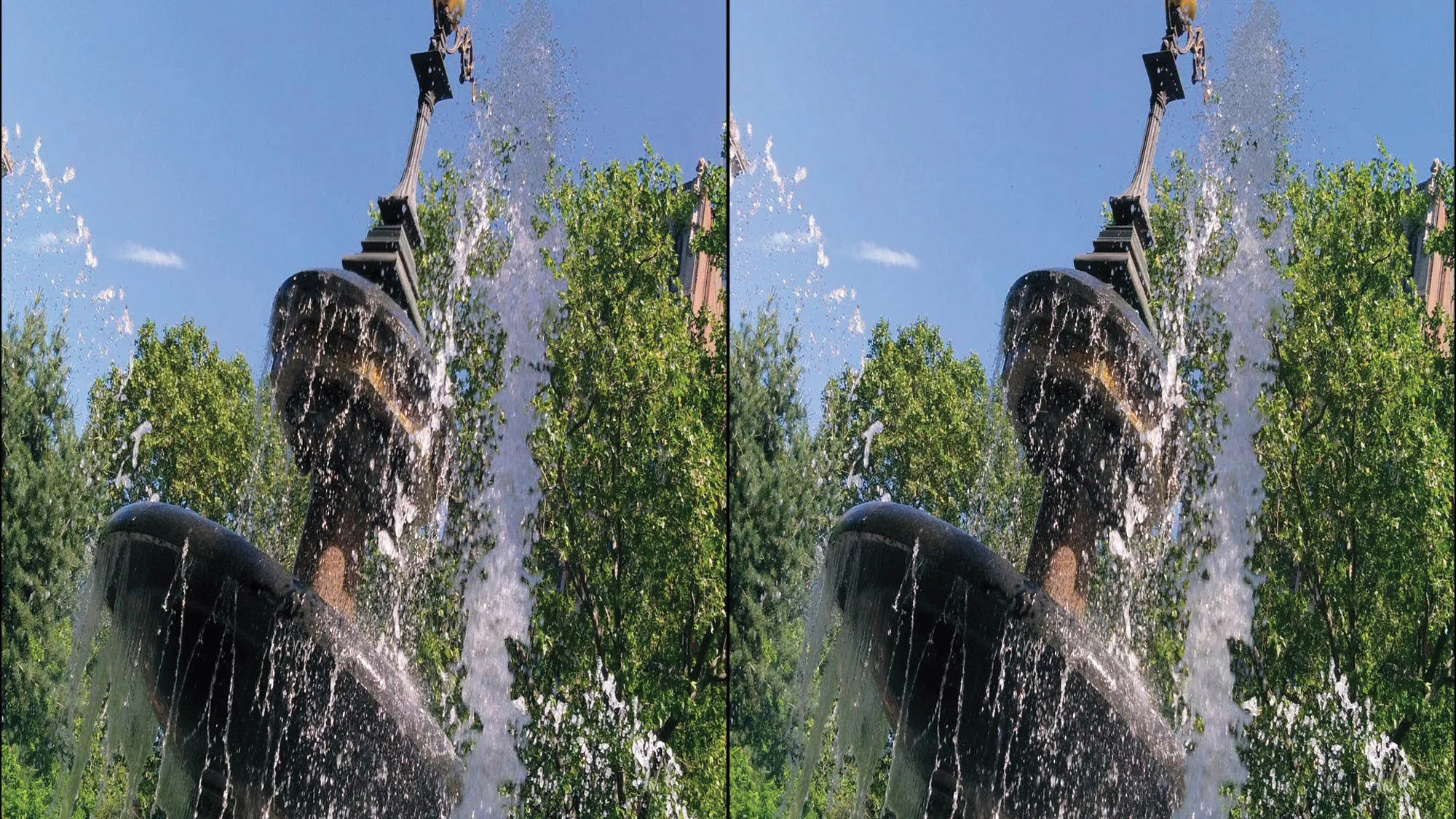
A double image of a fountain against greenery and a blue sky.

Blankets for Indians

Directed by Ken Jacobs

Blankets for Indians blends a stereoscopic study of water spurting from New York’s City Hall fountain with an intimately detailed portrait of an Occupy Wall Street march. While in the process of shooting the fountain in 2012, Jacobs serendipitously turned his camera toward a large protest marching to Zuccotti Park in support of Occupy Wall Street. The unexpected connection gives the film new life, seamlessly moving between sensual observation and political commentary, reflection, and abstraction. Using freeze-frames, text, and 3D manipulation, Jacobs questions the contemporary conditions of socio-political struggle, its relation to aesthetics, and the labor necessary to produce both.

Ken Jacobs is a pioneer of the American film avant-garde and a central figure in post-war experimental cinema. His films, videos, and performances have been received at such international venues as the Berlin Film Festival among many others; and MOMI, the Whitney, and MoMA, New York City. He was a featured filmmaker at the International Film Festival Rotterdam in 2004, and Courtisane Festival, Ghent, in 2014.

Main Image: Ken Jacobs, Blankets for Indians (2012). Video still courtesy the artist and EAI.

Image
Two people on scaffolding projecting an image of a gray ink blob onto a large screen on the concert hall stage.

Time Squared

Ken Jacobs

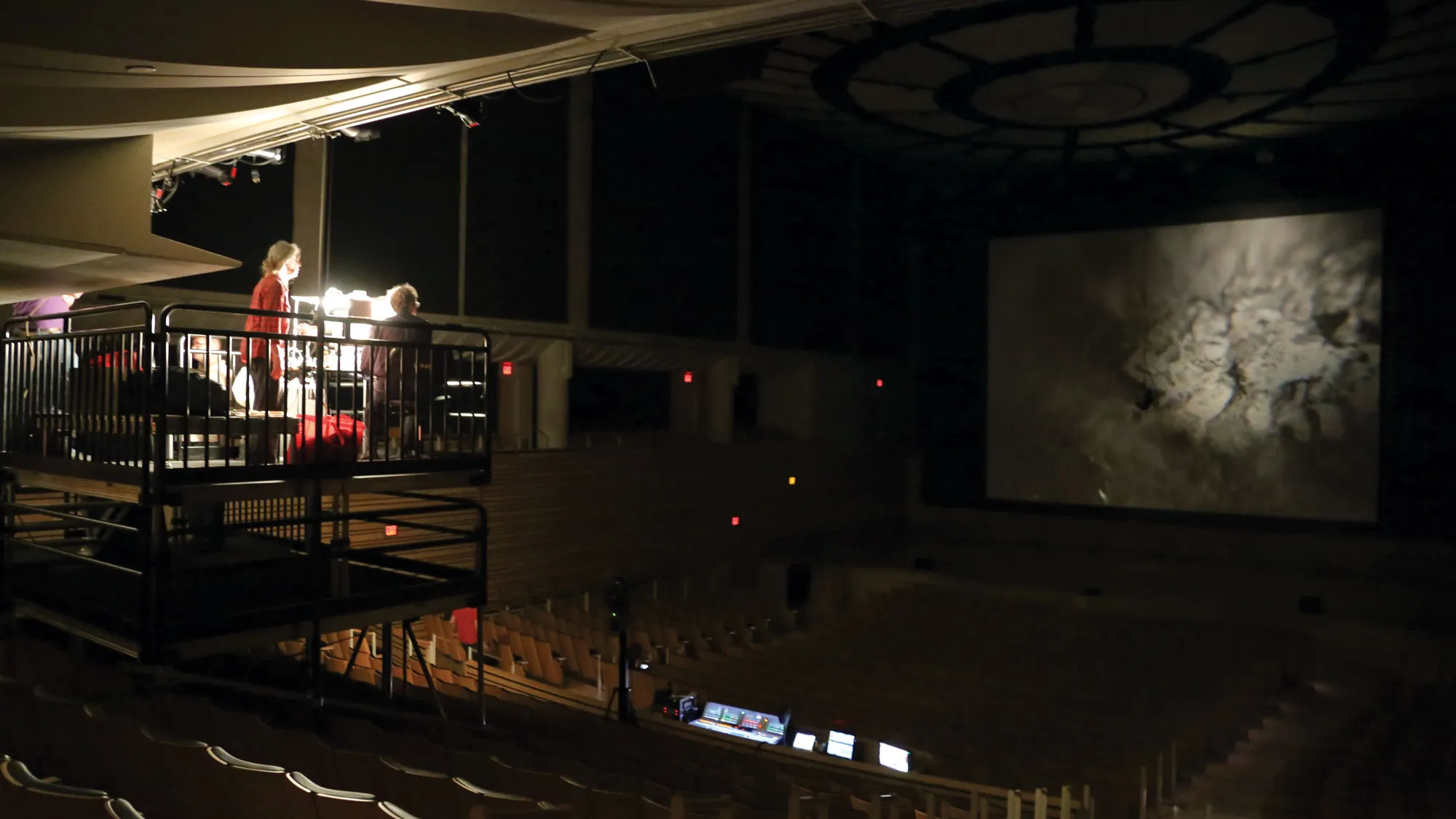
"Along with magician's assistant Flo, I have presented live film-performance since 1975 but other spectacles before that, including 3D shadowplay (with shadows reaching into the audience), in an ongoing investigation of "expanded cinema". This will be a performance with the Nervous Magic Lantern, a device so elemental it puts us in the running with the very earliest inventors of cinema. You will see Abstract Expressionism in depth, monster-creations of dark and light forming and reforming without film or electronics, live! and without 3D spectacles but with 3D available to be seen even by the single-eyed. A projection of evolving and moving, twisting and turning dimensional forms that could've happened before the invention of film, though Abstract-Expressionism had to come first to prepare minds. Light will pulse throughout, not to everyone's pleasure, but no pulse/no hallucination. (Do not prepare with drugs, the Nervous Magic Lantern is the drug.) Accompanied by the surround-sounds of the New York subway and its joyful inhabitants."

—Ken Jacobs, 2014

Time Squared, one of avant-garde film pioneer Ken Jacobs’ iconic Nervous Magic Lantern performances, uses projected light, the most basic ingredient of cinema, to create hallucinatory optical effects. Colored slides, a lens, and a spinning shutter are hand-manipulated by the artist—assisted by Florence Jacobs—to animate the patterns reflected onto the screen, creating stereoscopic effects without celluloid or video. Alongside numerous film and video productions, and extensive work with 3D filmmaking techniques, Jacobs has explored the histories and technologies of the moving image through projector performances for the past five decades, both in shadow plays and with The Nervous System—an apparatus consisting of two 16mm projectors with identical strips of film that create the illusion of spatial depth. Time Squared Nervous Magic Lantern performance is by Ken Jacobs, assisted by Florence Jacobs. Sound gathered from the New York Subways.

Ken Jacobs is a pioneer of the American film avant-garde and a central figure in post-war experimental cinema. His films, videos, and performances have been received at such international venues as the Berlin Film Festival among many others; and MOMI, the Whitney, and MoMA, New York City. He was a featured filmmaker at the International Film Festival Rotterdam in 2004, and Courtisane Festival, Ghent, in 2014.

Main Image: Ken and Flo Jacobs projecting Times Squared in the concert hall in 2014.

Image
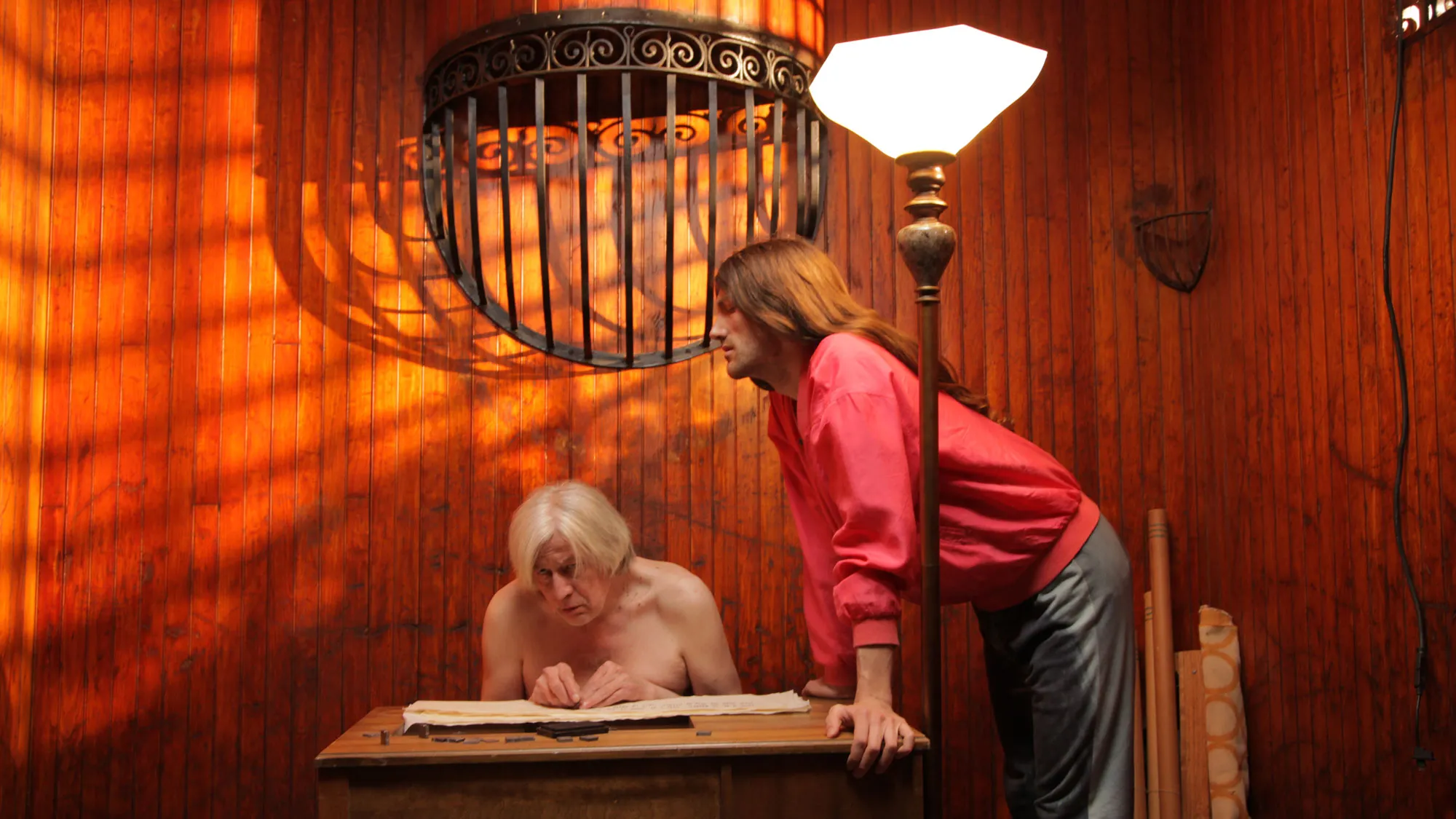
Two people in a wood paneled room. A naked white man with medium length gray hair sits at a desk hunched over a book as another person with long hair hearing a pink windbreak and gray pants leans over supervising.

Ward of the Feral Horses

Orit Ben-Shitrit

Commissioned, developed and produced as part of the DANCE MOViES Commission, a program that supports the creation of new dance works for the screen, with projects developed and produced through the EMPAC artist-in-residence program, interdisciplinary artist Orit Ben-Shitrit explores the sensation of a person being trapped in their body. Has the loss of privacy in our public and private lives gone too far? Why do we have the need to go wild? How can we break free? In the past 30 years, we have gradually moved from industrial production to a cognitive phase of Capitalism. From social networks to the marketplace, our online presence has merged the public with the private to an unprecedented degree of personal exposure.

Main Image: Production shot from Ward of the Feral Horses in 2014, on location in downtown Troy, NY. Photo: Mick Bello/EMPAC.

Image
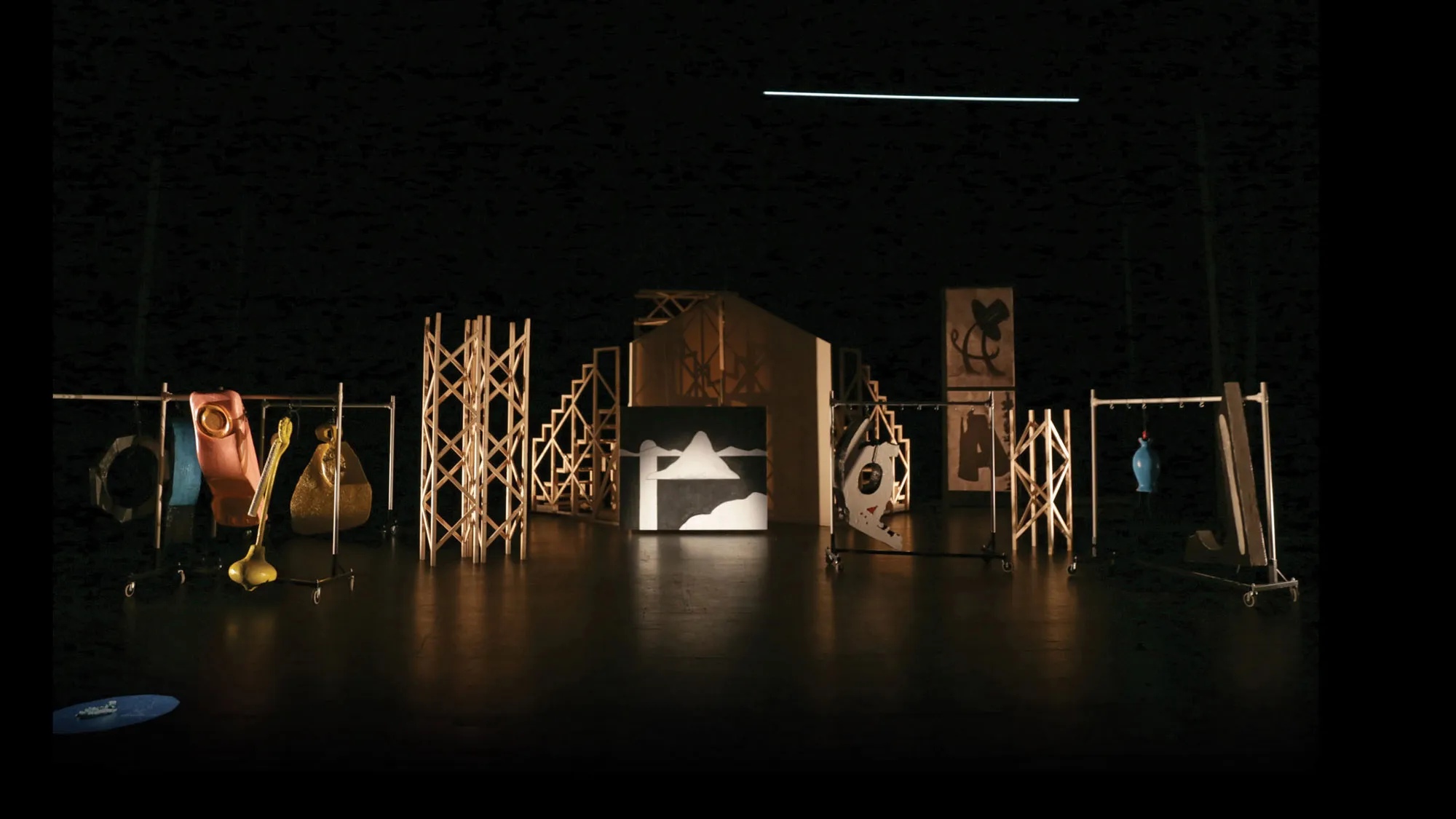
Various wood scaffolding and set pieces on a dark stage.

The Artist Theater Program

Erika Vogt

Los Angeles-based artist Erika Vogt presented a collaborative theatrical production that brought together visual artists and performers who work across media, including Math Bass, Shannon Ebner, Lauren Davis Fisher, Mariah Garnett, MPA, Silke Otto-Knapp & Flora Wiegmann, Adam Putnam, and Mark So. The Artist Theater Program was a choreographed chorus of individual works that moved, collided and overlapped in time, responding to the space and mechanics of EMPAC’s architectural infrastructure by combining performers, artworks, sets, props, and lighting effects that echo the corporeal, erotic, sensual, expressive, and strange. By acting collectively upon physical or sculptural forms, the artists created an alternate framework for an experiential exhibition, one rooted in the desire to build and present an artistic community. 

Erika Vogt’s work has been included in major international shows at New Museum, New York City; Hepworth Wakefield, Leeds; Triangle, Marseille; Whitney Museum, New York City; the Hammer Museum, Los Angeles; and SFMOMA, San Francisco. Vogt’s video Darker Imposter was screened on Channel 4 television, co-commissioned by Frieze Foundation, London; and EMPAC.

Main Image: Production still from The Artist Theater Program (2014). Photo: Mick Bello/EMPAC.

Media
Image
A bobcat with a dead bird in its mouth.

From the impossibility of one page being like the other

Oraib Toukan and Ala Younis

Oraib Toukan has been collaborating with artist Ala Younis on a project on found film footage from the former Soviet Cultural Center in Amman, and working with digital builder Matthew Epler, who designed a crowd-sourced database to globally identify 900 unknown film canisters in Amman. From this starting point, Toukan and Younis have developed a peculiar archeology of research that looks at early Palestinian film production, technocratic Soviet friendships, cine clubs, and Russian language films in Amman. The beginning of the project was locating the key early films of two members of the former Aflam Falistine collective (Palestine Films). The commission for Frieze Film 2013 is based on material from this growing archive.

Curated and produced in collaboration with Frieze Foundation curator Nicola Lees, Frieze Film is a series of new short-form moving image works by Petra Cortright, Peter Gidal, Patricia Lennox-Boyd, Oraib Toukan, and Erika Vogt produced for television. Petra Cortright, Patricia Lennox-Boyd, and Erika Vogt’s Frieze Films were all produced during artist residencies at EMPAC in fall 2013. The works are broadcast on Channel 4 (UK) as part of Random Acts. The shorts will be screened individually prior to EMPAC screening series throughout Spring 2014.

From the impossibility of one page being like the other will be screened Thursday, April 3, 2014 preceding Playtime

Oraib Toukan lives in New York and teaches and works in Ramallah and Amman. Toukan works across a variety of media focusing on historiographical absurdities and discreet institutional interventions. Previously, she produced a short sound work for radio for ARTonAIR.org and ArtDubai Projects (2011) and took part in the Serpentine Gallery Map Marathon (2010). Recent exhibitions include the 7th Asia Pacific Triennial of Contemporary Art, the Mori Art Museum, and the 11th Istanbul Biennial.

Ala Younis is an artist based in Amman. Collaboration forms a big part of her practice, as does curating and joint book projects. Using objects, film and printed matter, she often seeks instances where historical and political events collapse into personal ones. Recent exhibitions include the 9th Gwangju Biennial (2012); the New Museum Triennial (2012); Tea with Nefertiti at Mathaf and the Institut du Monde Arabe (2012-13); the 12th Istanbul Biennial (2011); Home Works ‘5, Beirut (2010); and PhotoCairo 4 at the Contemporary Image Collective in Cairo. Recent publications include ‘Needles to Rockets’ (2009), and ‘Tin Soldiers’ (2012), a collaboration of artists, writers, soldiers, and photographers on the concept of militancy. Younis curated Kuwait's first national pavilion at the 55th Venice Biennale (2013), as well as the ‘Museum of Manufactured Response to Absence’ at the Museum of Modern Art in Kuwait (2012), and ‘Out of Place’ at the Tate Modern and Darat al Funun Amman, among others.

Image
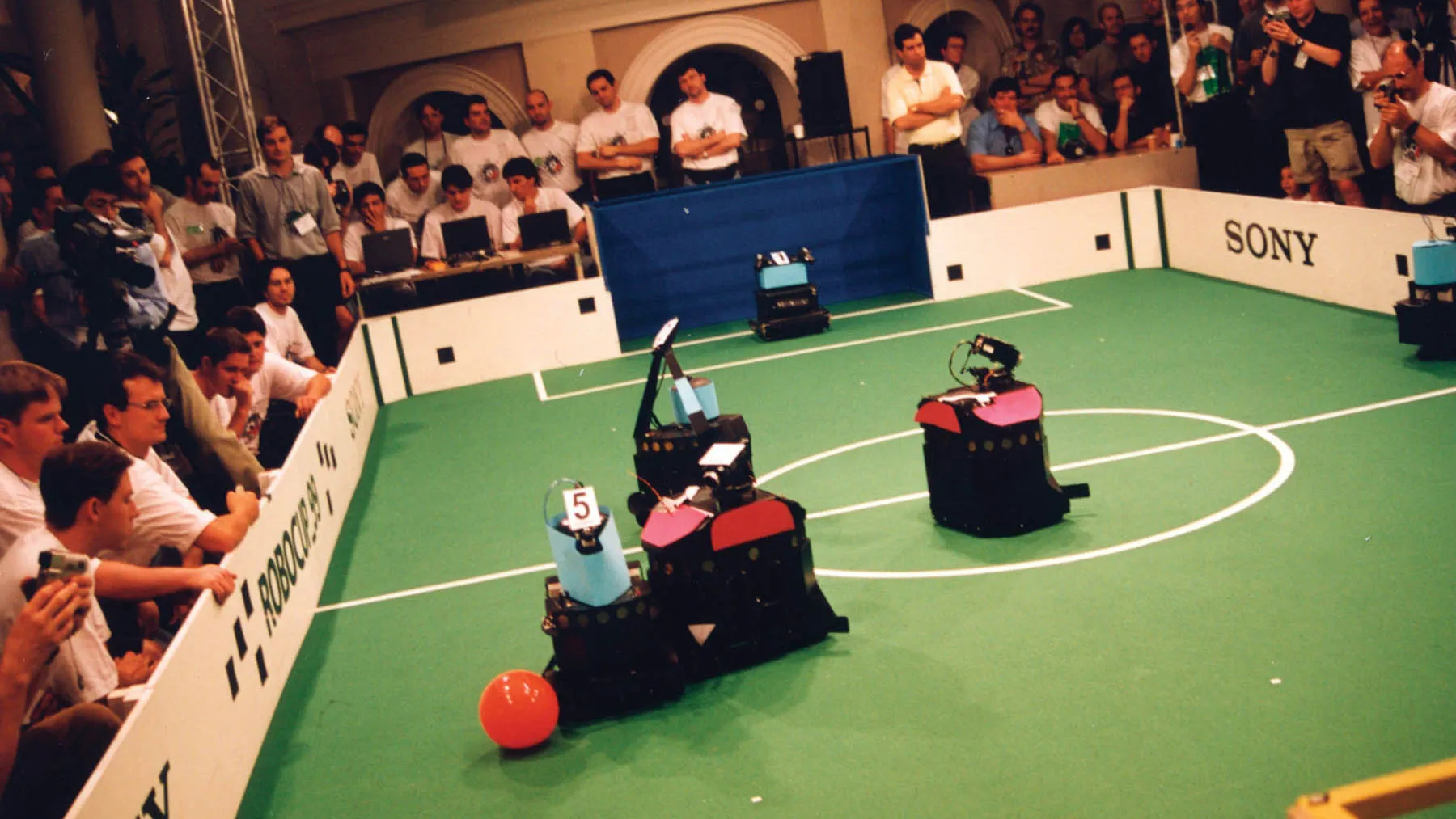
Six robots wearing blue or red on a pitch playing a form of soccer with a red ball surrounded by men controlling them.

RoboCup 99

Directed by Mika Taanila

Mika Taanila’s documentary follows the antics of soccer playing robots, pitted against each other at the annual RoboCup tournament on the eve of the 21st century. With RoboCup 99, the Finnish filmmaker continues his investigations into the unwieldy dynamic between man and machine. Using deliberately aged footage from the tournament to highlight the failed experiments of the past, the film tracks the clumsy desire of the makers’ drive toward technological progress. Taanila's short film Optical Sound, a symphony for an array of obsolete inkjet printers, will accompany the screening.

RoboCup 99 is part of Filmmaker Focus: Mika Taanila, a retrospective overview of the documentary films of Mika Taanila, who has created acclaimed works of film, video, photography, installation, and sound over the past 20 years. Reflecting on utopian technological innovators across the fields of engineering, architecture, and music, Taanila’s films explore unsung genius and delve into the gap between technological progress and society’s looming destruction to uncover the successes and failures of a century of progress. Filmmaker Focus is devoted to the presentation of a series of works by a single filmmaker whose considerable body of work experiments with the documentary form to investigate the implications of technological development and innovation.

Oraib Toukan and Ala Younis's From the impossibility of one page being like the other will be screened prior to RoboCup 99, as part of the Frieze Film series.

Image
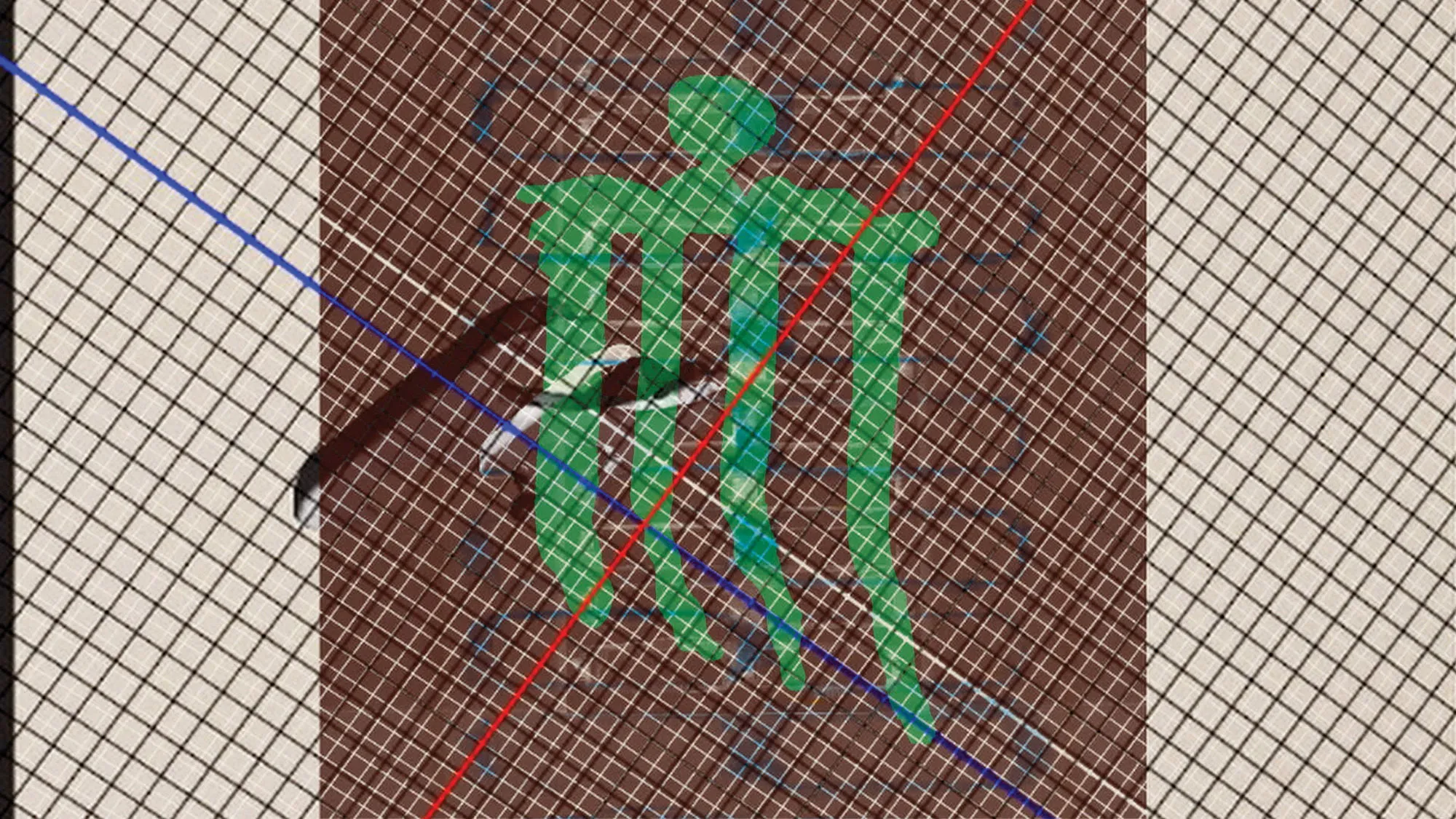
AN abstract green comb shape overlaid with a grid and red and blue lines.

Darker Imposter

Erika Vogt

Erika Vogt has described her commission for Frieze Film 2013 as working within the form of the commercial spot. Using images, including drawings and footage of friends collected throughout the preceding months, Vogt creates episodic video compositions that are broken up through editing. This extends Vogt’s previous interest in circumventing the video signal as seen in her works Stranger Debris Roll Roll Roll and Temple Drawn – OFF (both 2013). Curated and produced in collaboration with Frieze Foundation curator Nicola Lees, Frieze Film is a series of new short-form moving image works by Petra Cortright, Peter Gidal, Patricia Lennox-Boyd, Oraib Toukan, and Erika Vogt produced for television. Petra Cortright, Patricia Lennox-Boyd, and Erika Vogt’s Frieze Films were all produced during artist residencies at EMPAC in fall 2013. The works are broadcast on Channel 4 (UK) as part of Random Acts. The shorts will be screened individually prior to EMPAC screening series throughout Spring 2014.

Darker Imposter will be screened Thursday, March 6, 2014 preceding Orpheus

Erica Vogt Darker Imposter (2014). Courtesy the artist.

Future is Not What it Used to be

Directed by Mika Taanila

Mika Taanila’s lyrical portrait of Finnish designer, philosopher, and artist Erkki Kurenniemi, the pioneering developer of digital and interactive instruments in the 1960s-70s such as the legendary DIMI synthesizer, who went on to design robotic systems and industrial automation. Using archival footage and materials from the early years of electronic art and excerpts of Kurenniemi’s own experimental films, Taanila’s essay film follows his obsessive recording of every aspect of his daily life as a digital diary in order to create a reconstruction of his life, or a “virtual persona,” by July 2048.

Future is Not What it Used to Be is part of Filmmaker Focus: Mika Taanila, a retrospective overview of the documentary films of Mika Taanila, who has created acclaimed works of film, video, photography, installation, and sound over the past 20 years. Reflecting on utopian technological innovators across the fields of engineering, architecture, and music, Taanila’s films explore unsung genius and delve into the gap between technological progress and society’s looming destruction to uncover the successes and failures of a century of progress. Filmmaker Focus: Mika Taanila is devoted to the presentation of a series of works by a single filmmaker whose considerable body of work experiments with the documentary form to investigate the implications of technological development and innovation.

Erika Vogt's short film Darker Imposter will be screened prior to Future is Not What it Used to Be as part of the Frieze Film series.

Mika Taanila lives and works in Helsinki. For more than 20 years, he has created works in film, video, photography, sound, and installation that investigate various technological developments and the innovators behind them. Solo and two-person exhibitions include Mika Taanila: The Most Electrified Town in Finland, KIASMA Museum of Contemporary Art, Helsinki (fall 2013); On The Spot #4, Badischer-Kunstverein, Karlsruhe, Germany (2008); Zone d'éclipse totale, Dazibao, Centre de photographies actuelles, Montréal, Canada (2007); Une histoire saccadée (with Erkki Kurenniemi), Institut Finlandais, Paris (2006); Hotel Futuro, Spacex Gallery, Exeter, UK (2005); and Mika Taanila: Human Engineering at Migros Museum für Gegenwartskunst, Zürich (2005). Taanila’s films and installations have been featured at more than 200 international film festivals and exhibitions, including dOCUMENTA, Kassel, Germany (2012) and Contemporary Art Museum St. Louis (2013).

Trailer: Future is Not What it Used to Be (2002)
Image
A black screen with a slight beam of light in the center.

CODA I + CODA II

Peter Gidal

A foremost exponent of British Structural/Materialist cinema, Gidal contributes CODA I and CODA II to Frieze Film. The starting point for these 16mm films is a soundtrack that consists of three lines from a 1,000-word story he wrote in 1971, read by William Burroughs. Gidal describes the films’ so-called imagery as “a complex of barely visible cuts in space and time, the opposite of erasure, but nothing so much as visible.” Curated and produced in collaboration with Frieze Foundation curator Nicola Lees, Frieze Film is a series of new short-form moving image works by Petra Cortright, Peter Gidal, Patricia Lennox-Boyd, Oraib Toukan, and Erika Vogt produced for television. Petra Cortright, Patricia Lennox-Boyd, and Erika Vogt’s Frieze Films were all produced during artist residencies at EMPAC in fall 2013. The works are broadcast on Channel 4 (UK) as part of Random Acts. The shorts will be screened individually prior to EMPAC screening series throughout Spring 2014.

CODA I and CODA II will be screened Thursday, February 20, 2014 preceding The Short Films of George Lucas & Arthur Lipsett

Peter Gidal lives and works in London. One of the foremost exponents of British Structural/Materialist cinema and a key member of London Filmmakers’ Co-op since 1968, Gidal is active as a filmmaker and theorist. His films were given a retrospective at the Centre Pompidou, Paris, and LUX, London (both 1998), as well as the ICA, London (1983). He is renowned in particular for his highly influential publications Andy Warhol: Films and Paintings (Studio Vista/Dutton Pictureback, 1971), Understanding Beckett: Monologue and Gesture (Macmillan/ Palgrave, 1986), and Materialist Film (Routledge, 1989), which was reissued in 2013.

Bridal Shower

Petra Cortright

Produced during her residency at EMPAC in fall 2013, Petra Cortright’s Bridal Shower moves beyond her past Internet-based experiments to test new production values associated with broadcasting. Cortright is a member of the Nasty Nets Internet Surfing Club, Loshadka Internet Surfing Club, and Computers Club, making videos that intuitively play with online language, including representation of the physical body within the computer screen. DIY aesthetics characterize Cortright’s practice, which embraces and subverts the home user’s attitude toward social media and technologies.

Curated and produced in collaboration with Frieze Foundation curator Nicola Lees, Frieze Film is a series of new short-form moving image works by Petra Cortright, Peter Gidal, Patricia Lennox-Boyd, Oraib Toukan, and Erika Vogt produced for television. Petra Cortright, Patricia Lennox-Boyd, and Erika Vogt’s Frieze Films were all produced during artist residencies at EMPAC in fall 2013. The works are broadcast on Channel 4 (UK) as part of Random Acts.

The shorts will be screened individually prior to EMPAC screening series throughout Spring 2014.

Bridal Shower will be screened Thursday, January 30, 2014 preceding Existenz

Petra Cortright lives and works in Los Angeles. Her work has been included in numerous group exhibitions, including the San Jose Biennial (2010) and the Internet Pavilion at the Venice Biennale (2009). She has also had solo exhibitions at Club Midnight, Berlin, and Preteen Gallery, Mexico City. Cortright is interested in moving work beyond her past Internet experiments and testing new production values associated with broadcast.