Ipsa Dixit

Kate Soper

Ipse dixit /IP-suh DIK-sit/: noun (Latin). Literally “he, himself, said it.”

An uproven yet dogmatic statement, which the speaker expects the listener to accept as valid without proof beyond the speaker's assumed expertise.

Ipsa dixit: “she, herself, said it . . ."

Ipsa Dixit is an evening-length work of theatrical chamber music by American composer Kate Soper. Exploring the intersection of music, language, and meaning, the piece blends elements of monodrama, Greek theater, and screwball comedy to skewer the treachery of language and the questionable authenticity of artistic expression. Each of the piece’s six movements draw on texts by thinkers such as Aristotle, Plato, Freud, Wittgenstein, Jenny Holtzer, and Lydia Davis, delivering ideas from the linguistic disciplines of poetics, rhetoric, and metaphysics through extended vocal techniques and blistering ensemble virtuosity. Developed in pieces since 2010, Soper’s EMPAC residency culminated in the first performance of the work’s entire cycle.
 

Magic Electronics

Laure Prouvost

Magic Electronics is a 2014 work by French artist Laure Prouvost, in which she installed moving lights and synched audio into a gallery in order to animate and narrate her exhibition of objects. In doing so, she transformed the static exhibition into a stage. Magic Electronics is exemplary of an approach that slips between formats (video, sculpture, installation) and reg- isters (speech, image, object, light), deliberately mistranslating and misunderstanding as it goes.

Magic Electronics figured as the center of an evening-long conversation between Prouvost and EMPAC curator Vic Brooks during which the pair screened and discussed a selection of Prouvost’s work, taking the audience on a jour- ney from the pre-recorded and situated to the live and one-off. Prouvost was in residence at EMPAC to develop a new performance, which will be premiered alongside her solo exhibition at Walker Art Center in 2017–18.

Image
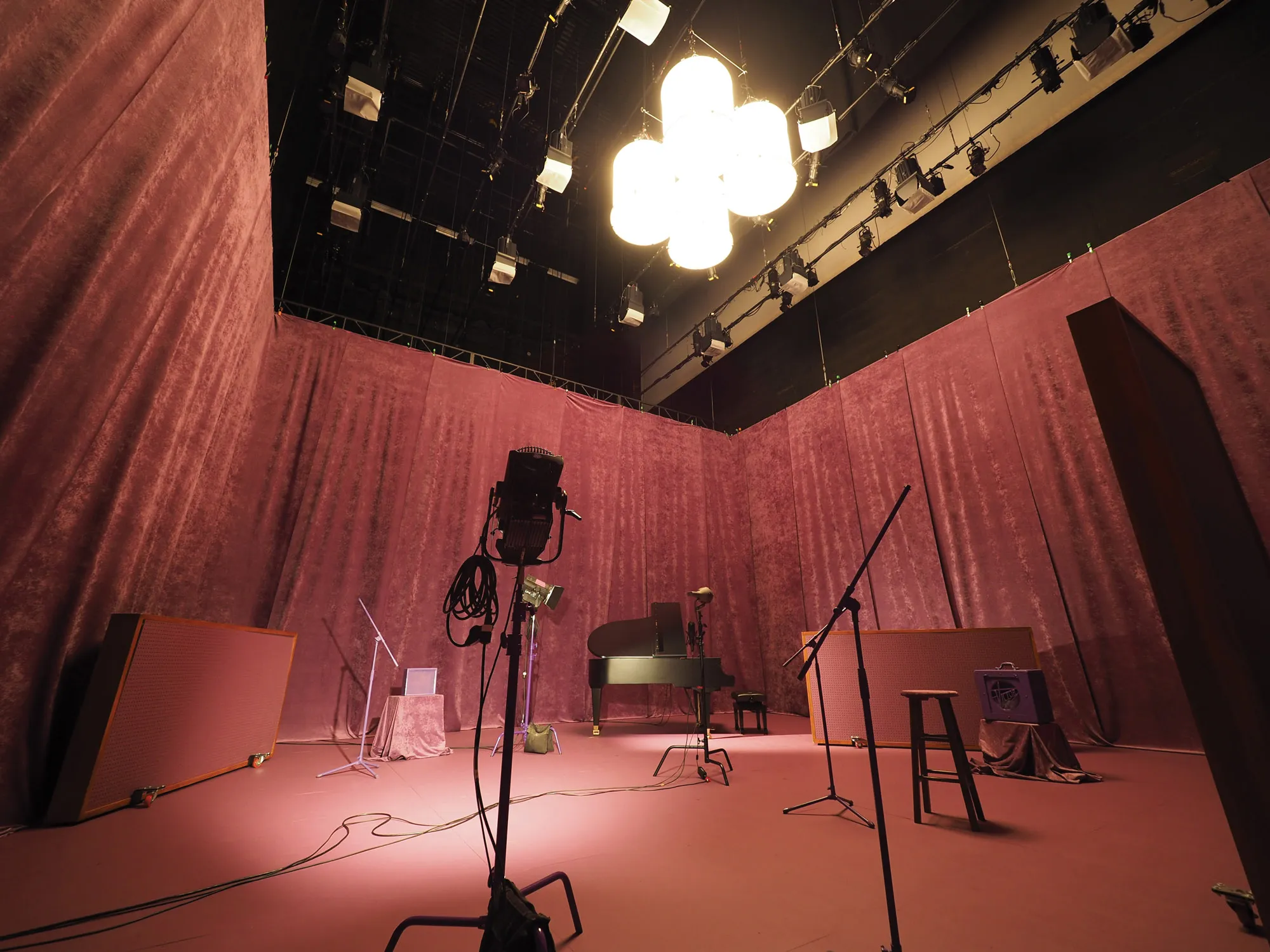
Studio set up with a piano, microphones, amp, and various lighting in a room with pink velvet walls with matching pink floors

An Evening with Queen White

Martine Syms

An Evening with Queen White was produced at EMPAC with a 360° camera rig—originally manu-factured to capture footage for virtual reality environments—placed at the center of a mono-chromatic purple set. Guitar amps, microphones, a piano, and acoustic panels that refer to the Motown recording studios of the 1960s decorate the set. Filmed in a single long take, the performer Fay Victor (as Queen White) moved freely around the set and was continually captured by the camera. 

Eschewing conventional VR, Syms explored how the audience can experience this kind of image environment without the use of a headset. The installation played with the possibility that parts of the performance still remain out of frame or off screen. Several screens were placed in different locations around the studio and each only showed a small part of the 360° video, exposing the limits of each screen’s size and shape. A mobile screen allowed the audience to explore the missing parts of the image for themselves. 

An Evening with Queen White is exemplary of Syms’ use of the monologue as a medium for exploring how voice, gesture, and persona are learned and performed. The script complicates the artist’s own biography and points toward how strategies of performing oneself as a Black woman in America are transmitted and crystallized across generations through both familial teaching and societal conditioning. 

Image
A man and a woman holding a large white piece of paper with a black diamond amongst other papers of various sizes strewn about the floor of a black box studio

One can make out the surface only by placing any dark-colored object on the ground

Hannah Rickards

One can make out the surface only by placing any dark-colored object on the ground is a performance that used navigational techniques to choreograph the interaction of a moving camera with two performers. 

The title refers to how one can travel in polar whiteout conditions by placing an object on the ground and continuing to place the object in front of you as you move forward. By this successive act, a pattern is formed, which can be viewed as a visual score for performance. Inspired by the graphic scores of Morton Feldman that explore musical composition as spatial terrain, London-based artist Hannah Rickards approached the media infrastructure of EMPAC’s Studio 1 in a similar fashion. A cable-suspended camera was maneuvered throughout the space in relation to the performers, capturing wide aerial shots as well as close-up detail of their gestures.

This performance was developed specifically for the production environment of Studio 1 and was the only time this work was performed live. Following the artist’s residency, One can make out the surface… toured solely as a video installation. 

Main Image: Production still, One can make out the surface only by placing any dark-colored object on the ground (2016). Image courtesy the artist and EMPAC.

Image
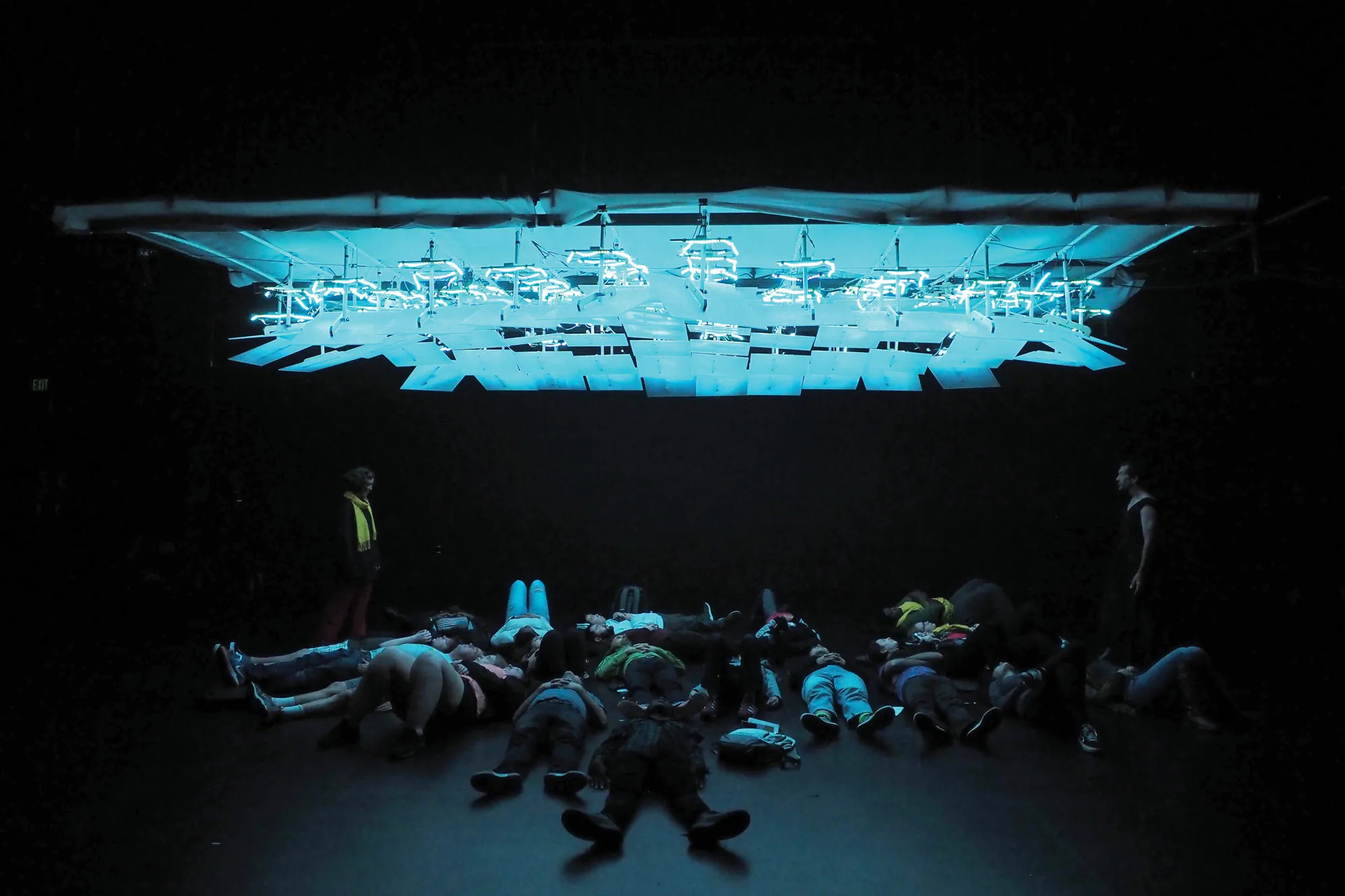
a group of about 15 people laying under a grid of lighted squares on the theatre stage

Listening Creates an Opening

Mary Armentrout Dance Theater

Over the course of two and a half years, Mary Armentrout Dance Theater worked in residence toward the fall 2018 premiere of Listening Creates an Opening. A collaboration between Oakland-based choreographer Mary Armentrout, media artist Ian Winters, composer Evelyn Ficarra, and performer Chris Evans, the project took shape over the course of a number of production visits, work-in-progress presentations, workshops, and pop-up performances. 

Armentrout introduced audiences to the project’s focus on bodily approaches to technology through a workshop in spring 2017, From Feldenkrais to GoPro, which paired Feldenkrais techniques of awareness-through-movement with media technologies. At this point, the team also initialized a year-long time-lapse video, documenting EMPAC’s north staircase and equipping the lower landing with props, including the work’s iconic motorcycle helmet, for building visitors to interact with the video. The scope of the work grew to incorporate themes of architecture and histories of place, resulting in a work-in-progress performance that led audience members from Rensselaer’s Off-Campus Commons, through the EMPAC building and down into the city of Troy. The final, roving performance expanded on this path, with performer Jack Magai leading audiences through these sites, as well as the Karma Hair Salon, and Uncle Sam’s Good and Natural Products, ending at the Hudson River. Along the way, the performance incorporated footage from the year-long time lapse as well as recurring performance motifs. 

Main Image: Listening Creates an Opening in the EMPAC Theater, 2019. Photo: Mick Bello/EMPAC.

Streya

Olivia De Prato

Violinist Olivia De Prato was in residence in the Concert Hall to record, mix, edit, and master new solo works by composers Reiko Füting, Taylor Brook, Ned Rothenberg, Samson Young, Victor Lowrie, and Missy Mazzoli.

Austro-Italian violinist Olivia De Prato has been an active performer in New York City’s contem- porary music community since moving there in 2005. As a member of critically acclaimed ensem- bles, the Mivos Quartet, Ensemble Signal, and Victoire, De Prato has been invoved in commis- sioning, premiering, and recording countless new compositions, with a range of figures spanning the diverse landscape of new music.

Image
two women hold their arms in a bent T shape in a black box studio.

Black Power of Hip Hop Dance: On Kinesthetic Politics

Naomi Bragin

Hip hop dancer, choreographer, and scholar Naomi Bragin led a workshop on the dance style known as the Robot, Robotting, or Botting. She introduced the basic steps and movements of Robotting and contextualized them within the history and practice of street dance. Participants were invited to take part in a dance workshop featuring the freestyle circle, a collective improvisation fundamental to black expressive dance practices. Bragin also addressed the complex relationship between kinesthesia, politics, and technology, and how this relationship enables our understanding of hip hop culture. The workshop explored what happens when the body is the robot and the robot is the body on the street.

Naomi Bragin is assistant professor in the school of Interdisciplinary Arts and Sciences at University of Washington Bothell. Drawing from 20 years dancing in clubs, the streets, and onstage, she researches the intersections of dance, popular culture, media, and black political theory, attending to issues of cultural appropriation and aesthetic politics. Bragin is the founder of DREAM Dance Company, for which she was the recipient of a Ford Foundation Future Aesthetics Artist Award, a Zellerbach Foundation Grant, and was a California Arts Council Artist-in-Residence.

Main Image: Ms Bragan during a workshop at EMPAC during Fall, 2016.

Media

Naomi Bragin presenting her talk in the Theatre in October, 2016. 

2016 Fall

fall 2016 brochure cover

2016 Fall season reel. Courtesy the artist/EMPAC.

108 Troubles

Rob Hamilton

In Spring 2016, EMPAC completed construction on a 496-channel wave field audio system, one of the most extensive in the world. Consisting of very small speaker heads oriented very close together, the system produces a 3D audio environment by localizing the source of individual sounds with an extreme level of precision.

For the wave field array’s inaugural performance, Rensselaer Professor Rob Hamilton created a running installation and performance (on Sept. 2) to explore and demonstrate advanced concepts of spatialized sound. Using a Disklavier piano, Hamilton transformed digitally recorded notes and distributed them across each of the independently controlled speakers in the system. Audiences were encouraged to physically explore the resulting environment much like a giant sonic hologram. The live performance was realized by pianist Chryssie Nanou.

being-time

Mivos Quartet and Eric Wubbels

The Mivos quartet (Josh Modney, Olivia De Prato, Victor Lowrie, and Mariel Roberts) and composer Eric Wubbels were in residence in Studio 2 to record his work being-time, for string quartet and electronic sound.

being-time is an audio variation on the psychological experience of time. Extending nearly an hour, it moves from sections of extreme slowness and static sustains to high-energy plateaus of dense, saturated sound textures. In the final sequence, quadraphonic electronic sound pushes the performance into an altogether new dimension, creating vivid psychoacoustic illusions by using extremely high sine waves.