Image
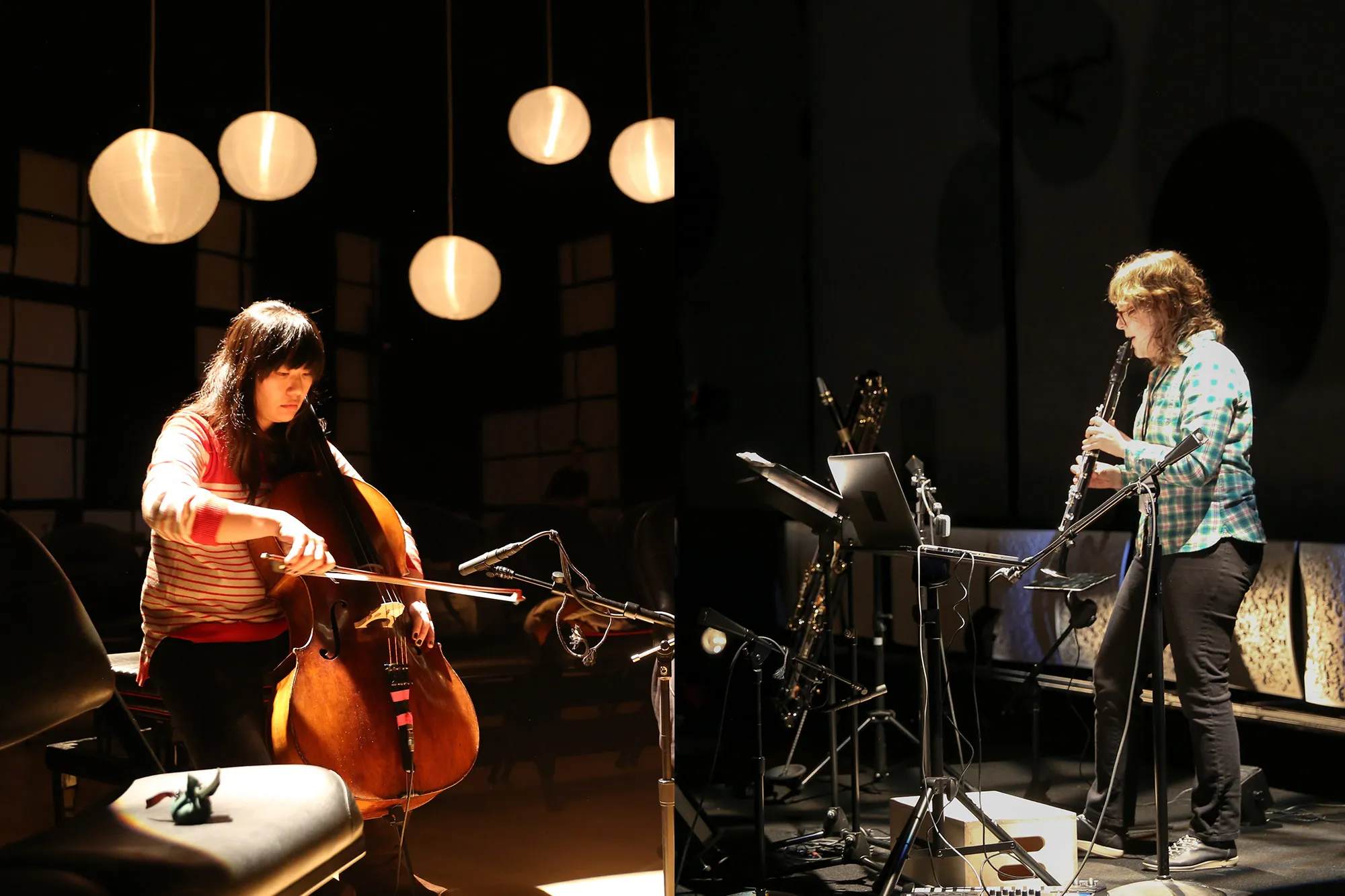
A split screen, on the left an asian woman plays the cello under a canopy of lit sphere paper lanterns. On the right, a white woman playing the clarinet in front of a music stand and a microphone setup.

Rane Moore + Okkyung Lee

Dislocating their instruments from their traditional orchestral context, Rane Moore and Okkyung Lee presented an evening of solo performances to explore a greater sonic range of the clarinet and cello.

Experimental cellist Okkyung Lee can be found everywhere—performing in underground clubs and venues across the world as well as with legends like Laurie Anderson, John Zorn, and Thurston Moore. Lee brings aggressive intensity to her amplified solo cello set, deconstructing the sound of the cello and rebuilding it in unexpected ways.   Boston-based new-music virtuoso

Rane Moore is known for her “enthralling and phenomenal” performances as a soloist and with Talea Ensemble, Callithumpian Consort, and Sound Icon. She will present a solo set of some of the most challenging contemporary works for bass and contrabass clarinet and electronics, by composers Raphaël Cendo, Hans Tutschku, Per Bloland, and more.

PROGRAM

Rane Moore, clarinets

Per Bloland — Quintet for solo clarinet and electronics (2009)

Hans Tutschku — Still Air 1 (2011)

Ronald Bruce Smith — Something Suspicious (Small) (2005)

Raphaël Cendo — Décombres (2006)

Okkyung Lee, cello

Solo Improvisations

Photo: Mick Bello/EMPAC.
Atlas Revisited

Karthik Pandian & Andros Zins-Browne

Choreographer Andros Zins-Browne and visual artist Karthik Pandian were in residence to film two camels against EMPAC's green screen for their new performance Atlas Revisited.

Radio Rewrite

Ensemble Signal

Ensemble Signal returned to the Concert Hall to complete their ongoing recordings of the works of American composer Steve Reich. This record- ing of Radio Rewrite, Reich’s 2012 composition for 11 players, joined Double Sextet, previously recorded at EMPAC on a 2016 release by the label Harmonia Mundi.

Image
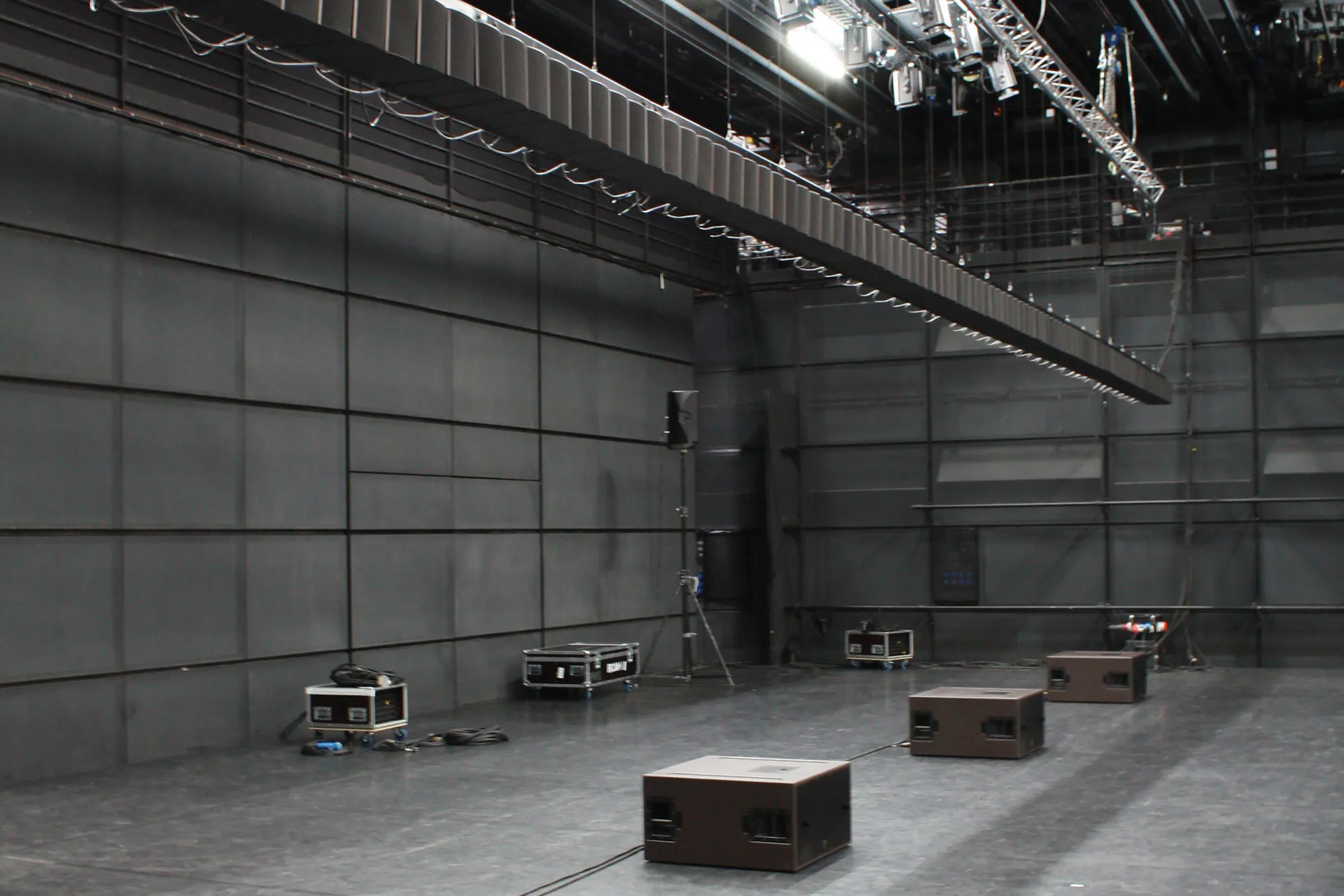
Empty grey black box studio.

Markus Noisternig

Modern 3D Audio Technologies and the Relationship Between Sound and Space

Recent advances in 3D audio technologies have given rise to new ways of creating spatial experiences with sound and in music. Sound is not only composed as moving along in time but also through the space surrounding the listeners. In playing with spatial relationships in musical performance, artists may access a further dimension of expressivity, and this play can redefine our understanding of sound in space. Along with rhythm, melody, harmony, and the "color" of sound, space has become an essential expressive element in music composition and performance.

This talk gives a brief introduction to modern 3D audio technologies, such as Wave Field Synthesis (WFS) and Higher-Order Ambisonics (HOA), and discusses their respective advantages and limits. It offers some insights into how the use of new sound projection and recording technologies helps create novel musical effects.

The visit of Markus Noisternig comes in collaboration with EMPAC's development of an innovative Wave Field System composed of 500 quite small loudspeakers, which uses the software developed at IRCAM.

Photo: EMPAC/Rensselaer

One can make out the surface only by placing any dark-colored object on the ground

Hannah Rickards

One can make out the surface only by placing any dark-colored object on the ground is a performance that used navigational techniques to choreograph the interaction of a moving camera with two performers.

The title refers to how one can travel in polar whiteout conditions by placing an object on the ground and continuing to place the object in front of you as you move forward. By this succes- sive act, a pattern is formed, which can be viewed as a visual score for performance. Inspired by the graphic scores of Morton Feldman that explore musical composition as spatial terrain, London- based artist Hannah Rickards approached the media infrastructure of EMPAC’s Studio 1 in a similar fashion. A cable-suspended camera was maneuvered throughout the space in relation to the performers, capturing wide aerial shots as well as close-up detail of their gestures.

This performance was developed specifically for the production environment of Studio 1 and was the only time this work was performed live. Fol- lowing the artist’s residency, One can make out the surface... is exhibited as a video installation.

Love Streams

Tim Hecker, MFO

Canadian electronic musician Tim Hecker returned to EMPAC to forge a new performance of sound and light for his album Love Streams. Hecker was previously in residence at EMPAC in 2012, during which time he recorded a portion of his critically acclaimed album Virgins.

Credited for helping lead and popularize the genre of experimental electronics, his works have been described as “structured ambient,” “tectonic color plates,” and “cathedral electronic music.” More to the point, he has focused on exploring the intersection of noise, dissonance, and melody, fostering an approach to musicmaking that is both physical and emotive. Drawing on traditions of metal, techno, classical, and musique concrete, his sound has found itself at home in the liminal space between traditional genres, audiences, and performing contexts.

For this multidisciplinary project, Hecker worked with lighting designer MFO, a Berlin-based visual artist who works with imagery, light, and space. He has created and directed audiovisual performances with artists such as Ben Frost, Kode9, and Clark. Performers also included Eliza Bagg, Suzanne Kantorski, Charlotte Mundy, and Amelia Watkins.

Yarn/Wire

Consisting of two pianists and two percussionists, the Brooklyn-based ensemble Yarn/Wire was in residence to record and produce newly commis- sioned works by composers Mark Fell, David Bird and Sam Pluta. Yarn/Wire/Currents is a yearly project that serves as an incubator for new experimental music focused on intersec- tions of composition, technology, installation, live performance, music theater, and much more. Yarn/Wire/Currents Vol. 3 was released in 2015.

Mt. Rush

Elizabeth Orr

Brooklyn-based artist Elizabeth Orr presented a multimedia performance and her work-in- progress film Mt. Rush, a moving-image work that interprets the language and visuality of online political marketing and the alarmist fundraising strategies of contemporary American politics.

Mt. Rush tracks the day-to-day activities of a Mount Rushmore park ranger attempting to navigate an onslaught of interactive fundraising emails in the lead up to the presidential election. Presenting a fantastical, near-future narrative that combines animation and live-action, the performance utilizes video technologies to animate a fictional email interface reminiscent of the holographic voice- and gesture-controlled screens imagined by contemporary science fiction. Serving as both narrator and foil to the ranger, the emails perform the politics of emergency so pervasive in today’s systems of governance.

Garden of Delete

Oneohtrix Point Never

When Oneohtrix Point Never (aka electronic musician Daniel Lopatin) was last at EMPAC, he and visual artist Nate Boyce developed and debuted a multimedia stage show for the world tour supporting his 2013 album R Plus Seven, released by Warp Records. Upon returning in 2015, he was in residence to develop and premiere the live stage show for his upcoming Garden of Delete world tour.

Daniel Lopatin is known for creating intricate electronic music that is characterized by its emphasis on melody and hypnotic pacing, con- ceptually stylized structures, and extreme use of audio-processing techniques. Early incarna- tions of Oneohtrix Point Never date back to the mid 2000s and drew heavily on the stylistic forms of cutout-bin ambient and new age records, combined with the structure and abrasiveness of noise music.

Newer work has focused on sample-based con- structions, while R Plus Seven drew on procedural poetry and ersatz instrumentation to produce a cryptic meditation on the materiality of sound itself. In addition to his own studio work in 2014/2015, Lopatin toured with Nine Inch Nails, produced Antony’s album, and exhibited an installation in collaboration with Boyce at MoMA PS1.

4.35 - R0 - 413

France Jobin

Using an array of specifically placed loudspeak- ers numbering in the dozens, the electronic music composer France Jobin presented a new work built for the EMPAC Concert Hall. Her approach to composition as sound-sculpture reveals a minimalist aesthetic where analog and digital methods intersect. While her music often makes use of restraint and limit, she isn’t one to shy away from extremes. Her skillful interplay between highs and lows, louds and softs, creates an intricate narrative, which stretches the listener’s perception and continu- ally refocuses attention.

France Jobin is a sound/installation artist, com- poser, and curator residing in Montreal, Canada. Her installations express a parallel path, incor- porating both musical and visual elements inspired by the architecture of physical spaces. Her works can be “experienced” in various music venues and new-technology festivals across Canada, the United States, South America, South Africa, Europe and Japan.