Image
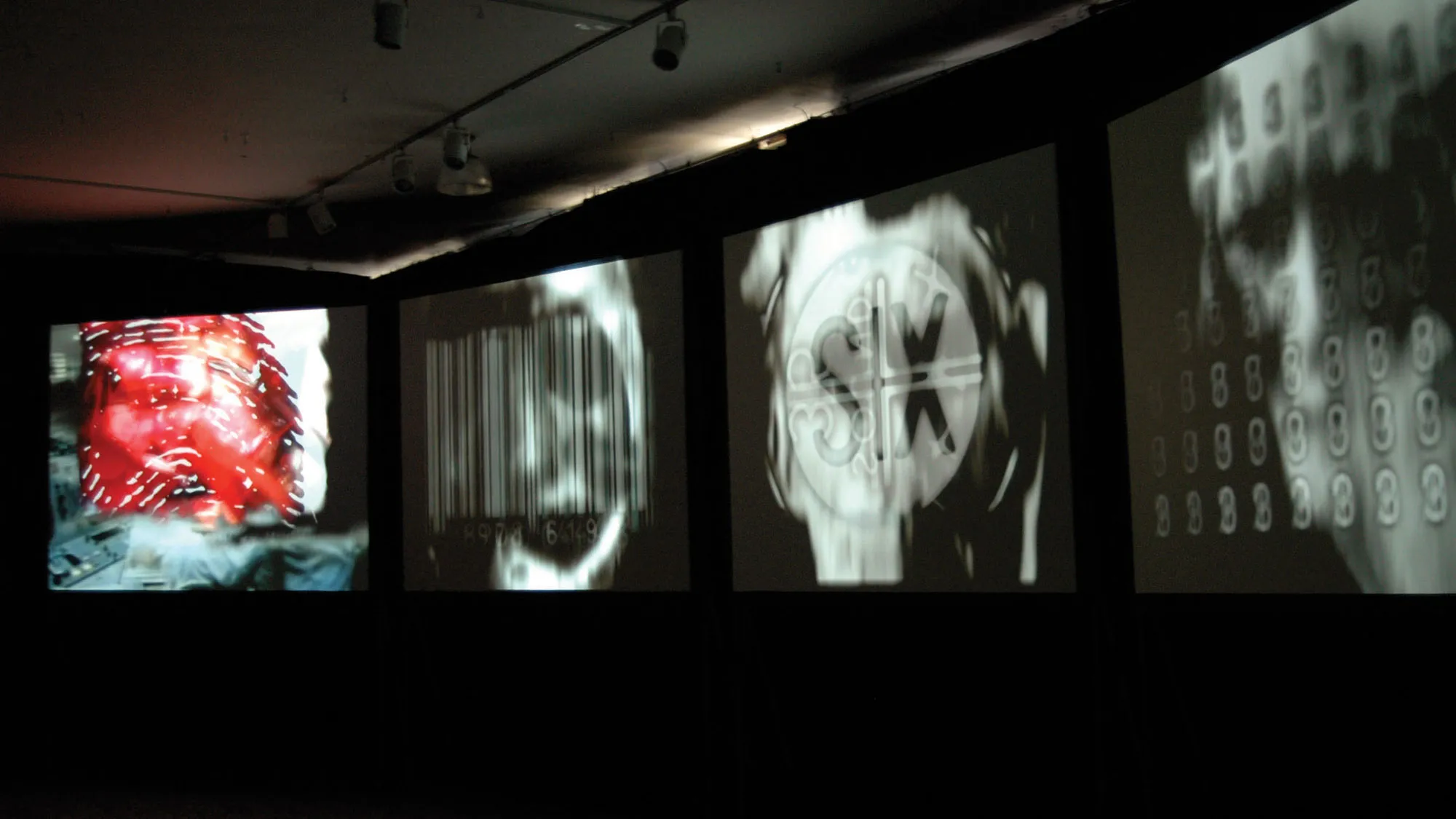
Three screens suspended from the ceiling of a dark blackbox  theater. A small crowd is gathered beneath them, looking up.

Jesse Stiles w / Strata live!

onedotzero

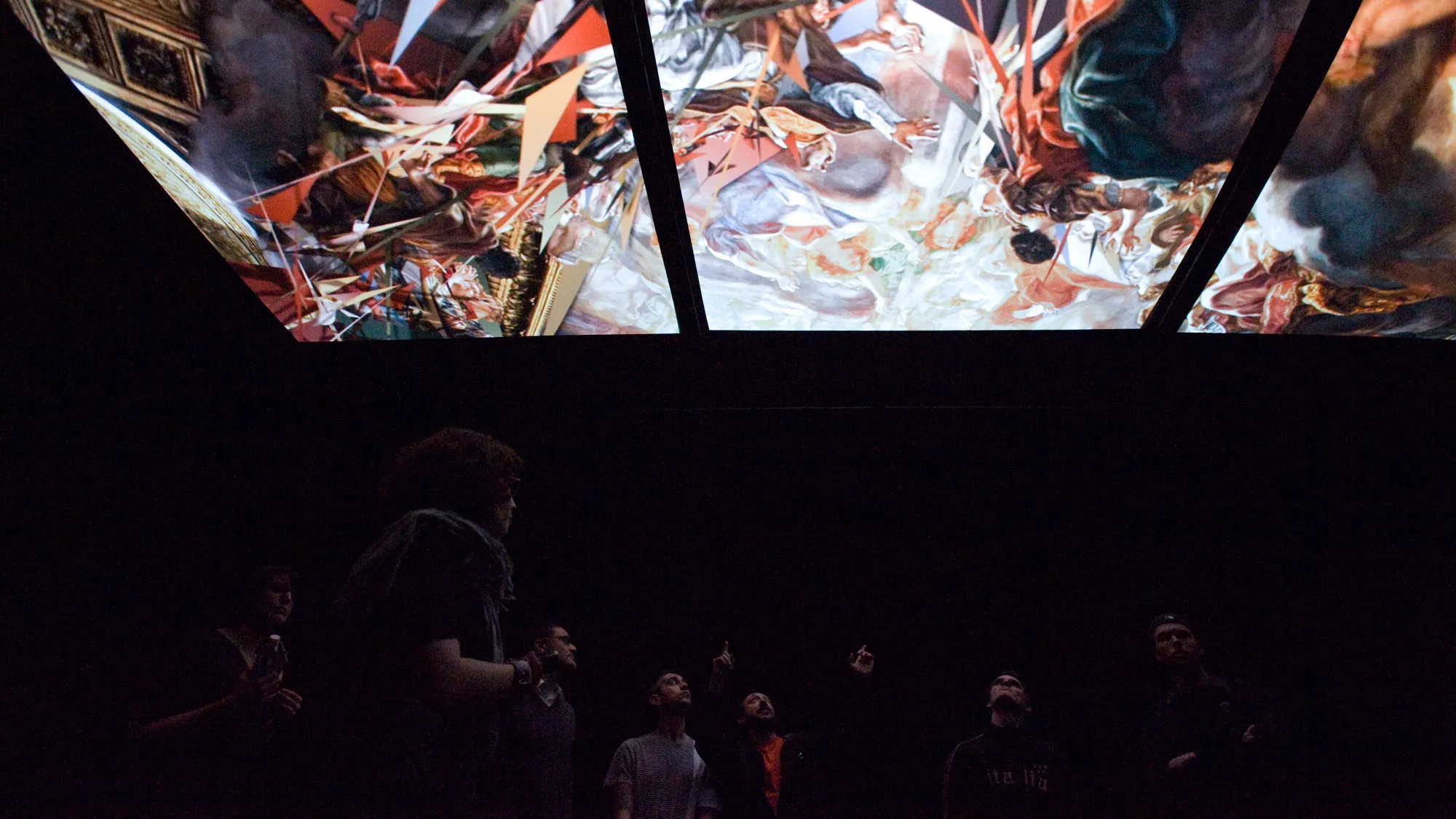
Musician and multimedia artist Jesse Stiles performs a new live score within Quayola’s brilliant video installation Strata viewed on a massive screen suspended from the ceiling.

Quayola is a visual artist based in London. His work simultaneously focuses on multiple forms exploring the space between video, audio, photography, installation, live performance and print. Quayola creates worlds where real substance, such as natural or architectural matter, constantly mutates into ephemeral objects, enabling the real and the artificial to coexist harmoniously. Integrating computer-generated material with recorded sources, he explores the ambiguity of realism in the digital realm.

Working in both the artistic and the commercial field, Quayola intelligently experiment with mediums traditionally perceived as separate. Currently active as Visual Artist, Graphic Designer and Director, he constantly collaborates with a diverse range of musicians, animators, computer programmers and architects. Quayola creates hybrid works blurring the boundaries between art, design and filmmaking.

Main Image: Strada live in 2009 in Studio 1. Photo: Ray Felix/EMPAC.
Strata #1

Quayola

Strata #1 is an audio-visual installation projected onto an oversized screen suspended from the ceiling that explores the icons of Rome’s renaissance architecture and focuses on the layering of time, functions and representations. Through sound and visual effects, Strata #1 concentrates on the collective imagery of particular buildings, reflecting upon the stratified historical meanings they detain in the western society through time. The video environment created within the installation becomes a hybrid between a real architectural space and an abstract two-dimensional pattern: a new space in-between the real and the artificial. In a dynamic dialogue between sound, image and architecture, the installation plays with history and its image, giving life to a process of metamorphosis which transforms the structure and function of the original architectural space. Assuming different meanings, the reoriented ceiling appears under a new perspective that focuses on their images rather than their historical and architectural significance.

Digital Zoetrope

Troika

As part of onedotzeros’s live multi-sensory identity, troika have been commissioned to create an installation that represents onedotzero_adventures in motion and the theme citystates. Taking the form of a modern digital zoetrope, this cylindrical drum displays a multitude of audio-visual outputs to stunning effect. audio by autobam.

Media

Founding curator of Time-Based Visual Arts Kathleen Forde with the Digital Zoetrope during the ODZ festival in 2009. 

Image
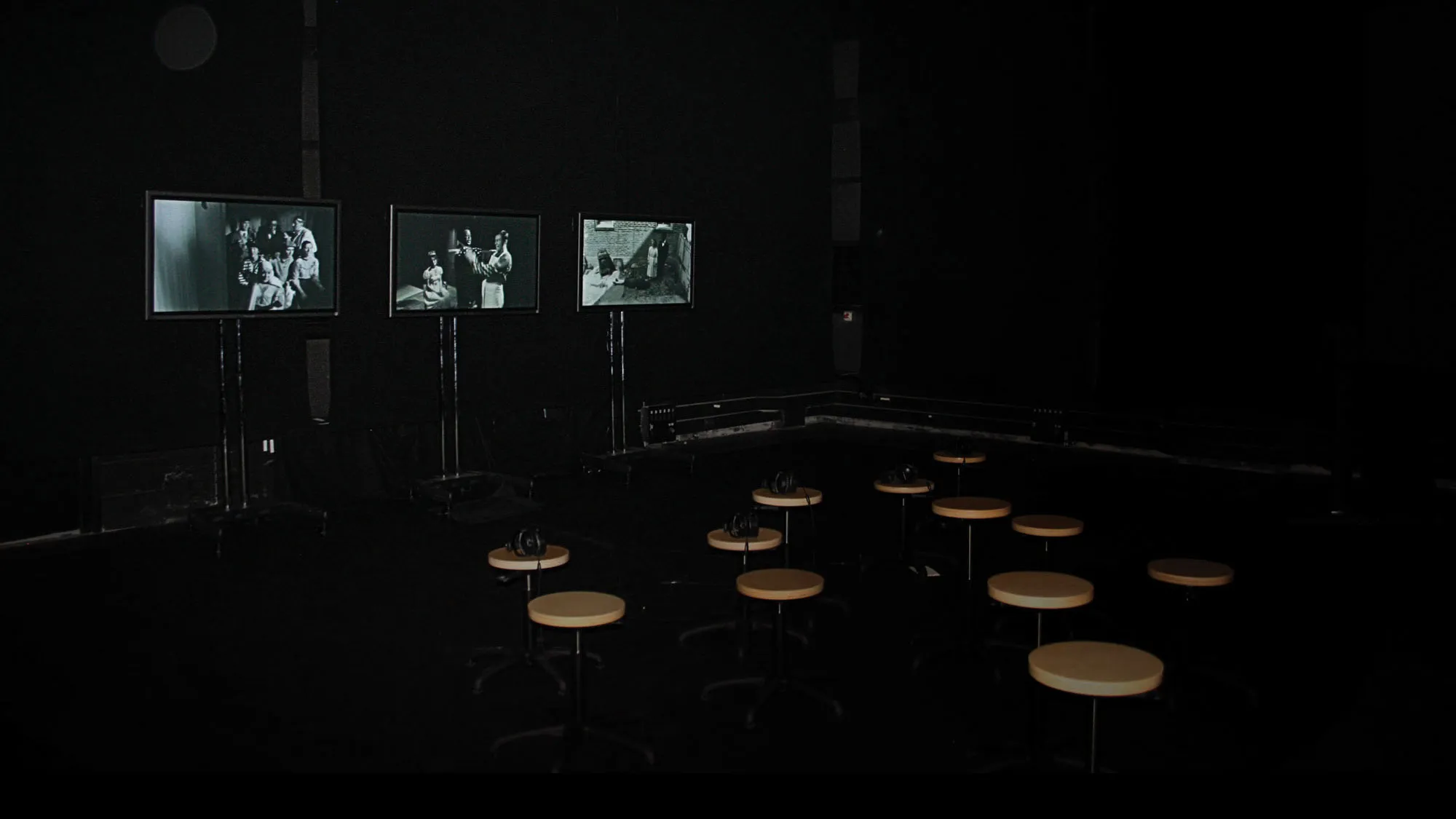
A dark black box theater with three small screens showing black and white images. Twelve round tan stools are are set up in front of them.

Triangle of Need, The Chittendens, + D-Pattern

Catherine Sullivan with Sean Griffin

As part of Sean Griffin’s second residency, EMPAC presents three video installations that cover the past six years of his integral collaboration with the artist Catherine Sullivan. Sullivan’s work comes out of theater, but has become primarily realized as multi-screen video installation with Griffin scoring and collaborating on the overall aurality of the work, in one case even authoring a pseudo-Neanderthal language used throughout Triangle of Need. In The Chittendens, the 16 actors execute elaborate movement structures, vocalize, and portray distinct attitudes from within characters embodying stereotyped identities of 19th and 20th century America. Existing somewhere between/beyond the formal approaches of Yvonne Rainer, Mike Kelley, and Anton Webern, the work is highly structured, beyond catharsis, and full of embedded cultural critique. In Triangle of Need, the far-flung, conceptually mosaic work takes the idea of the Neanderthal as its source metaphor but explodes into fractured narratives ranging from Nigerian email scams to figure skating. Triangle of Need, pairs seductive cinematic conventions with provocative ideas about evolution, human behavior and social inequality. D-Pattern is an exuberant work in which the emergence of narrative erupts from automata-like compositional/choreographic structures. Originally a live performance, the throng of actors/dancers in the piece perform repetitive movements that embody and effuse certain attitudes — and through the colliding and recombination of encounters a micro-history begins to unfold for the viewer. It's like a Ouija board, Griffin says, a conjectural machine spelling out something that isn't really there.

Image
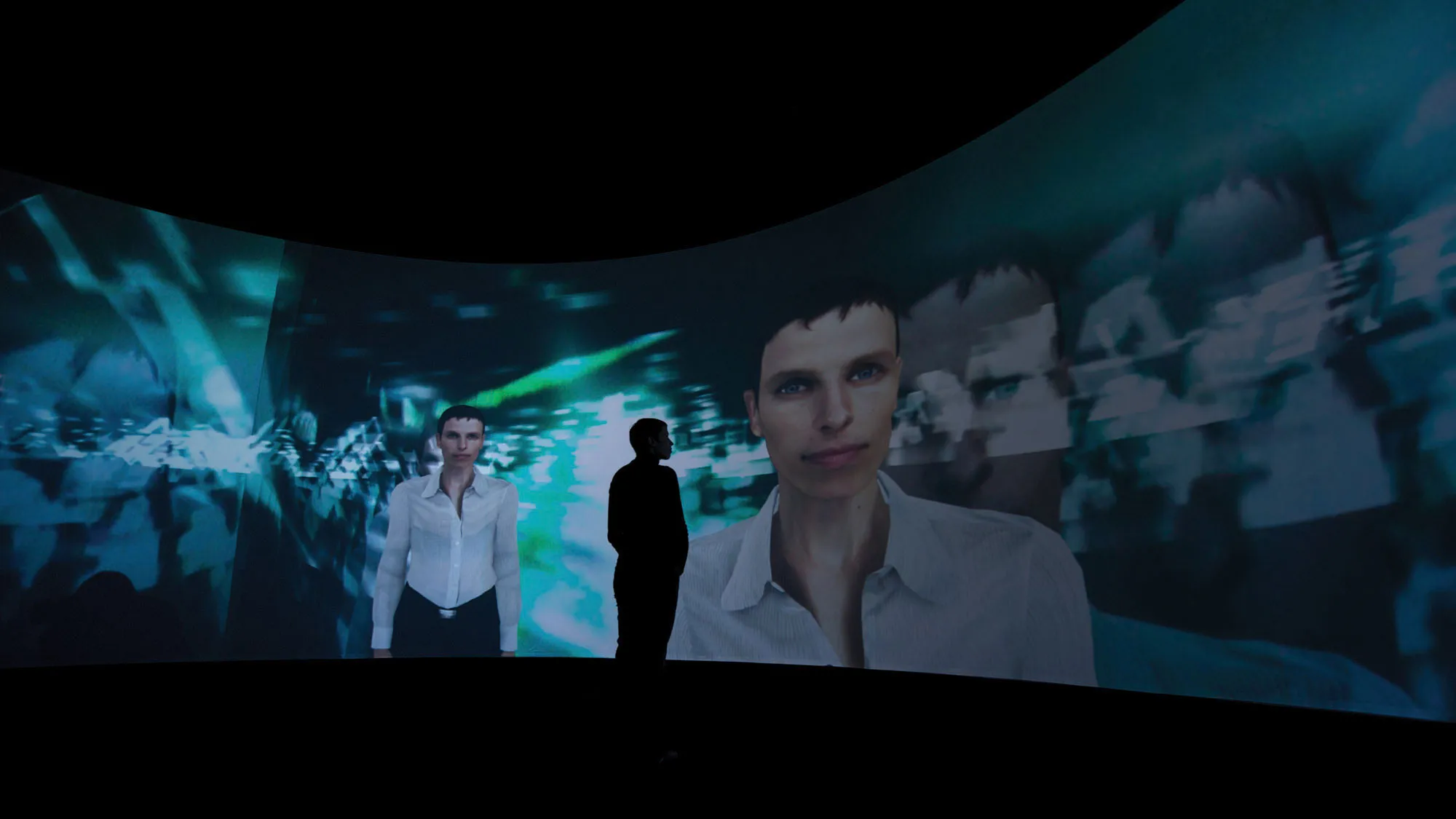
A computer generated image of a woman with a pixie cute and wearing a white button down shirt projected on a panoramic screen as a silhouetted person looks on.

They Watch

Workspace Unlimited

They Watch was an immersive installation commissioned by EMPAC for a panoramic screen, 360° interactive projection method, and a 32-channel sound system. Over a period of years and several residencies at EMPAC, including research and development with game-technology, Workspace Unlimited advanced methods to allow them to track audience members, and to develop interactive functions enabling avatars (virtual versions of the artists) that would appear to be aware of visitor’s presence within the panoramic environment. EMPAC’s panoramic screen is a cylindrical projection and software environment for 360°-panoramic projections, developed at the ZKM | Institute for Visual Media, at the Center for Art and Media in Karlsruhe, Germany in collaboration with the iCinema Research Centre, Sydney. It can display panoramic films via four or six projectors, such as 3D animations or video footage, as well as stereoscopic VR-applications and a wide range of applications for interactive real-time work. 

Workspace Unlimited (WU) is a digital arts collective co-founded by visual artist Thomas Soetens and architect Kora Van Den Bulcke that has been commissioned by cultural institutions to create large-scale digital environments for specific exhibits or buildings. WU’s projects feature hybrid spaces, merging the thin line between physical environments and perceptual realities. Conceptually rooted in the convergence of art and architecture, WU reconciles these two “realities” through the creation of environments where virtual space overlaps with “real” physical space, through the use of immersive environments, real-time gaming technology, projections, body tracking, and mirroring techniques.

Main Image: They Watch, 2009. Photo: EMPAC.

Image
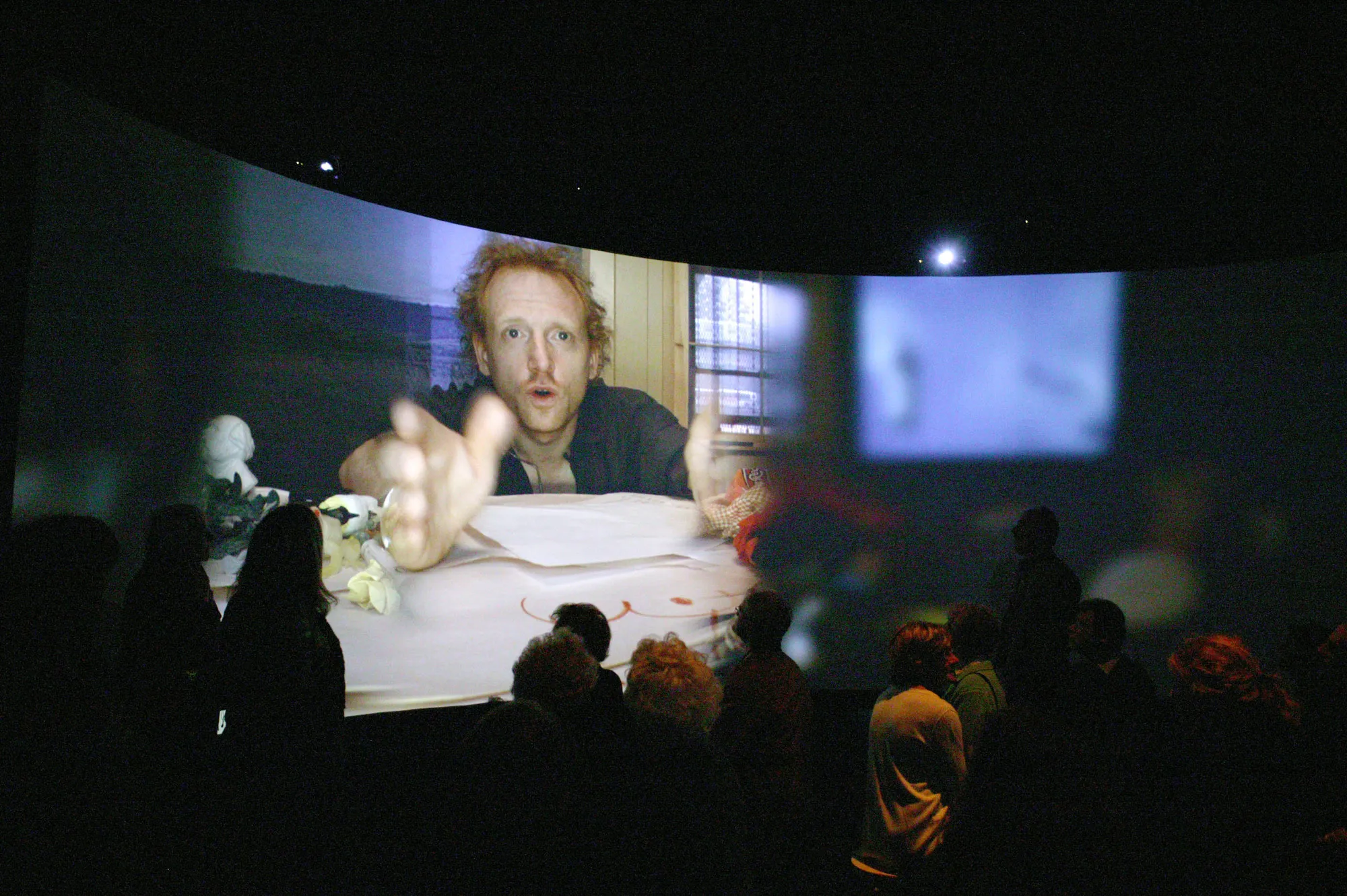
A small crowd milling about in front of a panoramic screen showing an image of a man with red hair reaching.

THERE IS STILL TIME..BROTHER

The Wooster Group

THERE IS STILL TIME..BROTHER is The Wooster Group’s first interactive 360-degree war film. Standing inside a 360-degree projection screen, the audience is surrounded by the film’s bewildering narrative space, where the action can only be seen and heard clearly through a virtual peephole that scans the circle, controlled by a member of the audience. The film’s host attempts to articulate the aesthetic implications of this shrunken-panoramic cinema space while massively outnumbered British troops battle the French for control of Fort Calypso. Grotesquely enlarged children’s toys vie for attention with politically-minded bloggers and unsavory YouTube videos. Each time the piece is viewed, a new narrative experience is spun out, threading together a unique sequence of revelations. The audience becomes immersed in a process of discovery whereby the very choice to look or turn away actually creates the story.

THE WOOSTER GROUP is a collective of artists who make new work for the Theater. Under the direction of Elizabeth LeCompte and with its associates and staff, the Group has created over 40 works for Theater, dance and media. For more than thirty years, The Wooster Group has cultivated new forms and techniques of theatrical expression reflective of and responsive to our evolving culture, while sustaining a consistent ensemble and maintaining a flexible repertory.

Elizabeth LeCompte has directed all of The Wooster Group’s productions since the founding of the company in 1976.

Jeffrey Shaw has been a leading figure in new media art since its emergence from the performance, expanded cinema and installation paradigms of the 1960s to its present day technology-informed and virtualized forms.

Media

Billie Cowie: In the Flesh

In the Flesh is an intimate and uncanny experience. The viewer enters a darkened space, and dons blue/red anaglyph 3D glasses. On reaching their designated spot, they are surprised to see a dancer on the ground in front of them. Although she is in fact a projection (a Spectrefilm), she appears to be actually in the space, solid and real; she is there, in effect, in the flesh.

About the Artist:

Billy Cowie is a Scottish composer, choreographer and filmmaker. His myriad interests have him writing text for dance, new musical forms especially in relation to dance, composition for voice and exploring an expressionist dance Theater language. Cowie's first novel 'Passenger' came in March 2008 and is published by old Street Publishers. Billy Cowie has also collaborated for 25 years with Liz Aggiss, making extremely varied work with a signature wit and sharpness. Based in Brighton, UK, they have made over twenty live performance pieces and have toured extensively both nationally and internationally. They have created single and multiple screen dance installations, four screen dance films, live performance installations alongside dance Theater, cabaret and live art. Aggiss and Cowie's book Anarchic Dance includes a three hour DVD-Rom that is a visual and textual record of their live and screen dance work, and was published in 2006 by Routledge.

Image
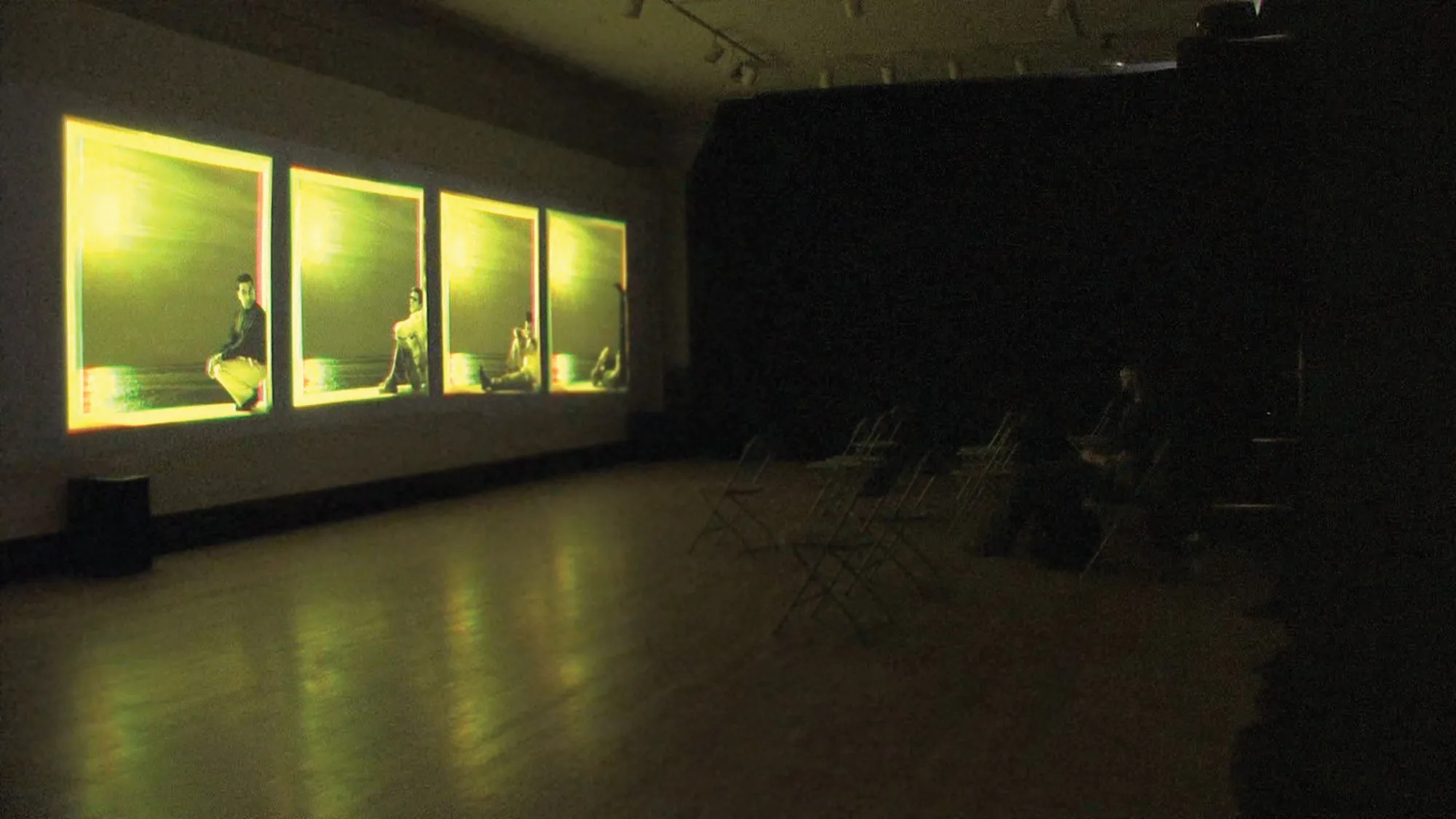
Four yellow projections of four people sitting against the wall within the box of each projection on a gallery wall.

Men in the Wall

Liz Aggiss and Billy Cowie

Men in the Wall is a four-screen 3D video installation where four men, life-size, chat across the boundaries of their own cramped frames, looping through a sequence of poetry, jokes, songs, quibbles, flamenco, and napping. To enter this quirky world, viewers don old school stereoscopic 3D glasses to watch these shared lives, revealing a public quartet of private differences. 

Photo: Shannon K. Johnson/EMPAC.

Image
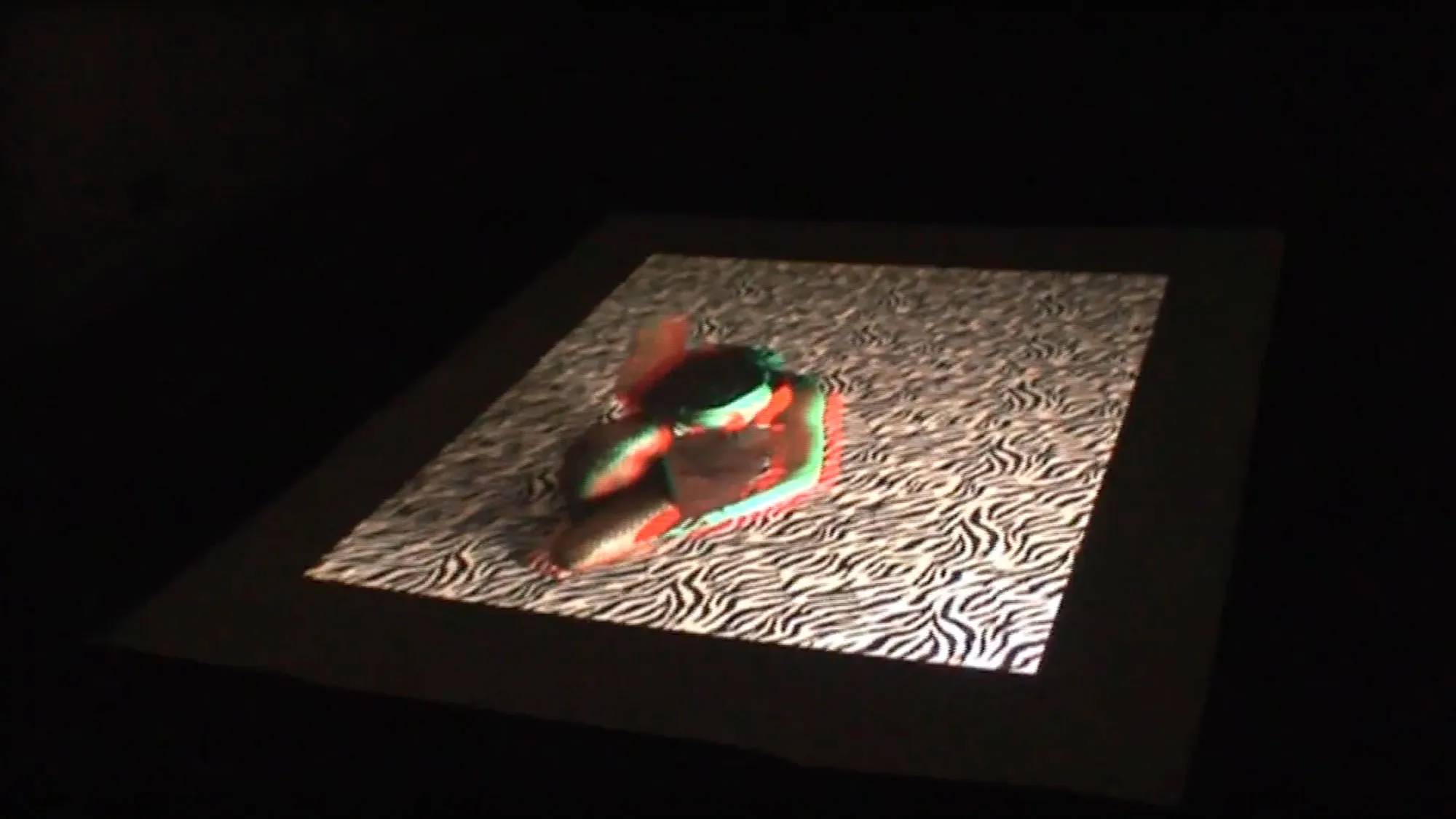
A dancer blurred with green and red shadow laying on their side on a zebra print floor.

In the Flesh

Billy Cowie

The audience enters a darkened space wearing blue/red anaglyph 3D glasses. On reaching their designated spot they are surprised to see a dancer on the ground in front of them. Although she is in fact a projection (a Spectrefilm), she appears to be actually in the space, solid and real; she is there, in effect, ‘in the flesh’.

Billy Cowie is a Scottish composer, choreographer and filmmaker. His myriad interests have him writing text for dance, new musical forms especially in relation to dance, composition for voice; exploring an expressionist dance Theater language, interdisciplinarity, convergence arts and hybrid performance languages, humour, stand-up dance and performance skills; creating dance for camera works; and researching dance and learning difficulties. Cowie's first novel 'Passenger' comes out in 2008.

Media

In the Flesh at EMPAC's Opening in October, 2008.

Image
Four large screens on a dark background projecting three abstract black and white images and one of an up close bloody fingerprint.

Bedlam

Robert Darroll + Sean Reed

Bedlam—originally the name for a medieval England insane asylum—has since become a synonym for tangled, chaotic states. This installation by Robert Darroll and Sean Reed draws us into the minds of five individuals planning their joint escape from Bedlam via multichannel sound and an amalgam of computer graphics, animation and video projected onto oversized screens. The word Bedlam refers to a medieval asylum for mad people in England. In the 18th Century, such asylums were a source of entertainment. Wealthy people paid a penny to enter and watch mad people behave crazily. Later the word came to mean, a chaotic, uncontrollable situation. A similar word is shambles, which Beckett uses symbolically to describe the very substance of existence.

Photo: Shannon K. Johnson/EMPAC.