Image
Maryanne Amacher

Lagrange: A Four Part Mini Series

Maryanne Amacher & The Openended Group

Maryanne Amacher and The OpenEnded Group collaborated on plans for a new, immersive multimedia performance with the working title Lagrange: a Four Part Mini Series. The piece was inspired in part by the evolutionary novels of British author and philosopher Olaf Stapledon that reflect on both humanity’s past and possible futures. Amacher and The OpenEnded Group drew on their respective histories in technological and perceptual innovation to consider how advances in media and performance technologies—performed in real-time—could generate a new kind of non-literal narrative, populated by visual and sonic characters. Their goal was a serialized narrative that would be experienced by audiences over a period of several weeks in a non-traditional space where, by moving from location to location, they would explore the story in a physical way. The collaboration reflected the artists’ mutual interest in immersive experiences.

The OpenEnded Group (Paul Kaiser, Marc Downie, and Shelly Eshkar) has worked to define a new kind of 3D space that does not aspire to photorealism, while until her death in 2009, Amacher explored the acoustic dimensions of sound propagated through walls, floors, rooms, and corridors (as opposed to sound projected by loudspeakers only).

Main Image: Maryanne Amacher at EMPAC in 2008. Photo: EMPAC.

Image
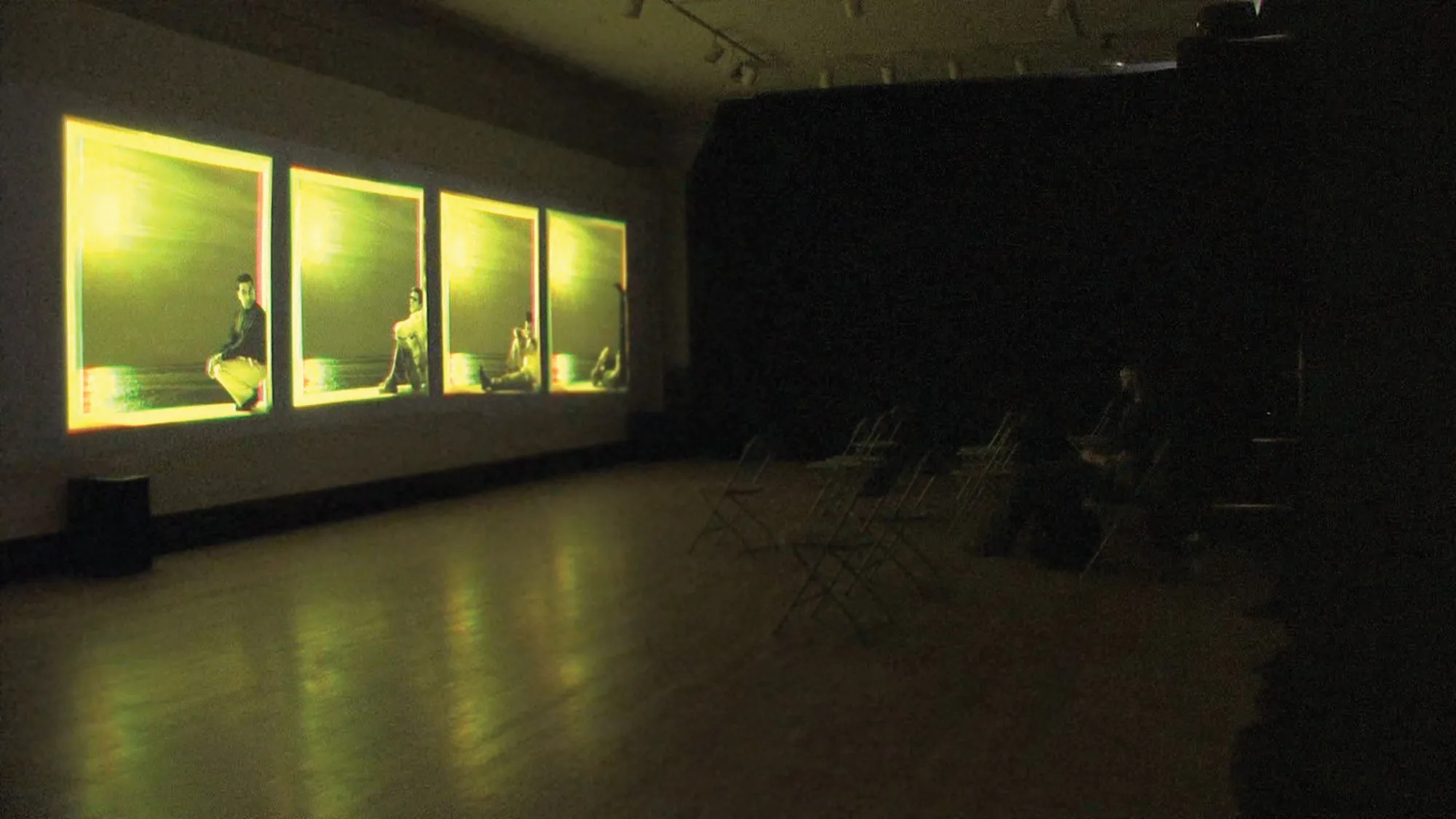
Four yellow projections of four people sitting against the wall within the box of each projection on a gallery wall.

Men in the Wall

Liz Aggiss and Billy Cowie

Men in the Wall is a four-screen 3D video installation where four men, life-size, chat across the boundaries of their own cramped frames, looping through a sequence of poetry, jokes, songs, quibbles, flamenco, and napping. To enter this quirky world, viewers don old school stereoscopic 3D glasses to watch these shared lives, revealing a public quartet of private differences. 

Photo: Shannon K. Johnson/EMPAC.

In a Glass Hour

In a Glass Hour is a lecture series devoted to exploring the topic of time from the diverse perspectives of media theorists, scientists, artists, historians, journalists and others. Taking a broadly interdisciplinary approach to this singular subject, the series will point to the elasticity of this pervasive topic.

Main Image:

Image
A white man with a greying beard and wearing a khaki coat and jeans, sitting at the back of a small fishing boat on the ocean surrounded by swooping gulls.

The Pervert’s Guide to Cinema

Sophie Fiennes and Slavoj Žižek

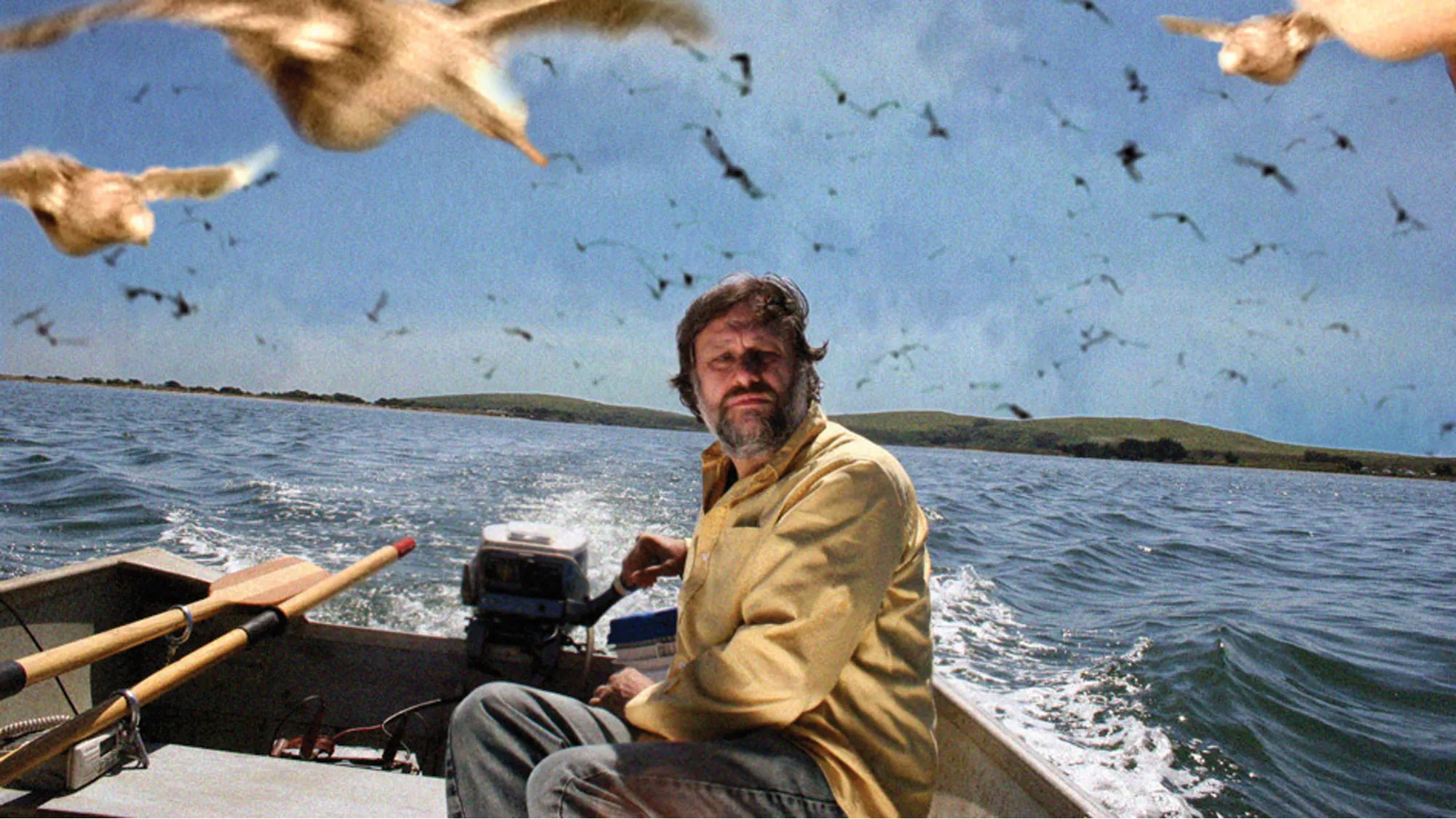
The Pervert’s Guide to Cinema is an exhilarating ride through some of the greatest movies ever made. The international rock star of contemporary philosophy, pscyhoanalyst Slavoj Žižek serves as presenter and guide. With his unusual, engaging and passionate approach to thinking, Žižek delves into the hidden language of cinema, uncovering what movies can tell us about ourselves. The Pervert’s Guide to Cinema offers an introduction into some of Žižek’s most exciting ideas on fantasy, reality, sexuality, subjectivity, desire, materiality and cinematic form. Whether he is untangling the famously baffling films of David Lynch, or overturning everything you thought you knew about Hitchcock, Žižek illuminates the screen with his passion, intellect, and unfailing sense of humor. The Pervert’s Guide to Cinema applies Žižek’s ideas to the cinematic canon, in what The New York Times calls “an extraordinary reassessment of cinema.”

Image
Two blurred people sitting at a folding table with various equipment and wires in an industrial looking space with an abstract projection of green, purple, and blue lines. The pair is lit from below causing long shadows.

Custom Control

A TOOLS — Analogs and Intersections Initiative

EMPAC in conjunction with the Arts Department at Rensselaer and the iEAR Presents! series present Custom Control, an evening of three performances where artists have built their own personal audio and video performance tools.

The artist duos hail from San Francisco, Mexico City, and New York and include Sue Costabile + Laetitia SonamiLuke Dubois + Manrico Montero, and Benton Bainbridge + Bobby Previte. In the 1970’s, in tandem with pioneering organizations like the Experimental Television Center in New York, artists began developing electronics for their live and installation-based video art. In this tradition, the artists in Custom Control all have personally crafted some aspect of their hardware or software for their performance tools.

The first performance, I.C.You, is a live film by Sue Costabile and Laetitia Sonami, Based on a script by poet Tom Sleigh, I.C.You follows the road-based travels of a truck driver delivering ice for the Universe Company. His job is to keep America cold. Sonami and Costabile open windows into his existence through a suitcase-sized foley stage, photographs, drawings, videos, shadow theater, and miniature lighting rigs.

By way of a specifically programmed Max/Jitter patch, guitarist Manrico Montero AKA Karras and video artist R. Luke Dubois create an improvised collaboration of sound and video entitled Night Breeze. Montero’s washes of layered guitar interact with DuBois’ live-camera-based imagery to create experience that translates the rich sonic language of Montero’s playing into a cinematic event.

The meeting of two mad scientists, composer Bobby Previte and video artist Benton-C Bainbridge, inspired the performance Dialed InDialed In is a true dialog between sight and sound—a live audiovisual performance and a collection of music movies. Previte’s music is an ambitious live solo electronic drum work—14 movements will be performed in real time, with no loops, no laptops, and no overdubbing. Bainbridge responds by freely grabbing from personal archives of video obscura, altering them beyond recognition, then recomposing them in a real-time process much like Previte's kit-triggered music. Each using obsolete and forgotten technology scavenged from the tech dump, Bainbridge warps video into strange shapes while Previte elevates raw sound into listenable music.

Image
A group of six adults gather and hunched over a boombox on a dark stage with potted greenery.

KOMMER

Kassys

“How are you?” “I’m fine, considering the circumstances. And how are you?” “Yes.”

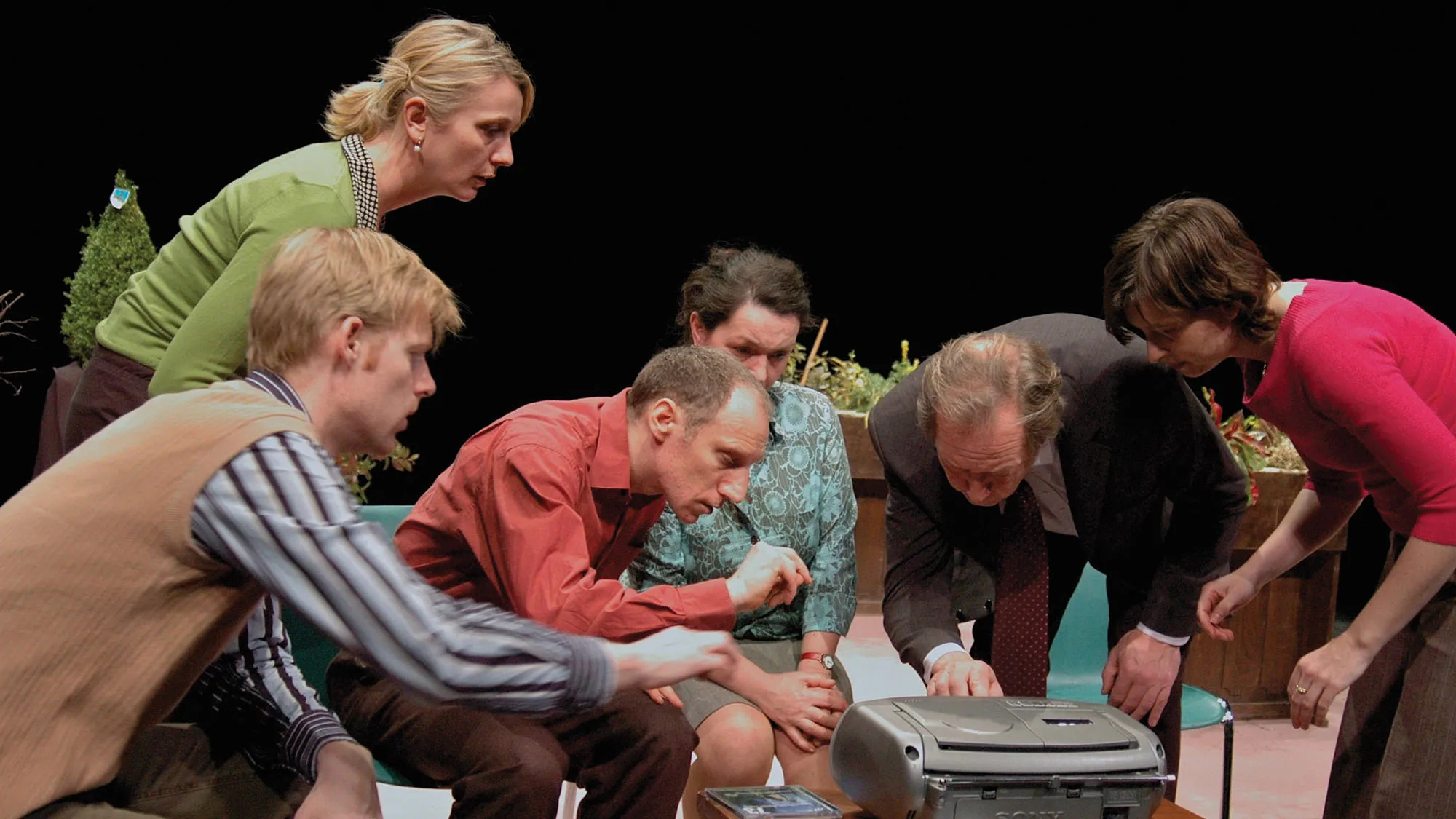
KOMMER is an awkward, spare, painfully funny portrait of human frailty in 50% theater, 50% film. The actors of the Amsterdam-based theater collective Kassys use precise movement and a deadpan delivery to create a stilted world on stage, where six people gather to mark and ponder the loss of a dear friend. Each person tries to absorb the news and give relief to the others, but the well-meant words and gestures wind up more like misplaced clichés. They reflect the inherent discomfort of the situation, stuck between tenderness and missed communication. In the second half of the performance, the actors leave the stage and the audience gets to catch a glimpse of their “real” lives, as they go out into the night after the show. KOMMER means “sorrow” in Dutch

Image
Layered projections of three individual pictures of people's face's in green over three images of people protesting in red.

True Fictions: New Adventures in Folklore

The Light Surgeons

The first public presentation of an EMPAC commission!

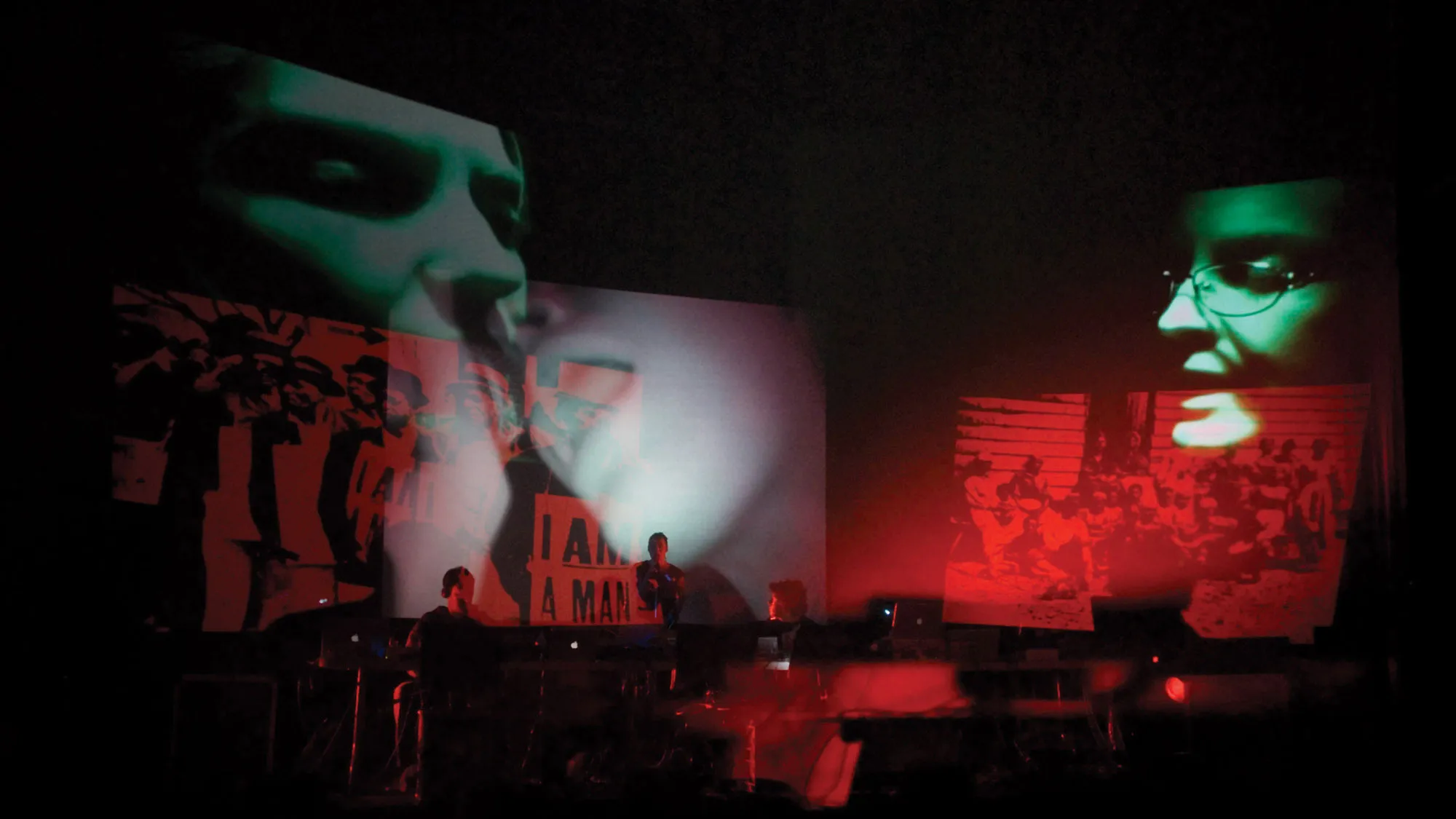
Recorded and shot in and around Troy, New York, True Fictions: New Adventures in Folklore is an eye-popping performance of epic proportions with projections on multiple over-sized screens that fuse documentary film making, live and electronic music, animation and motion graphics with innovative digital video performance tools.

Taking American folklore as a departure point, the UK-based Light Surgeons tackle the universal question of how our personal, political, and national myths evolve from subjective stories to widely held truths. The artists guide the audience through this terrain with a live collage of documentary footage, interviews and music recorded in Troy and across the rest of the state of NY—from Troy’s Uncle Sam’s Day Parade to a cramped music studio in Brooklyn to an upstate Native American reservation and more. 

Image
Four large screens on a dark background projecting three abstract black and white images and one of an up close bloody fingerprint.

Bedlam

Robert Darroll + Sean Reed

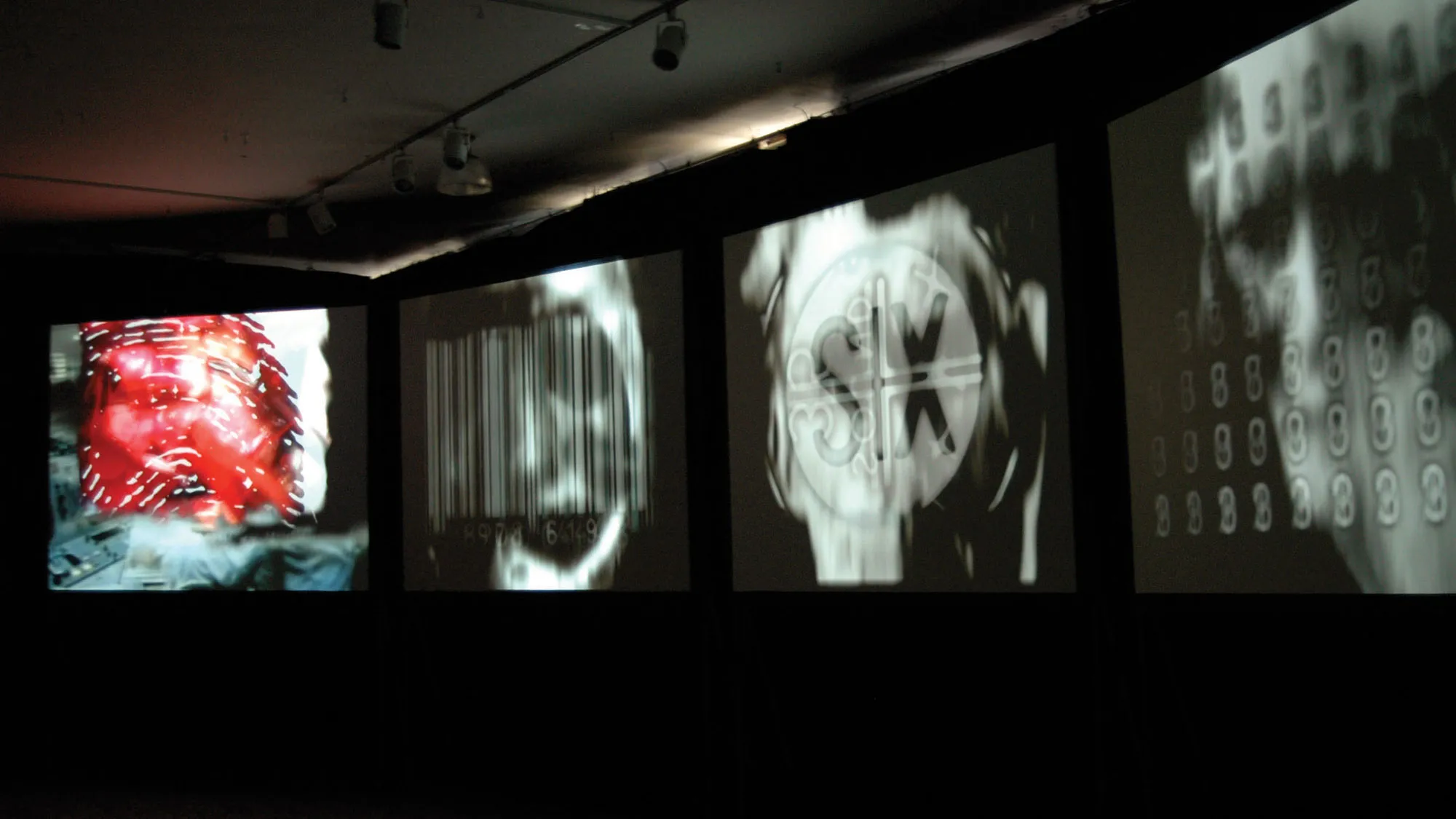
Bedlam—originally the name for a medieval England insane asylum—has since become a synonym for tangled, chaotic states. This installation by Robert Darroll and Sean Reed draws us into the minds of five individuals planning their joint escape from Bedlam via multichannel sound and an amalgam of computer graphics, animation and video projected onto oversized screens. The word Bedlam refers to a medieval asylum for mad people in England. In the 18th Century, such asylums were a source of entertainment. Wealthy people paid a penny to enter and watch mad people behave crazily. Later the word came to mean, a chaotic, uncontrollable situation. A similar word is shambles, which Beckett uses symbolically to describe the very substance of existence.

Photo: Shannon K. Johnson/EMPAC.

Image
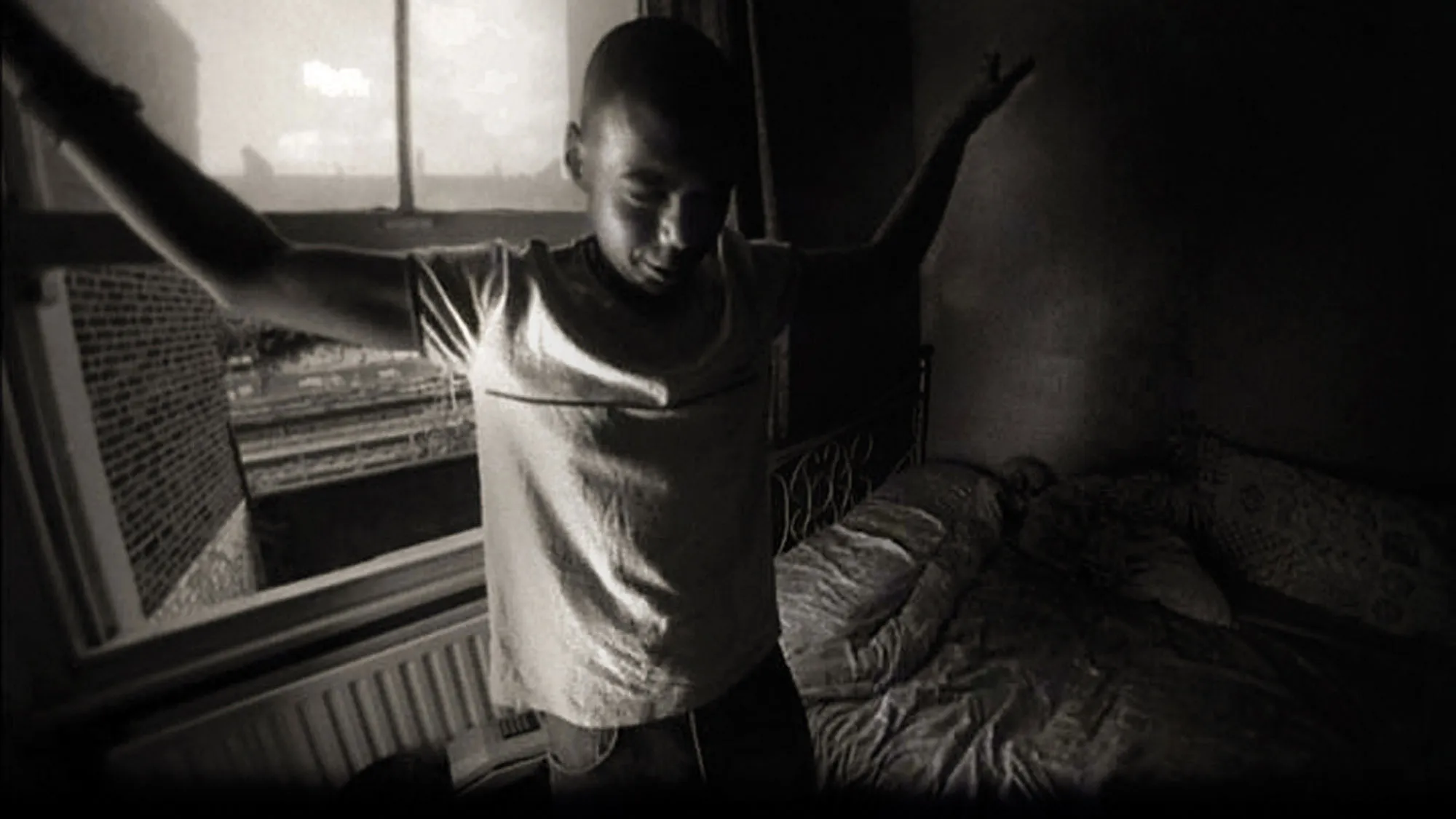
A young Black man standing in an apartment bedroom next to an unmade bed with arms outstretched to the sides.

DANCE MOViES 7

DANCE MOViES: An ongoing EMPAC series showing the latest, daring work made by contemporary dancers creating short films and experimental videos. A selection of international films that start from that common denominator: when you dance like no one's watching. Come witness people dancing on their own terms, at home in their bedrooms, living-rooms and kitchens, or out on the town in a bar, a ballroom, or a train station. Human Radio, 2002, 9' (U.K.) A Very Dangerous Pastime, 2000, 15' (Canada) Váró (Waiting), 2005, 8' (Hungary) Valse Wals (False Waltz), 2002, 62' (Netherlands) (showing 28 minute excerpt)

Human Radio

2002, 9' (U.K.) Director: Miranda Pennell Camera: Mary Farbrother Editor: Miranda Pennell Music: Andy Cowton Sound: Graeme Miller Production: David Obadiah Funded by: Arts Council England Capture People dance in private moments of personal abandon across London in the summer of 2001. The film is the result of the director's work with the first ten respondents to a local newspaper advertisement that she placed seeking 'living-room dancers' - people who love to dance behind closed doors. Miranda Pennell is a London-based film maker whose work reflects on aspects of performance that can be found in the everyday world. Her films have explored a diverse range of subjects that include soldiers and a marching band, teenage ice-skaters, fight directors, amateur dancers and rock-drummers.

A Very Dangerous Pastime

2000, 15' (Canada) Director: Laura Taler Producer: Canada Dance Festival, in association with Grimm Pictures Inc., Allison Lewis, and Laura Taler Editor: Vesna Svilanovic Sound: Phillip Strong Watching contemporary dance is not for the faint of heart. This film gives viewers the inside scoop on how to navigate that dangerous terrain, combining dance film, vintage footage and interviews from Canadian actors, athletes, and musicians.

Váró (Waiting)

2005, 8' (Hungary) Director and writer: Kasza Gábor Choreography: Hód Adrienn Performers: Garai Júlia, Bakó Tamás, Molnár Zoilly, Lex Alexandra, Francia Gyula, Murányi Zsófia, Molnár Csaba, Dányi Viktória, Németh Kálmán, Horváth Andrea Music: Kovács Ferenc Camera: Lovasi Zoltán Editor: Somossy Olivér Sound: Kovács ádám Costume: Németh Anikó - MANIER Supporters: Hungarian Railways, New Performing Arts Foundation, OFF Foundation A waiting room at a train station hums with the restlessness of strangers. What would happen if they could jump into the fantasy of dancing with that stranger sitting next to them? Two street musicians start to play and answer that very question.

Valse Wals (False Waltz)

2002, 62' (Netherlands) (showing 28 minute excerpt) Director: Mark de Cloe Performers: Ria Marks and Titus Tiel Groenestege What starts as a boozy courtship in a seaside bar becomes something more complicated. Adapted from the stage production, this film presents two veterans of wordless Theater, Ria Marks and Titus Tiel Groenestege, in a duet by turns absurd, outrageous and poignant. The Orkater music/theater collective has been creating stage and film work since 1983.
Image
Lee Lenox

Stop.Watch

Seeing Time in Music Video

Stop.Watch is a special screening of rock, pop and electronic music videos by top directors for the likes of Hot Chip, Death Cab for Cutie, Tiga and Kid 606. The compilation focuses on directors who use time itself as the creative or conceptual impetus for their videos. Limited by the length of a song, the artistic possibilities afforded to short music video directors has always been a challenge. However, recently it appears that it is often just that temporal context that prompts directors to concentrate on the parameter of time as a creative departure point, rather than as a restriction. Whether they are slowing down or speeding up time, layering or collapsing its boundaries or simply rendering time topsy turvy, these directors create videos that not only trigger us to think about time as an artistic device, but to physically see its creative manipulation in motion.

THE VIDEO LINEUP

Smiley Faces Music: Gnarles Barkley Director: Robert Hales Courtesy: HIS Productions and Downtown/Atlantic Records Velvet Cell Music: Gravenhurst Director: Thomas Hicks Courtesy: Warp Records You Gonna Want Me Music: Tiga Director: Olivier Gondry Courtesy: PIAS Recordings and Last Gang Records Inc. Beneath the Rose Music: Micah P. Hinson Director: Karni & Saul Courtesy: Flynn Productions Sugar Water Music: Cibo Matto Director: Michel Gondry Courtesy: Partizan Entertainment Sometimes Music: Kid606 Director: Pleix Courtesy: Pleix Films and Mille Plateaux Records Motus Music: Seb Martel Director: Arno Salters Courtesy: Spy Entertainment, Nose PH and Seb Martel/Corida Summer Skin Music: Death Cab for Cutie Director: Lightborne Inc. Courtesy: Lightborne Inc. PDA Music: Interpol Director: Christopher Mills Courtesy: Spy Entertainment/Matador Records Timber Music: Coldcut Director: Hexstatic Courtesy: Ninja Tune Over and Over Music: Hot Chip Director: Nima Nourizadeh Courtesy: Capitol/EMI Music and Partizan Entertainment The Girl and the Sea Music: The Presets Director: Lee Lennox Courtesy: Modular Recordings and Draw Pictures