
Image
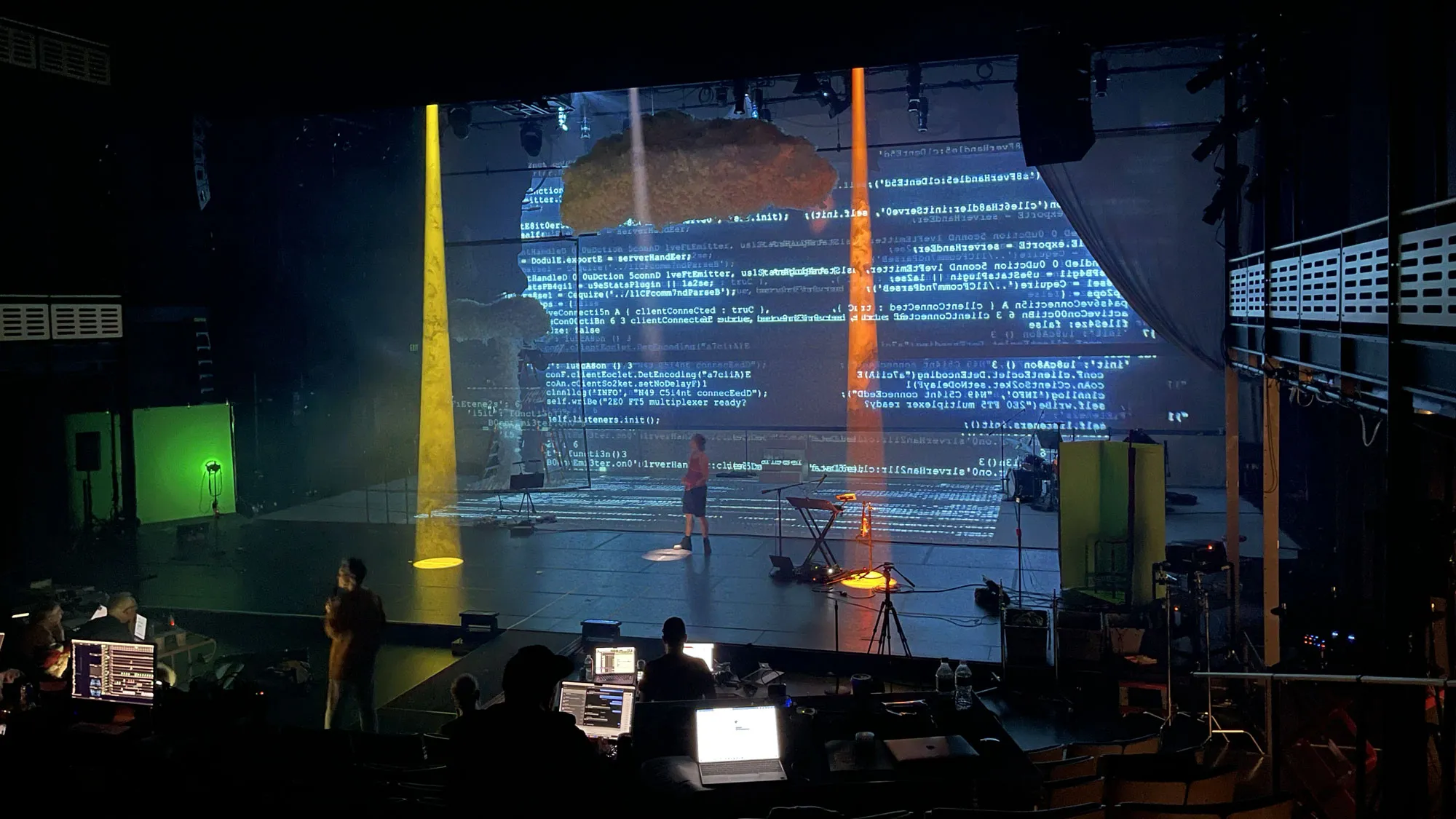
ARK
Laurie Anderson
Set to premiere in Manchester in 2024, ARK is an opera starring a host of mythical and contemporary figures. Anderson’s subjects—time, technology, and American history—are warped into a story that sometimes moves backwards. Apocalyptic climate events and information overload set the scenes for these stories, visual poems, and songs.
Laurie Anderson and her team are in the Theater in August for a final production residency for her opera ARK before it premieres in Manchester in November 2024.
Main Image: Production still from ARK in the theater, August 2024. Courtesy the artist. Photo: Shannon K. Johnson/EMPAC.
Image
In Pursuit: Short Films
Basel Abbas and Ruanne Abou-Rahme, Bi Gan, Gelare Khoshgozaran, and Miko Revereza
In Pursuit features short films that track itineraries through forms of exile or statelessness. Works by Basel Abbas and Ruanne Abou-Rahme, Bi Gan, Gelare Khoshgozaran, and Miko Revereza, center forms of furtive mobility that threaten the loss of political status–chase, evasion, urgent travel, and outlawed movement.
Following the screening program, featured artist Gelare Khoshgozaran will also present a live multimedia performance about political subjecthood and haunting in the ‘society of the archive.’
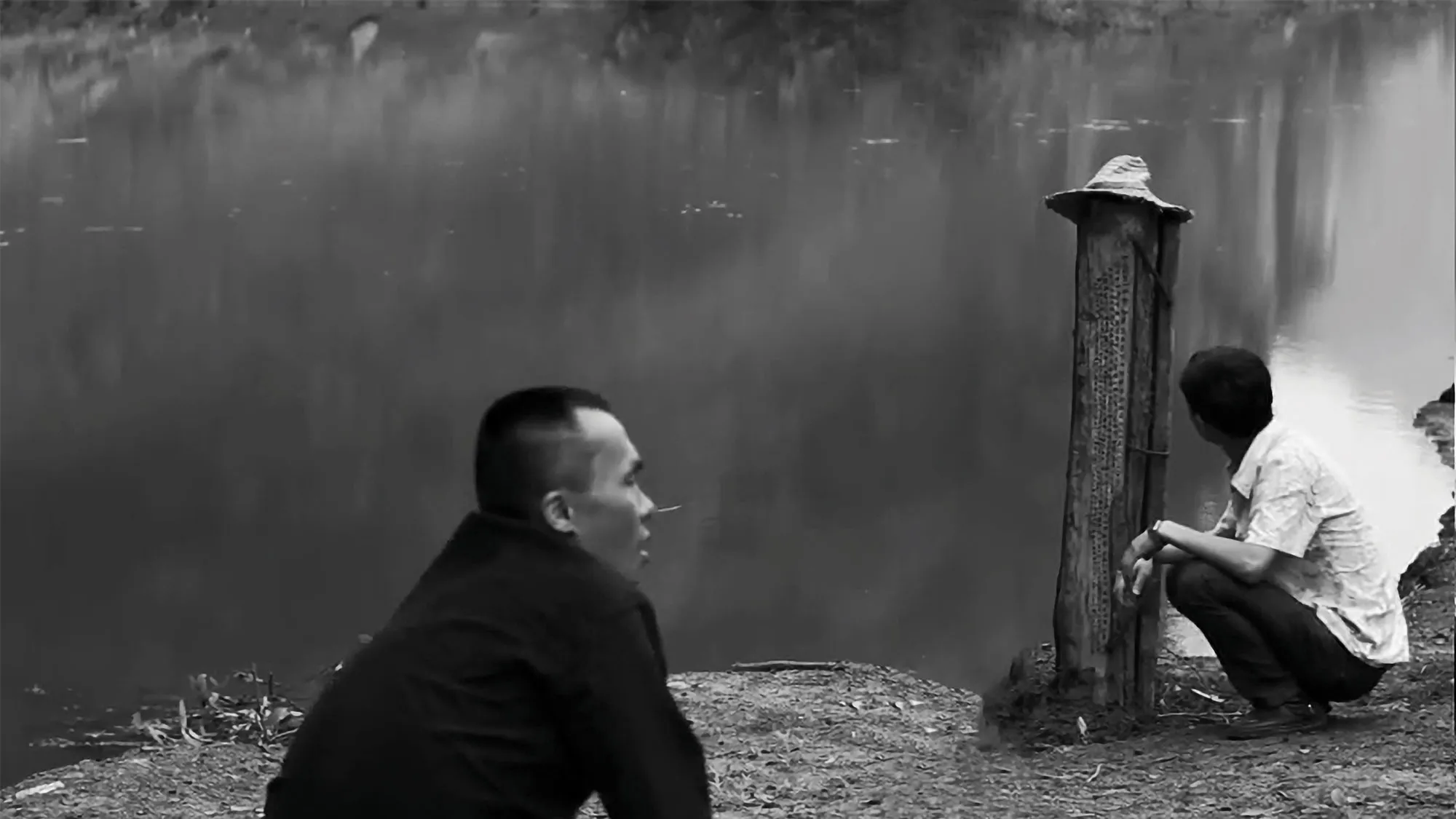
Artists Basel Abbas and Ruanne Abou-Rahme’s The Incidental Insurgents: The Part About the Bandits (Chapter 2) situates the genre-specific persona of the ‘outlaw’ as a figure that represents shrinking political agency. In Bi Gan’s dreamlike work The Poet and Singer, two men play at the edge of civil society in the Chinese countryside, their taboo actions blended with the characters’ surprisingly lyrical aspirations. Filmmaker Miko Revereza’s essayistic Distancing follows the artist’s choice to leave the United States after living most of his life undocumented. Gelare Khoshgozaran’s Royal Debris explores forms of exile and lost access through a speculative narrative constructed within the abandoned Iranian embassy in the United States.
The films’ inquiries into literal or metaphorical statelessness also affect their constructions (or destructions) of plot. The featured works foreground pursuit as a cinematic device that propels narrative, but also sets up ambiguous power relations between the forces behind the camera and the protagonists in front of it. The films use targeted, in-motion shots to capture a sense of escape and anxious transit. They also make use of poetic gestures, texts, and voiceovers to trouble conventions of genre and to draw attention to the ways in which the camera may appear to have its own motive. Here, mobility exists in terms of tactics and strategies, rather than in terms of the cosmopolitan freedom to travel.
Main Image: Film still: The Poet and Singer, 2012; Directed by Bi Gan. Courtesy Grasshopper Film.
Media
Image
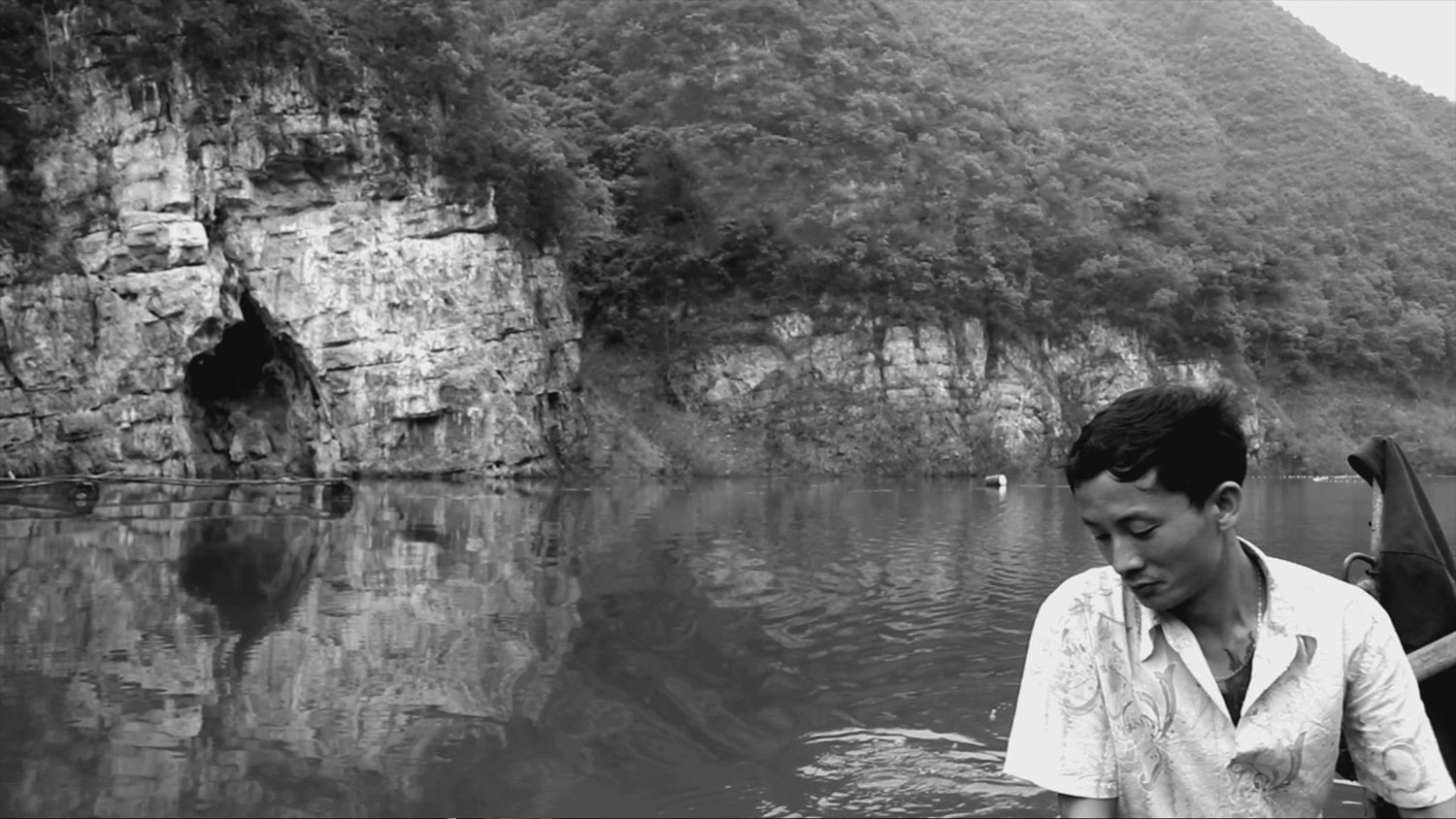
Film Still: Gelare Khoshgozaran, Preview of The Mystery of Violence, 2023. Courtesy the artist.
Image

Wake Up the Dead: Album Release
Christopher Fisher-Lochhead
To mark the release of his portrait album Wake Up the Dead (New Focus Recordings, 2023), composer-performer Christopher Fisher-Lochhead presents a lecture demonstration featuring the music on the album. A lecturer in the Rensselaer Arts Department, Fisher-Lochhead discusses his approaches to notation, instrumental technique, form, harmony, and collaboration. The demonstration will include musical examples from the album itself plus a full performance of grandFather played by the acclaimed bassoonist and long-time collaborator Ben Roidl-Ward. A question-and-answer session and reception will follow.
Wake Up the Dead showcases Christopher Fisher-Lochhead’s notated music and features performances by the JACK Quartet, Ensemble Dal Niente, Ben Roidl-Ward, and Quince Ensemble. By turns raucous and tender, frenetic and still, the music on the album documents two fundamental pillars of Fisher-Lochhead's compositional process: intense and long-term collaboration with performers, and a thoroughgoing reimagining of musical materials and organization.
Main Image: Christopher Fisher-Lochhead. Photo: Meghan Shalapin.
Media
Image

Main Image: Beatriz Cortez, Ilopango, the Volcano that Left, 2023. Pictured in Shifting Center, EMPAC / Curtis R. Priem Experimental Media and Performing Arts Center at Rensselaer, Troy, NY, 2023 (installation view). Courtesy the artist and Commonwealth and Council.
Photo: Shannon K. Johnson/EMPAC.
Shifting Center
Standing on a beach, facing the fierce south seas of Yogyakarta, Julian Abraham “Togar” captures the sound of a rock and films himself in the process. His microphone picks up the wind and the waves as they reflect their rhythm off the stony surface. As the recording is played back in Rocker’s Gonna Rock (2021), a question emerges: can we tune in to the rock or do we only hear the sea?
Drawing its title from a term in the field of acoustics that describes the perceived dislocation in the position of a sound source, Shifting Center stages processes of listening to infrasonic landscapes, acoustic architectures, and unsounded instruments across multiple scales of time. The exhibition poses sculpture as time-based and presents it with moving-image and spatial-audio installations across the concert hall, proscenium stage, and studios at EMPAC.
Research conducted alongside the exhibition by its curators Vic Brooks and Nida Ghouse considers two opposing tendencies: dislocation, or how objects, artworks, and cultural belongings are taken from their context and often silenced through museological mechanisms of preservation and display; and location, or how architectural acoustics impact exhibitions as resonant spaces of situated listening. Today, despite attempts to design “flexible” galleries for sound-making artworks as well as for performative or communal projects, contemporary exhibition spaces continue to inherit their sonic inadequacies from the visual priorities of the colonial museum.
Shifting Center engages the unique technical capacities of EMPAC, including its distinct acoustic properties, to address and destabilize some of these conventions. The exhibition plays with theatrical infrastructure and object-based sound technologies, such as higher-order ambisonics and wave field synthesis, to propose alternate techniques and practices to locate and listen to contemporary artworks that are themselves locating and listening to past events in the ever-changing present.
With contributions by Julian Abraham “Togar”, Tania Candiani, Padmini Chettur & Maarten Visser, Beatriz Cortez, Guillermo Escalón & Igor de Gandarias, Hugo Esquinca, Maurice Louca, Cannupa Hanska Luger, Nancy Mounir, Gala Porras-Kim, Micah Silver, and Clarissa Tossin & Michelle Agnes Magalhães, Shifting Center is choreographed not just in space but also time. It reaches across the disciplinary boundaries of the visual and performing arts to simultaneously inhabit their attendant temporalities, that is the event-based expectation of performance with the durational scale of an exhibition. It engages earlier experiments of deep listening and psychoacoustics by Pauline Oliveros (1932–2016) and Maryanne Amacher (1938–2009) at EMPAC through new works that approach the building as an instrument in itself.
The artworks in Shifting Center engage in the speculative construction of premodern and Indigenous instruments and repertoires, as well as the reconsideration of both geological formations and built architecture as actual sources of sounding. They listen to the material traces of not just cultural belongings but also tectonic and meteorological events. If the museum withdraws objects from their social uses and freezes them in time and place, the works follow such traces across multiple sites and extended temporal frames, moving between the seismic and the musical, the archeological and the cosmic.
Whether or not we can tune into the rock through the sounds of the sea, or to what degree we can listen to the histories carried by an object, the exhibition nonetheless attends to this acoustic potential. As Cannupa Hanska Luger puts it, a handful of clay can fill an entire room when modeled into a whistle, and as Igor de Gandarias’ transformation of subterranean infrasounds into an orchestral composition reminds us, the volcano performs for us every day as an instrument of the earth.
Shifting Center is curated by Nida Ghouse (curator-in-residence) and Vic Brooks (associate director of arts and senior curator of time-based visual art) with Katherine C. M. Adams (assistant curator) and M. Elijah Sueuga (curatorial fellow).
Main Image: Beatriz Cortez, Ilopango, the Volcano that Left, 2023. Pictured in Shifting Center, EMPAC / Curtis R. Priem Experimental Media and Performing Arts Center at Rensselaer, Troy, NY, 2023 (installation view). Courtesy the artist and Commonwealth and Council. Photo: Shannon K. Johnson/EMPAC.
Media
Image

Beatriz Cortez, Ilopango, the Volcano that Left, 2023. Pictured in Shifting Center, EMPAC / Curtis R. Priem Experimental Media and Performing Arts Center at Rensselaer, Troy, NY, 2023 (installation view). Courtesy the artist and Commonwealth and Council. Photo: Michael Valiquette/EMPAC.
Image

Gala Porras-Kim, various works, 2019 (detail). Maurice Louca, Missing Notes (or, what if stones could sing?), 2023. Pictured in Shifting Center, EMPAC / Curtis R. Priem Experimental Media and Performing Arts Center at Rensselaer, Troy, NY, 2023 (installation detail). Courtesy the artist and Commonwealth and Council. Photo: Michael Valiquette/EMPAC.
Image

Clarissa Tossin and Michelle Agnes Magalhães, Each Absent Breath, 2023. Pictured in Shifting Center, EMPAC / Curtis R. Priem Experimental Media and Performing Arts Center at Rensselaer, Troy, NY, 2023 (installation detail). Courtesy the artists and Commonwealth and Council. Photo: Ryan Jenkins/EMPAC.
Image

Cannupa Hanska Luger, Volume (Fox, Ocelot, Vulture, Armadillo, Turtle), 2023. Pictured in Shifting Center, EMPAC / Curtis R. Priem Experimental Media and Performing Arts Center at Rensselaer, Troy, NY, 2023 (installation detail). Courtesy the artist. Photo: Ryan Jenkins/EMPAC.
Image

Main Image: Tania Candiani, Percutor, 2020. Pictured in Shifting Center, EMPAC / Curtis R. Priem Experimental Media and Performing Arts Center at Rensselaer, Troy, NY, 2023 (installation detail). Courtesy the artist. Photo: Ryan Jenkins/EMPAC.
Image

Padmini Chettur and Maarten Visser, A Slightly Curving Place, 2022 (still). Two-channel HD video with sound. Courtesy of the artists.
Image

Hugo Esquinca, CONDICIÓN_1023, 2023. Pictured in Shifting Center, EMPAC / Curtis R. Priem Experimental Media and Performing Arts Center at Rensselaer, Troy, NY, 2023 (installation view). Courtesy the Artist. Photo: Michael Valiquette/EMPAC.
Image

Guillermo Escalón and Igor de Gandarias, Rapsodia Telúrica, 2023 (video still). HD video, sound. Courtesy the artists.
Image

Julian Abraham "Togar", Rocker’s Gonna Rock, 2021 (still). Video, sound. Courtesy of the artist.
Image

Elemental View
Ellen Fullman & The Living Earth Show
Elemental View is a musical work in six movements by pioneering composer Ellen Fullman for her Long String Instrument and the experimental music duo The Living Earth Show—guitarist Travis Andrews and percussionist Andy Meyerson. The expansive installation inhabits EMPAC Concert Hall with its 136 strings, precisely tuned and configured for this multi-movement piece. Elemental View invites the listener to discover, as if with a magnifying glass, the details of the physics of string vibration itself.
Invention and discovery are at the core of Fullman’s work. The artist brings her remarkable instrument to life using her fingertips, unfolding the physical sound spectrum of the strings as she walks, and producing undulating waves of continually shifting musical overtones. Additional tools developed and crafted by Fullman expand the possibilities of the instrument, allowing her to play three, six, or nine strings at once and to expand the timbre of the instrument while infusing its drone texture with rhythmic variation.
With their laser-focused precision and virtuosic ensemble playing, The Living Earth Show brilliantly executes the rhythmic and harmonic complexity of Fullman’s composition using specially-tuned instruments tailored to Andrews and Meyerson—a lap-steel guitar and hammered dulcimer.
Listening to the music of Fullman’s singular creation is akin to standing inside a giant musical instrument. The result is at once ancient and utterly new, environmental, and folk-like yet orchestral.
This presentation continues The Living Earth Show’s multi-season residency at EMPAC, offering engaging and exciting large-scale work from artists with whom they work closely. The Living Earth Show is a megaphone and canvas for the world’s most progressive artists, seeking to push the boundaries of technical and artistic possibility while amplifying voices, perspectives, and bodies that the classical music tradition has often excluded.
Main Image: Ellen Fullman and Living Earth Show in the concert hall on October 24, 2023. Photo: Michael Valiquette/EMPAC.
Media
Image

Ellen Fullman, Elemental View. Courtesy the artist. Photo: Robert Szkolnicki.
Sustained Surface Distant View excerpt
Image
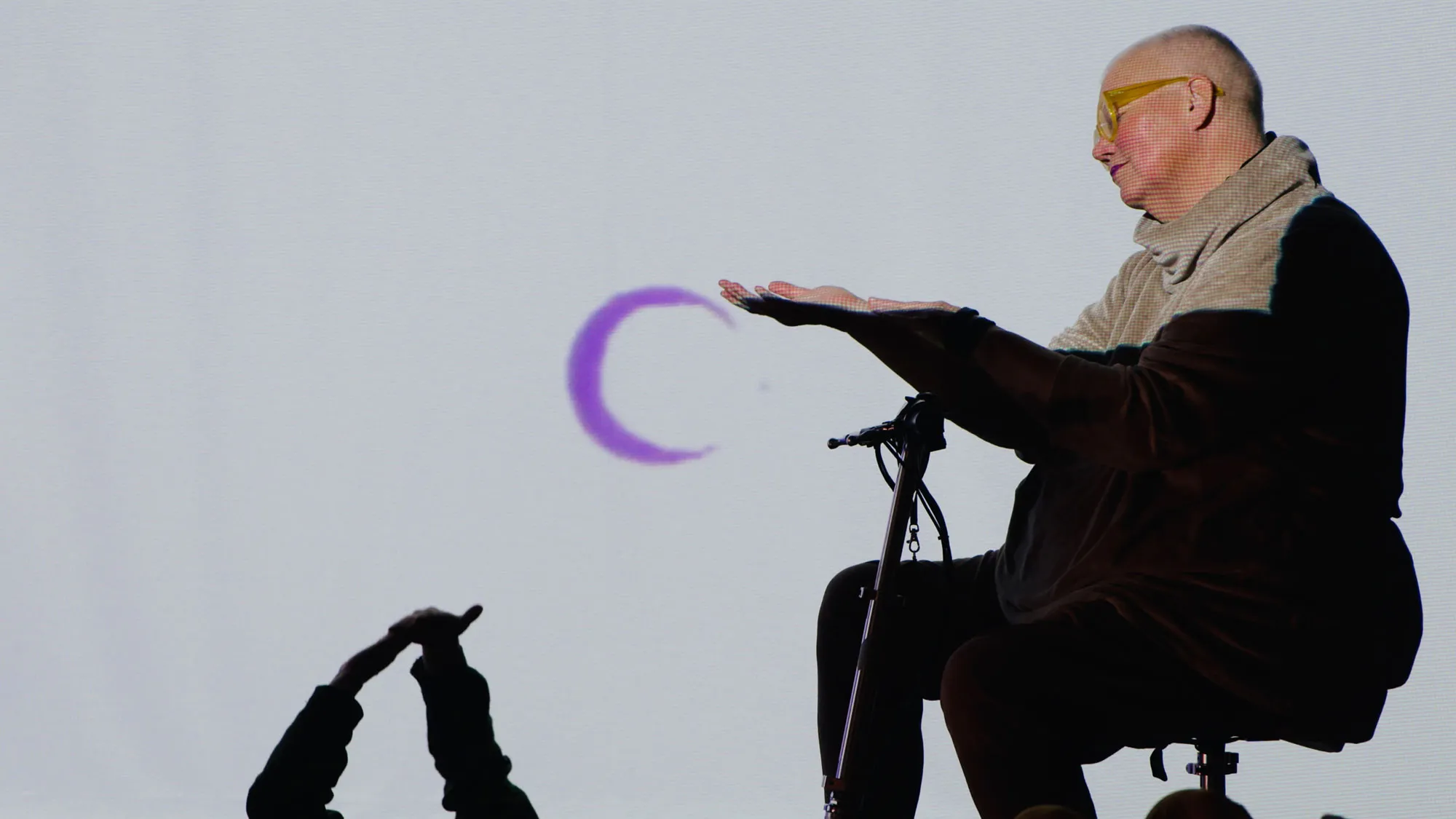
The Crip/Mad Archive Dances
Petra Kuppers
How can media technologies and live presence help us to think about embodied disabled and mad gestures in and out of the archive? What is an eco soma approach to engaging site, the elements, and time?
The Crip/Mad Archive Dances is a lecture by scholar and artist Petra Kuppers that draws on her prolific research integrating performance and disability studies to address disabled and mad presences in dance archives. The talk at EMPAC is rooted in Kuppers’s book Eco Soma: Pain and Joy in Speculative Performance Encounters (University of Minnesota Press, 2022, open access), parsing what she calls eco soma methods and finding dis/comfort within participatory performances grounded in disability culture. Kuppers discusses the strategies and insights of the performance and archive project Crip/Mad Archive Dances, including a poetic documentary-in-progress.
Content note: some film clips focus on medical incarceration but offer survivor testimonies of artful and agency-full reclamation.
This presentation will include in-person live ASL interpretation. This event will be livestreamed, with live ASL interpretation visible on-screen.
For visitors with mobility concerns, please email John Cook or call 518-276-2822 (voice only) to see how we can best accommodate you in your EMPAC experience.
This is the first of three events with Petra Kuppers, and is followed by two workshops, including a wheelchair procession, to take place on October 12 at The Sanctuary for Independent Media.
Petra Kuppers is a disability culture activist and a community performance artist. Kuppers grounds herself in disability culture methods, and uses somatics, performance, and speculative writing to engage audiences toward more socially just and enjoyable futures. In addition to Kuppers’s scholarly and performance work, she has published three poetry collections including her latest, Gut Botany (Wayne State University Press, 2020).
Kuppers is a 2023 Guggenheim Fellow and a 2022 Dance/USA Fellow. She is artistic director of The Olimpias, an international disability culture collective, and co-creates Turtle Disco, a somatic writing studio, with Stephanie Heit. Kuppers is the Anita Gonzalez Collegiate Professor of Performance Studies and Disability Culture at the University of Michigan, Ann Arbor.
Main Image: Petra Kuppers, Starship Somatics, video still, 2022-2023. Pictured: Petra Kuppers. Courtesy the artist. Image by The Olimpias.
Image
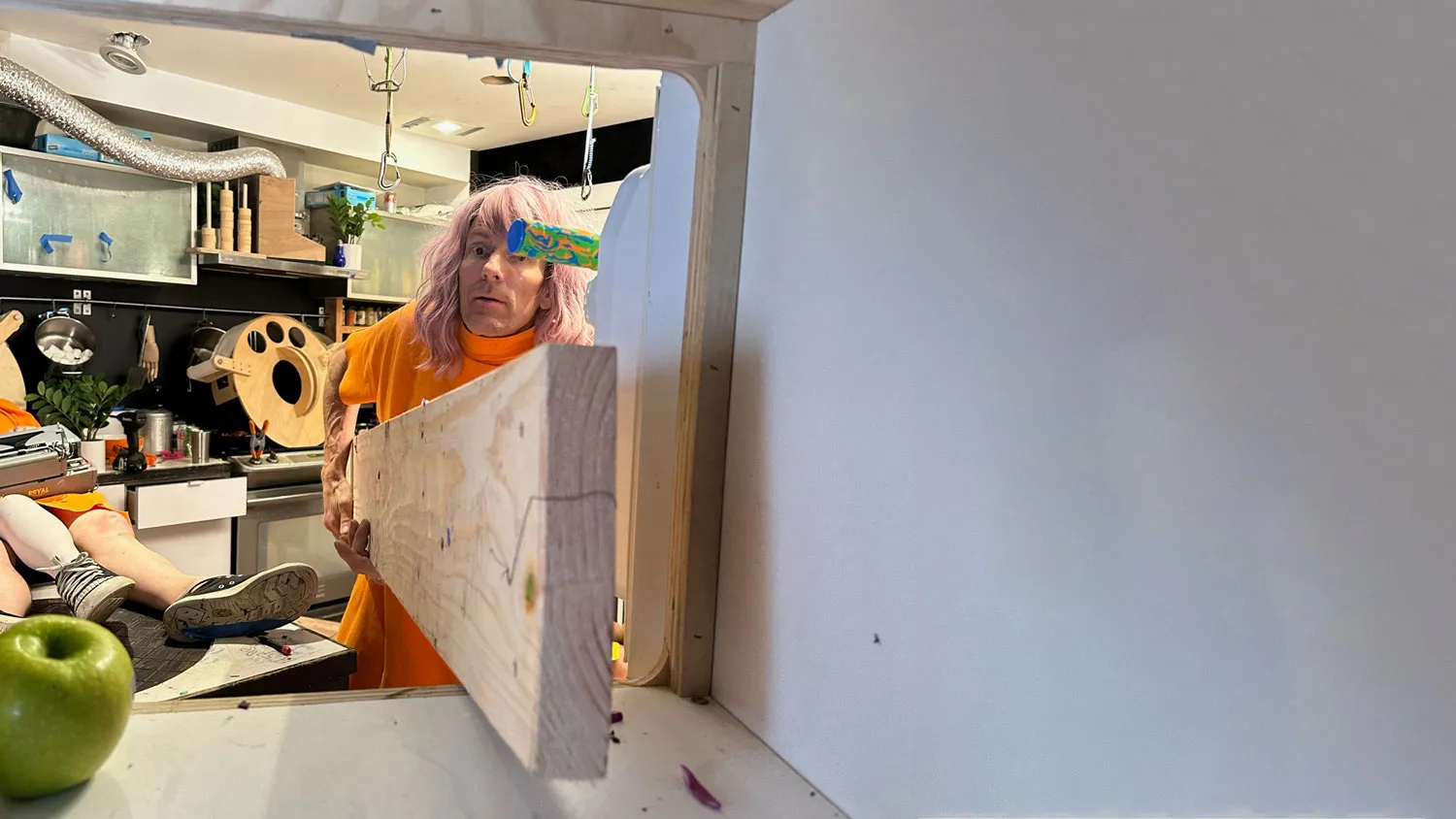
Evidence of Labor: State of the Kitchen
Michelle Ellsworth and Satchel Spencer
Evidence of Labor uses choreography to complicate the labor ethics of AI, such as ChatGPT, to better recognize how services like these may on the one hand appear to simplify word-ordering and meaning-making, but could have significant social implications for humans and machines. The new EMPAC commissioned performance takes choreographer Michelle Ellsworth and programmer Satchel Spencer’s long standing collaboration into the realm of machine learning, maintenance art, and ontological speculation.
Two dancers act as a neural network and another two build what the artists call a “cellular automata,” referring to a computational model that inspires their choreographic structure, in a kitchen. The work functions simultaneously as a reverse Turing test, a prototype for life After-AI (AA), and a birth canal. Working with dance’s inescapable failure to be documented meaningfully as a stable object, Ellsworth and Spencer use dance’s ephemeral methodologies within the black box theater setting. The performance replaces the labor of AI with choreographed acts of glitch-heavy kitchen hygiene that puts “dancers in latent space and words in a wood oven.”
Evidence of Labor is the sequel to Ellsworth’s Post-Verbal Social Network, and continues to propose that the efforts involved in generating language should match its impact. Following this preview performance at EMPAC, Evidence of Labor premieres at The Chocolate Factory Theater (Long Island City) in November. Initiated at EMPAC in 2020, the commissioned work was developed over the course of three residencies where the artists, their collaborators, and EMPAC production teams experimented with materials, construction, choreographic methods, and programmatic approaches.
Main Image: Michelle Ellsworth and Satchel Spencer, Evidence of Labor: State of the Kitchen, 2023. Pictured (l-r) Michelle Ellsworth, Bruce Miller. Courtesy the artists. Photo: Laura Conway.
Image

Salon Mondialité
Miho Hatori
Salon Mondialité is an electro-acoustic musical performance and video installation by musician, producer, and vocalist Miho Hatori that explores themes of memory, identity, and colonialism through kaleidoscopic and expansive dream-pop atmospheres and hypnotic rhythms. Hatori combines composed and improvised music, experimenting with the structure of a “talk-show” to create a listening environment where nostalgia for the past and possibilities for the future co-exist. Hatori’s “talk show” substitutes traditional segments with “sound stories” and features onstage collaborations with Hatori's friends and invited guests.
For this performance at EMPAC, Hatori’s guests include musicians Patrick Higgins and Michael Beharie, and cross-media artists Steffani Jemison and Cole Lu.
A pre-show conversation between Miho Hatori and music curator Amadeus Julian Regucera begins at 7PM.
Inspired by the writing of Martinican poet-philosopher Édouard Glissant and his conception of an “interconnected identity,” Salon Mondialité ultimately takes on the mood of a funeral: laying to rest outdated and colonial ideas of “identity” and a “requiem” for those who died through forced or involuntary exile.
Previously performed at venues such as The Broad in Los Angeles and The Kitchen in New York City, Hatori transforms the EMPAC Theater into the eponymous salon, welcoming audience members to a new version of this show.
Hatori is a Japanese-born and New York City-based vocalist, musician, and producer who performs widely and gained popularity in the 1990s with the legendary band Cibo Matto. Most recently, she released a solo album Between Isekai and Slice of Life and has recorded music under the pseudonyms New Optimism and Miss Information. Additionally, she produces music for soundtracks, films, commercials, and web content.
Main Image: Miho Hatori, Salon Mondialité. Courtesy the artist. Photo: Hassan Ali Khan and Miho Hatori.
Image
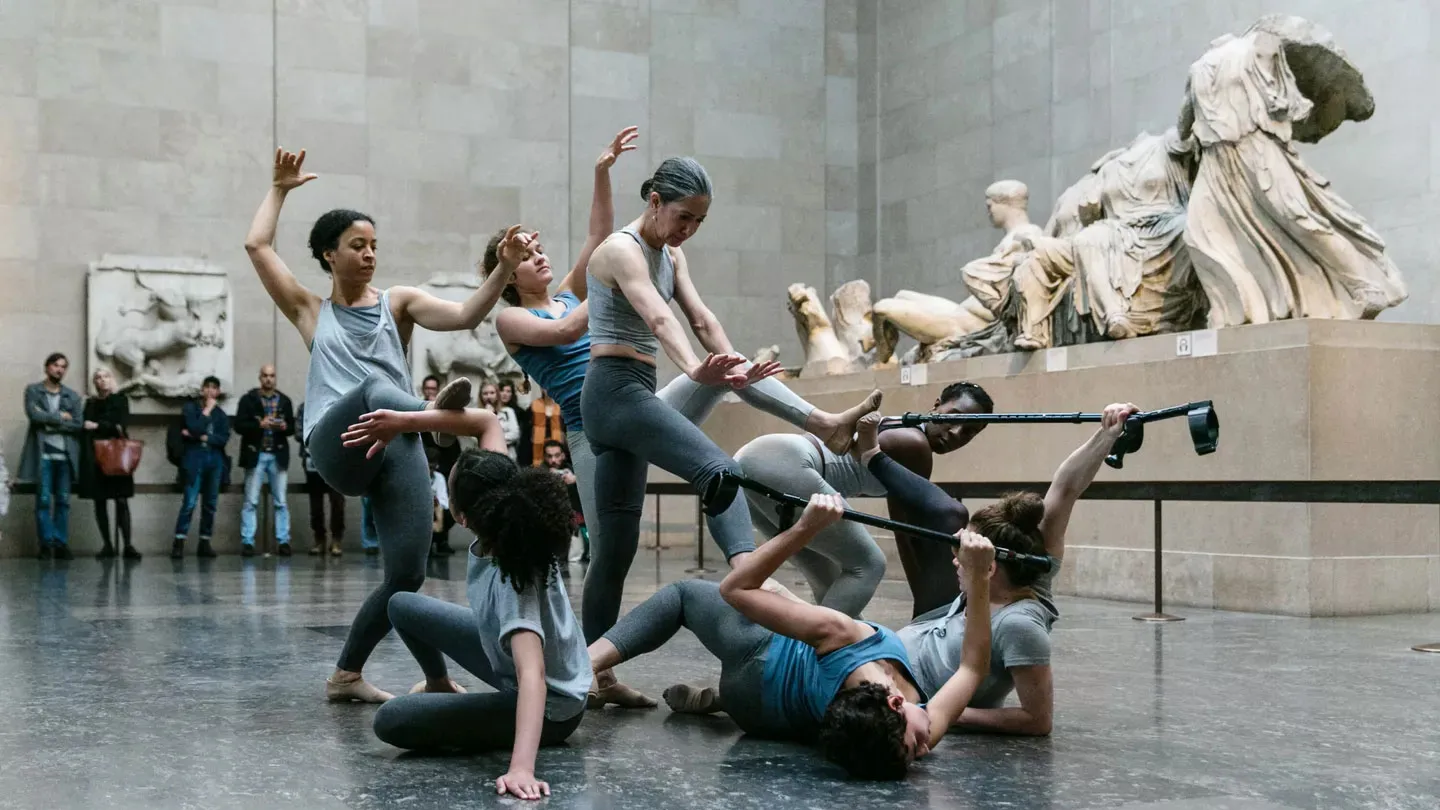
An Evening with Alexis Blake
Alexis Blake
This talk and conversation will delve into Alexis Blake’s approach to choreography. Experimentation with olfactory, sonic, and tactile materials figures prominently within Blake’s recent works. Working across the visual arts, performance, and dance, the artist’s choreographic practice plays with movement languages that have been sedimented by social structures and cultural precedents. Her works combine research into historically codified styles and gestures with responsive choreography that attends to dancers’ embodied physicality, building on individual movement languages to develop new pieces.
rock to jolt [ ] stagger to ash, awarded the Netherlands’ 2021 Prix de Rome prize, involves the gradual release of a smell of decay, realized in collaboration with the smell artist and researcher Sissel Tolaas. Blake’s recent project Crack Nerve Boogie Swerve develops from work with the bodily impact of resonance and low-frequency sound. In this new work, resonance stimulates forms of physical breaking: of both a glass scenography in the work, and of dance styles that draw from “breaking” in hip-hop. Like other works by Blake, Crack Nerve Boogie Swerve also takes a feminist approach to dance, using choreography to explore ways to fracture rigid models of gender.
Learn more about Blake and her projects on her website.
This presentation follows the US premiere of Crack Nerve Boogie Swerve at High Line in New York City.
Main Image: Alexis Blake, Conditions of an Ideal, 2015. British Museum, London, UK. Block Universe Festival. Courtesy the artist. Photo by Arron Leppard.