Image
A white light, oval shaped lens flare through a dirty pane of glass.

pas·sage

Patrick Quinn

An evening of experimental video + sound art + poetic programming exploring interpretations and manifestations of passage. pas·sage brings together the artist’s video travelogues, field recordings + sound synthesis, and a code-generated text inspired by Jorge Luis Borges’ short story The Library of Babel to create a psychogeographic multisensory experience.

Quinn is a PhD student in the Electronic Arts Department at Rensselaer Polytechnic Institute researching the connections between walking and writing, psychogeography, and remixological approaches to artmaking.

Every year, the Rensselaer Department of the Arts programs seven events utilizing the infrastructure and support of the production teams at EMPAC. These productions often include final graduate thesis projects that are developed in the venues themselves.

Image
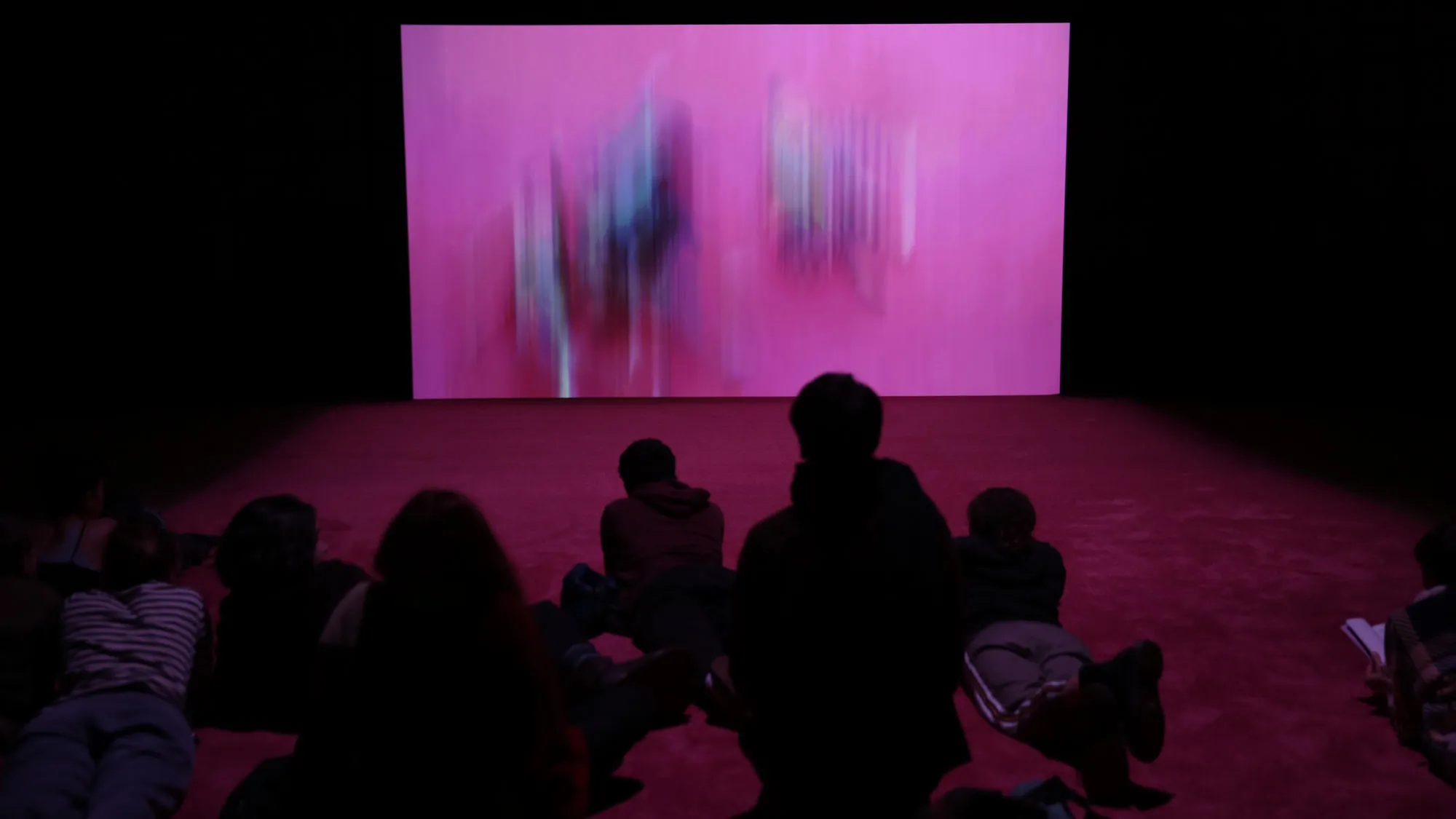
A small silhouetted audience laying on a pink rug watching a projection of pink brush strokes in a dark room.

Main Image: Installation view from EMPAC 10YEARS commission SlowMeDown (2018). Courtesy the artist.

Paula Court/EMPAC

SlowMeDown

Maria Hassabi

The US premiere of Maria Hassabi’s SlowMeDown, a moving-image installation commissioned for EMPAC’s 10YEARS celebration.

Partially filmed while Hassabi and her dancers were in residence this spring, the work features material from Hassabi’s live installation, STAGING (2017), which was presented internationally in public spaces, museums, and exhibition contexts. Blending collage and post-production effects, SlowMeDown builds a hyper-real frame that augments this footage and participates in the construction of what Hassabi calls a “performative surreality."

Maria Hassabi (b. Cyprus) is a New York based artist and choreographer. Her practice utilizes stillness and deceleration as techniques in choreographies that oscillate between dance and sculpture, subject and object, live body and still image, testing conventional rhythms of viewership in the process.

Main Image: Installation view from EMPAC 10YEARS commission SlowMeDown (2018). Courtesy the artist. Photo: Paula Court/EMPAC.

The Isle is Full of Noises

Michael Century

Beginning November 27, Rensselaer Polytechnic Institute will present The Isle Is Full of Noises, an environmental sound installation composed by Michael Century, professor of new media and music, with the assistance of Eric Miller, Ph.D. student in electronic arts. 

Free and open to the general public, the work will be presented November 27, 28, and 29, from noon to 5 p.m., in the Goodman Studio 1 in the Curtis R. Priem Experimental Media and Performing Arts Center (EMPAC) at Rensselaer.

Century’s installation employs Wave Field Synthesis speaker arrays to spatialize an 8-channel sound composition. The Wave Field Synthesis Audio Array, developed by EMPAC audio engineers, is one of the most extensive and precise spatial audio systems in the world. By placing a virtual sound source in physical space, the system creates “holophonic” sound that moves around the listening space, not unlike the sonic equivalent of 3D cinema.

The installation’s title, “The Isle Is Full of Noises,” is taken from Shakespeare’s play The Tempest.  The characters of Caliban and Miranda are foregrounded against the auditory backdrop of an imaginary tropical island. Visitors will hear poetic text, phonemic particles of language, birds, animals, and occasional snippets of melody.

According to Century, “Caliban can be taken as the figure of the indigenous people of the ‘New World,’ a slave to an imperious foreigner with magical powers. Shakespeare was responding in the early 1600s to early reports from imperialist explorers of the Caribbean islands. Caliban’s speech, which begins, ‘Be not afeard; the isle is full of noises,’ articulates with great beauty the abundance of life on the island. Miranda, for her part, marvels at the ‘brave new world, that has such creatures in it.’” The two characters’ words merge and intermingle with all the other sounds through a computer program designed by Century.

Local actors Kevin Craig West and Erica Tryon voice the parts of Caliban and Miranda.
Image
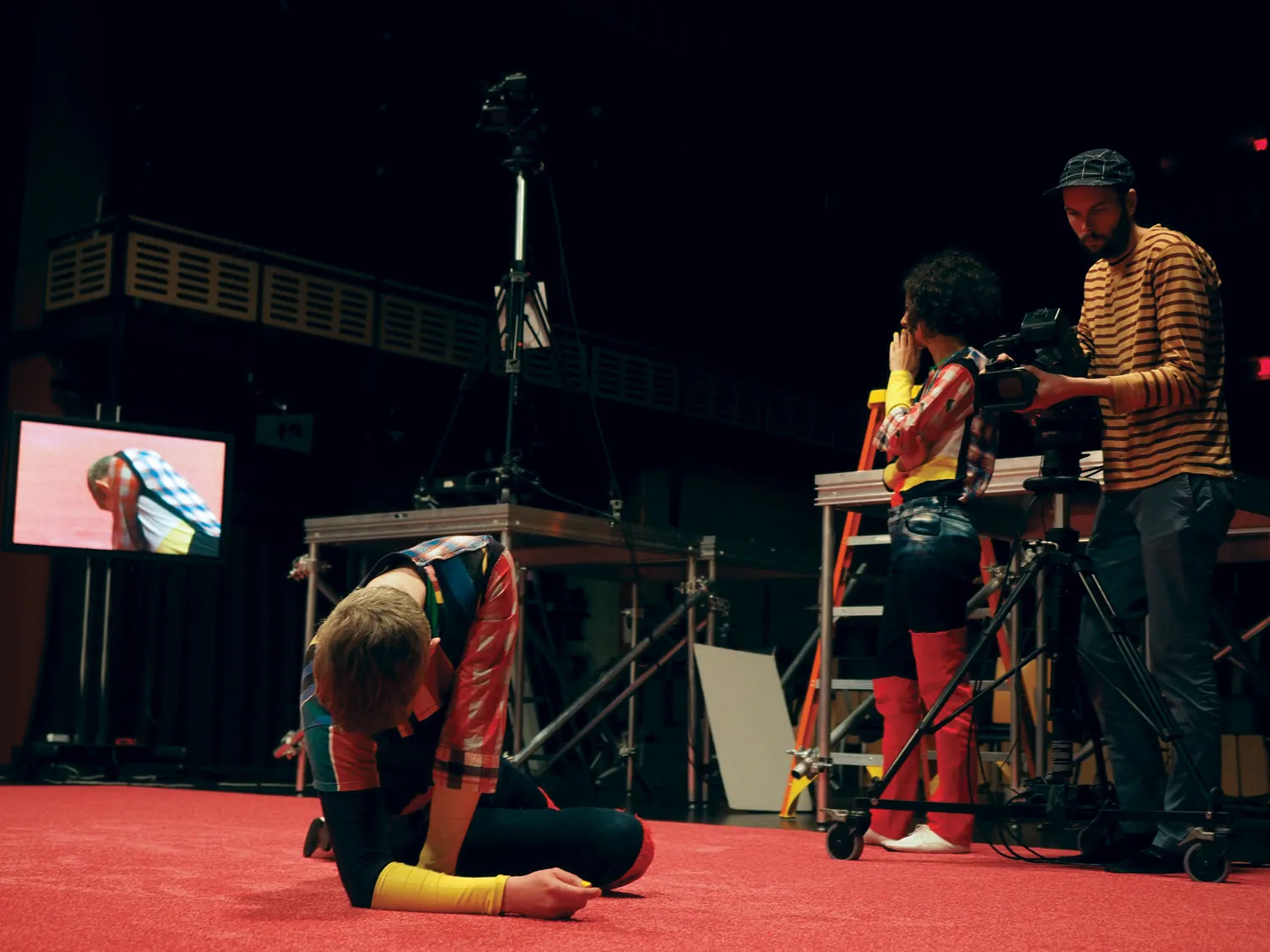
A dancer wearing a colorful costume laying on a red carpet while being filmed as Maria Hassabi looks at the video feed on a screen, contemplating.

SlowMeDown

Maria Hassabi

Artist/choreographer Maria Hassabi was in residence with dancers to shoot and begin editing footage for a moving-image installation derived from various iterations of her work STAGING (2017). This new project was Hassabi’s first moving-image installation and was co-commissioned by EMPAC.

The residency included a four-camera shoot on STAGING’s iconic pink carpet arranged in the EMPAC theater, as well as Steadicam and robotic camera shoots in four locations throughout the EMPAC building. Hassabi’s installation furthered her exploration of color and the signature slowness of her prior performances. The piece had its premiere at the EMPAC 10YEARS celebration.

Main Image: Maria Hassabi in residence shooting her commission for EMPAC's 10YEARS celebration SlowMeDown. Courtesy the artist. Photo: Mick Bello/EMPAC.

Image
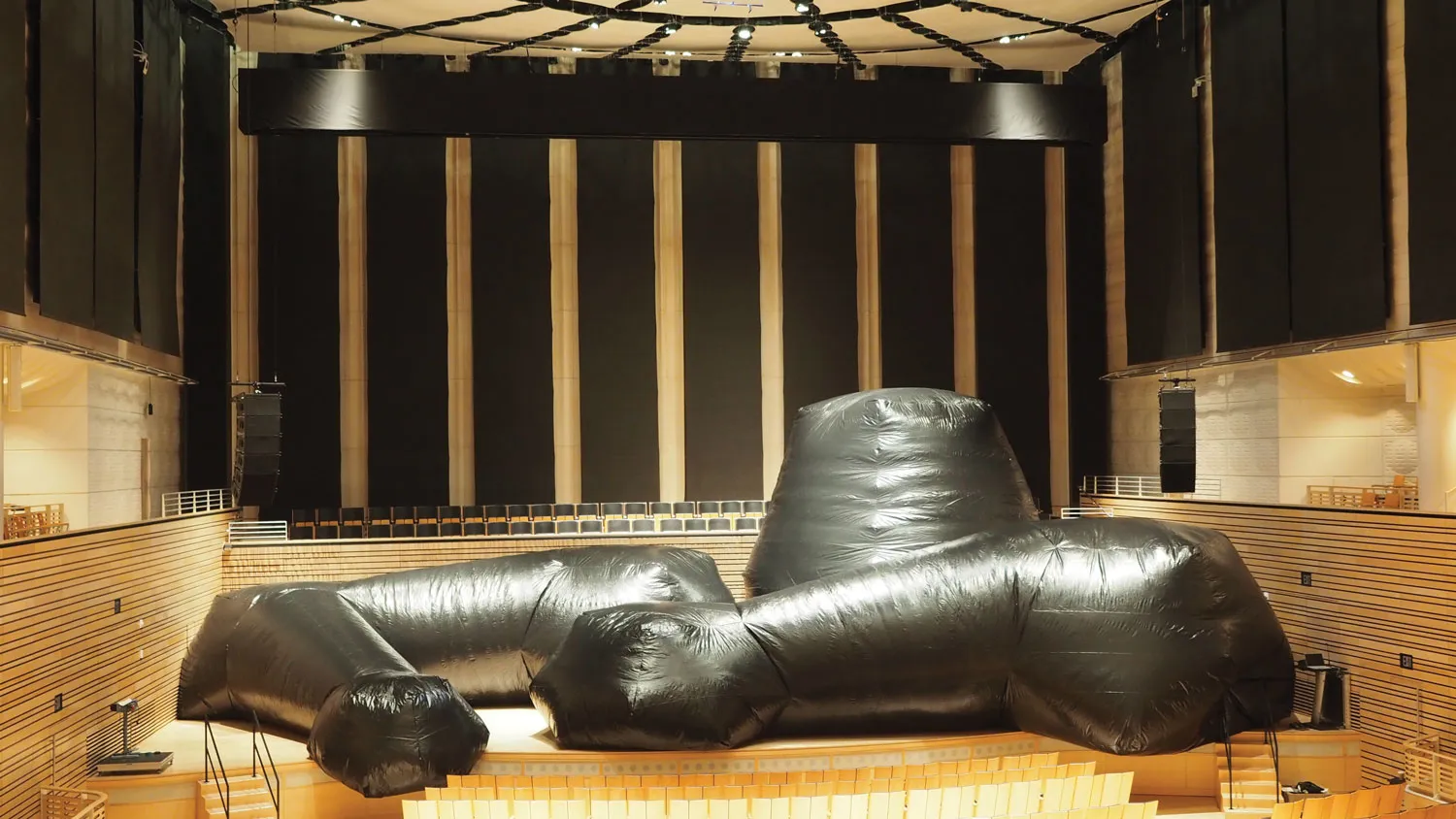
A black inflatable sculpture in an organic shape set up on the concert hall stage.

Myriad

Oneohtrix Point Never

Returning to EMPAC, Oneohtrix Point Never (AKA Daniel Lopatin) was in residence to develop elements for his concertscape MYRIAD, which premiered at the Park Avenue Armory in 2018. Lopatin and his team worked on audio, video, and staging — which included the construction of a giant inflatable object which occupied the Concert Hall.

Pulling from long-standing fascinations with film and television tropes, abstract sculpture, game ephemera, poetry, apocryphic histories, internet esoterica, and philosophies of being, MYRIAD generates a conceptual spectrum that is as much a speculation on the unthinkable future as it is an allegory for the current disquiet of a civilization out of balance with its environment.

Main Image: Oneohtrix Point Never working in the Concert Hall on Myriad in 2018. Photo: EMPAC.

Image
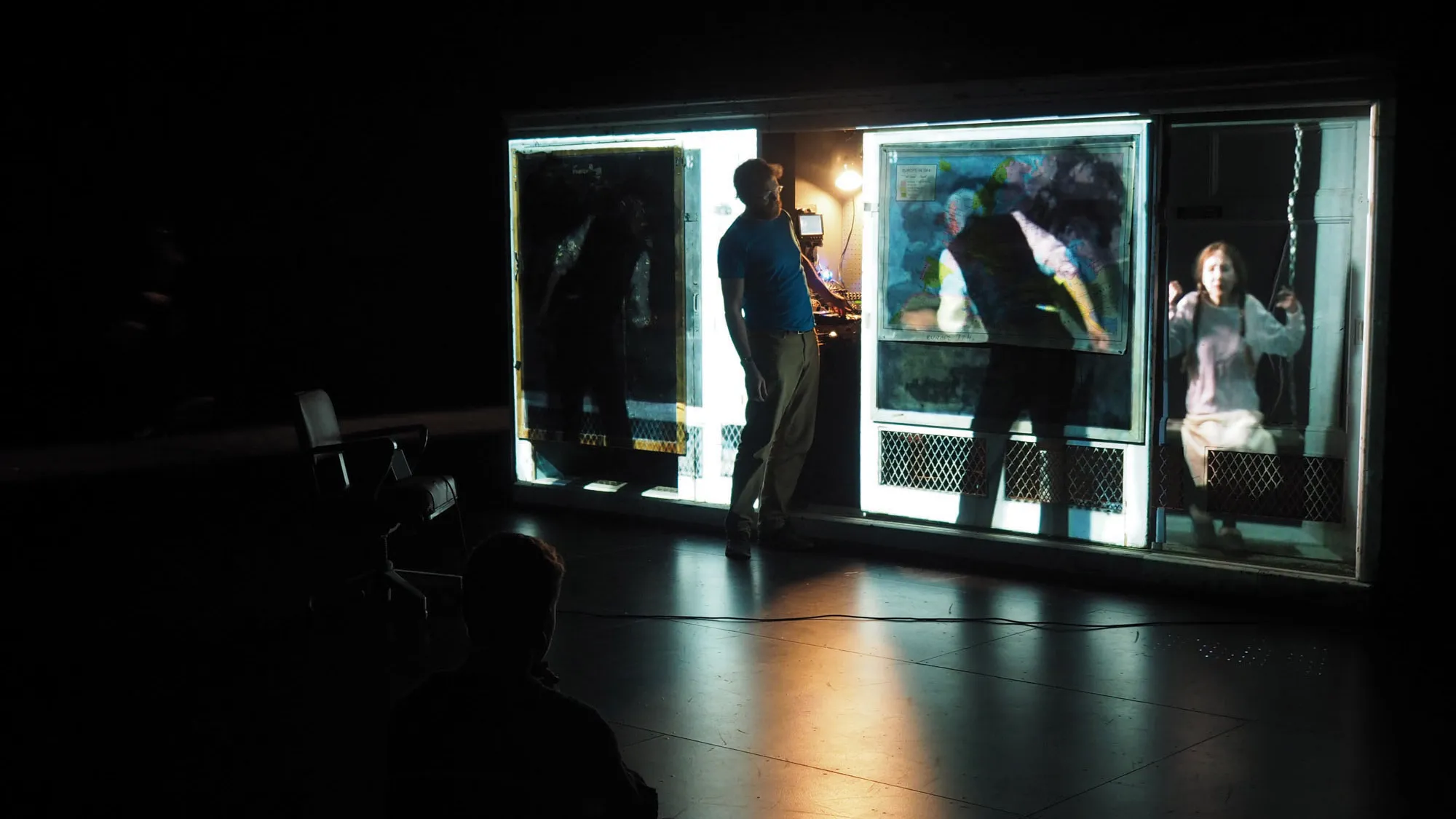
A contemporary man with a beard looking at a projection of a victorian era man and young girl projected over panes of glass.

This Was the End

Mallory Catlett / Restless NYC

This Was The End was a multimedia performance inspired by canonical Russian playwright Anton Chekhov’s Uncle Vanya. In the play, Vanya asks, “What if I live to be 60?” This Was The End answered that question through a story told by four actors in their 60s. Director Mallory Catlett was in residence at EMPAC with sound designer G. Lucas Crane and video designer Keith Skretch to develop their theatrical production into a multimedia installation about memory and time.

Like the performance, the new installation featured the architectural façade of the original PS 122, an iconic NYC arts building, to physically frame and contextualize Catlett’s adaptation. Catlett, her collaborators, and This Was the End actors were in residence at EMPAC to shoot new footage for their installation. They used this footage to activate the historic façade with interactive video and sound from their theatrical production, drawing viewers into the installation to investigate what came before, what is now, and what might be. On the installation’s opening night, Crane performed live sound inside the space. 

Mallory Catlett is a New York-based creator and director of performance across disciplines. She is the Artistic Director of Restless NYC whose production of This Was The End won an Obie Award. Other works include City Council Meeting, a regional theater experiment in participatory democracy and multimedia music theater piece Red Fly/Blue Bottle that performed at EMPAC in 2010. She has shown her work in New York City at Here, Performance Space 122, Abrons Arts Center, and the Brooklyn Academy of Music.

G. Lucas Crane is a sound artist and performer from Brooklyn, NY. Major projects include the psych-rock band Woods, the cassette-collage project Nonhorse, and the experimental theater of Performance Thanatology.

Keith Skretch is a New York-based video designer whose work has been shown at the Brooklyn Academic of Music, REDCAT, The Old Globe, MCA Chicago, and Performance Space 122.

Main Image: This Was the End in Studio 1 during 2018. Photo: EMPAC

Image
A contemporary man with a beard looking at a projection of a victorian era man and young girl projected over panes of glass.

This Was The End

Mallory Catlett / Restless NYC

This Was The End is a multimedia performance inspired by canonical Russian playwright Anton Chekhov’s Uncle Vanya. In the play, Vanya asks, “What if I live to be 60?” This Was The End answered that question through a story told by four actors in their 60s. Director Mallory Catlett was in residence at EMPAC with sound designer G. Lucas Crane and video designer Keith Skretch to develop their theatrical production into a multimedia installation about memory and time.

Like the performance, the new installationfeatured the architectural façade of the original PS 122, an iconic NYC arts building, to physically frame and contextualize Catlett’s adaptation. Catlett, her collaborators, and This Was the End actors were in residence at EMPAC to shoot new footage for their installation. They used this footage to activate the historic façade with interactive video and sound from their theatrical production, drawing viewers into the installation to investigate what came before, what is now, and what might be. On the installation’s opening night, Crane performed live sound inside the space. 

Catlett is a New York-based creator and director of performance across disciplines. She is the artistic director of Restless NYC whose production of This Was The End won an Obie Award. Other works include City Council Meeting, a regional theater experiment in participatory democracy, and multimedia music theater piece Red Fly/Blue Bottle that was performed at EMPAC in 2010. She has shown her work in New York City at Here, Performance Space 122, Abrons Arts Center, and the Brooklyn Academy of Music.

G. Lucas Crane is a sound artist and performer from Brooklyn, NY. Major projects include the psych-rock band Woods, the cassette-collage project Nonhorse, and the experimental theater of Performance Thanatology.

Keith Skretch is a New York-based video designer whose work has been shown at the Brooklyn Academic of Music, REDCAT, The Old Globe, MCA Chicago, and Performance Space 122.

Main Image:

Image
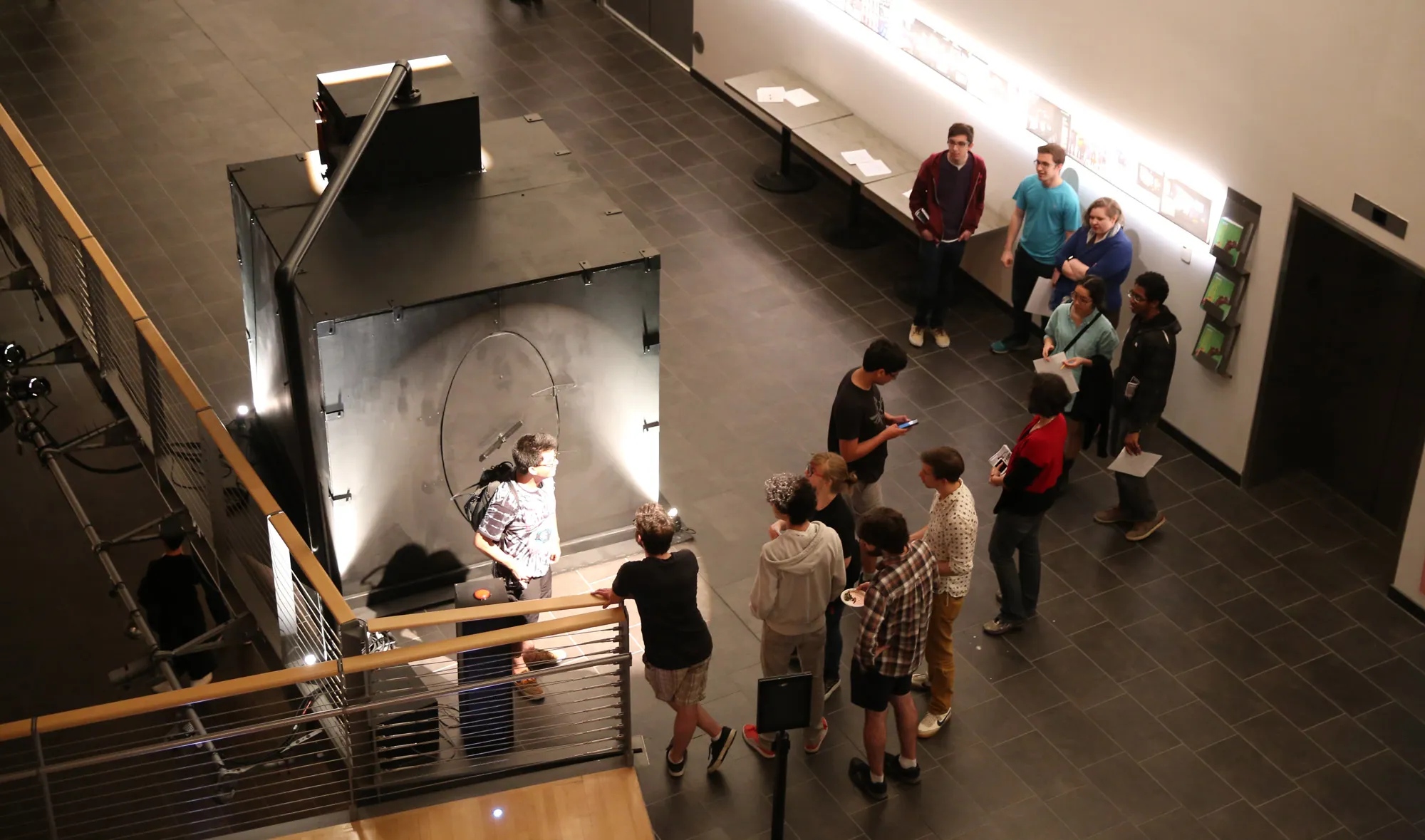
Students waiting in line out side of a black box with an oval door in a hallway.

SubBassProtoTon

Johannes Goebel

First invented in 1986 and recently reconstructed for artist-in-residence Tarek Atoui’s spring-season-closing performance WITHIN, the SubBassProtoTon is a walk-in bass generator that allows visitors to physically experience frequencies that are too low for audible perception and to interactively explore sound when it reaches the range of hearing.

The SubBassProtoTon (literally, “below-low-first-tone”) was first constructed by EMPAC’s Director Johannes Goebel for a large outdoor art event in Germany. Subsequently the ProtoTon traveled Europe as part of a sound exhibition for children and students, and other versions were built for exhibitions. Essentially a cubical organ pipe, the instrument consists of a wooden box large enough to comfortably accommodate two or three people.

When inside, participants can manipulate a sliding wooden wedge that opens and closes a window at the front of the box. Air is generated by a motorized organ blower outside the box and is channeled towards the wedge where different sounds are created depending on how far the wedge is opened or closed. This oscillating air pressure results in a sonic frequency that moves from the audible human range to below what can be heard, yet can be physically felt.

Although the SubBassProtoTon was used as a musical instrument for Atoui’s WITHIN, the box is more properly understood as a science-museum-style installation that allows visitors to explore some fundamental principles of sound while actually being immersed in the instrument itself. Anyone who interacts with the ProtoTon, regardless of age and musical or scientific aptitude, can come to understand the basic dynamic of sound behind instruments as diverse as the organ, flute, or ocarina, and enjoy the gentle massage that comes from standing inside these instruments’ vibrations.

Main Image: Students lined up for the SubBasProtoTon on the mezzanine during WITHIN in 2016. Photo: Shannon K. Johnson.

Image
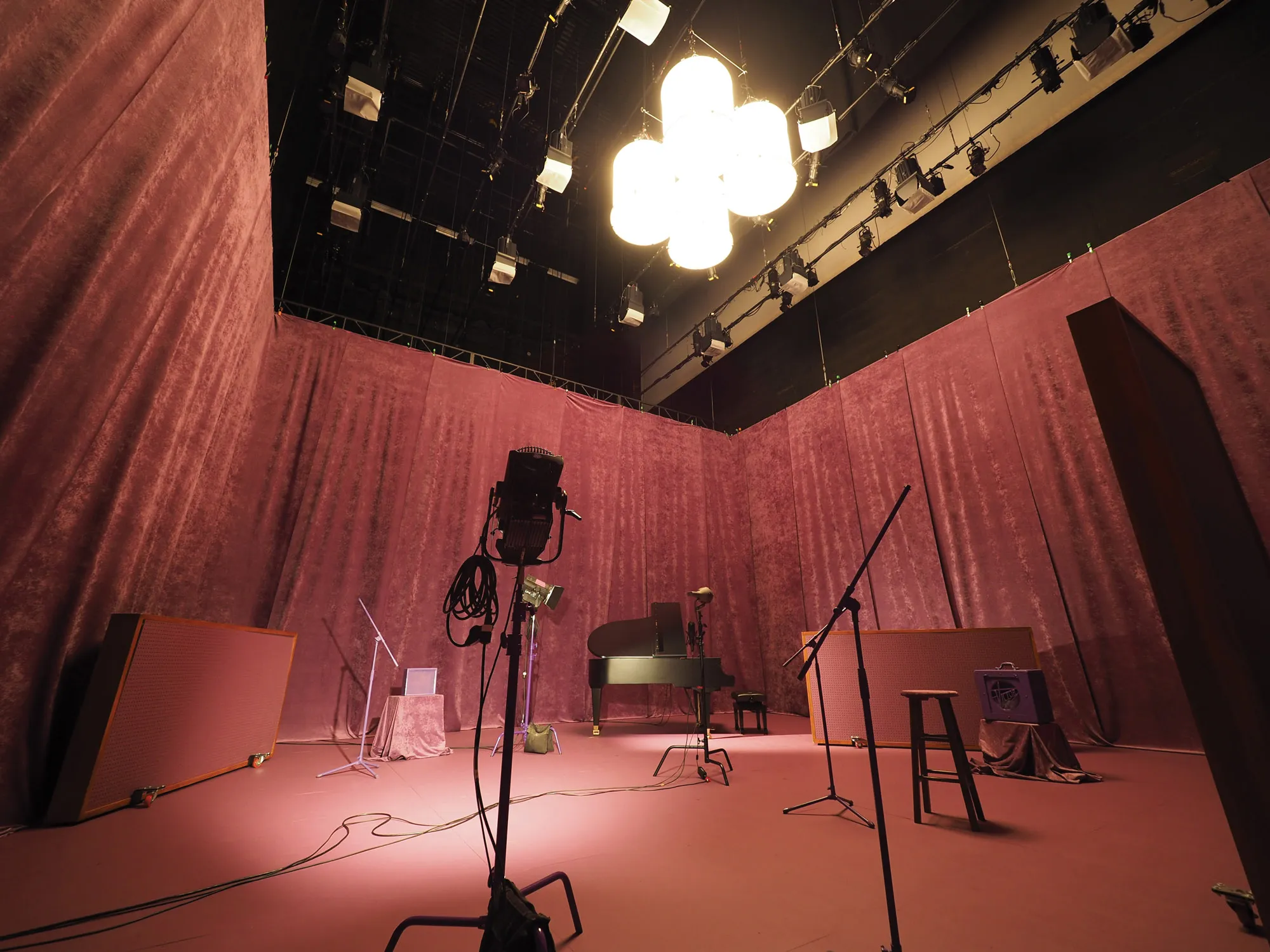
Studio set up with a piano, microphones, amp, and various lighting in a room with pink velvet walls with matching pink floors

An Evening with Queen White

Martine Syms

Martine Syms’ installation An Evening with Queen White invites visitors to meet the virtual character Queen White. An Evening with Queen White was produced at EMPAC with a 360° camera rig—originally manufactured to capture footage for virtual reality environments—placed at the center of a monochromatic purple set. Guitar amps, microphones, a piano, and acoustic panels that refer to the Motown recording studios of the 1960s decorate the set. Filmed in a single long-take, the performer Fay Victor (as Queen White) moved freely around the set and was continually captured by the camera.

Eschewing conventional VR, Syms explores how the audience can experience this kind of image environment without the use of a headset. The installation plays with the possibility that parts of the performance still remain out of frame or off-screen. Several screens are placed in different locations around the studio and each only shows a small part of the 360° video, exposing the limits of each screen’s size and shape. A mobile screen will allow the audience to explore the missing parts of the image for themselves.

An Evening with Queen White is exemplary of Syms’ use of the monologue as a medium for exploring how voice, gesture, and persona are learned and performed. The script complicates the artist’s own biography and points toward how strategies of performing oneself as a Black woman in America are transmitted and crystallized across generations through both familial teaching and societal conditioning. EMPAC screened Syms’ new feature film, Incense, Sweaters, and Ice, on the last day of the installation (Sept. 6) as part of the film series Other Uses.


Main Image: Production still from An Evening with Queen White (2017). Photo: Mick Bello/EMPAC.